Category Archives: Geocaching

Geocaching

June 1, 2015 Colorado Springs, Colorado

We continued our time in Colorado with a four night stop in Colorado Springs.  At first the weather continued to be cool with gusty winds and afternoon thunderstorms.  After a couple days we had temperatures in the 90’s and the mosquitoes came out in force at dusk. We had very gusty winds in New Mexico and the winds followed us to Colorado.  We camped at Cheyenne Mountain State Park, Colorado’s newest state park.  It is a very nice park with terraced campsites and full hookups.  Our campsite had a view of Colorado Springs which was especially pretty at night with the twinkling lights of the city shining below us.  Nearby is Fort Carson and in the evenings we could hear the sound of bugles as the flag was lowered.IMG_20150603_085748

We camped at the foot of Cheyenne Mountain, a very foreboding looking mountain.  Perhaps the history of the mountain makes it more mysterious.  The underground operations center for the North American Aerospace Defense Command (NORAD) was built in the early 1960’s during the Cold War to monitor the North American airspace for missile launches and Soviet military aircraft.  The command center is buried 2,000 feet underground in the granite mountain on five acres and was designed with a bunker to withstand bombing and fallout from a nuclear bomb.  Today it is still off limits but many of its functions were transfered in 2006 to Peterson Air Force Base nearby.  On top of Cheyenne Mountain is an antennae farm visible for miles around with transmitters for cell phones, radio, television and law enforcement.

We wanted to tour the Peterson Air and Space Museum located on the Peterson Air Force Base.  We read that for security reasons you had to go onto their website at least 24 hours in advance to request a visitor pass.  When we went online it said they were not accepting visitors at this time due to security precautions.

On our last day we rode the Pikes Peak Cog Railway, the longest and highest cog railway inIMG_20150603_100843 the world.  The trip began in Manitou Springs (elevation 6,320) for an 8.9 mile, hour and a half ride through high plains with aspen groves and dense pine forests to an alpine tundra.  As we neared the top the snow was piled high along the tracks, higher than the windows.  When we reached the summit of Pike’s Peak we were at an elevation of 14,110 ft.  The snow was ten feet high and the temperature was 36 degrees with a wind chill of 28 degrees.  We had read that at 14,000 feet you may experience breathing problems and nausea.  The air at Pike’s Peak has 50% of the oxygen pressure compared to sea level.  Since we had both been suffering quite a bit with allergy problems this spring we invested in a little spray bottle of oxygen at the gift shop before getting on the train.  Bill used it a few times.  I didn’t have any problems until we reached the summit.  When I stood and walked off the train I suddenly felt very lightheaded and dizzy.  After several sprays of oxygen I felt better.  They do have Medic services at the summit for people who experience serious problems.

Bill had to climb over some slippery snow drifts to get some pictures, including a memorial to Katharine Lee Bates.  Her visit to Pike’s Peak in 1893 inspired her to write a poem which later became the lyrics of “America the Beautiful”.  Pike’s Peak is nicknamed ” America’s Mountain”.IMG_20150603_102106IMG_20150603_113616IMG_20150603_114543IMG_20150603_115558IMG_20150603_130357IMG_20150603_120518IMG_20150603_120506IMG_20150603_121444IMG_20150603_120617IMG_20150603_120633IMG_20150603_121515

We lucked out on the right time to visit Pike’s Peak.  Less than a week earlier the train had not yet been able to reach the summit of the mountain due to ice and snow on the tracks.   Besides taking the train you can reach the summit by car and hiking.  The driving road has still not yet opened for the season.  Pike’s Peak has the possibility of snow any day of the year!IMG_20150602_155304

Pike’s Peak is named after Lieutenant Zebulon Pike, an American explorer who was sent to the southwest in 1806 to explore the source of the Arkansas River.  He attempted, but never reached the summit, but they named the mountain after him anyway.

After grabbing a late lunch we drove to the nearby Garden of the God’s Park, a National Natural Landmark.  This beautiful city park was once owned by railroad magnate Charles Eliot Perkins.  In 1909 he bequeathed the land to the city of Colorado Springs with the stipulation that it remain open and free to the public.  It is obvious people love this park.  One of the nicest and most elaborate Visitors Centers we have visited is in the park, staffed by volunteers.  It has a first class nature center as well as over 30 interactive exhibits on the geology, ecology and history of the area.  It has the world’s only Theiophytalia kerri dinosaur fossil replica.  The dinosaur skull was discovered in the park in 1886.  The park has nature talks, guided walks and guided rock climbing opportunities.  There are beautiful views of Pike’s Peak from the observation deck of the visitors center.   There is a nice loop drive around the park which we decided to do since it was late in the day.  The red sandstone formations were beautiful.IMG_20150603_153624IMG_20150603_150409IMG_20150603_151511IMG_20150603_151602IMG_20150603_154403IMG_20150603_160624IMG_20150603_160904

We had mixed feelings about Colorado Springs.  I expected more breathtaking views of snow capped mountains and a funky, quirky little town with boutiques and an active downtown area with restaurants.  Instead the town came across as old and tired.  The roads were terrible with constant potholes which made driving around town feel like driving an obstacle course.  On the positive side I saw my first revolving McDonald’s sign!

May 29, 2015 Trinidad Lake State Park, Colorado

Driving from the Albuquerque area we made the short drive to Springer, New Mexico for a one night stay.  Before heading to Colorado the next morning we drove to the Philmont Boy Scout Ranch in Cimarron, New Mexico.  IMG_20150528_112318Bill had been looking forward to visiting Philmont for a long time.  In 1938, an oil magnate who was very impressed with boy scouts who visited his ranch, donated 35,857 acres of land to the Boy Scouts of America.  IMG_20150528_101515Today the Philmont Boy Scout Ranch, whose name is derived from Waite Phillips who gave them the land, is a National High Adventure Base where Boy Scouts take part in backpacking expeditions and other outdoor activities.  It is one of the largest youth camps in the world in land with over 23,000 Scouts and adults leaders visiting each summer between the beginning of June and middle of August.  IMG_20150528_101711While we were there Bill toured their Philmont Museum and Seton Memorial Library.  The only documented Tyrannosaurus Rex track in the world was discovered within the camp’s boundaries in 1993. We noticed that the Santa Fe Trail ran thru the ranch.IMG_20150528_110832

On the way to Colorado we stopped in Raton, New Mexico at the NRA Whittington Center,  the largest and most complete shooting and hunting complex in the United States.  Bill was able to spend some time doing some pistol shooting practice.

As we passed through the end of the dusty plains of New Mexico into Colorado we were met with the green mountains to our west and the sight of even more snow capped mountains. We climbed and dropped in elevation until arriving at Trinidad Lake State Park (elevation 6300 ft) outside of Trinidad, Colorado.  The 800 acre Trinidad Lake was created in 1978 when the U.S. Army Corps of Engineers built a dam.  The Trinidad Lake State Park is a very popular area for fishermen.IMG_20150528_161412

While there we drove into the small town of Trinidad and did a bit of sightseeing.  We visited a statue of Christopher (Kit) Carson an American frontiersman and found a geocache nearby.  IMG_20150529_153149We drove a dirt road to the top of Simpson’s Rest, a sandstone bluff on a mountain with great views of Trinidad, Purgatoire Valley and the Sangre De Cristo Mountain Range, part of the Rocky Mountains.  It was amazing to see the combination of rolling prairies, hills and mountains.  Across those prairies the pioneers and traders traveled along the Santa Fe Trail.  This trail wound through what is now downtown Trinidad and across the mountainous Raton Pass which we crossed over on the way to Trinidad.  On the top is a Trinidad sign which lights up at night as well as the grave marker of George S. Simpson.  IMG_20150529_160950Simpson was a famous trail blazer, scout, trader and explorer in the area.  Legend says that in 1867 Simpson was confronted by warring Ute Indians.  He fled up the sandstone bluff and hid for three days.  He was thankful for the sandstone bluff that saved his life and requested to be buried there.  Simpson is credited with the first discovery of gold in Colorado which led to the famous 1859 Rush to the Rockies.IMG_20150529_160400

We stopped by the town’s Mount San Rafael Hospital to see a 28 by 12 foot ceramic mural designed and created by a nun, Sister Augusta Zimmer.  The history of Trinidad is depicted in the beautiful mural.IMG_20150529_162912

We enjoyed our time in Trinidad and it is always fascinating to see the history found in these small towns in America!

May 23, 2015 Santa Fe, New Mexico

We made the short drive from Los Alamos to our campground in Bernalillo right outside of Albuquerque.  We had a nice long pull through site with our own ramada.  We noticed in the southwest and Mexico it is quite common to have these ramadas, but it is not everyday each campsite gets their own. IMG_20150525_160149 We planned on staying here five nights to explore the Albuquerque and Santa Fe area.

One day we drove into Santa Fe, which is the oldest capital city in the country (1610) and also the capital city with the highest elevation (6,989 ft).  Santa Fe has the nickname “The City Different” and it truly IMG_20150523_122225looks very different from any other city in the country.  Thousands of years ago the Pueblo Indians used adobe, a mixture of earth, straw and water which was shaped into bricks and dried in the sun.  In 1912 a code was passed requiring the use of a style called Spanish Pueblo Revival which meant an architecture of earth-toned, flat topped buildings, wood beamed ceilings and doors and window frames painted white or turquoise.  Most of the buildings are stucco that resemble IMG_20150523_153536adobe called non-authentic adobe.  Consequently everything in Santa Fe looks adobe, including McDonald’s!  They also have a regulation that no building can be taller than three stories, or the height of the cathedral.

We concentrated our time in the Old Town section of Santa Fe.  We began by taking aIMG_20150523_130410 90 minute trolley tour that gave us a nice history of the town and took us to some areas we may not have found on our own.  We rode past a statue of Sacagawea, IMG_20150523_124114IMG_20150523_123636IMG_20150523_124811some interesting art and metal work, and ended up at a huge bronze replica of a stagecoach on the Santa Fe Trail.  This section of New Mexico is full of information on the Santa Fe Trail and there are signs everywhere showing where the trail came through.  Likewise there are signs denoting Historic Route 66 along the roadways.

The Palace of the Governors was built inIMG_20150523_134742IMG_20150523_122621 1610 and is considered one of the oldest public buildings in the U.S.  Along the sidewalks around the building you find many Native Americans selling handmade items.  Our tour guide said they have to show up very early in the morning to participate in a lottery system to get a spot on the sidewalk amid the tourists.

The San Miguel Mission Church, constructed in 1610, is thought to be the country’s oldest active church.IMG_20150523_123110

The beautiful Cathedral Basilica of St Francis of Assisi is one of the few buildings in the city that is not adobe.  Since it was a Saturday the church bells were frequently ringing as one wedding ended and immediately limousine doors would open and another bride emerged to enter the church.IMG_20150523_134308IMG_20150523_145041IMG_20150523_145208

Santa Fe was a very unique town and we really enjoyed our time there.


May 5, 2015 Grand Canyon National Park, Part 4

We continued to explore more areas of the park.  It is a huge park with so much to see.  We rode the shuttle bus to the western most point of the park which is only accessible by shuttle bus.  Our first stop was Hermit’s Rest.  In the early 1900’s a French Canadian took up residence in the canyon for twenty years and became known as “the hermit of the Grand Canyon “.  He ended up being a valuable source of information and one of the area’s primary guides.  Hermit’s Rest is named in his honor.  The building is one of seven in the park designed by southwestern architect Mary Jane Colter.  She is known for her Native American architecture and use of materials from the area.IMG_20150505_152001IMG_20150505_152414IMG_20150505_143648IMG_20150505_152759

We hiked part of the way along the Rim Trail and found a few geocaches before hopping back on the shuttle bus.  We were very impressed with the park shuttle bus service during our time in the park.  The bus drivers were friendly and helpful and the buses punctually arrived at convenient stops every 10 to 15 minutes.  Considering it was sometimes standing room only on the buses, they were well utilized by tourists visiting the park.IMG_20150505_152827IMG_20150505_155307IMG_20150505_155318IMG_20150505_155645IMG_20150505_161340IMG_20150505_161550IMG_20150505_161656IMG_20150505_172719IMG_20150505_175119

We stopped at Powell’s Point which is named after Major John Wesley Powell, the first explorer to journey down the entire length of the canyon on the Colorado River in 1869.  This feat is even more amazing considering he lost an arm during the Civil War.  He began the journey with nine men and four wooden boats.  Several months later he completed the trip with five men and one boat.  Several men had deserted the group along the way and were never heard from again and four of the boats had broken up.  Powell made a second trip in 1872.  There is a large monument to Powell and his men at Powell Point.IMG_20150505_181902IMG_20150505_181724

I think the western viewpoints are among the prettiest in the park and we had great views of the Colorado River from the rim.  The Colorado River is one of the only rivers in the world that classifies its rapids on a scale of 1 to 10 instead of 1 to 6 like other rivers.  There are many rapids in this part of the Colorado River with the Lava Rapid being the highest rated commercially run rapid in North America.  The majority of the rapids in the Grand Canyon are caused by debris that is funneled into the river from side canyons.

Another day we drove to the eastern end of the Grand Canyon.  Shuttle bus service does not extend this far.  Along the way we saw a large male elk feeding alongside the road and several other elk close by.  IMG_20150506_135250At the eastern end we visited the Desert View Watchtower, another Mary Colter design and one of the most prominent architectural features in the park.  Built in 1932, it is modeled after ancient Pueblo watchtowers found in the Four Corners region.  The tower is 70 feet tall and since it is the highest point in the South Rim, it provides stunning 360 degree views.  The inside of the tower was amazing with a staircase climbing to the top and walls displaying petroglyphs and murals by a Hopi artist and crafts by local Hopi artisans.IMG_20150506_150228IMG_20150506_144705IMG_20150506_143218IMG_20150506_142701

On the way back from the Desert Tower we stopped at several rim viewpoints.  Here are some pictures from the Grandview Point including a video.

use this if you don’t see the above video “https://www.youtube.com/watch?v=XoXj2VUueks&feature=youtu.be”

IMG_20150506_155119

On our last day in the park we hiked three miles with an elevation drop of 500 feet into the canyon on the Bright Angel Trail.  We had really hoped to do more hiking and biking while at the Grand Canyon, but we both had colds/allergies that lingered for over two weeks, and with the 7,000 foot altitude, we were just not up to it.  But by the last day we were feeling better and were determined to hike a little of the famous trail.  The day was a little cool and windy but had bright blue skies.  The trail is great and the same one is used to take visitors down by mule.  The hike down was fairly easy but the hike back up took twice as long.  We passed two really cool tunnels.  I loved the camaraderie of the people hiking the trail of all ages and fitness levels.  People greeted each other in passing and often asked how far they were hiking or if they had returned from hiking to the river.  We recognized those planning to hike to the river and back since they had large backpacks with supplies.  There were signs warning hikers not to attempt to hike down and back in one day due to the strenuous nature of the hike.  It usually takes half a day to hike to the bottom and a full day to hike back up.IMG_20150507_114638IMG_20150507_115730IMG_20150507_124649IMG_20150507_125323IMG_20150507_131548

Our ten days went by much too quickly and the park is on our list of places to return to someday.

April 16, 2015 Mangonui, New Zealand

We arrived at our final New Zealand destination, the tiny town of Mangonui where we stayed in a two bedroom duplex apartment overlooking Doubtless Bay, part of the South Pacific.  It was named by Captain Cook and the name stuck.   When he saw the bay in 1769 he said, “Doubtless, a bay”.  The beach was steps outside our door and we enjoyed walking on the beach.  One morning our neighbor knocked on our door to tell us that some dolphins were in ocean right outside our door.  We stood and watched the six or more dolphins frolicking and playing in the water before they disappeared from sight.        PicsArt_1429159271944PicsArt_1429156087344PicsArt_1429156242188

On Friday we took an all day bus tour of the peninsula.  We drove to Cape Reinga, the northernmost tip of New Zealand is where the Tasman Sea and the Pacific Ocean collide.  If you recall a picture in a previous blog of Bill standing at a sign at the southernmost point of New Zealand.  This sign at the cape shows the northernmost point of New Zealand.  We were able toPicsArt_1429264877979 find a geocache at both places.  At the Cape is a pohuteukawa tree believed to be over 800 years old.  Maori tradition teaches that this tree is where the spirits of the dead leap into the ocean to depart and head homeland.  It is seen as a sacred place and you are not allowed to eat at the Cape.PicsArt_1429262141176PicsArt_1429260322717PicsArt_1429260008457

Another cool place we went is called 90 Mile Beach which is really only 56 miles long.  Here people can actually drive on the beach.  Due to changing tides and the possibility of your car getting swept away or stuck in the sand, rental car companies forbid you driving a rental car on the beach.  This is one reason we decided to go on a bus tour.  Leave the driving and potential PicsArt_1429268037107 headaches to someone else!  The driver drove the bus through a riverbed stream to reach the beach.  He said it was quicksand and if he stopped we would actually sink.  He told us stories of buses and cars sinking in the sand and we had seen pictures online of this happening.  He stopped at a large sand dune area and passed out boogie boards to anyone interested in climbing to the top and surfing down the sand dune.  Some of the younger members of the group took him up on the offer.  Others declined once the driver told us the company would not be responsible for any injuries and described some of the injuries others had suffered while surfing down the steep dune.PicsArt_1429267029599PicsArt_1429271246809PicsArt_1429269867376

It was fun to speed down the beach in the bus with the waves lapping against the shoreline.PicsArt_1429311986648PicsArt_1429268379347

Before we left our landlord made us an interesting offer.  He offered to give us the use of his beautiful house, car, boat and a fuel card with as much fuel as we wanted, in exchange for the use of our RV in the States.  It was easy to say no because we have no plans to visit New Zealand again in the near future.  If any of our RV friends want to take him up on the offer, we will give you his contact information.

We look forward to heading home on April 19th.  We will do one final New Zealand post with our final thoughts when we get home.  We have a couple long travel days ahead.

April 11, 2015 Hamilton, New Zealand

We enjoyed our stay in New Plymouth regardless of the rainy weather.  Our last night there Bill was able to connect with some Kiwi ham radio operators on his hand held ham radio he brought with him.  He really enjoyed chatting with them.

The next morning the rain continued and we drove to Otorohanga for an overnight stay on the way to Hamilton.  We don’t usually stay at bed and breakfast lodgings, but this place had excellent reviews and the choices in tiny remote Otorohanga were very limited.  This bed and breakfast was located in the countryside and the proprietors had chickens, horses, a donkey, dog and cat.  We had a nice room with an outside entrance and private bath.  Breakfast was included in the price of the room so the next morning Bill enjoyed Eggs Benedict made with fresh eggs and I chose croissants with homemade jam.  It was nice that the proprietor was a chef by trade.

The next morning we headed to Hamilton for a three night stay.  Not far from the bed and breakfast lodging we came upon a field of several ostriches.  One was particularly friendly and quickly came over to see us.PicsArt_1428824829414 The weather was horrible for most of the drive to Hamilton with heavy downpours and wind.  We planned on visiting a Natural Bridge and a waterfall, both of which required a small hike.  We refused to let the weather defer our plans so we put on rain gear and trudged on.  We knew we couldn’t say “we would do it tomorrow” or “next time”.  It was now or never and we refused to let the rain stop us.

Our first stop was Mangapohue Natural Bridge.  A walk over several suspended catwalks and a swinging bridge led us to a beautiful limestone double archway.  Due to the lack of sunlight on this rainy day and the cave like interior, it was hard to get pictures to do the natural bridge justice. AfterPicsArt_1428825077344PicsArt_1428825293060 a short drive further down the road we came to the trail leading to Marakopa Falls, advertised as one of the most picturesque falls on the north island.  This one hundred foot waterfall was spectacular, made even more so by the heavy rains.PicsArt_1428825424436PicsArt_1428825669990

We were traveling on back roads and passing through small towns.  Our bed and breakfast proprietor did suggest we stop at one tiny restaurant that had great pies.  In New Zealand, pie always means a meat pie, similar to a chicken or turkey pot pie in the States.  There pies are usually beef, steak, lamb or kidney.  They never have fruit pies and you never see a slice of fruit pie on the menu in restaurants.  I find this so strange since they have so many orchards and farms here.  We stopped at the pie shop and Bill chose a steak and cheese pie which he said was “okay”.  I think he expected more since the motel proprietor said they always stop there and buy pies when they pass through the area and commented on how good they were.

We arrived in Hamilton still wet from our hiking excursions and glad to reach the hotel since the weather continued to be wet and miserable.  We have been really really lucky with the weather so far so we can’t really complain. Hamilton is a large college city with a vibrant downtown area with many restaurants to chose from.   Like most downtown areas with an abundance of restaurants within a small area, we had to circle around for awhile looking for a place to park.

Besides having several grocery stores they also had a Dunkin Donuts, our first since arriving in New Zealand.  We were excited and went there for breakfast one morning.  It was a bitter disappointment.  They don’t use Dunkin Donuts coffee blend which was a huge disappointment to Bill.  We buy Dunkin Donuts to fix at home in the States and he was looking forward to some coffee that tasted like home.   Instead he got the same stuff he gets everywhere.  Second disappointment was the price.  $12.50 for a half dozen.  Third disappointment was they were stale.  Bill mentioned this to the clerk and she said they are made at the Dunkin Donuts in Auckland an hour away and trucked in to Hamilton.  On top of that they freeze them.  So after almost two months we are still waiting for a good donut and a decent cup of coffee.

Our main reason for coming to Hamilton was to take the tour of Hobbiton in the nearby town of Matamata.  We drove on Saturday to Matamata for our 12:30 tour.  The Hobbiton bus took us thirty minutes into the countryside to the Alexanders’ spectacular 1,250 acre sheep and beef farm. PicsArt_1428827939323PicsArt_1428825946475PicsArt_1428826131629 This farm was selected by Sir Peter Jackson as the setting for many scenes for the “Lord of the Rings” movies.  The bus took us on a narrow winding road constructed by the New Zealand army so that the set could be constructed.  Sir Peter Jackson sent the Alexander family on an all expense paid vacation for three months and took up residence in their house where Jackson and his team went over daily film takes and conducted business.  Sir Jackson was a stickler for detail.  He didn’t like the sheep on the farm and brought in black face sheep from England.  He had members of the crew walk each day on the path to and from the various clotheslines so the path would look worn down.  He had a huge artificial tree built with over 250,000 fake leaves. When he didn’t like the color green of the leaves he had each leaf repainted to the shade of green he wanted.PicsArt_1428826841017PicsArt_1428826357250PicsArt_1428826981174

After the filming ended the sets were all taken down.  Then in 2009 the sets were all permanently rebuilt for the filming of ” The Hobbit Trilogy”.  PicsArt_1428826231025PicsArt_1428826300832PicsArt_1428826582829PicsArt_1428827150135Today daily tours are given of the movie set.  We had a great tour and at the end of the tour we stopped by the Green Dragon for a complimentary alcoholic beer or non alcoholic ginger beer.  PicsArt_1428827238082PicsArt_1428827790143We were so fortunate that the rain had stopped overnight and it was a beautiful sunny day.

On our last day in Hamilton we found a geocache, walking on a path covered with fallen leaves with leaves softly falling around us in the breeze.  Autumn in New Zealand and springtime awaiting us back home!  One week to go!

April 8, 2015 Wellington, Wanganui, New Plymouth, New Zealand

We left the South Island on Easter Sunday and traveled on the car ferry back to the North Island where we will stay for two weeks before flying home.  We have already toured the east coast of the North Island, driven east to west around the South Island, and now we will drive around the central and west side of the North Island to complete our journey.

The ferry ride was very unpleasant for me.  It started off fine but once we left the channel and got out into the ocean, the choppiness of the water and rocking of the boat made me feel very nauseous, even with two Dramamine in my system.  I spent the last two thirds of the trip sitting outside on one of the upper decks freezing with the cold and wind, but the cold air helped to fight the nausea.  How I envy people who read in moving vehicles and sit in the back seat of a car without getting sick!!

We arrived in Wellington late in the day and found an Italian restaurant within walking distance of our motel that was open on Easter.  The next day before heading out of town we drove around the Wellington Harbor for a last look at this charming capital city.  We were once again captivated by all the houses crowded on the hillsides and surprised to find surfers in the water around the harbor area.PicsArt_1428491181734PicsArt_1428492132046PicsArt_1428492032955PicsArt_1428491672401

We left Wellington and headed along the coast to Wanganui for a one night stay.  The next morning we drove to New Plymouth.  We took a slight detour to visit Egmont National Park where we took a short hike to Dawson Falls.  PicsArt_1428493453500PicsArt_1428493312626Since it was a cloudy day threatening showers, we did not have a clear view of Mt Taranaki in the distance.  Mt Taranaki is the North Island’s most majestic peak.  It is not often you see a conical volcano rising abruptly from sea level surrounded by beautiful beaches!PicsArt_1428493037055PicsArt_1428492499883

We spent two nights in New Plymouth.  We had planned to spend some time walking the beach there but our only full day in the town brought heavy rains.  The rain gave us a good excuse to have a nice “at home” day to relax and watch some tv, work on the blog and rest.PicsArt_1428493596854

Some observations:

  • New Zealand is an agricultural and dairy farming country.  So why are milk, fruits and vegetables so expensive?

March 28, 2015 Queenstown New Zealand

Queenstown is a hilly picturesque town along the shores of pristine Lake Wakatipu.  As if that wasn’t enough, it is surrounded by majestic mountains which are reflected in the water on a sunny day.  Like many other New Zealand towns, homes dot the hillsides.  Queenstown is knownPicsArt_1427946231934 as the “Adventure Capital of the World” since there are so many outdoor activities available to choose from.  It has a reputation for being the premier four season destination in the Southern Hemisphere and the world’s southern most wine producing region.  Queenstown is the birthplace of jet boating and bungy jumping.

We were not feeling particularly adventurous since it was drizzling and chilly when we got there.  It cleared up the next day but continued to be very chilly.  Autumn comes early to the South Island.tmp_20609-Queenstown tree-2006952504

While in Queenstown we drove one day to Glenorchy along the shoreline of Lake Wakatipu with breathtaking views.  The Queenstown area, especial Glenorchy, has been the backdrop for movies such as Lord of the Rings, the Hobbit trilogy, the Lion the Witch and the Wardrobe, 10,000 B.C., Wolverine, and Prince Caspian.PicsArt_1427946109729PicsArt_1427946191873

We also drove to the Kawarau Bridge Bungy Center.  In 1988 AJ Hackett and Henry Van Asch started the world’s first bungy jump facility in New Zealand.  This helped Queenstown become known as the adventure capital of the world.  We were able to stand on a large viewing platform and watch several people make the big leap.PicsArt_1427946577013PicsArt_1427946896046PicsArt_1427947072718PicsArt_1427947308639PicsArt_1427947236231PicsArt_1427947406658PicsArt_1427947478446PicsArt_1427947593831PicsArt_1427947802348PicsArt_1427947921007PicsArt_1427947713416PicsArt_1427947921007PicsArt_1427947713416PicsArt_1427947975236

Queenstown has plenty of tourists and traffic compared to other South Island towns.  They have a town center area with tons of shops and restaurants and it is a challenge to find parking during the day since we did not see any parking garages or public lots.  You can ride a gondola tmp_20609-Queenstown 1790877301and there are vendors everywhere trying to sell you any kind of adventure you can imagine.  It was common to see street performers and one evening we saw a young man in nothing but a thong singing very badly while being encouraged by a group of friends.  Our last night in Queenstown we went to a pizzeria for dinner.  We wondered why the crowds along the streets and in our restaurant were so rowdy.  We soon realized that New Zealand was playing Australia in the 2015 World Cup Cricket championship game.  We watched some of the game from our table.  Cricket is a strange game and the only way we knew what was happening was if the crowd cheered or groaned.  New Zealand lost, by the way, by seven wickets whatever that means.

Some observations:

  • New Zealand has its own version of American Idol (called X Factor), Dancing With the Stars and The Bachelor.  We also can watch the United States American Idol here on a delayed broadcast of several hours.
  • Kiwis love antique cars.  Wherever we are it is not unusual to see people driving around in them.  They love to take them out on the open road on a regular basis.
  • Even Bill is really tired of New Zealand food, especially New Zealand restaurant food.  We are both longing for American food right now!  Bill had goat for dinner tonight.  Sigh….
  • New Zealand has a ton of lakes, waterfalls and one lane bridges.

March 25, 2015 Te Anau & Fiordland National Park, New Zealand

Yes, it was absolutely worth the wait in the cold rain to see the penguins, but we left them behind and headed to Te Anau.  This small town is beautifully situated beside Lake Te Anau, which at 110 feet deep and 40 miles long is the largest lake in the South Island and the second largest lake in New Zealand.  Most people come to Te Anau due to its proximity to Fiordland National Park.PicsArt_1427615306068

Fiordland National Park , New Zealand’s largest, is one of the last true areas of remote wilderness in the world.  It lies in the southwest corner of the South Island and is made up of three million acres.  Fiordland National Park is an amazing combination of valleys, glacial lakes and magnificent fiords, having been carved by glacial action over thousands of years.PicsArt_1427615582629

On our first day we drove from Te Anau to Milford Sound.  Rudyard Kipling visited Milford Sound in the early 1900’s and called it the Eighth Wonder of the World.  This Sound, located in Fiordland National Park, the northernmost fiord in the park, is a 10 mile long fiord over 1,312 feet deep.  The area receives over 22 feet of rain a year (over an inch a day average).  In the distance you can see mile high Mitre Peak.PicsArt_1427615780661

It was such a pleasant beautiful drive and we stopped at various viewpoints along the way.  Our favorite was Lake Gunn with its gorgeous reflection of lake, mountain and sky.PicsArt_1427615458593PicsArt_1427617260802

We had to go through Homer Tunnel, a one lane tunnel built in 1954 that is a little under a mile long.  We waited in line with all the tour buses and cars for the traffic light to turn green signaling we could enter the tunnel.  It felt more like driving through a cave than a tunnel with dim lighting.  So amazing how they blasted such a long tunnel through the side of the mountain. This ten percent inclined tunnel was carved from both ends simultaneously, and they met perfectly.PicsArt_1427615669230PicsArt_1427616254086

In Milford Sound we had our first encounter with the dreaded sandfly.  We had heard they are very bad on the west coast of the South Island and fortunately brought bug spray with us.  Within seconds of stepping out of the car I had five attacking one leg.  They have an intense bite and leave itching skin.  The bug spray has works pretty well so far.

The next day we had booked in advance a day cruise into Doubtful Sound.  We were supposed to go on Thursday, but due to a doubtful weather forecast (pun intended) we were able to reschedule for Friday.  Doubtful Sound, also in Fiordland National Park, is three times longer and ten times larger than Milford Sound.  It is the second largest fiord of the fourteen fiords in the park.

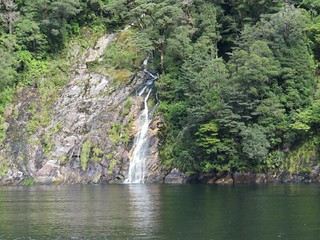
The area was named Doubtful Harbor in 1770 by Captain James Cook because he thought it was doubtful there was sufficient wind to maneuver his vessel into the narrow reaches of the water.  Early explorers wrongly called them sounds instead of fiords.  Sounds are caused by river erosion whereas fiords are carved and gouged out by glaciers.  This probably happened because most of the explorers were English and had never seen fiords before.PicsArt_1427618535277PicsArt_1427618486530PicsArt_1427618762216PicsArt_1427622680614PicsArt_1427621879966PicsArt_1427621780193PicsArt_1427618262431PicsArt_1427618003280

Our cruise started out early in the day when the tour company picked us up at our motel and bused us over to Manapouri where we boarded a boat for an hour ride across Lake Manapouri.  It was a beautiful ride with gorgeous views of the lake and mountains.PicsArt_1427617960648

Once we reached the other side of the lake we boarded a bus which took us through the rain forest over Wilmot Pass.  The only way to reach Doubtful Sound is to cross Lake Manapouri and cross Wimot Pass.  This steep, winding fourteen mile  road is New Zealand’s most expensive road and one of its most remote.  It was built in the 1960’s to provide access for heavy equipment during construction of a power station.  Floods, snows, mud and landslides lengthened the project from 12 months to 2 years.  We had a great bus driver who did a wonderful job maneuvering the mountainous road while keeping us entertained with information about the area.PicsArt_1427617740955PicsArt_1427617873570

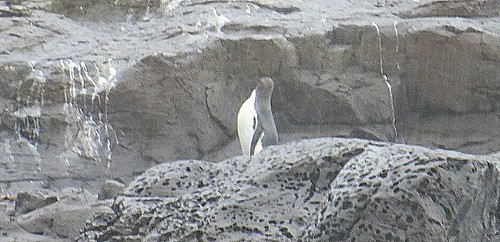
The bus dropped us off at the dock at Deep Cove where we boarded a catamaran for a three hour cruise around Doubtful Sound.  At one point we briefly entered the Tasman Sea.  It was pretty chilly but we spent a lot of time on the deck enjoying the views.  We saw a pod of bottlenose dolphins.  There is a pod of about sixty that hang out in the Sound and seldom leave.  These dolphins are among the southernmost in the world.  They enjoyed playing around the boat, occasionally leaping in the air.  They were quick and hard to capture on camera.  We also saw one yellow eyed penguin swimming in the water.  Now we know what those penguins do all day while we are onshore waiting for their return.PicsArt_1427621208896PicsArt_1427621489576PicsArt_1427619519662PicsArt_1427624220489

The catamaran then dropped us back to Deep Cove where we once again rode the bus over Wimot Pass to the boat which took us back across Lake Mansour then to the last bus and back to the motel.  A marvelous ten hour day.  The tour company, Real Journeys, did an exceptional job and all their employees on the buses and boats were very friendly and helpful   They all truly seemed to enjoy their jobs.  And since there is no tipping in New Zealand no one was waiting during any part of the trip with their hand out expecting a tip.

We enjoyed meeting and talking with couples from Australia and France on the trip.

Te Anau, Fiordland National Park and all the area around it is truly a beautiful beautiful place!

Some observations:

  • Diesel fuel is cheaper than gasoline at the fuel pumps.
  • The South Island is more mountainous than the North Island and has fewer people and more sheep, cattle and deer.
  • The South Island is colder, rainier and has many more bugs, especially sand flies.
  • The South Island has more tourists and Americans than we encountered on the North Island.
  • The South Island has more souvenir shops but less fast food restaurants.  Many smaller towns have a Subway restaurant but no other fast food.

March 22, 2015 Dunedin and Invercargill, New Zealand

After our visit to Mount Cook we stayed overnight in Timaru.  The next morning we drove towards Dunedin.  Along the way we passed the 45 parallel south which meant we were now closer to the South Pole than the PicsArt_1427353374559equator. We stopped at Katiki Point because our tour  book said we might be able to spot some yellow eyed penguins, the rarest and most endangered penguins in the world and native to New Zealand.   One of our goals while in New Zealand was to see penguins, preferably in the wild in their natural habitat.
We parked and began to walk along the beautiful coastline toward the point.  Suddenly Bill stopped and motioned toward a bushy area.  There, a few feet away, were two yellow eyed penguins.  So exciting!!  They are now at the time of year when they are molting, so they looked a little different from what you might PicsArt_1427256961287expect.  At first we barely moved and didn’t utter a sound for fear of scaring them away.  Once Bill took some pictures we moved closer down the path and they didn’t appear at all afraid of us.  This area is a highly protected reserve and we think they have become accustomed to people and know they have nothing to fear.  The area is under video surveillance and everyone is expected to follow the rules or face stiff penalties.
We proceeded down the trail and came upon one more penguin closer to the rocky shoreline.  What was really neat was there was also a fur seal not far from the penguin so we were able to get a picture of them together.PicsArt_1427257185593PicsArt_1427257249842
We walked to the end of the point passing by huge fur seals lounging on the rocks and upper hillsides.  We could have literally stepped over the seals and they would have cared less.  We enjoyed the view at the end of the point and walked back to the car, so pleased with our penguin discoveries.PicsArt_1427257784210PicsArt_1427257845710

Along the way to Dunedin we saw breathtaking views of the ocean with sheep grazing along the cliffs and people on horseback riding on the beach.   As we crested the top of a steep hill, we had a breathtaking view of the Dunedin nestled next to the ocean.  The first European settlers were Scottish settlers who arrived in 1848. It was originally named New Edinburgh but the name was changed to Dunedin which is an old Celtic name for Edinburgh.

“The people are Scotch.  They stopped here on their way from home to heaven, thinking they had arrived.” Mark Twain
Nearby goldfields generated wealth in the area and New Zealand’s first university, the University of Otago, was established here.  The discovery of gold encouraged the arrival of Chinese miners and by 1871 there were over 4,000 Chinese miners in the area.  Many settled permanently in Dunedin and are an important part of the community today.
We arrived in Dunedin late in the day since our penguin adventure took longer than expected.  We didn’t really have much time to explore the city before dark.  We did drive to Baldwin Street which is named in the Guiness Book of Records as the steepest street in the world.  The street runs from 98 feet above sea level to 330 feet above sea level with a slope of between 20% to 35%. The lower part of the street is asphalt but the upper reaches of the street, which is the steepest, is surfaced in concrete for safety on frosty mornings.2015-03-28_04-36-142015-03-28_04-35-56
Dunedin is often called the eco-capital of the world because of all the nature and wildlife in the area.  The Dunedin Railway Station is said to be the most photographed building in New Zealand.
I wish we had had more time to explore this charming city with its beautiful old Victorian and Edwardian buildings.
Next we headed to Invercargill.  Along the way our tour book suggested we stop by Nugget Point Lighthouse, which is the most photographed lighthouse on the South Island and a location often seen on postcards andPicsArt_1427258167378PicsArt_1427258384986 brochures of New Zealand.  The book said it was possible to see penguins here, though the best time to see them was between 5 and 6 PM  We saw a hide which is a little structure where people can hide so they can see the penguins but they don’t see us. It was early afternoon and we didn’t want to wait around that long since we still had a long drive to Invercargill.  We did trudge to the end of the trail where the lonely lighthouse sat on the edge of a PicsArt_1427258454378rocky cliff.  We enjoyed talking with a couple visiting from England.
Our time in Invercargill was short but Bill did have time to visit the E Hayes Motorworks Collection where there is a remarkable vintage motorcycle and car collection, but more importantly the world’s fastest motorcycle.  Ben Munro, built the World’s Fastest Indian, was born near Invercargill.  In 1920 he bought a Indian motorbike for $120 which he modified and tuned to a record of 190.07 mph, a world record.PicsArt_1427258753624PicsArt_1427258809437PicsArt_1427258654232PicsArt_1427258519862in 2005 the movie “The World’s Fastest Indian” was released and starred Anthony Hopkins as Burt Munro.
Also while in Invercargill we spent one day on another penguin hunting adventure.  Using the tour book tip of best places to look, we first headed to the most southern point in all of New Zealand. Here we were the closest we would get to Antarctica.  While hiking to the point we walked in a field of sheep who at one point trotted ahead of us as if showing us the way.  I tried to get a picture of them up close with Bill but they were very skittish.PicsArt_1427258895661PicsArt_1427258977231PicsArt_1427259017269PicsArt_1427259083780
We intentionally set out late in the day because the best time to see penguins is around dusk when they swim back to shore to their nest after being at sea ALL DAY.  We joined a throng of people waiting anxiously PicsArt_1427259121841for their arrival in a roped off area with a DOC (Department of Conservation) employee there to be sure everyone followed the rules.  We had to stay behind the yellow ropes and no flash photography because they think it hurts the penguins eyes.  We waited an hour PicsArt_1427259916676and a half in a very cold drizzle until we were rewarded with one penguin fairly far away.  Just as we were about to give up someone spotted another one closer.  He washed up on shore and then proceeded to hop across some rocks and then stop and preen.  After watching him for awhile it was getting dark, we were pretty wet and really cold, and we had over an hour’s drive back to the motel.  Was it worth the hour and a half wait in the cold and rain?  Absolutely!!PicsArt_1427445322474PicsArt_1427444362975PicsArt_1427446952935PicsArt_1427445192178
Some observations:
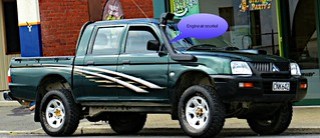
We noticed many trucks with an engine breathing apparatus (snorkel).  Evidently they like to take their trucks and play in the water and need this engine snorkel.PicsArt_1427258088107
You occasionally see a business or house for sale, you never see land for sale.
It is strange to see deer fenced in.  We are used to seeing them only running wild.  Bill has enjoyed eating lamb and venison in New Zealand. Wild deer can be hunted year round.
The motel guest laundry and laundromats use cold water only.  This totally freaks out a germ freak like me!
We are enjoying meeting and talking with people from other countries around the world.  There are many tourists here from Australia, France, Germany and Japan.