Category Archives: Geocaching

Geocaching

October 5, 2015 Heading east AT LAST!

This blog is from events of almost two months ago.  We have been on a fast track east and have had little time for blogging and/or poor internet service.

We only planned to stay in Yuma, Arizona for 5 days.  But due to a series of unplanned circumstances, our stay there turned into over a month.  While we love Yuma, a place very friendly to RVers with great weather this time of year, we were more than happy to finally pull out of the campground.  We had originally planned on taking a slow stroll across the country to Florida. But due to our extended stay in Yuma, now we had to travel at a fast jog. We were forced to skip stops in Austin and Big Bend National Park in Texas and New Orleans. Other stops were shortened with several one night stopovers and an occasional two or three night stop for Bill to rest from all the driving.
It seemed like a long way from Yuma to Florida, and it was at over 1,800 miles. Our first stop was Tucson followed by Deming, New Mexico. Two places we had not canceled were Roswell and Carlsbad Caverns, both in New Mexico.

IMG_20151108_111755Our drive took us through the White Sands Missile Range. The world forever changed here on July 16, 1945 at the Trinity Test Site when the first atomic bomb was detonated. The national historic site is open to visitors just ONE day a YEAR, and today was not the day. We did stop at the White Sands National Monument, the largest gypsum dune field in the world. Considered one of the world’s great natural wonders, the white dunes range over 275 square miles. We stopped at the Visitors Center and saw an excellent movie explaining how the dunes were shaped by natural forces. We decided not to take the scenic drive to see the dunes since we had the car hooked to the RV and we still had a long drive to our destination of Lakewood, New Mexico. We put the White Sands National Monument on our list of places to return to in a future visit.IMG_20151108_114734IMG_20151108_114859

IMG_20151108_134732After passing through Cloudcroft Tunnel, built in 1949 under a rock formation and is the only automotive tunnel in New Mexico, we finally arrived in Lakewood for a three night stay. Lakewood was a convenient destination because it was halfway between two places we wanted to visit in the area.

20151109_114759The next day we set out to see Roswell, New Mexico to visit the International UFO Museum and Research Centers. On July 6, 1947, a local rancher told Roswell authorities about an object that had crashed in his field. Investigating officials at the Roswell Army Air Field reported they discovered a “flying disk”. A few hours later they revised their story, saying it was not a UFO but a weather balloon. What really happened that day is a mystery and a source of speculation and debate to this very day. The UFO Museum mainly consisted of wall after wall of newspaper stories and eyewitness accounts told by local residents. There was a small theater with documentaries and movies, with the most interesting being eyewitness accounts of the days following the crash when townspeople were threatened to keep quiet and those who had supposedly witnessed things the government did not want them to see suddenly disappeared. I entered the museum with disbelief and skepticism and perhaps a somewhat closed mind. I did not see anything in the museum to make me a believer. Bill, on the other hand, has a much more open mind than I do and still entertains the idea of a UFO visit.20151109_12405520151109_124618

20151109_124340

This is a painted picture from eyewitness(s)

20151109_124018

The spaceship and robot from the movie: The Day The Earth Stood Still

20151109_125111
There is more to Roswell than the incident in 1947. In the 1800’s this was an area of frontier living with Apache Indians and often visited by Billy the Kid. Roswell is also the home of one of the largest mozzarella cheese factories in the world.
IMG_20151109_145415Of special interest to Bill was that in the 1930’s, Roswell was the place where Robert H. Goddard, known as the Father of Modern Rocketry, attempted to defy gravity. During this time Goddard worked with Charles Lindbergh and Harry Guggenheim. We stopped by the Roswell Museum and Art Center where we toured Goddard’s actual workshop and saw fascinating home movies made by Goddard’s wife showing Goddard launching his first rockets.IMG_20151109_145221IMG_20151109_145244
IMG_20151110_095248On our last day in the area we drove south from the campground to Carlsbad Caverns. It is considered by many to be the Eighth Wonder of the World with some of the world’s largest underground chambers. The Big Room alone would hold fourteen Astrodomes. We were really looking forward to touring the caverns and it is one of the few places we didn’t eliminate from our revised itinerary. Our plan was to hike the steep 800 foot descent into the cave and then take the elevator back up. Unfortunately, the elevator was broken.IMG_20151110_095301IMG_20151110_112126IMG_20151110_102641

I was fighting a cold and neither of us was in the mood for the steep hike down and especially the climb back out which was equal to climbing 79 stories. We did see a movie at the Visitors Center and walked to the entrance of the cave. We were disappointed to say the least since we had eliminated other places on the itinerary to come here. But we had no choice except to put it on the list for the future. We returned to the campground and prepared to hit the road running tomorrow.

September 18, 2015 Flagstaff and Phoenix, AZ

It was hard to leave Page with beautiful Antelope Canyon, Horseshoe Bend and Monument Valley.  What a gorgeous area of Arizona!!  The weather was really hot so we decided to spend five days in Flagstaff, which at an elevation of almost 7,000 feet was going to be cooler.

We thought we would just hang out in Flagstaff and enjoy the weather, but there turned out to be more to do than we expected.

A short drive from our campground was Wupatki National Monument, Sunset Crater Volcano National Monument and Walnut Canyon National Monument.

IMG_1364Sunset Crater Volcano National Monument is a 2,200 square mile volcanic field with more than 400 cinder cones.  Sunset Crater is the youngest volcano in the area, having exploded in 1065 AD.  Because it was pretty hot and we had already experienced a lot of lava fields at Craters of the Moon in Idaho and in Hawaii, we didn’t spend a lot of time here.  We saw a movie at the Visitors Center and we found a really cool geocache.  The geocache was located inside an extinct fumerole (an opening in the earth’s crust which emits steam and gases).  Since the fumerole was extinct it was no longer emitting steam and gases, but I was still surprised Bill jumped down into the fumerole to find this geocache.  Really, Bill??!!IMG_1362IMG_1361

IMG_1360Within Wupatki National Monument are 800 ruins, the homes and villages of the Sinagua and Ancient Puebloans.  These ancient people felt the warning tremors before the volcano erupted in 1065 AD.  The lava flows forced them to vacate the land they had cultivated for over 400 years, and they moved to Wupatki and Walnut Canyon.  Here they lived for another 100 years before moving to other areas of the Colorado plateau.  The agricultural potential of the area actually improved after the eruption because the thin layer of ash absorbed moisture and helped prevent evaporation in the hot, dry landscape.  By 1250 AD the pueblos in Wupatki stood empty.  While there we walked a paved trail which took us up close to several dwellings.IMG_1352IMG_1353IMG_1355IMG_1358

In the early nineteenth century settlers and visitors to the Flagstaff area explored the Wupatki and Sunset Crater National Monuments, looting the area for souvenirs and damaging the landscape.  In 1928 filmmakers planned to use explosives at Sunset Crater to create a landslide for filming.  This led to a public outcry and a push to preserve the area.  In 1930 President Herbert Hoover established Sunset Crater National Monument as part of the national park system.  Wupatki had already been designated a national monument in 1924 after extensive looting of the dwellings.

IMG_1365I think our favorite trip was to nearby Walnut Canyon National Monument.  Here there are dwellings sheltered by overhanging cliffs inhabited here in Walnut Canyon for over 800 years.  The people, known as Sinagua, meaning without water in Spanish, lived by farming, hunting deer and small game, and gathering plants.  It is amazing how they were able to turn this dry land into a homeland.  It is not known why they left, perhaps due to a severe drought.  It is thought they traveled southeast and assimilated into the Hopi culture.

In the 1880’s the railroad brought souvenir hunters to the region, and like Wupatki and Sunset Crater,  looting and destruction of the area caused alarm and dismay.  In 1915 Walnut Canyon was protected as a national monument.IMG_20150921_113003IMG_20150921_105715PANO_20150921_120825

We intended to only walk the Rim Trail around the top of the canyon which would have given us a distant view of the cliff dwellings.  The day was cloudy and cooler, so we decided to walk the Island Trail which was listed as a strenuous trail mostly because of the 240 steps each way which would take us closer to some of the cliff dwellings.  As it turned out it was more moderate than strenuous and we found the walk pleasant and very informative.IMG_20150921_115331IMG_20150921_110159IMG_20150921_111032IMG_20150921_112243IMG_20150921_111259IMG_20150921_112607

We left Flagstaff and drove to Phoenix and our elevation dropped 6,000 feet.  Boy could we feel a difference in temperature!!  Now the temperature climbed to 111 degrees during the day.  After several days of this, the local weatherman said it was going to be cooler with temperatures “only” around 100 degrees.  We were practically the only ones in the campground resort.  The snowbirds will not be arriving for at least another month.

PicsArt_10-08-06.54.23While in Phoenix we did drive into the downtown area on a Sunday to see the state capitol building.  We found some geocaches including one at the Liberty Bell located on the capitol grounds.  This Liberty Bell is identical in dimensions and tone to the Liberty Bell in Philadelphia.  The bell is one of 53 cast in France in 1950 and given to the United States government by several copper mining companies. PicsArt_10-08-06.58.20 It is dedicated to us, free citizens in a free country.  Every September the Bell is moved to Gilbert, Arizona where it is displayed as part of Constitution Week.  Close to the capitol grounds we found Wesley Bolin Memorial Plaza where there are many memorials honoring important people in Arizona history as well as memorializing wars and significant historical events.  We found a geocache at the USS Arizona anchor (see our post of the USS Arizona memorial).   The 16,000 pound anchor was part of the ship which was bombed and sank during the attack on Pearl Harbor.  The ship still lies at the bottom of Pearl Harbor.  In the plaza is also the USS Arizona signal mast and gun barrel.  Inside the capitol museum is a superstructure salvaged from the ship and the US flag which flew on the battleship when it sank.PicsArt_10-08-06.55.00PicsArt_10-08-07.00.19

Next we head to Yuma, Arizona for a few days before we begin our slow trek back east.

September 17, 2015 Monument Valley, Utah

IMG_1333There is so much to see and do in Page, Arizona.  Before we left we had one last thing  to do.  We wanted to visit Monument Valley and Valley of the Gods in Utah.  We had contemplated taking the RV there and camping for several days but the heat and some changes in our schedule convinced us it was best to make it a long day trip from Page.   And a long day it was with about a three hour drive each way.IMG_1345IMG_1336IMG_1341IMG_1290IMG_1295IMG_1296IMG_1343

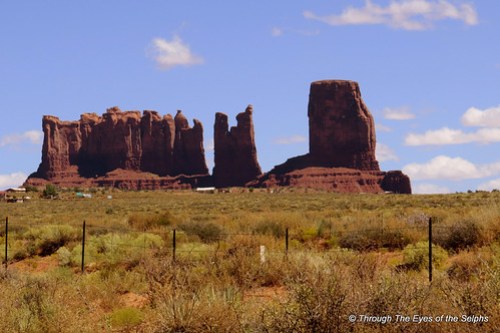
IMG_1351Monument Valley is on Navajo land and part of the Navajo Tribal Park which was established in 1958 to preserve the environment.  Monument Valley sits at 5,564 feet above sea level and is 91,696 acres in Arizona and Utah.  The height of the monuments, natural structures created by erosion, range from 100 to 1,500 feet tall.  There was a fee to enter the park and make the 17 mile loop drive.  The road of sand and dirt was in really bad shape making it almost necessary to have 4 wheel drive vehicle.  Monument Valley was made famous in many western movies, TV shows and commercials including Stagecoach (1939), She Wore a Yellow Ribbon (1949), How the West Was Won (1962), Easy Rider (1968), 2001: A Space Odyssey (1968), Back to the Future III (1990), Forest Gump (1994), The Lone Ranger (2013), Breaking Bad (TV) and Dr Who (TV) just to name a few.  John Wayne called Monument Valley “God’s Treasure”.

IMG_1297

Mexican Hat

We also drove to area of Utah called Valley of the Gods with similar sandstone formations to Monument Valley but on a smaller scale.  This land is public land managed by the Bureau of Land Management and did not require a fee. This too involved a loop drive on a dirt and sand road with less than ideal conditions to say the least.  We had downloaded a map ahead of time which led us to various named formations.  Sometimes it was very easy to see how the formation received its name, while others took an imagination we didn’t seem to have.IMG_1306IMG_1308

IMG_1301

Woman Sitting on Her Bathtub

IMG_1324

Hen on a Nest

IMG_1321

Rooster

IMG_1327

Seven Sailors with Flat Hats

IMG_1315Bill found a geocache in the rocks amid some sagebrush.  I stayed behind and took pictures.  The truth is I was terrified of possible snakes.IMG_1318IMG_1329

IMG_20150917_173850On the way home we stopped to find another geocache and saw John Wayne’s cabin (Captain Nathan Brittles) that was used as part of the set of his movie She Wore a Yellow Ribbon.

It was a full and tiring day.  We have certainly loved our time in Page.  Between Antelope Canyon, Horseshoe Bend, Glen Canyon Dam on beautiful Lake Powell and Monument Valley, Page is a place we look forward to visiting again.

September 7, 2015 North Rim Grand Canyon NP

On Labor Day we sadly left our campsite in Hurricane, Utah and drove to Jacob Lake, Arizona.  Jacob Lake is a tiny unincorporated community named after Mormon explorer Jacob Hamblin.  The town is known as the “Gateway to the Grand Canyon” because the town is at the starting point of Route 67, the only paved road leading to the North Rim of the Grand Canyon National Park.  Jacob Lake strangely does not have a lake but it does have an inn and a gas station.  The closest post office is over 30 miles away.  The only campground anywhere near the North Rim with full hookups is in Jacob Lake which is our reason for camping here.
We had planned on dry camping a few days in the North Rim of the Grand Canyon but their campground was full so we decided to stay at Jacob Lake.  We were a little nervous about the campground because it had mixed reviews.  But no worries as got settled in the midst of tall pine trees in the Kaibab National Forest and were still able to get satellite TV and good Verizon coverage.  Best of all, since our elevation here is over 7,000 feet, the temperature was at least ten degrees cooler than Utah.  One night it got down to 39 degrees but it warmed up quickly in the morning with the sun.
IMG_1229Our main reason for stopping in this remote area of Arizona was to visit the North Rim of the Grand Canyon.  We visited the South Rim back in May.  The two Rims are very different.  The South Rim gets many more tourists and is much more commercialized with lodges and several campgrounds, a large general store, and several restaurants and gift shops.  The North Rim gets 15% of the IMG_1260IMG_1234number of tourists as the South Rim. As the crow flies only ten miles separate the two Rims, however the trip by road is over 200 miles.  The South Rim is mainly desert while the North Rim is heavily forested with pine, spruce and fir.  The North Rim is 1,200 feet higher in elevation and has a longer winter season with an average of twelve feet of snow per year compared with five feet on the South Rim. There is one lodge called the Grand Canyon Lodge, a very small Visitors Center, one gas station and limited food service.
We drove from our campground to the North Rim and immediately upon entering the park we saw a herd of bison.IMG_1230IMG_1231
IMG_1237We drove the scenic road stopping at various viewpoints along the way, including Point Imperial, the highest point in the park at 8,803 feet.  IMG_1240

IMG_1238

This formation is known as Battleship

IMG_1242We especially liked Angels Window at Cape Royal where we walked the short trail that took us over the top of Angels Window to a spectacular viewpoint.  We were able to see the Colorado River from this viewpoint. There were several really nice short trails that took us to beautiful views of the canyon.IMG_1246IMG_1248IMG_1250IMG_1263IMG_1257IMG_1259IMG_1253IMG_1243
On the drive home we saw so many deer we soon lost count.  Sometimes they were standing right on the side of the road, poised as if waiting to jump in front of us.  It made for a somewhat nerve wracking trip home.
IMG_20150911_170802One day we did some geocaching in the Jacob Lake area.  One geocache was really unusual.  It was high in a tree with a string hanging down.  When you pulled the string a tape measure unrolled with the container holding the log sheet for us to sign.  Some people placing geocaches are IMG_20150911_155557really creative, making for really fun finds! I told Bill his sunhat hat looked really dorky so he showed me a couple other ways he could wear it.  What do you think?

IMG_1232

Sailor Bill

IMG_1233

Cisco Kid!

IMG_20150911_161236Bill noticed a squirrel with a long white tail running around the campground.  We saw another one at the North Rim.  This kind of squirrel is only found in this part of Arizona!IMG_1236IMG_1266IMG_1268
We really enjoyed our time in the Jacob Lake and North Rim area.  Our last day at Jacob Lake we had a thunderstorm that included enough hail to coat the car and roads like looked more like snow.  The temperature dropped over twenty degrees in less than an hour.  IMG_20150913_160206IMG_20150913_160233Regardless, the weather was delightful at Jacob Lake and a big relief after the Utah heat.   Unfortunately we are headed back into hot weather since our next location is at a much lower elevation in Arizona.

August 24, 2015 Bryce Canyon, Utah

IMG_20150827_135957We left Torrey and Capitol Reef National Park and headed to Panguitch, Utah which is about 30 minutes from Bryce National Park.  Panguitch is a small town, population 1,500. Butch Cassidy and his gang was photographed here.

IMG_20150827_141108

Fire water wagon from years past

As expected we were directed to a site with absolutely no shade but we had excellent satellite reception and good WiFi and Verizon coverage.  Since this area is cooler than Moab we were not too concerned about the heat.IMG_20150827_140034IMG_20150827_143042

IMG_1138Just when I think it couldn’t get any more beautiful, we go to a new park and we are awe struck by its beauty.  The same was true for Bryce Canyon which really isn’t a canyon but a plateau with a series of horseshoe shaped amphitheaters carved in the edges of the eroding plateau.  Bryce Canyon was settled by Mormon pioneers in the 1850’s and is named for Ebenezer Bryce, a Mormon settler who homesteaded the area in 1874.  It became a national park in 1928.

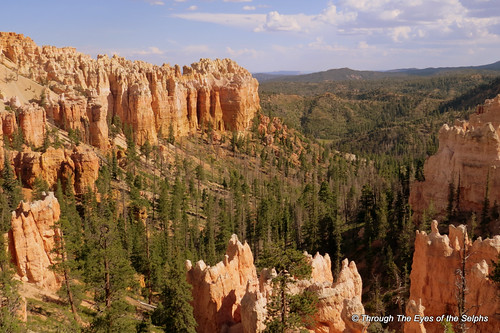
To get to Bryce Canyon we drove once more on Highway 12, The All American Road, passing through Red Canyon with its beautiful red sandstone and limestone formations and through two tunnels.  IMG_1136IMG_1132IMG_1137Once inside the park we stopped by the Visitors Center to see a movie about Bryce Canyon.  We then drove an 18 mile one way scenic drive through the park with 14 viewpoints with views down into the amphitheater.   Some of the stops had overlooks alongside the road while others involved short hikes along paved trails.  The views at all the overlooks were amazing.  We saw many “hoodoos” which are towering rock formations sculptured over time by ice freezing and thawing, some as much as ten stories tall.  There are approximately 200 days of freezing/thawing at Bryce Canyon each year.  It was fun to let our imaginations run loose and imagine faces or figures in the formations.  The Paiutes, original inhabitants of the area, believed that the rock figures were people turned to stone by angry gods.  If you look closely you can also see fairy tale castle formations.  Iron oxide gives red, yellow and brown tints to the limestone.IMG_1139IMG_1140IMG_1142IMG_1143IMG_1151IMG_1156IMG_1158IMG_1162IMG_1168IMG_1167IMG_1174IMG_1176IMG_1177IMG_1179IMG_1185IMG_1186IMG_1192IMG_1193IMG_1194IMG_1195IMG_1196IMG_1198IMG_1164

Here is a video for you: https://youtu.be/bA-UUBM0rXc

Our goal is to return to the park and hike the popular Navajo Trail which will take us down into the amphitheater for a closeup view of the hoodoos.  More about that in the next blog.IMG_1200IMG_1201

August 9, 2015 Antelope Island State Park, Utah

IMG_20150809_120534One of our RVing friends suggested we visit Antelope Island while we were in the Salt Lake City area.  It was about a 45 minute drive from our campground so we decided to dedicate one of our days to visit the island.IMG_0867IMG_0871
IMG_0869Antelope Island is the largest island in the Great Salt Lake.  The Great Salt Lake is the largest natural lake west of the Mississippi River.  The lake is a remnant of prehistoric Lake Bonneville which covered more than 20,000 square miles of land during the Ice Ages.  Water flows into the lake from four rivers, carrying 2.2 million tons of minerals into the lake each year.  Great Salt Lake has no outlet so water leaves only through evaporation, leaving high concentrations of minerals behind.  The salinity of the water is too high to support fish and other aquatic life, however brine shrimp, brine flies and algae thrive in the lake.  Because of the brine shrimp and flies, there are millions of migrating birds feeding off this food source. Nearly 80% of Utah’s wetlands surround Great Salt Lake, making its ecosystem one of the most important resources for migratory and nesting birds in North America.  The area has over 250 bird species with six to nine million birds migrating through each year.IMG_0874IMG_0878IMG_0879

IMG_0914The island is home to free roaming herds of bison, mule deer, pronghorn antelope and bighorn sheep as well as coyotes, bobcats, badgers and birds of prey.  While on the island we saw plenty of bison, one antelope, two mule deer, a hungry looking coyote and a ton of birds.  Antelope Island has more than 40 major freshwater springs that produce 36 million gallons of water each year which supports the wildlife and vegetation.  Twelve bison were brought to the island in 1893.  Today there is a herd of between 500 to 700.  In the fall some of the bison are rounded up and sold to national and state parks and ranches.  The pronghorn antelope are native to Utah and the island.  They are the fastest animals in North America and can reach speeds of up to 70 miles per hour.IMG_0883IMG_0885IMG_0923IMG_0886IMG_0922IMG_0888IMG_0893IMG_0895IMG_0918IMG_0897IMG_0906IMG_0908

Antelope Island comprises 28,022 acres and is 15 miles long and 4.5 miles across at its widest.  The oldest rocks on Antelope Island are some of the oldest anywhere in Utah.  Canyon rocks on the island are 1.7 billion years old which are the same age as rocks found at the bottom of the Grand Canyon.

Artifacts tell us that prehistoric people inhabited the island more than 6,000 years ago.  John Fremont and Kit Carson explored the island in 1845 and named the island after observing several pronghorn antelope grazing.  The first permanent residence on the island was established in 1848 and is Utah’s oldest Anglo built structure still standing on its existing foundation.IMG_0890IMG_20150809_120546

The beauty and wildlife of Antelope Island was beyond our expectations and it took us much of the day to see it all.  We even found two geocaches there!

August 8, 2015 Salt Lake City, Utah

IMG_20150813_113306

Salt Lake City

We made the short drive to a private campground located in North Salt Lake City, about six miles from downtown Salt Lake City which we could see in the distance.   What a difference these private campgrounds are from the state, national and forest campgrounds.  We had to get used to the narrow campsites with close proximity to neighbors that are found in most private campgrounds as well as traffic noise from the nearby freeway.

We settled in and then drove to the nearby Honda dealership to have maintenance done on the Honda.  We were very impressed with the people there.  Even though we were not local, just passing through the area and only having required maintenance done, we could not have been treated nicer.

Our first evening in the area we had a terrible storm with heavy rain and high wind.  Even though the forecast also called for severe lightning and hail, we didn’t experience any of that to our relief.

IMG_20150810_100703

Family History Library

We drove into downtown Salt Lake City on two separate days so Bill could do some research at the Family History Library.  The library was founded in 1894 and is one of the world’s largest genealogical libraries.  The collection mainly focuses on the United States, Canada, the British Isles and Europe, including Scandinavia, however there are genealogy records from other areas of the world.  While we were there many people of different nationalities walked through the door seeking information.  All Family History Library original records are kept at the Granite Records Vault in the mountains near Little Cottonwood Canyon.  Fortunately today many of the records are computerized.  Anyone is welcome to use the library and it is all free!  The library is 145,000 square feet and has more than 300 computers.  They have birth and death certificates, marriage licenses, census returns, property, probate and cemetery records.  HOWEVER, the Library’s collection focuses on people who lived before 1930 so you will need some older information on your family to begin.  I noticed they also have helpers throughout the library who speak other languages to help non-English speaking guests.

When we arrived we were given a first timer name tag and saw a four minute orientation movie (also available in many languages) about the five story library.  We were then ushered into a room full of computers where we were each given our own personal helper to get us logged in and to show us the ropes.  Create your account at familysearch.org then you can do about 99% of the research from the comfort of your home. There are over 4,500 branches of the library located around the world if you want assistance and/or if you want to use their equipment.  After about an hour of family research I had had enough and I went back to the lobby to work on our blog and read.  “… genealogy is the second most popular hobby in the U.S. after gardening, according to ABC News …”. Genealogy is really more Bill’s passion than mine.

IMG_0942

On May 15, 1829, Joseph Smith and Oliver Cowdery went into the woods

When he finished for the day we explored the downtown area some.  Salt Lake City was founded by the Mormons in 1847 and lies at the foot of the Wasatch Mountains.  It is a beautiful setting.  The Great Salt Lake lies to the northwest and the Great Salt Lake Desert to the west.  By the way, the name of the religion is The Church of Jesus Christ of Latter-day Saints.  Mormon is just a nickname.  Joseph Smith, Jr. said an angel entrusted him with golden plates inscribed with symbols which Smith translated into the Book of Mormon.  Smith advocated polygamy.  Although no more than 4% of the Mormons practiced polygamy, advocacy of it led to problems with non-Mormons wherever they tried to settle.  In search of a place where they could practice their religion without prosecution, they tried settling in Missouri and Illinois.  Smith was arrested, jailed and eventually shot to death.

After Smith’s death the church split into two groups with the group opposed to polygamy forming a “Reorganized Church” and returning to Missouri.  A larger group followed Brigham Young, the second president of the Mormon Church to Utah in 1847, establishing Salt Lake City.  By 1869 more than 60,000 Mormons had immigrated to Utah by covered wagon or handcart.  Also in 1869 the transcontinental railroad was completed linking Utah to both coasts.  They applied for statehood in 1849 but their request was not granted until 1896 after the church abolished polygamy.  By the 1900’s there were over 400 cities in Utah.

The streets downtown are laid out in a grid pattern fanning out from Temple Square, the spiritual and historical headquarters of the Mormon Church.  The streets were designed to be “wide enough for a team of four oxen and a covered wagon to turn around”.  The streets are named for their directional distance from the Temple, such as West Temple, North Temple, South Temple and then Main Street.  So one street south of South Temple is 100 South, next street is 200 South, etc.

IMG_0934

Utah State Capitol Building

With a population of 186,440, Salt Lake City is the state capital of Utah.  We stopped by the beautiful capitol building which sits high on a hill overlooking the city below. The Corinthian style building was completed in 1915 and resembles the National Capitol.

Temple Square is advertised as the number one tourist attraction in Utah.  Three of the buildings on the square were built by pioneers; the six-spired granite Salt Lake Temple which took 40 years to complete, the domed Tabernacle which is home to the Mormon Tabernacle Choir and organ, and the Assembly Hall.  Only church members may enter the Temple.  The Mormon Tabernacle Choir began with a small Choir in 1847, twenty-nine days after the first Latter-day Saint pioneers entered the Salt Lake Valley.  Today the choir has 360 members.  The Choir’s first radio broadcast took place in 1929.  Today their broadcast is the longest running continual network broadcast in the world.

IMG_0937

Mormon Assembly Hall

IMG_0943IMG_0945IMG_0947

IMG_0938

Domed Tabernacle Choir Building

IMG_0949We also drove by a small park wedged between two apartment buildings where we found the Mormon Pioneer Memorial park where Brigham Young and several members of his family are buried.  We were surprised to find Young’s grave in such a plain, isolated park not far from the capitol building. Young died in 1877.IMG_0953IMG_0950

IMG_0928

Eagle Gate

On the way to the capitol we passed under the 4,000 pound bronze eagle with a wingspan of 20 feet atop Eagle Gate.  The structure was erected in 1859 and at one time marked the entrance to Brigham Young’s farm.

Unfortunately Salt Lake City has the worst panhandling problem we have seen in our travels.  There are a large number of tourists in the Temple Square area and they are targets of the panhandlers.  While I was waiting for Bill in the lobby of the Family History Library, a lady came in complaining about a panhandler.  Security was called and from what I overheard, it is an ongoing problem with security called almost daily.  Bill and I were approached twice, once when leaving the library and in the parking lot two blocks from the library. Too bad Salt Lake City cannot solve this problem because it is such a turn-off for tourists in an otherwise beautiful city.

Like many cities, Salt Lake City does not have enough parking downtown and what they do have is pretty expensive.  One of the volunteers at the library gave us directions to a parking lot just a couple blocks from the library where the parking was only $1.00 an hour.  We were really glad to find that jewel!

Utah facts:

  • Seven national parks, 45 state parks, 6 national monuments, 8 national forests, 14 ski resorts
  • Population of 2,942,902
  • Symbol is the beehive representing thrift and industry
  • Origin of name is from the Native American Indian Tribe, the Utes

July 1, 2015 Buffalo, Wyoming

IMG_20150629_103912We left Sundance and drove 135 miles to Buffalo, Wyoming.  The drive was rather boring, just an endless straight road with open plains and the occasional herds of cattle and some horses.  I will say the horses in this part of the country are beautiful, looking very much like the horses used by Indians in the old western movies and TV shows.

We arrived in Buffalo for our stay at a private campground.  The temperature was pretty hot and they had some nice shady spots.  Unfortunately in order to get our Dish satellite antenna to work we had to park in the section without a bit of shade.

The park provided internet and therefore we spent time researching and making reservations for November, December and January.  We were shocked and somewhat dismayed to learn many Florida RV parks have a three month minimum stay and most of the popular state parks were already booked!  Since we want to move around Florida during the winter, the three month minimum stay will not work for us.  Foiled by those snowbirds yet again!

IMG_0287While in Buffalo we made the 90 minute drive north into Montana to visit the Little Bighorn National Monument.  It was here in the valley of the Bighorn River that George Custer’s 7th Cavalry Regiment of 600 men met with a gigantic Indian village including several thousand Lakota, Arapaho and Northern Cheyenne braves. Custer divided the regiment into four battalions, keeping a force of 215 under his own command in June, 1876. IMG_0293IMG_0290IMG_0289IMG_0302

The 1.2 square mile site has a Visitors Center with Ranger talks throughout the day, a large memorial, a memorial to Native Americans and a drive around the battlefield with overlooks and descriptive signs.  On the battlefield are approximately 263 white markers showing where IMG_0305human remains were found.  Custer’s marker showing where he died is easy to locate due to its special black markings.  Custer’s brother also died near him.  In the park are two cemeteries.  At the large memorial on Last Stand Hill is buried the remains of those who were found in shallowIMG_0292IMG_0291 graves. The remains were buried together under the memorial.  I asked the ranger why the remains were disturbed and not buried where they were found and he said at that time:

  • they did not have the proper equipment to bury that many bodies in deep graves
  • Custer was buried 18 inches deep
  • in many cases only partial remains were found
  • many wounded solders needed to be transported ASAP to a hospital 500 miles away

The Native American memorial was completed in 2013.  The memorial is in the shape of a circle, which is considered sacred, and is open to ceremonial events.  The inside walls display the names of many who fought here and the words of some.  A “Spirit Warrior” sculpture is IMG_0295IMG_0296IMG_0297IMG_0298prominently displayed.  Throughout the battlefield are several red granite markers to mark the location of fallen Indian warriors.  The first red granite marker was placed on Memorial Day, 1999.  The red granite was chosen by Native Americans.  It was hard to locate the remains of Native Americans because they were removed from the battlefield by the Indians.IMG_0294IMG_0303

Also located in the park is a national cemetery established in 1879, which looks much like Arlington National Cemetery though much much smaller.  Veterans of all wars can be buried there but at this time the cemetery is at its limit.  Any man who fought at Little Bighorn and could be positively identified is denoted with a US flag next to the white marker.

IMG_0288

Marcus Reno was second in command under Custer and survived the battle

Custer was buried at this location but his body was later moved to West Point.  Custer is a controversial figure.  He was said to have bravely fought against Confederate troops during the Civil War, supposedly having eleven horses shot out from under him.  Some would say he was only following government orders in his various interactions with Native Americans.  Others would call him vicious, boastful and arrogant.

Bill and I readily admit we are biased when it comes to battles between the settlers and the Native Americans.  While we do not agree with everything the ranger said in his talk about the Battle of Little Bighorn, we cannot deny he did an excellent job in his presentation.  We learned more about the U.S. invasion of Indian territories.  The government was under pressure from people who wanted western expansion.  The discovery of gold only intensified this push.  As more settlers moved west the Native Americans saw more of their land being taken away with no regard to their way of life.  The American government, feeling it was cheaper to feed the Indians rather than fight them, initiated peace treaties with them which they then turned around and broke.  The 1868 Laramie peace treaty designated a large area of eastern Wyoming as a permanent Indian reservation and the government promised to protect them.  The treaty was broken in 1874 as thousands of gold seekers rushed the territory.  The government tried unsuccessfully to keep them out.  The government then tried to buy the Black Hills from the Indians but they refused to sell.  The Indians left the reservation and resumed raids on settlers and travelers.  In January, 1876 the government then ordered free Plains Indians, who are labeled “hostiles” to return to the small reservations.  When the Indians did not comply, the army was called in to enforce the order.IMG_0299

While this was Custer’s Last Stand, it was also the last stand for the Native Americans.  A huge public outcry over Custer’s defeat led to such events as the Battle of Wounded Knee and the Indians relocation on reservations.  At the Battle of Little Bighorn, the Indians may have won the battle but they lost their land, their culture, their way of life.  They won the battle but lost the war.

June 24, 2015 Sundance, Wyoming

After twelve days we left South Dakota and headed to Wyoming. We enjoyed our time in South Dakota but sure experienced some scary weather there. On our next to the last night in South Dakota we were hit with another frightening thunderstorm with winds over 45 mph, lightning, heavy rain and even more hail than we had in the Badlands.

IMG_0249We arrived in Sundance and checked into a nice campground. Wyoming is the least populous state in the country with approximately 544,270 residents spread out over more than 97,000 square miles. It is nicknamed “The Cowboy State” because of the estimated 11,000 farms and ranches. The Black Hills are 90% in South Dakota but this small area of northeast Wyoming, including Sundance, in part of The Black Hills. Our main reason for stopping in Sundance was to visit Devils Tower National Monument. This granite formation rises 1,267 feet from the prairie and has hundreds of parallel cracks making it one of the finest traditional rock climbing areas in North America. The site is sacred to the Lakota and other tribes. Legend has it that the rock rose up just in time to save seven young Indian girls from a bear and the rock rose higher and higher out of reach of the bear. The marks on the tower were caused by the bear’s claws. The girls were pushed up into the sky where they became seven stars (the Pleiades constellation).IMG_0250IMG_0248

The Devils Tower was proclaimed the first national monument in 1906 by President Theodore Roosevelt. Devils Tower is best remembered as the one of the sites in the 1978 Spielberg movie, “Close Encounters of the Third Kind”. I had never seen the movie and as luck would have it the campground office had it for rent so we watched it before going to see Devils Tower.IMG_0252IMG_0253

We walked the Tower Trail that circles the tower where you can see rockfalls of gigantic columns that have fallen. Devils Tower is 1,000 feet in diameter at the bottom and 275 feet at the top.  It was formed 40 million years ago when a column of molten lava pushed through the limestone.  As the rock cooled, it fractured into vertical columns.  The limestone eventually eroded away revealing the towering formation seen today.  It is a wonderful example of erosion.

After leaving Devils Tower we drove to Aladdin, population 15. Yes, you read that right. Population 15. The town is currently for sale if you want a town.IMG_0256

IMG_20150625_151142Sundance, population 1,182 is the largest town in the area. In 1879, Albert Hoge, a Prussian born immigrant staked his claim and named the town Sundance in honor of the “sun dance” performed by the Native Americans.  Perhaps what Sundance is best known for is the Sundance Kid, friend of Butch Cassity. The Sundance Kid, born Harry Alonzo Longabaugh, got his start as an outlaw when he stole a horse, gun and saddle. He spent the next eighteen months in the Sundance jail, earning him his name.  Outside the former jail is a statue of the Sundance Kid lounging in his cell. Not many towns have a statue of a horse thief and notorious bandit as the focal point of their town!

IMG_0261We drove to Belle Fourche (pronounced “Bell Foosh”) which is located in southwest South Dakota and therefore a closer drive from Sundance than from the Badlands. We came here because there is a Center of the Nation Monument in the shape of a compass rose carved out of South Dakota granite.  We were the only ones there at this 21 foot in diameter monument surrounded by the flags of all 50 states.  We love geographical places like this even though the real geographic center is located twenty miles north of Belle Fourche on private property.  IMG_0257This is the geographic center of the United States if you include Alaska and Hawaii.  It was interesting to read that when Alaska was admitted to the union the geographic center shifted 439 miles northwest and when Hawaii was added it shifted 6 miles west-southwest.  Along with the monument was a nice visitors center and an original 1876 log cabin from the gold rush days.  The cabin was hosted by an elderly gentleman, a Korean War Veteran, and since we were the only ones there he had plenty of time for us.  We certainly enjoyed spending time talking with him about the area and we found a geocache behind the cabin.IMG_0259IMG_0260

IMG_20150627_122423While we were in Sundance the ARRL (American Radio Relay League) was having their annual Field Day.  For 24 hours amateur radio operators contact as many other amateur radio operators around the world.  It is a popular contest and challenge among amateur radio enthusiasts.  An AARL group was getting together in the small town of Upton about thirty miles from Sundance so Bill drove over and spent some time with them.  He had a great time talking with fellow amateur radio enthusiasts!

On our last day in Sundance we drove the Spearfish Canyon Scenic Byway which took us briefly back into South Dakota.  We stopped at two waterfalls, the only waterfalls we saw in South Dakota.  The Spearhead Falls was especially beautiful and had a cool refreshing mist blowing on us from the falls.  The sign said Spearhead Canyon was older than the Grand Canyon.IMG_0273IMG_0277IMG_0271

IMG_0280We drove through Deadwood, a western town much like Tombstone, Virginia City or any other tourist attraction with fake gunfights and plenty of places to spend money.  Wild Bill Hickok was killed here in Saloon #10 and is buried in a cemetery nearby.

IMG_0286Before heading back over the border into Wyoming we drove through Sturgis, famous for one of the largest annual motorcycle events held in the world.  Motorcycle enthusiasts from around the world come here in August.  This year will be the 75th anniversary.  We heard the tiny town makes 90% of their income for the year during that one week in August!  The streets were relatively quiet and we could only imagine what the town is like during that week in August!

June 5, 2015 Denver, Colorado

Bill and I calculated that since we were at the Grand Canyon the beginning of May we have had rain everyday. What a crazy spring this has been weather wise and the crazy weather continued to follow us through Colorado.IMG_20150607_120939
We drove from Colorado Springs north to a state park campground just outside of Denver. We have been very happy with the Colorado state parks, and this campground, Cherry Creek State Park, was another winner. We had a large pull through site with full hookup and a lot of green space between each site. Everyday we had rabbits playing around the RV.
The first day the weather service was calling for severe weather so we decided to stay home. The day was spent listening to tornado sirens and the sound of heavy rain and thunder. The tornado siren would sound and after the storm passed the all clear siren would sound. In a matter of minutes another storm would roll in and the tornado siren would sound again. This cycle was repeated several times throughout the day. We listened to continuous coverage on the local TV station and Bill listened to ham radio operators helping the sheriff departments on his ham radio. We never had to evacuate the RV, but we were ready just in case.IMG_20150607_114039IMG_20150606_134014
The next day brought sunny blue skies in the morning but the forecast called for severe storms during the afternoon. We made a quick drive on the Lariat Loop Scenic and Historic Byway. Due to the weather forecast we did not drive the entire loop but we saw some beautiful views of snow capped mountains and stopped by to visit the gravesite of William F. Cody, known as Buffalo Bill. The museum and gravesite is located in Lookout Mountain Park. The area has great views of the plains and Rockies, however our view was limited due to the clouds quickly rolling in. As we made the short walk to the gravesite, thunder rumbled in the distance. Buffalo Bill earned his nickname because of his skill as a buffalo hunter and he traveled the world with his Buffalo Bill Wild West shows.
On the way home we passed through some charming little western towns with tall tree covered rock cliff walls and streams with rushing water from recent rains along the roadway. We noticed a Buffalo Overlook area on the map and were surprised when the overlook was nothing more than a pull over on busy Interstate 70. It seemed like a pretty dangerous area to encourage people to stop, but we pulled over and got out and were rewarded with a herd of buffalo (American Bison), including some babies nuzzling their mothers.IMG_20150606_143327IMG_20150606_143312IMG_20150606_143113IMG_20150606_143055IMG_20150606_142821
The next day we took advantage of it being a Sunday with less traffic and drove into downtown Denver. We had originally planned to go on Monday so we could tour the U.S. Mint in Denver. When we went online Friday to reserve a tour, we found out all tours were full for at least the next 30 days. Since they give six tours a day Monday thru Thursday, that is pretty amazing. We put the Mint tour on our list to do on our next visit to Denver.IMG_20150607_114745IMG_20150607_115923
While downtown we drove by the Mint and the capitol building. We spent some time driving around just getting a feel for the city. IMG_20150607_120405IMG_20150607_120422IMG_20150607_120432IMG_20150607_122119We ended with a stop at the Sports Authority Field at Mile High, home of the Denver Broncos. We made it home before the first of two thunderstorms rolled through the area.IMG_20150607_123026IMG_20150607_123108
We saved Rocky Mountain National Park for Monday, our last day in the area, when the weather forecast called for the best weather. The day turned out to be beautiful with no afternoon thunderstorms, the first day without rain in a long time! IMG_20150608_105457This park was created in 1915, the nation’s 10th national park, and they are celebrating their centennial this year. The park is so large there are several visitors centers and we stopped by three of them. We drove the Trail Ridge Road to the Alpine Visitors Center, at one point the road took us atop the alpine tundra to an elevation of 12,183 feet. The road is the highest continuous paved highway in the U.S. Because the IMG_20150608_131527IMG_20150608_130927deepest, wettest snow occurs in the spring, snow plow operators work hard to have the road open each year by Memorial Day. Tall poles along the side of the road is the only way the snow plow operators know where the edges of IMG_20150608_121728the road are. Even in June the road can occasionally be closed due to snow or ice. The views of the Rocky Mountains along the Trail Ridge Road were breathtaking!IMG_20150608_113301IMG_20150608_114830IMG_20150608_115721IMG_20150608_115818IMG_20150608_120234IMG_20150608_134908
We really enjoyed our time in Denver. The area is prettier than Colorado Springs due to more beautiful views of snow capped mountains. Huge pot holes continued to be a problem. Colorado definitely has more pot holes than any other state! Denver traffic can be challenging. They do not have HOV lanes so the morning and afternoon commuter traffic is pretty bad! Regardless of the traffic and bad roads, we will add Denver to our list of places we would like to visit again.