Category Archives: Spain

Spain

Vigo, Spain NOV 19, 2025

After two days at sea, we arrived at the port of Vigo, Spain. Vigo is a city on the northwest coast of Spain. Fortunately we didn’t have any excursions scheduled for this port because Bill was not feeling well from his cold and cough. Since it was a short walk from the ship to the city center, we decided to go into the city for an hour or two depending on how Bill was feeling.

Marina and Our Ship In The Background


We wandered through Casco Vello (the old quarter) and we were pleasantly surprised to see it decorated for Christmas, including a huge Christmas tree. There were musicians playing in the street, giving the area a lively feeling.
We were immediately charmed by the architecture with wrought iron balconies. Many of the buildings are made of granite.
We saw the Mermaid Man or Merman. It is the first European sculpture made of aluminum.
We walked into the beautiful Basilica Santa Maria, a Roman Catholic Church dating back to the 12th century. It was burned down by Sir Francis Drake’s soldiers in 1585 and rebuilt in the early 19th century.

Church Bell Tower


We certainly enjoyed our short time in Vigo, Spain.

Our cruise ship is registered in Hamilton Bermuda and this it their flag.

Next up: Ponte Delgada, Portugal

The Canary Islands NOV 8-10, 2025

The Canary Islands are an archipelago in the Atlantic Ocean. On November 8th we arrived at Santa Cruz de Tenerife, the first of three ports we visited in the Canary Islands. This island is one of two capitals of the Canary Islands which are owned by Spain. It is located 130 miles off the northwest coast of Africa and 810 miles from mainland Spain. Tenerife is the largest, most visited and most populous of the Canary Islands with a population of 968,000.

Auditorio de Tenerife Adán Martín: Seafront arts complex & auditorium housed in a landmark building with futuristic, curving design.

We booked an excursion to Teide National Park, with Mt Teide being the highest point in Spain at 12,198 feet. The volcano activity that formed the island is evident throughout the park. In the park are volcanic formations, craters, previous lava flows and unique flora. The volcano here is the third largest volcano in the world.
We were amazed how people have built homes and communities up against the mountains of lava fields. It was a very interesting day but it is very hard for me to get up and down the stairs on these big buses with my back brace. The steps are usually steep and curve as they go up and they scare me. So often I would sit on the bus while Bill got off at different viewpoints to take the pictures.

The roads in the park were curvy and narrow.  When two buses passed each other they were so close the sides of the buses almost touched. At least one time the buses had to adjust forward and backward to miss a high jagged rock formation. In popular viewpoints people visiting the park would park their cars along the side of the roads making the roads even more narrow. Some local musicians and dancers entertained us on the ship.

The next day we visited the island of La Palma where the volcanic landscape was very similar to Tenerife. We walked into town but since it was Sunday, very few stores were open.José Francisco de Arce y Rojas was born in Santa Cruz de La Palma and savagely killed in Brazil by the Payaguás Indians of the Mato Grosso (Brazil) on December 15, 1715 (film The Mission 1986).

Mcdonalds had Beer and No Milkshakes

In the Cruise Terminal was this Mermaid and her Cat

Our last stop was the island of Arrecife, Lanzarote. No shuttle was provided and it was too far for me to walk into town. People who had walked into town earlier said there wasn’t much to see so we didn’t think it was worth the price of a taxi there and back. We did walk along the pier to Harbor Rock where we logged a geocache. The huge Harbor Rock is an example of the volcanic rock found in the Canary Islands.
Fun fact: The Canary Islands are for the Latin word for dog, “canaria,” meaning “of the dogs”. This name was first given by ancient Roman expeditions who found the islands inhabited by large, fierce dogs or possibly seals that the Romans called “sea dogs”. Canary birds, native to the islands, were named after the islands themselves, not the other way around.

Barcelona, Spain May 5, 2023

On May 5th we arrived at our port in Barcelona, Spain. We were feeling tired from the previous two days of lots of walking. We had planned on riding the Hop On Hop Off Bus in Barcelona which made for an easier day. 

Barcelona, population 1.6 million, is one of the largest metropolises on the Mediterranean Sea. As with any large city, there is always the chance of petty crime, in particular pickpockets. We had heard stories from other travelers and we were on guard, but experienced no problems. 

The day began somewhat stressful. The ship arrived an hour later than planned and when we arrived at the terminal there was a very long line waiting to buy bus tickets. After buying those tickets we learned we had to stand in another line to get a different ticket for a shuttle bus to take us from the port several miles to the location of the Hop On buses.

This is their World Trade Center

The Christopher Columbus Statue

The Christopher Columbus stands a 24 ft tall bronze statue atop a 131 ft tall Corinthian column. The statue said to depict Columbus pointing towards the New World.

Then there was a huge line waiting for the shuttle buses and then once we got into Barcelona, another long line to board the Hop On buses. We learned there were five cruise ships in port today with over 16,000 cruise passengers wanting to visit the city.

Our perseverance paid off. When the next Hop On bus arrived, the bus was miraculously empty. We were the first ones on and were able to grab prime seats on the top deck. We contentedly rode the orange-line bus around the city snapping pictures from the top deck.

This stadium in Barcelona, Catalonia, Spain was originally built in 1927 for the 1929 International Exposition in the city. It was renovated in 1989 to be the main stadium for the 1992 Summer Olympics. The Olympic torch is on the left of the entrance.

As we passed the most popular attractions we could see long lines everywhere.  We saw nothing we wanted to see bad enough to give up our great seats. We had visited Barcelona in 2016 on a month long bus tour of Europe and had already visited many of the top tourist attractions.

Barcelona Stadium

This time we were able to see many parts of Barcelona we had not seen before such as different residential and shopping areas. The best way to share our day is with pictures. The architecture is exquisite. We liked Barcelona very much but prefer a small town like Cartagena with much less people and less traffic.

National Art Museum of Catalonia is located in the National Palace of Montjuïc, built for the International Exhibition of 1929.

The Las Arenas de Barcelona bullring was inaugurated in 1900 and was the second of 3 bullfighting rings built in Barcelona. Closed in 1977, then converted it into a shopping canter and entertainments complex.

Previous Bull Fighting Ring

Eventually we needed lunch and a restroom so we saw several possible places for lunch and hopped off at the next stop. We enjoyed a relaxing lunch sitting outside surrounded by plenty of pigeons, hoping for a handout.

Even The Pigeon Likes Five Guy Fries

After lunch we walked around the square while enjoying the beautiful day. As luck would have it we walked right by a Hard Rock Cafe where Bill got a “Hard Rock Cafe Barcelona” tee shirt. A miracle we came upon it considering the size of the city. We then hopped back on the bus for the last part of the bus tour. Getting the shuttle bus back to the ship was much easier in the afternoon. After logging over five miles on our watches, we were glad to get back on the ship and relax.

Elevators Here use “-1” for Basement

Next stop: Toulon, France

Cartagena, Spain May 4, 2023

On May 4th we visited the beautiful Mediterranean port city of Cartegena, Spain, population 220,000.

It was a charming city that we liked very much. Once again, instead of scheduling a ship excursion, we decided to explore on our own. We purposely had a late breakfast to let the thundering herd of eager passengers get off first. By the time we left the ship, there were no lines at the elevators or gangway.

Cartagena City Hall

Cartagena Crest

Cartegena was founded by the Carthaginians around 220 B.C. There are Roman ruins including a 1st century Roman theater.

Roman Theatre As Seen From The Fortress

After stopping by the information booth at the port entrance to get a map of the city, we headed to the Castillo San Felipe de Barajas, a fortress. In order to get to the fortress located high above the city, we first took a lift to the top. What a beautiful panoramic view we had of the city!

This is the Fee Based Lift or Elevator

The Remains of a Bullfighting Ring

A Model Of The Fortress

The castle fortress was built in 1536 by African slave labor under Spanish rule during the colonial era. Its high location in a strategic position provided protection from enemies by land or sea. The triangular shape included eight batteries and a garrison of 200 soldiers and four gunners.

No Flags but Poles Representing Cartagena

Our Ship from the Panoramic View Point

Viewing the City from the Panoramic View Point

Viewing the City from the Panoramic View Point

Inside the Fortress

Peacocks Run Wild Near the Fortress

Today, Cartegena is an important naval base. The inventor of the first battery powered submarine, Isaac Peral, came from Cartegena. 

As we walked along we saw many tiled pictures like this.

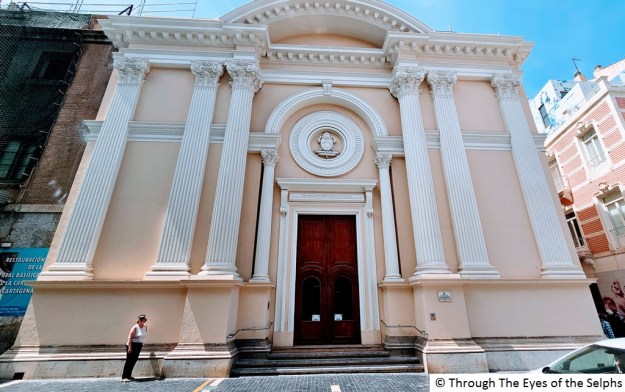
We also saw the beautiful The Royal Basilica of Our Lady of Charity is a neoclassical Catholic temple with a metal structure.
After visiting the fort we walked to the popular and pedestrian friendly street, Calle Mayor, in the heart of downtown and not far from the harbor. Closed to traffic, it is a very clean, picturesque area of stores and restaurants where people stroll along or sit at little sidewalk cafes enjoying coffee or a meal with pleasant sea breezes. Above the stores and restaurants are apartments and residences. The architecture is stunning.

Artificial Flowers Around the Town

Iglesia Castrense de Santo Domingo, a Catholic Church, built 1580

Gran Hotel from 1916

Battle of Santiago de Cuba was a decisive naval engagement that occurred on July 3, 1898 between an American fleet, led by William T. Sampson and Winfield Scott Schley, against a Spanish fleet. This monument is in commemoration of the Spanish losses.

After logging almost five miles, we returned to the ship. One thing we have noticed is the sidewalks in Spain are usually cobblestone, tile or marble. They can be slick and are definitely harder on the feet and legs. We had a great day and we would definitely like to return here again someday. 

Next up: Barcelona, Spain

Malaga, Spain May 3, 2023

Very early on May 3, just after midnight we began our passage through the Strait of Gibraltar. We went up on a top deck to see the lights of Spain on one side and Africa on the other. It was so windy I thought we were going to be knocked off our feet. We could see lights in the distance but unfortunately it was too dark to see the famous Rock of Gibraltar. We will have to save that for another trip.

Morocco to the South in Africa

Another Ship Headed for Malaga

After getting to bed shortly before 2:00 AM, we were up at 8:30 for breakfast. After nine days at sea, we arrived at the port in Malaga, Spain. Malaga lies on the southern coast of Spain on the Mediterranean Sea and is a beautiful city of just under 600,000, the sixth most populous in Spain. It is known for beautiful weather, with 300 days of sunshine a year. Malaga’s history goes back 2,800 years, making it one of the oldest continuously inhabited cities in Western Europe. Its most important economy comes from tourism, construction and technology. In recent years it has become a tech hub with a new large technology park.

Instead of doing a ship excursion, we decided to walk around and explore on our own. After exiting the ship we walked along the beachfront on a lovely pedestrian walkway that led to the town center.

In the old historic area we saw an ancient Roman theater dating to the 1st century B.C.

High above the ruins, on a steep hill overlooking the sea, is the Moorish Castle of Gibralfaro, built in the 11th century. Also is the dramatic LA Alcazaba, an old military fortification originally built to protect the city from pirates.

Malaga is the birthplace of Pablo Picasso and his birthplace is a museum. There is an additional museum of some of his work.

Next we saw the majestic Cathedral of Malaga, a huge Renaissance designed Catholic church built between 1528 and 1782.  There was a long line waiting to enter so we didn’t go inside.  

Of course no port stop is complete without a stop at the Hard Rock Café so Bill could add to his Hard Rock tee shirt collection.

We made our way back to the ship with just under seven miles logged on our watches. Sure felt good to sit down for a late lunch with lots of iced tea and water! 

With no sea days left and four more ports before we reach Rome, we have some very busy days ahead! 

Next up: Cartegena, Spain