We had not originally planned on visiting this national park, but after reading about it we realized we were about to miss a real treasure so we changed some reservations and altered our itinerary to allow us to spend a day and night in the park.
In 1851 Captain J. L. Stokes, while mapping the West Coast of New Zealand, sighted a huge mountain which he named Mount Cook after Captain James Cook. The Maori called the mountain “Aoraki” which means cloud piercer. In 1998 Mount Cook was renamed Aoraki Mount Cook to incorporate its Maori heritage. Aoraki Mount Cook is the only place to have its English name preceded by its Maori name.
Aoraki Mount Cook National Park became a park in 1953 and is 270 square miles, with 40% of the area glaciers. The park has 27 mountains with 140 peaks more than 600 feet high. Mount Cook at 12,316 feet is the highest in New Zealand. The park is a gorgeous combination of grasslands, huge river valleys, lakes and snow/glacier covered mountains.


Sir Edmund Hillary is New Zealand’s most famous New Zealander. It was at Mount Cook in 1948 that he climbed his first major mountain, including the difficult south face of Mount Cook. Hillary trained here for his Everest and Antarctica expeditions.
We splurged and stayed overnight at the Aoraki Mount Cook Village – Heritage Hotel with a breathtaking view of Mount Cook from the balcony in our room.


Before heading home the next day we decided to hike the Tasman Glacier Lake Trail which gave us a view of Tasman Glacier Lake with small icebergs. Our non-trusty tour book called it an easy 15 minute walk each way. When are we going to learn not to trust that book? The hike started out easy enough and we enjoyed meeting a couple from South Carolina along the way. About a third of the way up the trail we started to come to some rocks to climb on. Uh oh! The climb got steeper with a greater number of rocks. I do okay with steep trails, but I don’t do well with rocks. I would have never made it to the top without my walking sticks and Bill’s patience and helping hand. I felt like quite the wimp as young children sailed past me over the rocks and young people rerouted around me. By the time we got to the top I was sufficiently traumatized and stood frozen to the spot while Bill took pictures of the lake. The icebergs over the years have dwindled.
While Tasman Glazier is New Zealand’s largest glacier and icebergs periodically tear away from the face of the glacier into the rapidly growing lake, the effects of global warming and other climatic processes are taking their toll on glaciers. The Tasman Glacier is melting and calving at an exponentially increasing rate. In recent years the Tasman Glacier has changed from mainly melting to a calving (pieces breaking from the glacier) and melting resulting in a lake that is rapidly increasing in size.
After Bill enjoyed the view and I pondered how in the world I would ever get down, we began our descent. Did I mention we also had winds of around 30 mph during the ascent and descent? Actually the descent wasn’t nearly as bad as climbing up had been but I was relieved to see the car in view. This was my most difficult hike ever and I was proud of myself for doing it.


Some observations:
It feels strange seeing the leaves begin to change color and the farmers clearing their fields as autumn begins in New Zealand.
The drivers in New Zealand are very courteous. If you turn on your signal to change lanes they immediately back off and allow space for you. Merging is called “Zip” on traffic signs because you are supposed to merge alternating one lane at a time like a zipper.
Cost of living here is very high. There is a GST (Goods and Services Tax) of 15% added to all goods and services purchased in New Zealand.
There is no industry in New Zealand so everything is brought in. For example they ship their logs to Japan where they are made into paper products and shipped back to New Zealand. Products may be labeled made FROM New Zealand products but it doesn’t say made IN New Zealand. Everything in New Zealand is centered around farming and horticulture. One man Bill talked with said a Ford F150 pick up truck here would cost about $95,000 New Zealand dollars. The man has family in Dallas, Texas that he goes to visit and he said he is amazed how cheap everything is in America.
Category Archives: Geocaching
March 17, 2015 Christchurch, New Zealand
March 14, 2015 Nelson, New Zealand
March 11, 2015 Wellington, New Zealand
March 8, 2015 Napier, New Zealand
March 5, 2015 Turangi, New Zealand
Our next stop was Turangi, about a 45 minute drive from Taupo. We were glad we had timed our visit to Taupo just right since they were having an Ironman Marathon competition there that weekend and hordes of people were beginning to descend on the town, traffic was picking up and the hotels were all displaying No Vacancy signs. I had practiced a little driving while in Taupo and felt comfortable driving to Turangi. Along with driving on the wrong side of the road with the steering wheel on the right, the turn signals are on the right side of the steering wheel with up meaning left turn and down a right turn. The windshield wiper control is on the left side of the steering wheel. The lights on the right. My biggest fear are the round a bouts where you drive on the wrong side of the road going in a clockwise direction in a circle. Back in the States we drive in a counterclockwise direction.
We arrived in Turangi, a sleepy little town known as the “Trout Fishing Capital of the World”. It is known for three things: trout fishi white water rafting, and its close proximity to Tongariro National Park. Can you guess which of those three brought us to Turangi?
We checked into our home for the next two nights which was really a fishing lodge with several cottages spread around the property. We are no longer surprised to receive our complimentary bottle of milk (we always have a choice of whole or skinny). We were pleased with our cottage with a living room area, kitchen, bathroom and separate bedroom.
If you guessed Tongariro National Park as our reason for coming to Turangi, you are correct! Tongariro National Park is the first national park in New Zealand and the fourth oldest in the world. It is a Dual World Heritage Area because of its cultural and physical attributes. It is made up of three active volcanoes, Ruapehu, Tongariro, and Ngauruhoe. It is a 80,000 hecacre park with lava flows, craters, hot springs, forests, and ski areas in the winter. Much of the Lord of the Rings movie was filmed in this park. Mt Ruapehu is New Zealand’s largest volcano with its peak rising to 2797 meters and the largest ski area in New Zealand.
We knew that bad weather was forecast for the next day, so after settling into the cottage we drove part of the way to the park in hopes of getting some pictures of the mountains before they became fogged in the next day. We stopped at an overlook on the way back to grab a geocache and spent a few minutes chatting with some French tourists. We are surprised we have still not met any Americans.

By now we were getting hungry and since the restaurant choices were very limited in Turangi, we decided to stop by the grocery store. There was only one grocery store in town, a chain called New World. They proudly advertise themselves as being 100% New Zealand owned. We prefer Pak n Save since the prices tend to be a little cheaper, but the New World stores are always clean and the people very friendly.
We decided to get some bread, peanut butter and jelly to make sandwiches since eating lunch out was getting old and we needed to pack a lunch to take to the park the next day. We noticed you can buy sliced bread for sandwiches or thicker bread for toast. One of the first things we did after arriving in New Zealand was purchasing a large cooler and that has really come in handy as we travel from place to place.
The frozen dinner selections in New Zealand are extremely limited, no matter which store you go to. We settled on a frozen pizza to cook back at the cottage. I needed something to cook the pizza on so it wouldn’t make a mess in the oven, so I walked up to the office and asked the owner for a cookie sheet and a pot holder. He looked at me like I had three heads since he had no idea what I was talking about. After explaining why I needed them he went into his house adjacent to the office and after consulting with his wife he came out with something resembRings (LOTR) a cookie sheet and a dish towel. Guess they don’t use pot holders/oven mitts in New Zealand.
The next day we awoke to clouds and showers and drove to Tongariro National Park. New Zealand does not charge a fee to enter their National Parks. In return you are not furnished with free maps and information on the park like we receive in the States. We passed the beautiful Tongariro Chalet on our way to the Visitors Center. The rangers at the Visitors Center

were warning hikers about the forecast calling for heavy rain, cold temperatures and gale force winds, especially on the mountain trails which are famous for their hiking, one being the Tongariro Alpine Crossing. They had stopped running the shuttle that takes hikers to the beginning of the trails in an effort to discourage hiking that day. There were still some die hard hikers who failed to heed the warning and headed out. We contented ourselves with seeing two great movies about the park which explained how in 1887 Chief Horonwku presented the land to the Crown for the purpose of a national park to ensure the land’s everlasting preservation. This area of New Zealand was one of the last to be settled. Development was slow until the railroad reached there in 1909 and the first visitors began to arrive. In 1936 WWII servicemen settled in the remote valleys under a government program to transform the forest into farmland. Though initially prosperous, the farmers eventually gave up due to difficult access for trading and the Great Depression. A bridge called “The Bridge to Nowhere” is a memorial to their dreams. Development began to mushroom in the 1950’s and 1960’s with the building of roads.
After finishing at the Visitors Center we decided to drive the loop road around the park and do some geocaching. We had hoped to take some short hikes, but by now the rain had picked up and the wind was really whipping. With temperatures around 50, not factoring in the wind chill, any hikes were unpleasant. The rain did let up long enough for us to take a short hike to Tawhai Falls and we did stop a few times to grab some geocaches close to the car. With the rain and fog we didn’t have a chance to see much except for field after field of sheep. A lot of sheep! By the time we headed home the rain had turned into a steady downpour. We stopped for a quick dinner at a pub and were glad to get home, somewhat wet and cold.


Some more thoughts on food:
If you want a burger most like back home go to a fast food restaurant. All larger towns have a McDonald’s or a Burger King or both. Wendy’s is most like back home but they are harder to find. If you order a burger in a sit down restaurant it is standard for it to come with an egg, beets, carrots, lettuce, tomato and onion all piled on top. If you ask, they will leave off the egg and beets, but we went in one restaurant where the snarly waitress told Bill that is the only way they fix it and told him to order something else. That kind of rudeness is rare here. Most people are eager to please and helpful.
I am supplementing my diet with shortbread cookies, but I am getting tired of them. They have never heard of White Zinfandel wine here so I have adjusted to drinking Rose and it isn’t bad. Wouldn’t you know my one positive adjustment was wine? And I don’t drink that much.
Bill’s biggest adjustment was the coffee. Both the price and the weak taste. He finally decided to buy some instant coffee at the grocery store and uses the pot furnished in all the hotels to heat water. American beer is also ridiculously expensive here or not offered.
Since we have no way to keep ice cream in the tiny freezers, we have broken our habit of eating ice cream at night. Just as well since the ice cream here isn’t as good as back home. There are no donut shops in New Zealand. They have bakeries but things taste different. I think it is the flour. French fries are always good and mashed potatoes are always fresh, never instant.
Some observations:
The government wants to make the country completely smoke free which makes the tourism industry very nervous because they feel it will keep tourists from coming.
Gasoline is averaging about $1.92 a liter. Half of the money goes back to the government. We got a free card from BP which gives us a few cents off at the pump and gives us more money off as we add up points from purchasing fuel. There is no pre-pay at the pump. You pump your gas first and then go inside to pay.
No 7/11 convenience stores here. They have something similar throughout the country called “The Dairy”.
March 3, 2015 Taupo, New Zealand
We drove the Thermal Explorer Highway from Rotorua to Taupo, occasionally seeing steaming vents puffing steam from deep inside the earth amid the scenic farmland. It was easy to see all around us where the land had been pushed up leaving tall pointed hills. After about an hour drive we entered Taupo, a beautiful town hugging the shoreline of huge Lake Taupo. With many shops and restaurants lining the shoreline, this town
appeared more like a resort town.We stopped for lunch and parked in a P60 space (60 minute limit). We noticed what appeared to be sensors in the asphalt under each car. We surmised these must be a kind of device that keeps track of how long you have been in that parking spot.
For the first time since we arrived in New Zealand we saw several souvenir shops. We did not see any in Thames and Rotorua only had one.
We checked into our motel with a small fridge, microwave and private patio with table and chairs where we could sit in the mornings or afternoons and relax with coffee or a drink. No plunge pool. Once again we were given a container of milk for coffee or tea, so Bill uses it for his cereal.
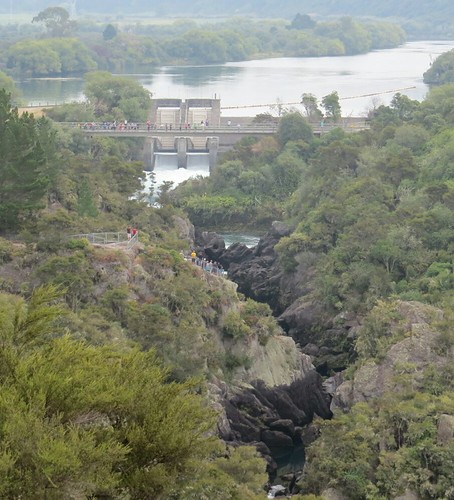
While in Taupo we visited the Aratiatia Rapids. This once natural whitewater gorge was damned up behind the gates of the Aratiatia hydro-dam. Due to public outcry over the loss of the rapids, four times a day the floodgates are raised and a torrent of river water rages again through the Aratiatia gorge. Beginning eight minutes before the gates are 

raised and at two minute intervals, bells and whistles sound. We had a choice of three viewing platforms and chose to hike to the highest one. We arrived early enough to grab a geocache close by the viewing platform. Bill showed a family walking nearby with small children the geocache and explained geocaching. The parents were intrigued and the children thought it was really neat! By the time the gates were raised all three viewing platforms were full of observers.

Also while in Taupo we visited Huka Falls. This is advertised as one of the most beautiful tourist attractions in New Zealand. The Falls are a 100 meter basalt crevice channeling the Waikato River over a 15 meter ledge. The falls were lovely though we felt the viewing areas did not provide a really great view of the falls. The water flows through the crevice or channel at 62,000 gallons per SECOND!
Our last day in Taupo we spent geocaching. We searched the geocaching.com site and chose several caches where people had given the caches many favorite mark. We have found that geocaching in new places takes us to beautiful areas we would not ordinarily know about and see. And this day did not disappoint with two geocaches that led us to a cave and one with a beautiful view of Lake Taupo.

Some observations:
Tipping is not expected and the service reflects this. Once your order is taken and your food delivered, you never see the waiter again. No one checks to see if you need anything or if you like your food. If you need something you flag a waiter down. We learned after waiting for our check a couple times that your check is not delivered to the table. You go inside to the register and they ring up the bill.
Salad and bread is never provided with your entree. They are separate items on the menu.
When you order water with your meal it rarely has ice and they give you a decanter since they won’t be coming back!
If you order a burger and it says it comes with a salad, the salad is the lettuce and tomato on the burger. After waiting a couple times for the salad that never came, we figured it out.
If you order a side salad with your entree it is delivered with the meal, not ahead of time.
The mattresses are on the floor. There is no space between the box springs and the bed.


March 1, 2015 Rotorua, New Zealand
February 28, 2015 Karangahake Gorge, New Zealand
We left Thames and headed to Rotorua (Row-toe-roo-a). Along the way we stopped at Karangahake Gorge. Here the Waitawheta River charges out of its steep rocky canyon
and merges with the Ohinemuri River. Almost all the names of streets, road, cities and towns and geographical places are named by the Maori people. Generations ago canoes of Maori ancestors sailed from East Polynesia and landed in New Zealand. Due to mixed marriages there are now very few Maori of pure Maori descent in New Zealand.
Here at the Karangahake Gorge we elected to do the Windows Walk which took us over two swinging bridges, up many many steps, and through tunnels which required 

flashlights which fortunately we had brought from Phoenix. The mine tunnels had a series of openings or windows which looked down at the remains of the batteries and river below. Panels along the path told the story of how over 100 years ago gold was mined in this area. Gold was extracted from quartz ore and was the nation’s third largest and most productive quartz gold mine. An incredible four million ounces of gold
was removed from this area.
After our hike we stopped to view Owharoa falls then we continued on to Mt Maunganui
which is really a lovely and popular beach town in the shadows of Mt Maunganui, an extinct volcano. This seemed much like a California beach town with many shops and
restaurants as well as sun worshipers. We saw people making the long trek up to the top of the volcano for the
view of the town below, but we found people watching more entertaining. On this day they were having youths between the ages of 10 and 14 competing in an ocean lifeguard event. All of the youth had qualified to be lifeguards and this competition was to recognize the best of the best. We chatted with one of the mothers of the competitors and she said that since New Zealand is surrounded by water, children train at a young age to be lifeguards since they are in high demand.
Some observations:
Everything in New Zealand is metric so we are having to refresh our knowledge of the metric system.
A “track” is a walk and a “tramp” is a hike and expect some challenging terrain.
A “torch” is a flashlight.
A large pizza and a large coffee is the size considered medium in the U.S.
New Zealand does not have many traffic lights or stop signs. Instead there are round-abouts everywhere. Bill loves them and I hate them.
All the beef used in fast food restaurants is 100% New Zealand beef and it is really good.
The New Zealand people are friendly and eager to help. They are curious about where we have been and where we are going in their country. Strangers say hello and wish you a good day.
February 27, 2015 Thames, New Zealand
We left Auckland and headed toward the town of Thames ( pronounced Tims). Along the way we drove to the Coromandel Peninsula. This stretch of scenic highway is considered one of the best on the North Island. The road hugs the coast of the Firth of Thames (a bay) and has narrow roads and several one lane bridges with signs telling you which side has to “give away” (yield). We passed through one particularly harrowing stretch of road that was extremely narrow and we wondered what would have happened if we had passed one of the many large trucks traveling the road.
We stopped along the way at a rest/camping area and talked awhile with a New Zealand couple camping there in their camper van. They owned their camper van but this also 
seems like a popular way for tourists to travel in New Zealand since they are readily available for rent. New Zealand is very friendly to campers and there are several options available with campgrounds as well as places you can camp for free for two nights. This couple was staying in a free two night area near the water where they could swim and fish. We seriously considered this option when planning our trip but decided to go the rental car/hotel route.
We arrived in Thames for a two night stay. We usually do not do bread and breakfast places, but this place had excellent ratings and private chalets. We were greeted warmly by the owner and given homemade shortbread cookies and a bottle of liqueur. We loved our little chalet which was bigger than a hotel room and had a small fridge, microwave and hot plate/convection oven. We had access to the hot tub steps away from our chalet and the use of their large barbecue grill. We certainly enjoyed relaxing in the hot tub and watching the sun set over the Firth of Thames.
The new day we drove to Cathedral Cove and Hot Water Beach. Cathedral Cove is known as the most beautiful small beach on the North Island. We were lucky to find a
parking spot in their very small lot and walked around admiring the beautiful views. It is possible to hike from the parking lot down a very long steep path to the beach, but on this hot day we decided to pass on the hike and admire the beauty from afar.
Our next stop was Hot Water Beach. This is one of the North Island’s biggest tourist attractions. During low tide scalding hot water pulses out of the sand. You can rent a shovel and dig yourself a spot to make your own spa pool. All this must be done within

two hours of low tide and since low tide was 9AM and 9 PM we missed it. Somehow knowing we had a nice clean hot tub waiting for us at the chalet made the thought of wallowing in hot mud less attractive anyway. 


Some observations:
A car park is a parking lot.
The New Zealand sun is very intense and hard on fair skin. It is possible to get a sunburn through the car window and 50 SPF doesn’t help much.
The New Zealand currency is much like the U.S. dollar in some ways. They have coins for one and two dollars instead of paper. The smallest coin they have is 10 cents so if you purchase something and need change less than ten cents they keep the difference. Hey! That adds up!
The days here are 13 hours long.
Bill says the coffee is not very strong.
Living out of a suitcase and moving every two or three days has its challenges. If I had 10 cents for every time we said “I can’t find” or “do you know where….”, I would have enough money to buy me one of those $4 cans of Diet Coke!
A note on immigration. The government here makes it very hard to immigrate to New Zealand. Before we boarded the plane the airlines made it clear to everyone boarding the plane that you better have proof of a return ticket when you got to Customs in New Zealand. When we arrived they did ask us how long we were staying and we signed a customs form declaring that to be true. They did not ask us for any proof.