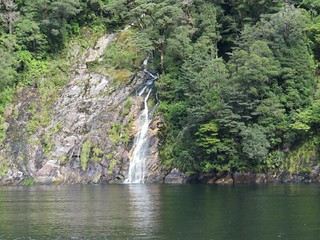
Category Archives: Waterfalls

waterfalls

Sept 8, 2016 Seneca Falls, NY

Thursday morning we left the Adirondacks and headed west to Seneca Falls, population 6,700. We thought it was going to be a short three night stop on our way to Niagara Falls without much to see or do. Boy were we wrong!!
We camped at Cayuga Lake State Park near beautiful Cayuga Lake, one of the longest of the Finger Lakes. During the past million years, glaciers covered New York state. As they moved through river valleys they carved deep troughs with steep sides. When the glaciers receded about 10,000 years ago, water filled these troughs, creating eleven Finger Lakes. Cayuga Lake is thirty-eight miles long and 435 feet deep at its deepest spot. Cayuga Lake is named after the Cayuga Indians, one of the Six Nations of the Iroquois in New York.
20160909_110825
I was looking through some literature about the area and came across Watkins Glen State Park about thirty minutes from our campground. I read that in 2015 it was voted the third most beautiful state park in the country in a USA Today poll. All the reviews I read talked about a gorgeous 1.5 mile (three miles roundtrip) hike with 832 steps and nineteen waterfalls. We both love waterfalls so even though the 832 steps seemed a bit daunting, we decided to give it a try.20160909_111629
20160909_093118We headed out early Friday morning. On the way to Watkins Glen we came across a plaque in the small town of Waterloo. We had no idea that Waterloo, NY was the official birthplace of Memorial Day, with the first ceremony held in 1866. Some of the interesting things we just happen to stumble across is amazing to us. 20160909_093044We drove beside Seneca Lake, the largest of the Finger Lakes and the deepest lake in the state.
We didn’t realize that the town of Watkins Glen is renowned for auto racing and is considered the birthplace of American racing.   Since 1948 Watkins Gen has hosted international automobile car racing and in 2015 was voted the best NASCAR track in the country in a USA Today Reader’s Poll.  The town has an International Motor Racing Research Center with 5,000 square feet of racing history.  From April through September they host NASCAR sports car and racing events. This weekend was the U.S. Vintage Grand Prix and as we drove down Main Street they were getting ready to close off the street for a parade. To our dismay we discovered that even though the state park was open, the parking lot was closed. We asked where we could park and they said our only option was to find a parking lot or side street parking, which seemed highly unlikely on a parade day in a tiny town. Across the street from the park was a restaurant and Bill decided to go inside and ask if we could park in their restaurant parking lot for a few hours. I told him there was no way they would allow that on parade day. We pulled into the lot and I stayed with the car while he went inside to ask. He came back a few minutes later and said the owner said no problem and refused to take any money. Yeah!!
We grabbed our walking sticks and headed over to the entrance. We had an idea what was ahead when we saw a beautiful waterfall at the entrance. This park certainly lived up to its #3 best ranking. Everywhere we looked there was beauty. We were apprehensive about the steps but they were nice stone steps put in years ago by the CCC and easy to climb. I had worried they might be uneven and slick, but no problem. The hike on the Gorge Trail was not tiring at all because we were constantly stopping to gaze in wonder and awe at the beauty. We followed the gorge trail as it wound over and under waterfalls.20160909_11111420160909_11403320160909_11431820160909_11592220160909_12072320160909_12192020160909_12201920160909_12264920160909_11234620160909_135502
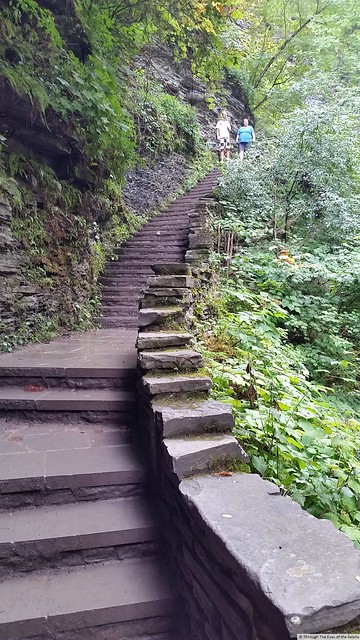
At the end we walked up the last of the stairs which were steel steps called “Jacob’s Ladder”. Once at the top we could either walk back down the 832 steps or take the easy “Indian Trail” back. We chose the easy hike and once we were back to the car we put our hiking gear away and decided to go into the restaurant for a late lunch. We thought it was a small way to thank them for letting us park in their lot. Bill had lunch and I had a big slice of fresh blueberry pie! On the way home we took a different route and followed Cayuga Lake seeing wineries along the lake.20160909_154053
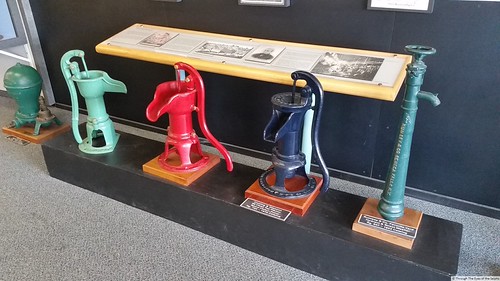
20160910_14073820160910_142224On Saturday we decided to spend our last day in Seneca Falls exploring the small town and finding some geocaches. First we stopped by the town Visitors Center which had a fantastic museum detailing the history of the town. European settlers first moved to the area and began farming. In the 1820’s the construction of the Erie Canal changed Seneca Falls to an industrial and shipping center. We were surprised to see all the items designed and manufactured there from water pumps, TV picture tubes to wooden rulers.20160910_13314820160910_13425520160910_13505320160910_140408
20160910_150328Seneca Falls is the birthplace of the Women’s Rights Movement led by resident Elizabeth Cady Stanton. The first women’s rights convention was held here on July 19-20, 1848. Today there is a Women’s Rights National Historical Park, established in 1980, in the middle of town. We stopped by the park, saw a film and looked at the exhibits. Amelia Bloomer, for whom bloomers were named, lived in Seneca Falls. She didn’t invent bloomers but wore them and promoted them in magazines.20160910_15050020160910_150738
20160910_14312620160910_143112Our last stop of the day was at the “It’s a Wonderful Life” museum. In 1945 Frank Capra stopped by Seneca Falls to get a haircut on his way to visit his sister. It is said that he was so taken with the quaint little town that it was his inspiration for the fictional town of Bedford Falls in the famous Christmas movie. There are several similarities between Seneca Falls and the fictional Bedford Falls, including they are both mill towns, had a grassy median down Main Street, homes of Victorian architecture, a large Italian population and a toll bridge. The free museum opened in 2010 and is full of memorabilia from the film that fans have donated or loaned to the museum. We were the only visitors there when we stopped by and enjoyed talking with the guide who obviously loves the movie. He said he has lost track of the number of times he has seen it. Every year in December they celebrate with a parade and all sorts of events. This year will be a big celebration since it is the 70th anniversary of the movie.20160910_144641 20160910_14471220160910_14474820160910_142407The guide so enthusiastically described the upcoming celebration it almost made me want to brave the snow to attend. Almost, but not quite!
Yes, tiny Seneca Falls far exceeded our expectations. We could have stayed a couple more days but Niagara Falls was calling!

Sept 6, 2016 Ticonderoga, NY

20160906_14423220160906_10033920160906_103144Our time in the Adirondacks was drawing to a close so on Tuesday we traveled to nearby Ticonderoga where Bill was ecstatic to visit the newly opened Star Trek: The Original Series Set Tour.  The sets, under license by CBS Consumer Products, recreated the sets of the Starship Enterprise as they were laid out at Desilu Studios Stage 9 in Hollywood.  Visitors are transported back to 1966.  Bill is a huge Star Trek fan and loved touring this set.  He didn’t know that Lucille Ball was instrumental in getting Star Trek on the air when she agreed to film the series at Desilu Studios.20160906_10111220160906_10121420160906_10143120160906_10163120160906_10253420160906_10275820160906_114618
20160906_115101Next we went to Fort Ticonderoga which played an important role both in the French and Indian War and the Revolutionary War.  It was originally built by the French in 1755 and called Fort Carillon.  Located a the southern end of Lake Champlain, it was captured by the British in 1759 and named Ticonderoga, an Iroquois name meaning “it is at the junction of two waterways”.  In 1775 Ethan Allen and his Green Mountain Boys along with Benedict Arnold took the fort from the British in a surprise attack during the Revolutionary War.  This was the first victory of the Revolutionary War.  The cannons from the fort were taken to Boston and helped persuade the British to evacuate Boston in 1777.20160906_11443920160906_11470620160906_12225020160906_12270720160906_122723
20160906_12395720160906_124005The British abandoned the fort in 1781 and it was looted for stone, metal and wood by settlers looking for material to build homes.  In 1785 the fort’s lands became the property of New York state who then donated the property to Columbia and Union colleges in 1803.   In 1820 the fort was sold to William Ferris Pell who first used the property for a summer home.  When more and more tourists came to the Adirondacks, he converted his home to a hotel.  In 1909 the Pell family restored the fort and opened it to the public.  The fort is now maintained by the Fort Ticonderoga Association, a not for profit organization.
We enjoyed touring the fort, soaking up the historical significance of the events which took place here.  It was somewhat disappointing to discover the original fort was wooden, not the stone structure of today.  We asked about this and it was explained that the fort was in such poor shape that only the stone foundation remained, leading the Pell family to mistakenly believe that the entire fort was stone.  It was also pointed out that a member of the Pell family was related to a stone mason so they were able to get stonework done easily and cheaply.
20160906_14422420160906_145725As part of our admission we were given access to Mount Defiance, an 853 foot high hill on the New York side of Lake Champlain.  In the 1777 Siege of Fort Ticonderoga, the British army placed artillery on Mount Defiance, causing the Americans to withdraw without a fight.  The Americans had mistakenly thought the hill to be inaccessible and never fortified it.

World War II Navy aircraft carriers were named after Revolutionary War victories: Lexington, Ticonderoga, Saratoga and Yorktown.
20160906_152522On the way home we stopped to find a geocache.  The short hike led us to a peaceful little waterfall.  We love it when geocaching takes us to such beautiful places we wouldn’t otherwise find.
We enjoyed our time in the Adirondacks.  We were glad to see Labor Day end and with it all the summer tourists.  The campground is now quiet and peaceful once again.  Ahhhhhh!
Next stop:. Seneca Falls, New York


July 30, 2015 Mammoth Hot Springs, Yellowstone N.P.


IMG_20150730_153826

IMG_0616With only two days left in Yellowstone we still had the northwest section of the park to explore.   one of those days we drove to Mammoth Hot Springs.  The road to Mammoth was undergoing extensive road work with signs warning of up to 30 minute delays.  We were lucky and only had about a fifteen minute delay going and no delay returning home.

IMG_0696

Liberty Cap, named after the French tall cap

Mammoth Hot Springs has mineral laden hot water from deep within the Earth’s crust which finds its way to the surface and builds beautiful tiers of cascading, terraced stone.  Hot water and gases ascend through limestone deposits, sculpting the rock.  Once exposed to the air, calcium carbonate from the limestone is deposited as a rock called travertine.  These hot springs do not erupt but instead build these spectacular terraces.  The terrace sculpting has been going on for thousands of years as thousands of gallons of water well up and deposit large amounts of travertine, or limestone, daily and as quickly as three feet per year!

We walked along the Hot Springs Terraces Walk, a boardwalk which led us around the terraces and hot springs.IMG_0704IMG_0711IMG_0700

We then drove the Upper Terrace Drive, a road that gave us a perspective from atop the terraces.IMG_0724

IMG_20150729_120532Mammoth Hot Springs is where the Yellowstone park headquarters is located and it has a village of stores, gift shops, a Visitors Center and a couple restaurants.  In the early days of Yellowstone National Park’s existence the park was protected by the U.S. Army from 1886 to 1918. From what you might wonder. From people damaging the geothermal areas and other land and hunting the wildlife.  The original buildings of Fort Yellowstone such as the guardhouse, jail and soldiers’ barracks are preserved and still standing in Mammoth Springs today.

IMG_0717

Fort Yellowstone is the red top buildings in the background

Here is a video showing the water flowing down the terrace:

While in the area we drove the short distance to the north entrance of the park where the Roosevelt Arch is located.  The beautiful arch was constructed under the supervision of the U.S. Army at Fort Yellowstone.  The cornerstone was laid by President Theodore Roosevelt in 1903.  The top of the Arch is inscribed with a quote from the Organic Act of 1872, “For the Benefit and Enjoyment of the People”.IMG_0689IMG_0690

July 27, 2015 Canyon, Yellowstone N. P.

IMG_0657Our last four days in Yellowstone were scheduled to be dry camping at two campgrounds in the park.  But very unseasonably cold weather with nightly temperatures around 30 degrees and my being on medication for shingles convinced us we needed to look for some place else.  The only full hookup campground in the park was booked solid.  Bill found a national forest campground near the small town of West Yellowstone located right outside the west entrance of the park.  The campground had a small number of nonreservable electric sites available on a first come basis.  We got up really early and drove to the campground where we waited for someone to leave so we could grab an electric site.  By 10:00 AM we were all set up in our new site.

When the doctor gave me the pills for shingles she was five pills short and neither of the other two clinics in the park had pills for me.  She gave me a prescription so we headed into West Yellowstone to have the prescription filled.  Not much to say about West Yellowstone except it has a very nice Visitors Center with friendly helpful volunteers, a couple food markets, a few gas stations, one pharmacy, a McDonalds and several hotels, restaurants and gift shops.  Typical tourist town.

By the time we got back home a cold steady rain was falling and the temperatures were in the upper 40’s and falling.  I made some chili and we stayed inside where we were warm and very very thankful to have heat and electricity.  The next few nights the temperature dipped to near freezing.  This campground made for a bit longer drive back into the park to do activities, but it was well worth the extra drive.

IMG_0656Yellowstone National Park has geysers and wild animals and gorgeous scenery.  Would you believe on top of all that it also has a grand canyon?  I kid you not.  It is called The Grand Canyon of the Yellowstone River and it is a beauty!  The canyon is from a lava flow 484,000 years ago.  It is mainly made of rhyolite rock.  Past and current hydrothermal activity weakened and altered the rock, making it softer.  The Yellowstone River eroded these weakened rocks to deepen and widen the canyon, a process continuing today.  The canyon is 20 miles long, more than 1,000 feet deep, between 1,500 and 4,000 feet wide and has two beautiful waterfalls.IMG_20150730_130825IMG_0652

IMG_0666

Lower Falls

IMG_0659

Upper Falls

It took us several days of driving and walking quite a few trails to see the canyon and waterfalls.  One end of the canyon begins at the 308 foot tall Lower Falls which may have formed because the river flows over volcanic rock more resistant to erosion than rocks downstream.  The same is true for the 109 foot Upper Falls.IMG_0653IMG_0667IMG_0678IMG_20150730_130729

IMG_20150726_133631

Brink of the Lower Falls

We walked trails that led us to the brink of both the Upper and Lower Falls.  The Upper Falls trail was easy but the Lower Falls trail involved a steep drop with thirteen switchbacks.  Going down was easy but coming back up was….well you can imagine.  Luckily it was a cool day with a nice breeze and they had benches along the trail to rest.  It was a great view and workout!  There is a viewpoint on the South Rim called Artists Point with gorgeous views of the Lower Falls and the canyon.  The weather was overcast while we were at Artist Point but Bill still got some great pictures.

The North Rim side of the canyon has a 1.2 mile drive with multiple stopping points along the way with amazing views of the canyon.

We took a longer hike on the South Rim Trail which led us along the canyon rim with views of the canyon and both falls.  At one point we came to a great view of the Upper Falls.  I love how there always seems to be a rainbow!  We stood at the overlook and enjoyed the view while talking with a family from Holland who was spending their summer touring the West in their rented RV.IMG_20150730_141027IMG_20150730_140810IMG_20150730_140128IMG_0654

Every day there seems to be more and more to love about this wonderful park.  What an amazing place!!

July 22, 2015 Fishing Bridge, Yellowstone N.P.

We made the hour drive from Grant Village to another campground in Yellowstone in an area called Fishing Bridge.  This is the only full hookup campground in Yellowstone.  By the time we arrived I had a bad headache and didn’t feel well.  Three days earlier I noticed four blister like places on my lower back.  It had the appearance of poison ivy or bug bites, and even though we couldn’t imagine how I got poison ivy or bites there, we didn’t pay them any attention.  After setting up, since the blisters hadn’t gone away and I was not feeling well, we decided to visit one of three medical clinics located in Yellowstone National Park.  Fortunately one of the clinics was a short drive from our campsite.  The diagnosis was shingles, certainly not what we wanted to hear and very surprising.  The doctor put me on 800 mg of Acyclovir five times a day for seven days.  The doctor said she thought it had been caught early but she had no idea whether I would have a full blown outbreak or if the medicine would lessen the severity of the shingles.  We were prepared if necessary to abandon our Yellowstone plans if the outbreak was severe and I needed to be in a town with doctors and stores with supplies.  As it turned out I was very blessed.  One more small blister appeared and that was it.  I was uncomfortable but it was tolerable.  I cannot imagine the agony someone with a full outbreak must endure.

The next day it rained and we stayed home resting and relaxing.  My mind played tricks on me and every time I had an itch I would run to Bill so he could check my back for a new blister.  And every time I felt great relief when he said nothing new was there.

IMG_20150725_142314This post will focus on the animals we saw during our time in Yellowstone.  Since my shingles was under control and I was feeling better, we decided to take a short hike to Natural Bridge.  The signs warned of bears and suggested walking in groups.  We had our trusty whistle, just in case.  Along the way we saw many places where bears had sharpened their claws and marked their territory on trees.

The hike to Natural Bridge was supposed to be short but we took a wrong turn and ended up on a longer trail that took us to the top of the bridge.  The trail became very steep with several switchbacks.  The trail had small gravel that feels like walking on marbles when descending.  I

hate those kinds of

PANO_20150725_134423

Natural Bridge looking down to the trail below

IMG_20150725_140137trails!  Along the way we met a very nice IMG_20150725_140040couple visiting from England and we enjoyed chatting with them while we stopped to catch our breath.  An older lady was trying to make her way down the steepest part of the trail with walking sticks.  We stopped to wait for her to pass and she apologized for holding us up and commented that her walking sticks were not helping.  Since we have walking sticks, Bill asked if she would like him to show her a different way to hold and use them.  He showed her the correct way to hold them, and right away she could feel the difference and felt so much more confident walking on the trail.  She was so happy and as she walked past me she told me how wonderful my husband was for helping her.  Bill is an Eagle Scout and lives by their motto of “Do A Good Deed Every Day”.  We reached the top of the bridge and enjoyed the view, snapped some pictures and began the hard descent down.  When we reached the bottom we saw the shorter trail that led to the view of Natural Bridge from below.  Natural Bridge is a 51 foot cliff of rhyolite rock cut through by Bridge Creek.  In the end we were glad we took that harder trail because we met a nice couple from England and helped the lady with her walking sticks.  It was all good!

Rangers in the park refer to traffic jams by the animals that cause them.  So there are bison jams, bear jams, elk jams, moose jams etc.  Whenever you see traffic stopped or slow moving, it is most likely to be from an animal jam.IMG_0581

IMG_0583There are between 2,300 and 5,000 bison living in Yellowstone.   We got caught in a huge bison jam one day while heading to Hayden Valley which is known to have a lot of wildlife.  We passed through at the time of day a large number of bison were crossing the road to get to the river.  Traffic slowed to a halt or slow crawl as bison blocked the road or people gawked at the bison along the side of the road, everyone trying to get that perfect picture.  At one point we shut off the car engine and just waited.  No worries.  We had plenty of time and enjoyed watching all the bison around us.  Much later in the day we passed through the area again and most of the bison were gone.  One lone bison slowly sauntered down the middle of the road blocking our lane of traffic.  There was nothing to do but follow him and wait for him to move.  He was headed home after a long hard day entertaining crazy tourists.  We had about ten cars in front of us and traffic was piling up behind us.  One driver behind us blew his horn.  He was too far away for the bison to care and just annoyed others patiently waiting.  He is the kind of tourist who should never come to Yellowstone in July.  Eventually, when the bison was good and ready he left the road and wandered up the hillside and began grazing and we were once again on our way!  We have already posted lots of bison pictures in previous posts so we won’t post too many here.IMG_0572IMG_0573IMG_0579IMG_0585

IMG_0591We stopped at Tower Falls and while we were there a small bear walked across the patio area of the gift shop/general store.  A dog barked, scared it and it ran off into a grassy area.  The grass was so tall we could barely see him, not close enough to get a picture.  Later in the day we came upon a bear jam with a mother bear and her cub digging up and eating grubs along the side of the road.IMG_0617IMG_0624

A smaller pronghorn jam occurred later.  Pronghorn are similar to antelope.IMG_0598IMG_0599IMG_0602

We created our own bald eagle jam.  Bill spotted a bald eagle perched on a rock.  Another eagle circled overhead.  As cars noticed us stopped and Bill with his camera, more cars stopped and pulled over.  Before long we had an eagle jam!IMG_0603IMG_0613
During our time in Yellowstone we also saw elk, moose and even a beaver!
IMG_0588

IMG_0729

This beaver was shy!

IMG_0725

Gibbon Falls

IMG_0727

Gibbon River


June 24, 2015 Sundance, Wyoming

After twelve days we left South Dakota and headed to Wyoming. We enjoyed our time in South Dakota but sure experienced some scary weather there. On our next to the last night in South Dakota we were hit with another frightening thunderstorm with winds over 45 mph, lightning, heavy rain and even more hail than we had in the Badlands.

IMG_0249We arrived in Sundance and checked into a nice campground. Wyoming is the least populous state in the country with approximately 544,270 residents spread out over more than 97,000 square miles. It is nicknamed “The Cowboy State” because of the estimated 11,000 farms and ranches. The Black Hills are 90% in South Dakota but this small area of northeast Wyoming, including Sundance, in part of The Black Hills. Our main reason for stopping in Sundance was to visit Devils Tower National Monument. This granite formation rises 1,267 feet from the prairie and has hundreds of parallel cracks making it one of the finest traditional rock climbing areas in North America. The site is sacred to the Lakota and other tribes. Legend has it that the rock rose up just in time to save seven young Indian girls from a bear and the rock rose higher and higher out of reach of the bear. The marks on the tower were caused by the bear’s claws. The girls were pushed up into the sky where they became seven stars (the Pleiades constellation).IMG_0250IMG_0248

The Devils Tower was proclaimed the first national monument in 1906 by President Theodore Roosevelt. Devils Tower is best remembered as the one of the sites in the 1978 Spielberg movie, “Close Encounters of the Third Kind”. I had never seen the movie and as luck would have it the campground office had it for rent so we watched it before going to see Devils Tower.IMG_0252IMG_0253

We walked the Tower Trail that circles the tower where you can see rockfalls of gigantic columns that have fallen. Devils Tower is 1,000 feet in diameter at the bottom and 275 feet at the top.  It was formed 40 million years ago when a column of molten lava pushed through the limestone.  As the rock cooled, it fractured into vertical columns.  The limestone eventually eroded away revealing the towering formation seen today.  It is a wonderful example of erosion.

After leaving Devils Tower we drove to Aladdin, population 15. Yes, you read that right. Population 15. The town is currently for sale if you want a town.IMG_0256

IMG_20150625_151142Sundance, population 1,182 is the largest town in the area. In 1879, Albert Hoge, a Prussian born immigrant staked his claim and named the town Sundance in honor of the “sun dance” performed by the Native Americans.  Perhaps what Sundance is best known for is the Sundance Kid, friend of Butch Cassity. The Sundance Kid, born Harry Alonzo Longabaugh, got his start as an outlaw when he stole a horse, gun and saddle. He spent the next eighteen months in the Sundance jail, earning him his name.  Outside the former jail is a statue of the Sundance Kid lounging in his cell. Not many towns have a statue of a horse thief and notorious bandit as the focal point of their town!

IMG_0261We drove to Belle Fourche (pronounced “Bell Foosh”) which is located in southwest South Dakota and therefore a closer drive from Sundance than from the Badlands. We came here because there is a Center of the Nation Monument in the shape of a compass rose carved out of South Dakota granite.  We were the only ones there at this 21 foot in diameter monument surrounded by the flags of all 50 states.  We love geographical places like this even though the real geographic center is located twenty miles north of Belle Fourche on private property.  IMG_0257This is the geographic center of the United States if you include Alaska and Hawaii.  It was interesting to read that when Alaska was admitted to the union the geographic center shifted 439 miles northwest and when Hawaii was added it shifted 6 miles west-southwest.  Along with the monument was a nice visitors center and an original 1876 log cabin from the gold rush days.  The cabin was hosted by an elderly gentleman, a Korean War Veteran, and since we were the only ones there he had plenty of time for us.  We certainly enjoyed spending time talking with him about the area and we found a geocache behind the cabin.IMG_0259IMG_0260

IMG_20150627_122423While we were in Sundance the ARRL (American Radio Relay League) was having their annual Field Day.  For 24 hours amateur radio operators contact as many other amateur radio operators around the world.  It is a popular contest and challenge among amateur radio enthusiasts.  An AARL group was getting together in the small town of Upton about thirty miles from Sundance so Bill drove over and spent some time with them.  He had a great time talking with fellow amateur radio enthusiasts!

On our last day in Sundance we drove the Spearfish Canyon Scenic Byway which took us briefly back into South Dakota.  We stopped at two waterfalls, the only waterfalls we saw in South Dakota.  The Spearhead Falls was especially beautiful and had a cool refreshing mist blowing on us from the falls.  The sign said Spearhead Canyon was older than the Grand Canyon.IMG_0273IMG_0277IMG_0271

IMG_0280We drove through Deadwood, a western town much like Tombstone, Virginia City or any other tourist attraction with fake gunfights and plenty of places to spend money.  Wild Bill Hickok was killed here in Saloon #10 and is buried in a cemetery nearby.

IMG_0286Before heading back over the border into Wyoming we drove through Sturgis, famous for one of the largest annual motorcycle events held in the world.  Motorcycle enthusiasts from around the world come here in August.  This year will be the 75th anniversary.  We heard the tiny town makes 90% of their income for the year during that one week in August!  The streets were relatively quiet and we could only imagine what the town is like during that week in August!

April 11, 2015 Hamilton, New Zealand

We enjoyed our stay in New Plymouth regardless of the rainy weather.  Our last night there Bill was able to connect with some Kiwi ham radio operators on his hand held ham radio he brought with him.  He really enjoyed chatting with them.

The next morning the rain continued and we drove to Otorohanga for an overnight stay on the way to Hamilton.  We don’t usually stay at bed and breakfast lodgings, but this place had excellent reviews and the choices in tiny remote Otorohanga were very limited.  This bed and breakfast was located in the countryside and the proprietors had chickens, horses, a donkey, dog and cat.  We had a nice room with an outside entrance and private bath.  Breakfast was included in the price of the room so the next morning Bill enjoyed Eggs Benedict made with fresh eggs and I chose croissants with homemade jam.  It was nice that the proprietor was a chef by trade.

The next morning we headed to Hamilton for a three night stay.  Not far from the bed and breakfast lodging we came upon a field of several ostriches.  One was particularly friendly and quickly came over to see us.PicsArt_1428824829414 The weather was horrible for most of the drive to Hamilton with heavy downpours and wind.  We planned on visiting a Natural Bridge and a waterfall, both of which required a small hike.  We refused to let the weather defer our plans so we put on rain gear and trudged on.  We knew we couldn’t say “we would do it tomorrow” or “next time”.  It was now or never and we refused to let the rain stop us.

Our first stop was Mangapohue Natural Bridge.  A walk over several suspended catwalks and a swinging bridge led us to a beautiful limestone double archway.  Due to the lack of sunlight on this rainy day and the cave like interior, it was hard to get pictures to do the natural bridge justice. AfterPicsArt_1428825077344PicsArt_1428825293060 a short drive further down the road we came to the trail leading to Marakopa Falls, advertised as one of the most picturesque falls on the north island.  This one hundred foot waterfall was spectacular, made even more so by the heavy rains.PicsArt_1428825424436PicsArt_1428825669990

We were traveling on back roads and passing through small towns.  Our bed and breakfast proprietor did suggest we stop at one tiny restaurant that had great pies.  In New Zealand, pie always means a meat pie, similar to a chicken or turkey pot pie in the States.  There pies are usually beef, steak, lamb or kidney.  They never have fruit pies and you never see a slice of fruit pie on the menu in restaurants.  I find this so strange since they have so many orchards and farms here.  We stopped at the pie shop and Bill chose a steak and cheese pie which he said was “okay”.  I think he expected more since the motel proprietor said they always stop there and buy pies when they pass through the area and commented on how good they were.

We arrived in Hamilton still wet from our hiking excursions and glad to reach the hotel since the weather continued to be wet and miserable.  We have been really really lucky with the weather so far so we can’t really complain. Hamilton is a large college city with a vibrant downtown area with many restaurants to chose from.   Like most downtown areas with an abundance of restaurants within a small area, we had to circle around for awhile looking for a place to park.

Besides having several grocery stores they also had a Dunkin Donuts, our first since arriving in New Zealand.  We were excited and went there for breakfast one morning.  It was a bitter disappointment.  They don’t use Dunkin Donuts coffee blend which was a huge disappointment to Bill.  We buy Dunkin Donuts to fix at home in the States and he was looking forward to some coffee that tasted like home.   Instead he got the same stuff he gets everywhere.  Second disappointment was the price.  $12.50 for a half dozen.  Third disappointment was they were stale.  Bill mentioned this to the clerk and she said they are made at the Dunkin Donuts in Auckland an hour away and trucked in to Hamilton.  On top of that they freeze them.  So after almost two months we are still waiting for a good donut and a decent cup of coffee.

Our main reason for coming to Hamilton was to take the tour of Hobbiton in the nearby town of Matamata.  We drove on Saturday to Matamata for our 12:30 tour.  The Hobbiton bus took us thirty minutes into the countryside to the Alexanders’ spectacular 1,250 acre sheep and beef farm. PicsArt_1428827939323PicsArt_1428825946475PicsArt_1428826131629 This farm was selected by Sir Peter Jackson as the setting for many scenes for the “Lord of the Rings” movies.  The bus took us on a narrow winding road constructed by the New Zealand army so that the set could be constructed.  Sir Peter Jackson sent the Alexander family on an all expense paid vacation for three months and took up residence in their house where Jackson and his team went over daily film takes and conducted business.  Sir Jackson was a stickler for detail.  He didn’t like the sheep on the farm and brought in black face sheep from England.  He had members of the crew walk each day on the path to and from the various clotheslines so the path would look worn down.  He had a huge artificial tree built with over 250,000 fake leaves. When he didn’t like the color green of the leaves he had each leaf repainted to the shade of green he wanted.PicsArt_1428826841017PicsArt_1428826357250PicsArt_1428826981174

After the filming ended the sets were all taken down.  Then in 2009 the sets were all permanently rebuilt for the filming of ” The Hobbit Trilogy”.  PicsArt_1428826231025PicsArt_1428826300832PicsArt_1428826582829PicsArt_1428827150135Today daily tours are given of the movie set.  We had a great tour and at the end of the tour we stopped by the Green Dragon for a complimentary alcoholic beer or non alcoholic ginger beer.  PicsArt_1428827238082PicsArt_1428827790143We were so fortunate that the rain had stopped overnight and it was a beautiful sunny day.

On our last day in Hamilton we found a geocache, walking on a path covered with fallen leaves with leaves softly falling around us in the breeze.  Autumn in New Zealand and springtime awaiting us back home!  One week to go!

March 28, 2015 Queenstown New Zealand

Queenstown is a hilly picturesque town along the shores of pristine Lake Wakatipu.  As if that wasn’t enough, it is surrounded by majestic mountains which are reflected in the water on a sunny day.  Like many other New Zealand towns, homes dot the hillsides.  Queenstown is knownPicsArt_1427946231934 as the “Adventure Capital of the World” since there are so many outdoor activities available to choose from.  It has a reputation for being the premier four season destination in the Southern Hemisphere and the world’s southern most wine producing region.  Queenstown is the birthplace of jet boating and bungy jumping.

We were not feeling particularly adventurous since it was drizzling and chilly when we got there.  It cleared up the next day but continued to be very chilly.  Autumn comes early to the South Island.tmp_20609-Queenstown tree-2006952504

While in Queenstown we drove one day to Glenorchy along the shoreline of Lake Wakatipu with breathtaking views.  The Queenstown area, especial Glenorchy, has been the backdrop for movies such as Lord of the Rings, the Hobbit trilogy, the Lion the Witch and the Wardrobe, 10,000 B.C., Wolverine, and Prince Caspian.PicsArt_1427946109729PicsArt_1427946191873

We also drove to the Kawarau Bridge Bungy Center.  In 1988 AJ Hackett and Henry Van Asch started the world’s first bungy jump facility in New Zealand.  This helped Queenstown become known as the adventure capital of the world.  We were able to stand on a large viewing platform and watch several people make the big leap.PicsArt_1427946577013PicsArt_1427946896046PicsArt_1427947072718PicsArt_1427947308639PicsArt_1427947236231PicsArt_1427947406658PicsArt_1427947478446PicsArt_1427947593831PicsArt_1427947802348PicsArt_1427947921007PicsArt_1427947713416PicsArt_1427947921007PicsArt_1427947713416PicsArt_1427947975236

Queenstown has plenty of tourists and traffic compared to other South Island towns.  They have a town center area with tons of shops and restaurants and it is a challenge to find parking during the day since we did not see any parking garages or public lots.  You can ride a gondola tmp_20609-Queenstown 1790877301and there are vendors everywhere trying to sell you any kind of adventure you can imagine.  It was common to see street performers and one evening we saw a young man in nothing but a thong singing very badly while being encouraged by a group of friends.  Our last night in Queenstown we went to a pizzeria for dinner.  We wondered why the crowds along the streets and in our restaurant were so rowdy.  We soon realized that New Zealand was playing Australia in the 2015 World Cup Cricket championship game.  We watched some of the game from our table.  Cricket is a strange game and the only way we knew what was happening was if the crowd cheered or groaned.  New Zealand lost, by the way, by seven wickets whatever that means.

Some observations:

  • New Zealand has its own version of American Idol (called X Factor), Dancing With the Stars and The Bachelor.  We also can watch the United States American Idol here on a delayed broadcast of several hours.
  • Kiwis love antique cars.  Wherever we are it is not unusual to see people driving around in them.  They love to take them out on the open road on a regular basis.
  • Even Bill is really tired of New Zealand food, especially New Zealand restaurant food.  We are both longing for American food right now!  Bill had goat for dinner tonight.  Sigh….
  • New Zealand has a ton of lakes, waterfalls and one lane bridges.

March 25, 2015 Te Anau & Fiordland National Park, New Zealand

Yes, it was absolutely worth the wait in the cold rain to see the penguins, but we left them behind and headed to Te Anau.  This small town is beautifully situated beside Lake Te Anau, which at 110 feet deep and 40 miles long is the largest lake in the South Island and the second largest lake in New Zealand.  Most people come to Te Anau due to its proximity to Fiordland National Park.PicsArt_1427615306068

Fiordland National Park , New Zealand’s largest, is one of the last true areas of remote wilderness in the world.  It lies in the southwest corner of the South Island and is made up of three million acres.  Fiordland National Park is an amazing combination of valleys, glacial lakes and magnificent fiords, having been carved by glacial action over thousands of years.PicsArt_1427615582629

On our first day we drove from Te Anau to Milford Sound.  Rudyard Kipling visited Milford Sound in the early 1900’s and called it the Eighth Wonder of the World.  This Sound, located in Fiordland National Park, the northernmost fiord in the park, is a 10 mile long fiord over 1,312 feet deep.  The area receives over 22 feet of rain a year (over an inch a day average).  In the distance you can see mile high Mitre Peak.PicsArt_1427615780661

It was such a pleasant beautiful drive and we stopped at various viewpoints along the way.  Our favorite was Lake Gunn with its gorgeous reflection of lake, mountain and sky.PicsArt_1427615458593PicsArt_1427617260802

We had to go through Homer Tunnel, a one lane tunnel built in 1954 that is a little under a mile long.  We waited in line with all the tour buses and cars for the traffic light to turn green signaling we could enter the tunnel.  It felt more like driving through a cave than a tunnel with dim lighting.  So amazing how they blasted such a long tunnel through the side of the mountain. This ten percent inclined tunnel was carved from both ends simultaneously, and they met perfectly.PicsArt_1427615669230PicsArt_1427616254086

In Milford Sound we had our first encounter with the dreaded sandfly.  We had heard they are very bad on the west coast of the South Island and fortunately brought bug spray with us.  Within seconds of stepping out of the car I had five attacking one leg.  They have an intense bite and leave itching skin.  The bug spray has works pretty well so far.

The next day we had booked in advance a day cruise into Doubtful Sound.  We were supposed to go on Thursday, but due to a doubtful weather forecast (pun intended) we were able to reschedule for Friday.  Doubtful Sound, also in Fiordland National Park, is three times longer and ten times larger than Milford Sound.  It is the second largest fiord of the fourteen fiords in the park.

The area was named Doubtful Harbor in 1770 by Captain James Cook because he thought it was doubtful there was sufficient wind to maneuver his vessel into the narrow reaches of the water.  Early explorers wrongly called them sounds instead of fiords.  Sounds are caused by river erosion whereas fiords are carved and gouged out by glaciers.  This probably happened because most of the explorers were English and had never seen fiords before.PicsArt_1427618535277PicsArt_1427618486530PicsArt_1427618762216PicsArt_1427622680614PicsArt_1427621879966PicsArt_1427621780193PicsArt_1427618262431PicsArt_1427618003280

Our cruise started out early in the day when the tour company picked us up at our motel and bused us over to Manapouri where we boarded a boat for an hour ride across Lake Manapouri.  It was a beautiful ride with gorgeous views of the lake and mountains.PicsArt_1427617960648

Once we reached the other side of the lake we boarded a bus which took us through the rain forest over Wilmot Pass.  The only way to reach Doubtful Sound is to cross Lake Manapouri and cross Wimot Pass.  This steep, winding fourteen mile  road is New Zealand’s most expensive road and one of its most remote.  It was built in the 1960’s to provide access for heavy equipment during construction of a power station.  Floods, snows, mud and landslides lengthened the project from 12 months to 2 years.  We had a great bus driver who did a wonderful job maneuvering the mountainous road while keeping us entertained with information about the area.PicsArt_1427617740955PicsArt_1427617873570

The bus dropped us off at the dock at Deep Cove where we boarded a catamaran for a three hour cruise around Doubtful Sound.  At one point we briefly entered the Tasman Sea.  It was pretty chilly but we spent a lot of time on the deck enjoying the views.  We saw a pod of bottlenose dolphins.  There is a pod of about sixty that hang out in the Sound and seldom leave.  These dolphins are among the southernmost in the world.  They enjoyed playing around the boat, occasionally leaping in the air.  They were quick and hard to capture on camera.  We also saw one yellow eyed penguin swimming in the water.  Now we know what those penguins do all day while we are onshore waiting for their return.PicsArt_1427621208896PicsArt_1427621489576PicsArt_1427619519662PicsArt_1427624220489

The catamaran then dropped us back to Deep Cove where we once again rode the bus over Wimot Pass to the boat which took us back across Lake Mansour then to the last bus and back to the motel.  A marvelous ten hour day.  The tour company, Real Journeys, did an exceptional job and all their employees on the buses and boats were very friendly and helpful   They all truly seemed to enjoy their jobs.  And since there is no tipping in New Zealand no one was waiting during any part of the trip with their hand out expecting a tip.

We enjoyed meeting and talking with couples from Australia and France on the trip.

Te Anau, Fiordland National Park and all the area around it is truly a beautiful beautiful place!

Some observations:

  • Diesel fuel is cheaper than gasoline at the fuel pumps.
  • The South Island is more mountainous than the North Island and has fewer people and more sheep, cattle and deer.
  • The South Island is colder, rainier and has many more bugs, especially sand flies.
  • The South Island has more tourists and Americans than we encountered on the North Island.
  • The South Island has more souvenir shops but less fast food restaurants.  Many smaller towns have a Subway restaurant but no other fast food.

March 17, 2015 Christchurch, New Zealand

 We left Nelson and headed to Kaikoura.  During the two hour drive we saw many fields of sheep and cattle, as well as several fenced fields with large herds of deer and a field of llamas.  Venison is a popular item on menus here.
Shortly before reaching Kaikoura we stopped at Ohau Point where there were a large number of seals of all ages and sizes on the rocks and in the water.  People were able to walk down on the rocks and get up close and personal with the seals.  They had no fear of people and we hope that people respect the marine life rule: look but don’t touch.  While looking at the seals we talked with a family from New York State.  Always great to meet people from back home!!PicsArt_1426847688649PicsArt_1426845913329PicsArt_1426845997163PicsArt_1426846543154PicsArt_1426846327099PicsArt_1426846766240PicsArt_1426846945101PicsArt_1426847177841
We loved our motel room in Kaikoura.  For the equivalent of $106 American dollars we had a large room with a view of the ocean and small kitchenette, but best of all was the bathroom.  It had heated towel racks, a heated floor and a heater when you turned on the fan so the air was warm when you stepped out of the shower.  Loved, loved, loved it!PicsArt_1426848577753
After a short one night stay in Kaikoura we headed to Christchurch, the largest city on the South Island with a population of 340,000.  The first recorded settlers here were Maori, with European settlers arriving in 1840.  In 1850 the first organized group of English immigrants arrived on four ships and are considered the city founders.  In 1856 it was declared a city and land was set aside to build the first dwelling, a cathedral.
It is called the “Garden City” but today it is very much a city under extensive regrowth and change.  The people of Christchurch are an extremely strong, resilient people full of hope and strength and resolve.  You see, since 2010 Christchurch has been shaken by over 10,000 earthquakes.  One earthquake was 7.1 magnitude, three earthquakes over 6 magnitude, fifty-seven over 5 magnitude, and many thousand more.  The 7.1 earthquake occurred in 2010, but the 6.1 earthquake in February 2011 did the most damage since it was shallow and close to the city center.  The 2011 earthquake killed 185 people and brought down many buildings already weakened from the 2010 quake.PicsArt_1426933713089PicsArt_1426932952379PicsArt_1426932886793
The destruction was evident to us as we walked and drove around the city.  Complete city blocks in the downtown area are now vacant after the destroyed buildings were razed.  In the face of all this tragedy the people have risen to meet the challenge.  Two perfect examples are the Cardboard Cathedral and Re:Start.
When the original Angelica Christchurch Cathedral was badly damaged in the quake, the people of Christchurch, just like the city founders before them, found a way to build a church.  Japanese architect Shigeru Ban designed one of his famous “Emergency architecture” buildings in which a cathedral was built from 96 cardboard tubes, timber beams, structural steel and a concrete pad.  The cathedral opened in August 2013 and is a symbol of innovation, hope, and inspiration.  It is built to last for fifty years while the new permanent cathedral is designed and built.PicsArt_1426933949477PicsArt_1426933846113PicsArt_1426932273487PicsArt_1426931491835PicsArt_1426931983052PicsArt_1426931584830
Another example of the tenacity of the people is Re:Start.  After the quake destroyed their stores in the downtown area, business owners brought in converted steel shipping containers and operated business from these containers.  While many containers remain, we read that the containers are gradually disappearing as more permanent stores are being built.  We walked through the shopping area and had lunch at one of the vendors set up near the containers.  Bill had a lamb souvlaki which he said was very good.PicsArt_1426933050726PicsArt_1426933114187PicsArt_1426933266856PicsArt_1426933387410PicsArt_1426933449255PicsArt_1426933539195
There was evidence everywhere of construction as the city is hard at work rebuilding.  It is somewhat sad to see all the beautiful old buildings razed to make way for the larger new ones because the real charm of the city lies in these past structures.
As we walked their streets, ate in their restaurants, shopped in their stores, stayed at their motel, we were always met with smiling, friendly, cheerful people.  It was our pleasure to meet them.  They are an inspiration!
The next day we took a day trip to Arthur’s Pass which is the highest pass over the Southern Alps, connecting the east and west sides of the South Island.  The Southern Alps is a mountain range which runs along the western side of the South Island and forms a natural dividing range along the entire length of the South Island.  Arthur’s Pass is both a national park formed in 1929 and a small village where we had lunch at a small cafe.PicsArt_1427016427893PicsArt_1427016648557
After lunch we hiked to Devil’s Punchbowl, a 430 foot waterfall.  We use a tour book which we have found tends to underestimate the difficulty of the hikes, and this was another example.  This hike was marked as an easy though steep hike to the waterfall.  Not quite!  We met a couple coming back from the hike and the woman shook her head and sighed and mentioned 289 steps. Didn’t seem a big deal to us until we had started the hike and discovered that some of the 289 steps were cut into the earth and/or high steps which really presents a challenge for my short legs.  It was hard for me but the view at the top was amazing.  While there we met people from Seattle and Tampa, Florida.  For some reason we are meeting many more Americans on the South Island.PicsArt_1427015467225PicsArt_1427015243071PicsArt_1427014879996PicsArt_1427014239506
Some observations:
Most motels have guest laundry and if you don’t want to use the dryers they often have clothes lines outside.  Clothespins are called pegs.
Emergency is 111 not 911.
Reservations are called bookings.  When you go to a restaurant they may ask if you have a booking.
All New Zealand tap (faucet) water is among the world’s best and safe to drink.
On both the North and South Islands the motels all keep electric blankets on the bed.  The blankets are put under the sheet not on top of the sheet.  If you are not careful you will lay on one of the controls which is uncomfortable.  The first time we felt it we thought the springs were coming through the mattress.  We find having the blanket under the sheet where you lay on it with the wires odd.
The cold and hot water faucets are reversed with the cold water on the left and hot water on the right.
They include French fries (chips) with everything on the menu.  Bill ordered chicken parmesan last night and it included chips (no spaghetti). Bill asked if they would substitute mixed vegetables for the chips.  We are both really tired of French fries even though the fries here are always good.  I never thought I would say I am tired of potatoes, but I am!