Category Archives: State Park

State Park visited or camped here

Sept 25, 2016 Somerset, PA

On Sunday, September 25th, we left northwestern Pennsylvania and headed south. We stopped outside of Pittsburgh and had the oil changed in the RV. We continued to be amazed at how hilly Pennsylvania is as we went up and down hill after hill. After reaching an elevation of 2,800 feet we descended down into the Laurel Highlands where we had five nights booked at Laurel Hills State Park. We were disappointed to find the campground was very hilly and it took us awhile to get the RV level.
20160926_110042On Monday we drove just outside of Shanksville to the Flight 93 National Memorial. This is a Memorial dedicated in 2002 to the thirty-three passengers and seven crew members who died when the plane was hijacked by four terrorists. 20160926_121414

After hearing about the planes that had flown into the World Trade Center and Pentagon, these heroes made the decision to try to reclaim the plane from the terrorists, knowing it meant they would likely die. The plane had been redirected towards Washington, DC. The plane crashed at 563 mph upside down into the Somerset County field.20160926_11592920160926_11334520160926_11344220160926_113147
The Memorial is made up of a Visitors Center and a Memorial Plaza. The Visitors Center had detailed displays describing the events of the day and what they know happened on the plane. Several of the passengers and crew were able to make phone calls to loved ones, and the terrorists mistakenly made an announcement over the radio instead of the intercom, which alerted the control tower that the plane had been hijacked. Later the black boxes were recovered as well. It was very touching to see an entire wall with the names and faces of those who died that day.
Very little was found from the crash but they did discover small personal items from the passengers which were on display. They did find a credit card that belonged to one of the terrorists and this helped in the investigation to determine who was behind the attack.
A mile from the Visitors Center is the Memorial Plaza, which borders the crash site. A boulder in the field marks the point of impact. The fields and woods in the distance marks the final resting place of the passengers and crew, their remains still present. A wall is created with each person name and flowers, flags, stuffed animals and notes.20160926_12223120160926_122352

One veteran left his boots in honor of the fallen.20160926_115431

After DNA tests were completed, it was suggested by the coroner that the large impact crater be filled in.
The Flight 93 National Memorial is very well done. The experience was very heart wrenching and emotional for us. As Bill said, it was hard to hold back the tears. We visited on a beautiful morning in September, much like that day in 2001. We were pleased to see the Memorial busy with people and a group of school children. One thing I noticed was how quiet it was both at the Visitors Center and the Memorial Plaza. People gazed at the displays with sadness, most saying nothing or talking softly.

The black boxes were recovered for flight 93 but the black boxes from the other three planes were not recoverable. 20160926_113831
One of the forty that died that day was a flight attendant, she was the only one from Florida. Her name is CeeCee Ross Lyles.20160926_115013
As one of the displays said so well, “A common field one day. A field of honor forever”.20160926_120303

We went geocaching and found a covered bridge, a tank and a helicopter near an American Legion.20160926_13020620160926_130128
Our final Pennsylvania stop will be coming up next in Gettysburg.

Sept 23, 2016 Punxsutawney, PA

We left our quiet, peaceful campsite at Buckaloons Recreation Area in the Allegheny National Forest and spent two nights at Cook Forest State Park near Cooksburg.  The time went by quickly watching college football and doing laundry.
When we first arrived on Friday we set up our campsite and then hopped in the car for the short drive to Punxsutawney where Phil, the famous groundhog, makes his appearance every year on February 2nd. The town is obviously eager to promote their connection to Phil because everywhere you look are statues of Phil.20160923_16271020160923_14483520160923_14493020160923_14491120160923_150438
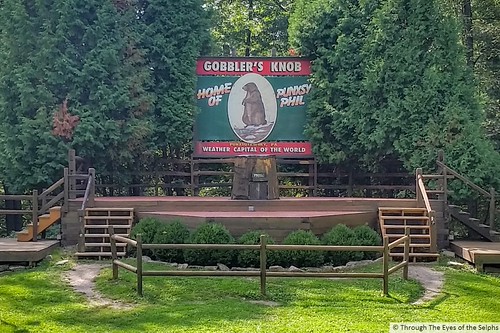
We drove to Gobblers Knob where the Groundhog ceremonies and fireworks are held each year on Groundhog’s Day. There was a trail there where we did some geocaching. It was a hot day and the mosquitoes were out in force.20160923_150606
We drove back into town and visited Phil and his wife Phyllis. They have a nice man made burrow next to the public library with a large viewing window. Phil and Phyllis were both sleeping and didn’t even notice our visit. We left him a note requesting a short winter and early spring. I don’t think Phil’s accuracy has been very good lately.20160923_16281720160923_16294520160923_163357
It was a nice little trip and fun to see where all the hoopla is done every February. By the way, none of the movie “Groundhog’s Day” was filmed in Punxsutawney.
Next stop will be Somerset, PA.

Sept. 15, 2016 Letchworth State Park, NY

Thursday we left Niagara Falls and headed to our last stop in New York State.  Along the way we passed around Buffalo.  This city gets its electricity from Niagara Falls and was the first city in the country to have electric street lights.  The traffic around Buffalo was pretty heavy even though it was past the morning rush hour.
20160916_134341We arrived at Letchworth State Park near Castile. This park was not originally on our planned itinerary.  We had actually booked a different state park.  But when we were in Seneca Falls I happened to read that Letchworth State Park was voted the most beautiful STATE park (not national park) in the United States in a 2015 USA Today Reader’s Poll.  So of course we had to change our plans and visit this park.
Also known as the Grand Canyon of the East, Letchworth State Park is 14,350 acres of magnificent beauty along the Genesee River.  Tens of millions of years of erosion wore away rock forming river valleys.  Glaciers buried areas of the valleys under masses of sand and gravel.  Three deep winding canyons are from the Genesee River detouring around the blocked sections of riverbeds.  Each year the river cuts deeper into the cliffs, with some cliffs 600 feet in height.
To call it the Grand Canyon of the East is definitely a stretch, but there is no denying the beauty of the seventeen mile Genesee Gorge, the thick forests and the three large waterfalls.20160916_15381220160916_15385320160916_16063120160916_16075120160916_160803

The state park once belonged to the Seneca Indians.  In the mid 1800’s William Letchworth purchased 1,000 acres of land and deeded it to the State of New York in 1907 to preserve the land for future generations.  Letchworth felt strongly about preserving the Native American history of the Seneca people and Genesee Valley.  On the park property is a restored Seneca Indian Council House, the statue and grave of Mary Jemison, and the cabin Mary lived in. 

20160916_130952Mary was born in 1743 on the ship “William and Mary” while her parents were en route to America from Northern Ireland.  They landed in Philadelphia and Mary and her parents were part of a group of Scots-Irish immigrants who headed west to settle on the frontier.  They settled on territory that was under the Iroquois Confederacy.  One morning in 1755 at the beginning of the French and Indian War, six Shawnee Indians and four Frenchmen kidnapped fifteen year old Mary and her family.   Mary’s family was killed and she was sold to the Seneca Indian tribe.  A Seneca family adopted her and she grew up there.  She fully assimilated into the Seneca culture, married and moved to Seneca land in what is now Letchworth State Park.  She chose to remain with the Senecas her entire life. The Seneca Indians honored Letchworth with the Native American name “Hai-wa-ye-is-tah” meaning “he who does the right thing”.20160916_13045020160916_131327

There are three major falls in Letchworth State Park, the Upper, Middle and Lower Falls. There are short hikes to each fall. Western New York is under an extreme drought so the falls were not as magnificent as they could have been. I would love to see them under normal conditions. In some of the pictures in this blog you can see how low the water level is in the Genesee River.

20160916_132631

Middle Falls in the middle and the Upper Falls is in the distance

The Upper Falls is 70 feet high and a horseshoe shape.20160916_124529
The Middle Falls is the largest of the three falls at 107 feet high and 285 feet wide.20160916_12225420160916_122523
20160916_152130
The Lower Falls had two ways to view the falls. There is an easy way and then a hike that involved 127 steps down and of course 127 back up. And of course we chose the hard way!20160916_14485620160916_145709

As we were trudged back up the 127 steps a lady in front of us suddenly stopped and called out to Bill for help. There was a big black snake stretched across the steps. Those who know me know I am terrified of snakes. Terrified. I hung back while Bill went up and waited for the snake to move. Mr. Snake took his good old time moving but eventually started slithering up the natural wall. Bill told me to go ahead and just not look to the left. I went up those last 50 steps so fast I don’t even remember climbing them! Bill managed to snap a couple pictures of him before he slithered under some tree roots at the top of the wall.20160916_15255820160916_152536
There is a nice footbridge down at the bottom that takes you from one side of the gorge to the other.
20160916_150834
20160916_143049We stopped by a statue of a CCC worker. We owe so many thanks to these young men who worked so hard in state and national parks all over the country so we have such wonderful parks to enjoy today. The stonework steps and walls they labored to put in is amazing, not to mention trails and buildings and picnic tables. The list goes on and on.20160916_14312320160916_160657
We also met a new friend!20160916_14350120160916_143645

20160916_201513

Middle falls taken at night

After dinner we drove back to the Middle Falls which is illuminated at night. There was a huge full moon over the falls. What a beautiful, peaceful setting.
We have certainly enjoyed our time in upstate New York.  Even with a drought the waterfalls have been magnificent.20160916_16000920160916_122730

The Adirondacks were beautiful and we loved the history we stumbled across in Seneca Falls.  On the downside, it is an expensive state to visit.  Even the state park campgrounds are pricey, the gas higher, and we paid about $75 in road and bridge tolls.  But we would like to return again, perhaps later in the fall when the leaves have turned.  But not too much later in the year as the temperature got down to the mid 40s one night at Letchworth!
Next stop: Pennsylvania as we head south

Because there’s a lot of life to live!

Sept 11, 2016 Niagara Falls

Picturesque Seneca Falls exceeded our expectations and we would have stayed a couple more days but we had reservations at Four Mile Creek Campground about fifteen minutes from Niagara Falls.  It was an easy drive and as soon as we got settled in our campground we drove to nearby Fort Niagara.

20160911_15410920160911_160445Originally the fort belonged to the French and was built in 1726.  It was expanded to its current size in 1755 because of increased tensions between the French and English.  The fort played an important role in the French and Indian War and fell to the British in 1759 during the Battle of Fort Niagara.  It served as a British base during the Revolutionary War and was ceded to the United States in 1783 at the end of the war.  The British recaptured the fort during the War of 1812 and held it during the remainder of the war.  After the war ended they gave it back to the United States.  It is now known as Old Fort Niagara State Historic Site and is a National Historic Landmark.  It is said the fort is haunted by a French soldier who was beheaded there during a duel and he wanders the grounds looking for his head.  The paranormal claims have been investigated by the “Ghost Lab” on the Discovery Channel and on the Syfy series “Ghost Hunters” in 2011.20160911_15583320160911_15585020160911_160405

20160911_161513We also found a marker that indicates that WW II prisoners of war were kept here.

Our campground is located along Lake Ontario and we have a lovely view of the lake from our campsite.  On a clear day you can see the Toronto skyline across the water.20160911_15474920160911_154622
Of course our main reason for coming here was to see the mighty Niagara Falls.  Monday morning we left bright and early for the short drive to Niagara Falls State Park.  There is no charge to enter the park but you do have to pay $8.00 a day for parking.  Niagara Falls is America’s FIRST state park, established on July 15, 1885.  There are few words to describe the power and beauty of the majestic falls where 750,000 gallons of water PER SECOND flows over Niagara Falls. Today we visited the American side of the falls and can see across the water to Canada.  Our first stop was the Observation Tower which provided us with a view of both the American and Horseshoe Falls.20160912_09435620160912_09454120160912_095132

20160912_10043720160912_100347Next up was a ride on the boat, Maid of the Mist.  The boat takes you right to the base of Horseshoe Falls where it hovers for several minutes while we are sprayed with water and feel and hear the thunderous falls above us.  But first we have to pay admission where we are handed a poncho to wear before boarding the boat.  The ride was short but it was exciting to be that close to the bottom of the falls and we could only gaze in wonder.  It was hard to get pictures because it was so wet we had to place the camera in a plastic bag to keep it from being ruined.  Between the water and the heavy mist it was hard to get pictures but I think Bill did a great job as always.  In some of the pictures you can see the boat we road on down below. 20160912_10014020160912_10133520160912_10065220160912_132252

We walked on some stairs near where the boat let us out.

20160912_10291420160912_10292620160912_10372020160912_113223
Next we wanted to do Cave of the Winds, but first we had quite a long walk from one side of the park to another.  For those unable to walk there is a shuttle to take you around the park for a small fee.
The walk was a wonderful way to see the falls and park.  We walked across a pedestrian bridge onto Goat Island.  There we walked to the overlook to view Horseshoe Falls which is on the Canadian side. We walked past a memorial to Nikola Tesla, an idol of Bill’s. This is where the first hydroelectric power plant was made and used to provide electricity to Buffalo NY.20160912_12032220160912_12133920160912_12151720160912_121257

We viewed the American falls from Goat Island.20160912_11515820160912_11530320160912_11534720160912_11552420160912_120517

20160912_123617We then bought tickets to our next attraction, Cave of the Winds.  Here we were given another poncho, water shoes and a bag to put our own shoes in.  We were then taken 175 feet down in an elevator where we walked along a series of steps and boardwalks at the base of the Bridal Veil Falls.20160912_123953

20160912_124319One location was called “Hurricane Deck ” where the power and wind from the thundering falls simulated a hurricane.  It was really fun and despite the ponchos we both got wet.  One amazing thing is every November the walkways and boardwalks are removed so they do not get caught in icy waters in the winter.  In the spring they are rebuilt for summer tourists.20160912_12500720160912_125023

We finally took a view of the Horseshoe Falls which has one side in the USA and the other in Canada.20160912_13172820160912_132105
After a walk back over the pedestrian bridge to the parking lot, we were tired and hungry.  We grabbed a late lunch.  On the way home we stopped by Whirlpool State Park where we walked down to an overlook of the Niagara Whirlpool on the Niagara River and the Niagara Gorge.
Tuesday we drove across the Rainbow Bridge to Canada to see Niagara Falls from the Canadian side.  The view of the falls is prettier from this side because you have more of a direct view of both the American Falls and Horseshoe Falls.  The Horseshoe Falls is located on the Canadian side of the river.  Another difference is when you look at the falls from the United States you look across the water at Canada.  The Canadian side is very touristy with hotels, casinos, a ferris wheel etc.  When you stand in Canada and look across the water at the American side you are looking at Niagara Falls State Park with plenty of trees and green space.  Much more appealing!20160913_18072720160913_18121420160913_181939

We also took this video of the American falls from the Canadian side https://youtu.be/pfDoIUPj6Qw


After getting a few pictures in daylight we grabbed dinner and waited for it to get dark.  At 8:30 PM they illuminate the Horseshoe falls with multicolored lights.  We were a little disappointed that the lights were not deeper in color.  It was really hard to get a decent picture with the darkness, moving water and mist.20160913_204514

This is chart that show how the Horseshoe Falls has receded over the years because the rock wall face underneath crumbles.20160913_211109
It was going to be a long walk uphill back to the car in the dark so we paid to ride the Inclined Railway (funicular) back up the hill.  After driving back across the border into the United States we arrived back home.
We enjoyed our short time at Niagara Falls and will next head to our last stop in New York State.

Here is a nighttime video of Horseshoe falls taken from the Canadian side. https://youtu.be/qBXjLr1Ns-8

Sept 8, 2016 Seneca Falls, NY

Thursday morning we left the Adirondacks and headed west to Seneca Falls, population 6,700. We thought it was going to be a short three night stop on our way to Niagara Falls without much to see or do. Boy were we wrong!!
We camped at Cayuga Lake State Park near beautiful Cayuga Lake, one of the longest of the Finger Lakes. During the past million years, glaciers covered New York state. As they moved through river valleys they carved deep troughs with steep sides. When the glaciers receded about 10,000 years ago, water filled these troughs, creating eleven Finger Lakes. Cayuga Lake is thirty-eight miles long and 435 feet deep at its deepest spot. Cayuga Lake is named after the Cayuga Indians, one of the Six Nations of the Iroquois in New York.
20160909_110825
I was looking through some literature about the area and came across Watkins Glen State Park about thirty minutes from our campground. I read that in 2015 it was voted the third most beautiful state park in the country in a USA Today poll. All the reviews I read talked about a gorgeous 1.5 mile (three miles roundtrip) hike with 832 steps and nineteen waterfalls. We both love waterfalls so even though the 832 steps seemed a bit daunting, we decided to give it a try.20160909_111629
20160909_093118We headed out early Friday morning. On the way to Watkins Glen we came across a plaque in the small town of Waterloo. We had no idea that Waterloo, NY was the official birthplace of Memorial Day, with the first ceremony held in 1866. Some of the interesting things we just happen to stumble across is amazing to us. 20160909_093044We drove beside Seneca Lake, the largest of the Finger Lakes and the deepest lake in the state.
We didn’t realize that the town of Watkins Glen is renowned for auto racing and is considered the birthplace of American racing.   Since 1948 Watkins Gen has hosted international automobile car racing and in 2015 was voted the best NASCAR track in the country in a USA Today Reader’s Poll.  The town has an International Motor Racing Research Center with 5,000 square feet of racing history.  From April through September they host NASCAR sports car and racing events. This weekend was the U.S. Vintage Grand Prix and as we drove down Main Street they were getting ready to close off the street for a parade. To our dismay we discovered that even though the state park was open, the parking lot was closed. We asked where we could park and they said our only option was to find a parking lot or side street parking, which seemed highly unlikely on a parade day in a tiny town. Across the street from the park was a restaurant and Bill decided to go inside and ask if we could park in their restaurant parking lot for a few hours. I told him there was no way they would allow that on parade day. We pulled into the lot and I stayed with the car while he went inside to ask. He came back a few minutes later and said the owner said no problem and refused to take any money. Yeah!!
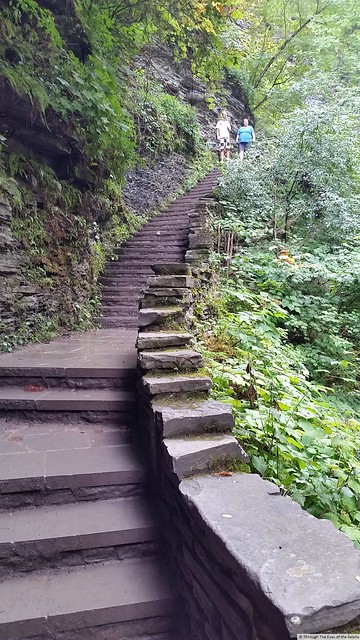
We grabbed our walking sticks and headed over to the entrance. We had an idea what was ahead when we saw a beautiful waterfall at the entrance. This park certainly lived up to its #3 best ranking. Everywhere we looked there was beauty. We were apprehensive about the steps but they were nice stone steps put in years ago by the CCC and easy to climb. I had worried they might be uneven and slick, but no problem. The hike on the Gorge Trail was not tiring at all because we were constantly stopping to gaze in wonder and awe at the beauty. We followed the gorge trail as it wound over and under waterfalls.20160909_11111420160909_11403320160909_11431820160909_11592220160909_12072320160909_12192020160909_12201920160909_12264920160909_11234620160909_135502
At the end we walked up the last of the stairs which were steel steps called “Jacob’s Ladder”. Once at the top we could either walk back down the 832 steps or take the easy “Indian Trail” back. We chose the easy hike and once we were back to the car we put our hiking gear away and decided to go into the restaurant for a late lunch. We thought it was a small way to thank them for letting us park in their lot. Bill had lunch and I had a big slice of fresh blueberry pie! On the way home we took a different route and followed Cayuga Lake seeing wineries along the lake.20160909_154053
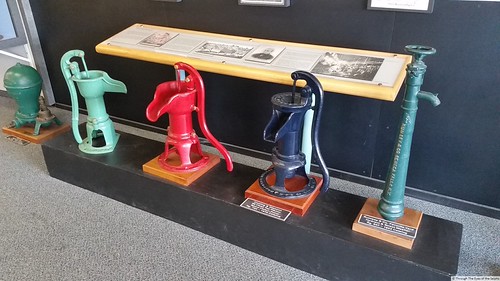
20160910_14073820160910_142224On Saturday we decided to spend our last day in Seneca Falls exploring the small town and finding some geocaches. First we stopped by the town Visitors Center which had a fantastic museum detailing the history of the town. European settlers first moved to the area and began farming. In the 1820’s the construction of the Erie Canal changed Seneca Falls to an industrial and shipping center. We were surprised to see all the items designed and manufactured there from water pumps, TV picture tubes to wooden rulers.20160910_13314820160910_13425520160910_13505320160910_140408
20160910_150328Seneca Falls is the birthplace of the Women’s Rights Movement led by resident Elizabeth Cady Stanton. The first women’s rights convention was held here on July 19-20, 1848. Today there is a Women’s Rights National Historical Park, established in 1980, in the middle of town. We stopped by the park, saw a film and looked at the exhibits. Amelia Bloomer, for whom bloomers were named, lived in Seneca Falls. She didn’t invent bloomers but wore them and promoted them in magazines.20160910_15050020160910_150738
20160910_14312620160910_143112Our last stop of the day was at the “It’s a Wonderful Life” museum. In 1945 Frank Capra stopped by Seneca Falls to get a haircut on his way to visit his sister. It is said that he was so taken with the quaint little town that it was his inspiration for the fictional town of Bedford Falls in the famous Christmas movie. There are several similarities between Seneca Falls and the fictional Bedford Falls, including they are both mill towns, had a grassy median down Main Street, homes of Victorian architecture, a large Italian population and a toll bridge. The free museum opened in 2010 and is full of memorabilia from the film that fans have donated or loaned to the museum. We were the only visitors there when we stopped by and enjoyed talking with the guide who obviously loves the movie. He said he has lost track of the number of times he has seen it. Every year in December they celebrate with a parade and all sorts of events. This year will be a big celebration since it is the 70th anniversary of the movie.20160910_144641 20160910_14471220160910_14474820160910_142407The guide so enthusiastically described the upcoming celebration it almost made me want to brave the snow to attend. Almost, but not quite!
Yes, tiny Seneca Falls far exceeded our expectations. We could have stayed a couple more days but Niagara Falls was calling!

July 29, 2016 Glen, N.H. & Millinocket, ME

20160730_143604On July 29th we left the RV rally fairgrounds in Essex Junction, Vermont and headed back to New Hampshire for a week in the White Mountains. Along the way we saw many signs on the highway warning of moose crossings, but we never saw any moose. We arrived at our campground in Glen, New Hampshire. This is a touristy town in the White Mountains advertising among other things snowmobile rentals and scenic train rides. The town is busy year round with summer tourists, fall foliage viewing and winter skiing.
20160730_13115120160730_131212We were in this area back in September, 2011 and took the cog railroad to Mt Washington so we passed on doing it. We did drive the scenic Kancamagus Highway, the first National Scenic Byway in the northeastern United States. The highway is named for Kancamagus, the grandson of Chief Passaconaway. The road was first begun in 1837 and much of the work was completed by the CCC. It was opened in 1959. Along the drive we passed many areas with people lounging on the rocks or swimming in the Swift River. Over time the Swift River has worn a narrow cleft in the rock forming a rocky gorge. We walked two short trails to the Rocky Gorge Falls and Sabbaday Falls, so named because it was discovered on a Sunday.20160730_13234420160730_13235720160802_12022420160802_12024520160802_12072520160802_12080320160808_102433
On August 5th we left Glen and headed to Maine. A few days before we left, Bill discovered there was an amateur radio gathering, called a Hamfest, in Milo along our route. I had thought many times about taking the exam to get my amateur radio license with the FCC, but never took the time to prepare. When I learned they would be doing testing in Milo, I decided to go for it. I got busy studying using the test preparation materials available online. It wasn’t easy for me because I do not have any background in electronics or radios. I studied hard and had lots of questions for Bill. The morning of the test I was pretty nervous. Three examiners are required to be present during the written exam. It turns out one of the examiners attended medical school at UVA many years ago. What a small world. I passed the exam and was pretty proud of myself! As Bill said, I am now radioactive!
After enjoying the Hamfest festivities we continued on to tiny Millinocket, Maine for five days. This was a pretty remote area of Maine and our most northern point for 2016. The roads in this part of Maine are pretty bad from frost heaves which causes the roads to buckle. We bounced our way along over bumps and dips, swaying from side to side. When we finally arrived at our campsite, our exhaust pipe cap had worked its way loose and the ladder attached on the back of the RV had shifted!
20160808_103349While in this area we wanted to visit Baxter State Park. The park is unique because it isn’t really a state park. It was a gift to the people of Maine by former Maine Governor Percival P. Baxter in 1931 on the condition it remain a wilderness. The park is made up of 209,644 acres, including Katahdin, Maine’s highest mountain. Baxter Park is Maine’s largest public trust and is administered by a special authority and is independently funded.
According to Baxter, the land and animals are primary and people secondary. Therefore visitors are responsible for their own safety and there are no facilities available except for the occasional pit toilet. There are signs throughout the park warning to treat the water before drinking. When we entered the park and paid the entrance fee (Maine residents are free), the worker took our names and emergency contact information. We were given a card to turn in when we left so they would know we left safely. When we asked about the possibility of seeing moose we were told it was the wrong time of year. In the summer they are further up in the mountains where it is cooler.
20160808_114256We wanted to take a hike in the park but it was hard to find a hike that was not too difficult. Keeping with the land and animals first theme, the trails throughout the park have not been altered to make hiking easier. The most famous trail in the park is the Katahdin Trail to the mountain peak. It is also the beginning/end of the 2,200 mile Appalachian Trail. I had read that the most difficult sections of the Appalachian Trail are in New Hampshire and Maine. In fact Maine and New Hampshire are the two most forested states in the country. It is recommended that hikers not start the trail in Maine. Less than 1,300 people have ever finished the famous Appalachian Trail if they started in Maine, which makes up 280 miles of the Trail.
We knew that trail was too intense so we decided on the trail to Small Niagara and Big Niagara falls. At the beginning of the trail was a sheet where you signed in and later signed out, just in case. The trail was less than three  miles round trip, but it kicked my butt. It wasn’t as hard for Bill but I think he was glad when it was over too. We had to watch our footing constantly as we clambered over huge tree roots and rocks. In the beginning we balanced ourselves on narrow boards placed over marshy areas to protect the fragile plants. The worst part of the hike was at the Small Niagara Falls and later at Big Niagara where some tricky footing was required to get down to see the falls. At Big Niagara we watched a woman hiking alone fall on her face before we could assist with a helping hand. Bill helped her up and she was fine.20160808_12461420160808_12454220160808_13152220160808_131534
Back at the car we had a late lunch and continued our drive through the park before leaving at the far entrance. Unfortunately we never saw a moose. Besides being the wrong time of year I also read that the moose population has significantly declined in recent years due to calves dying from an illness caused by ticks.20160808_16170320160808_161734
Maine Facts:
Geographically, Maine is larger than the other five New England states combined.

  • The state animal is the moose and there are more moose per square mile than any other state.
  • Maine has over 32,000 miles of rivers and streams and over 6,000 lakes and ponds.
  • Maine has over 542,629 acres of state and national parks.
  • Maine produces 99% of all wild blueberries in the country, making it the largest producer of blueberries in the country.

Next stop: Eastport, Maine

July 8, 2016 Cape Cod, Mass. Part 2

A man may stand there and put all America behind him.” Henry David Thoreau
After seven days in Sandwich we moved further east in Cape Cod to Nickerson State Park in the town of Orleans.  We only reserved two nights at this park since it was dry camping.
20160707_151108We had a lot to see in this area and a short time so we had no time to waste.  Bill wanted to visit the Chatham Marconi Maritime Center in nearby Chatham.  Here numerous exhibits and short films tells the story of Marconi’s role in the history of wireless communication.  20160707_150752

Marconi’s original 1914 TransAtlantic Wireless Receiving Station where telegrams were sent from ship to shore was on display. Exhibits showed how the U.S. Navy used the station during WWII as well as displaying a highly classified Enigma cypher machine used by the German Navy for communications.20160707_15082320160707_150109
20160709_110033On Saturday we had a busy day exploring the Cape Cod National Seashore Park and the small towns and villages in the upper part of Cape Cod.
Cape Cod National Seashore has two Visitors Centers at each end of the park and we stopped at both of them.  At the first center we toured the museum about the history of Cape Cod and saw a movie detailing how the it  was formed. Cape Cod is a glacial deposit always undergoing natural changes as water and wind move sand along the shoreline, tearing away some places and building up others. The harsh North Atlantic winters contributes to these changes which can quickly take place. Native people began living on Cape Cod about 10,000 years ago. The Pilgrims arrived here in 1620 and briefly stayed before sailing across the bay to Plymouth.
20160709_115333We then stopped at the first Marconi Station Site where the first transatlantic wireless communication was sent from President Theodore Roosevelt to King Edward VII of England. Marconi built his first towers here in 1901. As just described, the forces of nature has eroded much of this high cliff to the extent that the towers and station had to be removed. We visited the plaques and exhibits now placed a safe distance from the edge of the cliffs.20160709_114343
20160709_14025220160709_135347Next we drove to Provincetown at the end of Cape Cod.  Here we found a Pilgrim Tower to commemorate the first landing of the Pilgrims.  We then went to First Landing Park where the Pilgrims first set foot on American soil. (No, it wasn’t at Plymouth Rock).  The area wasn’t to their liking so after a short time on the cape they sailed across the bay to Plymouth.20160709_13543720160709_135310
20160709_15374520160709_153643Afterwards we drove back towards home, stopping at three more historic places.  At Corn Hill there is a plaque commem-orating the place where starving Pilgrims stumbled across a stockpile of corn the Indians had left for later use.  The plaque says the Pilgrims said they didn’t know what would have become of them if they had not found the corn. I am sure hungry Indians were not happy to find the corn missing and we read that the Pilgrims later paid restitution to the Native Americans.
20160709_164611Next was Encounter Beach.  Here a plaque commemorates the place where the Pilgrims and Native Americans first encountered each other.  Bill and I both love historical places like this.
Our last stop of the day, very close to home was Nauset Beach.  It is here at Nauset Beach in Orleans, Mass. that a German submarine fired on a tug, four unarmed barges and sank them during WWI.

20160709_173258Nauset Beach is the only place on American soil attacked during WWI.
At several of the historical sites we visited today we found geocaches. What fun!
I mentioned in an earlier blog about meeting Bob and Sue during our trip to Europe and the wonderful afternoon we spent at a cookout at their house.  Our good luck continued since it turned out Sue’s mother and stepfather live 5 minutes from Nickerson State Park where we were staying.  So Friday night we went to Earl and Bea’s house and had a delicious dinner and were able to spend more time with Bob and Sue.  A great time was had by all!  We could get use to this!
Next stop: Boston area.  Can’t wait for more history coming up!!


January 16, 2016 Everglades N.P.

IMG_20151214_104921First, a quick catch up.  Since our last posting we have really been on the go.
We spent eight days in Jacksonville at Kathryn Hanna City Park.  While in Jacksonville we visited my Uncle Bill and Aunt Peggy and were able to spend time with their daughters, granddaughter and three adorable great grandchildren.  It is always a real treat to visit my Jacksonville family.  They are always so gracious, welcoming and fun.  You haven’t truly lived until you experience one of their Sunday family dinners.20151207_163828
Bill grew up in Jacksonville Beach so while we were there we were able to catch up with several of his good friends.  Old friends are such a treasure!  We enjoyed some of the area Christmas decorations.
It was hard to leave family and friends behind but our next stop was St Augustine for a short stay.  The Spaniards created the City of St Augustine 450 years ago (1565), making it the oldest settlement in America, not to be confused with the settlement of Jamestown (1607), the oldest English settlement in America. We didn’t have enough time to explore and do the town justice so it is on our list of places to visit again.  Since it was December we were able to enjoy all the white lights and Christmas decorations, especially beautiful at night!  We enjoyed dinner with Bill’s ex boss Robert and his lovely wife Donna.IMG_20151210_193736IMG_20151210_205706~2
Flagler Beach was next on the list where we stayed at Gamble Rogers State Park.  Wow we loved this park on the Atlantic Ocean.  The state park has done a nice job of providing several boardwalks leading down to the water.  We enjoyed walking on the beach.  We can never get too much beach time!!
After a short stay in Titusville we arrived in Vero Beach for a week long stay over Christmas.  We were so happy to spend time with Bill’s son Sean and his girlfriend Cathy.  We enjoyed some beach time on Christmas Day.  Notice Santa relaxing on the beach after a busy night.  He was still wearing his Santa hat!IMG_20151225_142835
New Years found us in Clearwater, the area we lived in before beginning our grand adventure.  We caught up with friends and some of Bill’s former coworkers.  We were thrilled to spend New Years Eve with our friends Ben, Anne, Denise and Ralph at their annual party.  During the party we launched Chinese lanterns after making New Years wishes. Yes, good friends are truly a treasure!20151231_230834
20160104_103510January found us in southwest Florida in Fort Myers.  What a beautiful area along the Gulf of Mexico!  We liked our RV park even though it was crowded and tight.  We had great neighbors and hope to return next year to the same spot.  The beaches are beautiful and there is a trolley which you can ride from the campground to the beach for 75 cents.  What a bargain, especially considering parking at the beach is expensive and limited.  While there we had a bad storm and our cell phones shrieked with weather alerts of tornado warnings.  Bill monitored the storm on the local TV station. The weatherman I used to watch for years on the local tv station in Charlottesville is now the chief senior weatherman in Fort Myers.  We found out the next day that a tornado touched down about four miles from our campground.  This weather is unusual for Florida in January.  Thanks a lot El Nino!  While in Fort Myers we drove north to meet Bill’s cousin Shirley, her husband Jim, and two of their friends for dinner.IMG_20160108_194024~2
We reluctantly left Fort Myers and headed to a campground near Miami.  Our main reason for stopping here was to visit my cousin Duane.  IMG_20160113_194602~2We hadn’t seen each other in almost five years and I was beyond excited to see him.  We made the short drive to Coral Gables to meet him for dinner.  The time went by much too quickly.  There is never enough time to spend with family and friends!
IMG_20160119_104730Well, you are caught up on our travels and now on to the subject of this blog, Everglades National Park.  We had reservations at Flamingo Campground at the very tip end of the park.  Once you enter the park entrance it is 37 miles to the campground.  From the time we left Miami until we reached the campground we drove through torrential rain with poor visibility.  Thanks again, El Nino!
We stopped at the Visitors Center at the entrance of the park.  We put on our rain gear and splashed our way to the door.  They had nice displays and we saw a movie about the park.  Our national park system throughout the United States sure has great and informational movies.  We always come away impressed!
The movie said many people think of the Everglades as looking like a swamp, and I was one of them.  It is actually mostly grasslands along with jungle like tropical hardwood hammock, massive mahogany trees, mangrove trees and subtropical pine forest.  It is the only place in the world where both alligators and crocodiles live.  The park was established in 1934 to protect the fragile ecosystem and was dedicated by President Truman in 1947.  At 1.5 million acres it is the third largest national park, the largest tropical wilderness in the U.S. and the largest mangrove ecosystem in the Western Hemisphere.  It is the most significant breeding ground for tropical wading birds in North America and home to 36 threatened or protected species including the Florida panther, the American crocodile and the West Indian manatee.
With the heavy rain we were glad to arrive at our campsite.  Once we left the Visitors Center near the park entrance we lost all cell phone service.  Flamingo Campground has electric sites but no water or sewer at each site.
Since neither of us had ever seen a crocodile in its natural habitat, we were biting at the bit to see one.  The Ranger told us there were “over a million alligators in the Everglades but only about four thousand crocodiles”.  We didn’t think our odds of seeing one was very good but we got a tip that there were two over behind the marina store.  So we hopped in the car and made the short drive to check it out.  First we saw some manatees near the parking lot in a little docking area of the marina.  IMG_20160116_114740IMG_20160116_115414They sure are shy, quick and hard to photograph.  It didn’t help that the water was murky.  We were still on a crocodile hunt.  We saw a huge osprey nest with one lone bird peeking out of the top.  IMG_20160116_120538We walked around the back of the marina store looking in the water but saw nothing.  Suddenly we glanced on the bank and there were two huge crocodiles basking in the sun.  What joy!  The area near them was blocked off so we had to settle for some long distance shots and help from the zoom lens.IMG_20160116_120255
IMG_20160118_155728Another day we drove almost back to the park entrance to walk the Anhinga Trail which we were told was the best place to see alligators.  We only saw four, including this beauty who was completely oblivious to the people around him.  He appeared to be sleeping with his eyes open or playing possum, waiting to pounce when someone turned their back.  One older lady near me commented on how cute he was.  I would have to agree!IMG_20160118_162039~2IMG_20160118_155714
We were told that usually winter in the Everglades is the dry season and it is usually possible to see alligators by the dozens on the banks and even in the roadways.  Thanks to El Nino it has been a very cool, wet winter and alligator sightings are way down.  Sigh.
One fear I had when in the Everglades was encountering snakes.  Bill can’t understand why I have no fear of alligators but am terrified of snakes.  I have read stories of people who buy pythons for pets and when they  get too big or they tire of caring for them, they release them in the Everglades.  It has become a real problem and hunters come to hunt them.  I have seen the pictures of the 200+ pound pythons in the Everglades.  I am happy to report I left the Everglades without seeing a single snake.  But boy was I careful where I walked!
IMG_20160118_153018IMG_20160118_150815One surprise was to discover that Everglades National Park houses one of the best preserved relics of the Cold War in Florida.  The historic Nike Hercules Missile Base, dubbed HM-69, remains virtually the same as when its use was terminated in 1979.  The missile base was built by the US Army Corps of Engineers in 1964 at the height of the Cold War, immediately following the Cuban Missile Crisis in 1962.  The United States Army chose this strategic site within Everglades National Park because of its location 160 miles from the Cuban coast.
The missile site was listed on the National Register of Historic Places in 2004.  Bill took a 90 minute tour of the site conducted by a  park ranger. IMG_20160118_153334IMG_20160118_143836IMG_20160118_150656 IMG_20160116_141924Since we arrived in Florida the mosquitoes and especially the no-see-ums have just about eaten me alive.  Bill found a solution at the Everglades gift shop.
Our next stop is a week long stay at Big Pine Key, about thirty miles north of Key West.

November 21, 2015 Gulf Shores, ALA & FLA at last

We left Lakewood, New Mexico and hit the road running toward Florida. After overnight stops in Fort Stockton and Junction, Texas, we pulled into a nice campground in Columbus, Texas for a three day rest. We planned to leave Columbus early on a Sunday morning to avoid the weekday traffic nightmare around Houston. So much for that plan. We got up early and had everything ready to go. Bill got in the driver’s seat, turned the ignition key, and NOTHING happened. We had a broken starter. Of course nothing is open on Sunday, so we had no choice but to tell the campground we would be staying another day. We were SO lucky this didn’t happen somewhere along the road when we stopped for gas or at a rest area. We were so thankful to be in a nice campground with helpful people offering us any tools we might need and plenty of advice. This bad starter was just one of several bad luck events that happened to us, beginning back in September when a passing truck threw up a rock and chipped our windshield just as we were getting ready to turn into a campground. At our next stop in Phoenix in early October the motor on the large motorized windshield night shade broke and the shade would not go up. So while in Phoenix we had the windshield fixed and a new motor installed in the night shade. Now the starter! Whew!

20151116_142935Luckily we have roadside service on the RV so the next day the RV was towed in the rain to a repair facility in a nearby town. It kind of makes a big lump in your throat to see your home being towed away. Ford was able to get right to work on the warranty replacement of the starter. By late afternoon we were back on the road. That was the good news. The bad news was it put us going through Houston at rush hour. It took a giant margarita to get me through that without freaking out.

We stopped for the night at a casino in Vinton, Louisiana. We had a nice boondocking spot in a back parking lot with several other RVs doing the same thing to keep us company. By the time we got there it was late and we were pretty exhausted so it was a very easy, safe spot to stop for the night.
The next morning we headed to a campground in Livingston, Louisiana, passing through Baton Rouge which had some traffic back up due to an accident. We originally had planned to drive down to beautiful Palmetto Island State Park for several days, but since we were now on a fast track east, the state park was too far off I-10 for just a couple days. Another place to add to our growing list of future places to visit. We were not thrilled with our campsite at this Livingston campground. The site they put us on backed up to a busy road and traffic noise was a problem day and night. While we were there we had heavy wind and torrential rain and the bad luck continued when one of the windows began to drip water. Not a big deal since Bill could fix the problem with some additional caulking once everything dried. Just one of those nuisance problems.
IMG_20151120_161853IMG_20151120_161906Next stop was a nice campground near Gulf Shores, Alabama for a two night stay. While there we drove down to the beach. Our first beach in quite awhile. The beach was surprisingly deserted. We don’t know why except it was a weekday in late November. We enjoyed the views but the biting flies were terrible.
While in Gulf Shores we celebrated Bill’s birthday (NOV 22). I bought a birthday cake at Publix and we had dinner at Longhorns, one of Bill’s favorite restaurants. The steak was exceptionally good!IMG_20151122_182855
We enjoyed our stay in Gulf Shores but were anxious to get back on the road and see the Florida border. Bill honked the horn as we passed from Alabama into Florida. We were back after 877 days on the road. I think Bill was especially happy to be back in his home state.
Our first stop in Florida was a week at Rocky Bayou State Park in Niceville. We had a great campsite except for the oak tree towering above us which deposited acorns on the roof of the RV day and night, sometimes waking us up with loud pinging as they hit the roof.
While in Niceville we enjoyed visiting Bill’s cousin June, her husband Randy and their family. June fixed us two really delicious meals and we enjoyed watching the Alabama/Auburn football game with them. We can’t wait to see them again next November!

Our next stop was a COE (Army Corp of Engineers) campground called Eastbank, just over the border in Georgia.

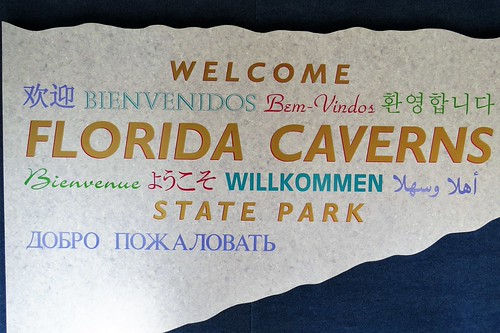
IMG_1366We left Niceville early and stopped by the Florida Caverns State Park on the way to the campground. Who knew Florida had caverns! We took a tour of the caverns with a great guide. Some of the places on the tour had really low ceilings so Bill had to do quite a bit of bending over while walking. It wasn’t equal to Carlsbad Caverns, but still a great place to visit!IMG_1367IMG_1368IMG_1369IMG_1372IMG_1374IMG_1377
IMG_1379The Eastbank Campground was on a lake overlooking a dam. We enjoyed views of the lake with ducks and birds splashing in the water. It was a very quiet and peaceful campground and we enjoyed our time there. So far Florida has been pretty chilly and the mosquitoes are biting!IMG_1380
We left Georgia and were back in Florida, heading to Osceola National Forest for a three day stay in the forest. We had hoped to get one of the electric sites in the Ocean Pond Campground, but since hunting season has begun and snowbirds are migrating back, all the electric sites were taken at this nonreservable campground. No problem since we were able to get a site with water hookup and open sky for our satellite TV and solar panels. The solar panels we had installed in Phoenix are really coming in handy.
We are enjoying our time in the forest. Tomorrow we head to Jacksonville to see family and friends. Remember earlier in this post I mentioned the bad luck we experienced? All of that is behind us and we feel really blessed to have made it safely back over those 1,800+ miles and back in Florida!!

August 15, 2015 Canyonlands N. P. & Dead Horse Point S.P. Utah

20150816_065519Our last day in Moab we set out very early to try to beat the heat.  The red rock walls surrounding our campsite were beautiful in the early morning light and at sunset as the sun lit up the walls to a bright red.  We had early morning guests to greet us as we were getting in the car.20150816_065759IMG_1013

IMG_1018

These Buttes are named after the Civil War ironclad ships

IMG_1020Canyonlands National Park and Dead Horse Point State Park were both about 45 minutes from Moab in the same direction so we decided to visit both in one day.

Canyonlands National Park, established in 1964 by President Lyndon Johnson, has canyons, mesas and buttes carved by the Colorado and Green Rivers and their tributaries.  There are four areas of the park with “Island In The Sky” being the most accessible, hike-able and favorite of tourists.  Island in the Sky sits atop a massive 1,500 foot mesa with beautiful views and a twenty mile scenic drive, making it truly feel like an island in the sky.IMG_1021IMG_1024IMG_1028IMG_1034

Once again we used Gypsy Guide as our tour guide as we drove the scenic drive through the park.  We were able to get in two hikes before the heat became unbearable by starting early.  First we did a short hike to Mesa Arch.

IMG_1058A much longer hike took us to the Grand View Point Overlook with amazing views.  We had to climb at times over “slickrock” which is the name the early settlers gave the rock because their horses’ metal shoes couldn’t grip the rocks’ surface.

IMG_1045

The trail is well marked with three square blocks

IMG_1046

Zoomed in view of Green River, the Colorado River was not view-able from the trail

IMG_1061IMG_1063IMG_1064IMG_1053

Here is a video of the view: https://youtu.be/smzHZQlX49s

IMG_1071

A jeep trail that leads to the Colorado River

IMG_1075On the way home we stopped by Dead Horse Point State Park.  The overlook, 2,000 feet above the Colorado River, provides breathtaking views of Canyonlands National Park in the distance.  From the viewpoint we could look across the canyon and see the cliff where Thelma and Louise drove their car off the edge at the end of their movie.  Legend says that around the turn of the century cowboys herded wild mustangs roaming the mesa top, surrounded by sheer cliffs on all sides, across the narrow neck of land only 40 yards wide and onto the point.  The neck was then fenced off with branches and brush to make a corral.  However one time, for some unknown reason the horses were left corralled on the water-less point where they died of thirst with the Colorado River within view below them.IMG_1080IMG_1085

IMG_1066

Colorado River

IMG_1081

Colorado River

IMG_1084

Movies filmed in Dead Horse State Park include “The Lone Ranger (2013), Mission Impossible II, Thelma and Louise”.
Here is a video of the view: https://youtu.be/cdQ6LFRX88w

Colorado River Trivia:

  • The Colorado River supplies water to the states of Utah, Colorado, Arizona, California, Nevada and New Mexico.  It starts as a small trickle of snowmelt high in the Colorado Rocky Mountains and begins a 1,450 mile journey through mountain canyons and three deserts.
  • More water is exported from the Colorado River’s 250,000 square mile basin than any other river basin in the world.
  • Seventy percent or more of its water is siphoned off to irrigate 3.5 million acres of crops.
  • At one time every drop of water was pumped or diverted to cities and farms in the U.S. and Mexico before it had a chance to reach the end of its 1,450 mile journey to the ocean.
  • Today that has been changed due to federal laws, court decisions, contracts and regulatory guidelines, including agreements between the U.S. and Mexico which allows Mexico to store water in U.S. reservoirs.