Category Archives: National Park or Forest

National Park or Forest

May 1, 2015 Grand Canyon National Park, Part 2

On May 1st we celebrated our fourth wedding anniversary.  On our first anniversary Bill was in Tulsa on a business trip and I went with him.  On our second anniversary we put the house in Florida on the market in preparation for Bill’s retirement and the beginning of our RV adventure. On our third anniversary we were in beautiful Bodega Bay, California.  So what shall we do for our fourth anniversary?  How about a helicopter ride over the Grand Canyon?  Of course!IMG_20150501_135555

Neither Bill nor I had ever flown in a helicopter and neither of us have a fear of flying.  My only fear was possible air sickness but 2 Dramamines helped prevent that problem.  We arrived at Grand Canyon Airport and checked in where we were weighed and shown a safety video.  Since we would be flying at some points over the Colorado River we were given a personal flotation device which was folded up and worn like a fanny pack.  It was a state of the art helicopter with large seats arranged for maximum viewing.  There were two other couples on the helicopter with us, one from England and one from France.Selph Helo Flight081

We put on a seatbelt and safety harness and headphones so we could hear the pilot, narrations of what we were seeing and music.  I thought it was funny that while we were waiting to take off the song p!aging on the headphones was “Everything Is Going To Be All Right”.

Soon we were off flying over the tops of a forest of trees.  The take off and landing was very smooth as was the entire flight.  I never felt sick or afraid.IMG_0002

As we reached the end of the forest and over the ledge into the canyon, the theme song from “2001 A Space Odyssey” played and as the canyon walls dramatically appeared before us the view was breathtaking.  Beyond description.  We flew around in the canyon seeing the Colorado River snaking through the canyon as well as buffalo grazing on a cliff top.IMG_0004IMG_0008IMG_0009IMG_0015IMG_0022IMG_0013IMG_0033IMG_0038IMG_0069

We will continue with more pictures from the helicopter in our next blog.

April 30, 2015 Grand Canyon National Park, Part 1

We left Cottonwood and made the three hour drive to Grand Canyon National Park.  The bad news is our colds/allergies followed us there.  The good news is we have ten days to enjoy the park.  Hopefully during that time the cold/allergy medicine will eventually kick in.  For two people who have never had allergy problems in the past, springtime in Arizona has really kicked our butt!!  Evidently this area doesn’t have cottonwood trees but it does have juniper which is just as bad.IMG_20150501_142837

Our campground is right in the heart of the national park and super convenient to everything.  We have a full hookup site and the first thing we noticed were all the elk roaming throughout the campground.  It is possible to step out of your RV and see elk a few steps away.  They are completely unafraid of people.  However we realize this is not a petting zoo and we stay a respectful distance away.IMG_20150430_170732IMG_20150430_170759IMG_20150428_174137IMG_20150429_173751

Grand Canyon National Park was established in 1919.  The canyon is 277 miles long, one mile deep and covers a total of 1,900 square miles.

This was my first visit to the Grand Canyon and Bill’s first visit in about ten years so after setting up the RV we drove over to the south rim for a first look at the Grand Canyon.  It is truly breathtaking and leaves you awe struck!IMG_20150429_163506

We are staying at the south rim of the canyon and will visit the north rim in the fall when we have completed our summer travels.  Unlike the north rim, the south rim is well developed with a village that includes hotels, lodges and several restaurants.  Also located in this area of the park are a general store, bank and a post office.  The general store amazed us with their collection of souvenirs, clothes, shoes, hiking poles for rent as well as a huge range of food items and a wide choice of cold/allergy medicines as well as other first aid supplies.  To discourage traffic they have a convenient and free bus shuttle service throughout the park.  Other national parks we have been to have provided this service and we usually don’t take advantage of it since we prefer to come and go as we please.   But they make the bus service so convenient we took full advantage of it.  The bus picked us up at our campground and the bus stop was just a short walk from our campsite.  The bus ran until 10:00 PM and stopped at various places every 15 minutes throughout the park.  Each bus had bike racks on the front so you could take your bikes with you and if you got tired, ride the bus home.

There is a thirteen mile rim trail that follows the rim of the canyon with part of it being wheelchair accessible.

Another day we stopped by the Visitors Center and were reminded how much nicer the national parks are in the United States compared to New Zealand.  The national parks in New Zealand are free, but the facilities and services are extremely limited.  If you want a map or any information such as hiking trails, you have to pay for any printed materials provided and the amount of information is very limited.  In the United States our national parks have ranger programs, movies, visitors centers with displays and well maintained trails.  We heard many tourists in New Zealand tell us how much they loved the national parks in the United States.  At the Grand Canyon Visitor Center we saw a great movie about the canyon.  A ranger talk was beginning and there was a lengthy list of ranger talks and programs scheduled for the week.

We walked on the rim trail to Mather Point, one of the most popular lookout points at the canyon.  The view was spectacular.  While we were there a kind gentleman offered to take our picture.  Our colds/allergies were still making us miserable so we stopped by the village General Store on the way home for more allergy medicine.IMG_20150429_164621IMG_20150429_163113IMG_20150429_163643

There is a fantastic Geology Museum in the park and the bus dropped us off near the entrance. The museum building was dedicated in 1928 and that site in the park was chosen because it was felt that this site had the best view in the park.  The museum does an excellent job of describing the geological history and composition of the canyon with floor to ceiling visuals and interactive displays.  While we were there we caught a ranger talk on how the Grand Canyon was formed and the rocks that make up the layers of the canyon.  One interesting thing was the difference in temperature between the rim of the canyon and the floor of the canyon.  Down on the floor of the canyon the temperatures can be twenty plus degrees warmer, critical information for hikers to know in the summer months before hiking into the canyon.  The Grand Canyon was formed by erosion from the mighty Colorado River and it was interesting to learn that the river is just as wide now as it was five million years ago.  The river continues to cut the canyon deeper but not wider.  We also learned that the Grand Canyon is constantly changing.  Since it rained a bit that day, that means the Grand Canyon has changed since we arrived.  Cool!!IMG_20150429_164308IMG_20150429_164301IMG_20150429_163800

April 27, 2015 Cottonwood and Sedona, Arizona

We are back from New Zealand and glad to be home!!  Except for things like high prices for food and gas and unusual food selections, we really enjoyed our time in New Zealand.  It was fun and exciting to visit the North and South Islands and live amidst a different culture.  It was challenging to drive on the opposite side of the road and learn new traffic laws and patterns.  Some parts were easy such as New Zealand being an English speaking country and their monetary system is based on the New Zealand dollar and therefore similar to ours.  Before going to New Zealand Bill and I wondered what would happen if we fell in love with New Zealand and wanted to live there.  No worries.  There is no place like home.  America’s greatness far outweighs the problems and Americans are truly blessed to live in the U.S.A.  We can also truthfully say that New Zealand, with all its natural beauty, doesn’t begin to compare with the magnificent beauty we have seen in America, from sea to shining sea.
A couple days before leaving New Zealand I picked up a bad cold which made the long two day travel back home especially miserable.  The day we arrived back in Phoenix, Bill came down with my cold so we were both down for the count.  After spending the night in a Phoenix hotel we hit the ground running the next day despite us both feeling pretty miserable.  We got the RV and car out of storage and after checking them out we were relieved to see they both survived the two month storage and were in fine shape.  With the refrigerator empty and the pantry pretty bare we had to make a big grocery run.
We then drove two hours north to Cottonwood, Arizona for an eight night stay.  When we turned off the main road to drive the two miles to the campground we occasionally had to stop and wait for cows to cross the road since this is an open range area.  This “Home, Home On the Range” feeling added to the western charm of the area.  We reached the campground which is a Thousand Trails resort with full hookups and a nice clubhouse, restaurant and pool/sauna.
Cottonwood is a small town with a population around 12,000, about thirty minutes from Sedona and the Red Rock Canyon.  We had hoped to spend our time there exploring the area, however our colds seemed to get worse instead of better.  Except for some short trips into town to get soup, juice, tissues and stop by McDonald’s to check our email, we stayed inside.  We went to the pharmacy to ask for advice on what to take to relieve our colds, and the pharmacist told us this was high allergy season in Arizona.  The cottonwood trees are in full bloom causing many people allergy problems.  Since the town is called Cottonwood, you can imagine how many cottonwood trees there were!  So it appeared we were hit with the double whammy of a cold and allergies.
On our last day in Cottonwood we refused to let our colds stop us and we decided to drive to Sedona and the Red Rock Canyon area on the Red Rock Scenic Byway. The beauty of the Sedona area has long inspired artists, musicians, architects and craftsmen to settle in the area.  Sedona is known around the world for its unusually high number of active vortex sites and a place for spiritual and holistic healing. These vortex sites are points at which the earth is believed to emit swirling waves of energy and Sedona is one of the few places in the world that emits all three forms of energy; electrical, magnetic and electromagnetic.  These sites are thought to enhance prayer, meditation, and stress reduction.IMG_20150427_105814IMG_20150427_111758IMG_20150427_104726
We saw the Chapel of the Holy Cross, one of the seven man-made wonders of Arizona and recognized as a Sedona vortex site.  The chapel is built directly into the buttes of Sedona’s red rocks.  It is possible to park at the bottom of the chapel and walk up the road to the interior of the chapel with its magnificent views, but we did not feel up to the walk.  We settled with stopping long enough to take some pictures.IMG_20150427_124931IMG_20150427_130242
We passed colorful rock formations ranging from bright red to a pale sand color which change colors as the rays of sunshine and clouds pass over.  The rocks are mainly sedimentary and constantly eroding and changing shape.  Some locals have named the rock formations with names such as Chimney Rock, Cathedral Rock, Thunder Mountain, Bell Rock and Courthouse Butte.  With some imagination we could see how the formations received their names.  This area has served as a backdrop for many Western movies.IMG_20150427_112653IMG_20150427_112632IMG_20150427_113030IMG_20150427_125752
With more than 200 miles of hiking and biking trails and two state parks, there is so much of this beautiful area left to explore so we put it on our list of p!aces we definitely want to return to someday.  Between the allergy season in the spring and the extreme heat of summer, next time perhaps we will come back in the fall.IMG_20150427_191145

April 15, 2015 Tutukaka, New Zealand

We left Hamilton and set out for a four hour drive to the final area of New Zealand we had yet to visit, the remote Northland.  Rain followed us, heavy at times and intermittent at best.  We passed through Auckland, the city where we had landed seven weeks earlier.  Traffic in this area was heavy and we slowed to a crawl around the city.  We had literally come full circle, starting in Auckland seven weeks ago, traveled south down the east side of the North and South Islands and then north up the west side of the South Island.  Now in our final week we would circle north of Auckland on the east side of the island and then west down the other side and back to the Auckland airport.

Other than the rain it was a pleasant drive.  The Northland area of the North Island is known as “Wilderness North” with more than 100 bays and beaches as well as forests, sand dunes and serene lakes.  It is New Zealand’s narrowest region.  It is a long narrow peninsula with no place more than 44 miles from the sea and is more tropical in climate.  Northland is where the Maori and Europeans first decided to settle and this area is known as the “Birthplace of the Nation”.  Some of the country’s oldest buildings are in this area.

We arrived at our first destination for a two night stay in Tutukaka.  Our motel was located on a cliff with spectacular views of the Pacific Ocean.  The Tutukaka coast area is rated as one of the Top Coastal Destinations on the Planet by National Geographic Traveler.  We could certainly see why with these views!PicsArt_1429148849311PicsArt_1429146650499

After a long day of rain as we drove up to the motel we looked out over the ocean and saw a beautiful rainbow, our first one in New Zealand.  We registered, went to our room and unloaded the car and then went for a walk.  Another beautiful rainbow awaited us and after admiring the view we stopped along the fence to greet some curious sheep.PicsArt_1429149022238PicsArt_1429147489250PicsArt_1429147946809

We loved our motel apartment, a two story apartment with floor to ceiling glass windows overlooking the ocean on both levels.  The upstairs bedroom had a nice balcony. Our only complaint was the only bathroom was on the first floor.  I could really get used to those cliff side ocean views!  The weather during our stay here was uncertain with rain one minute and sun the next, but the rainbows made it worth the rain!!PicsArt_1429169375887PicsArt_1429149511100

We made a trip to Waipoura Kauri Forest to see the world’s tallest and largest living kauri tree.  It is named Take Mahuta meaning Lord of the Forest.  It is one of the most ancient trees, having sprung from seed around 2,000 years ago.  It is 170 feet tall with a girth of 46 feet.PicsArt_1429149745283 PicsArt_1429151914748While there we also hiked to see Te Matua Ngahere, meaning Father of the Forest, the second largest known living kauri tree with a height of 95 feet and a girth of 54 feet.  (Keep in mind neither of these trees are as old or large as the California Redwood/Sequoias.) PicsArt_1429150399301PicsArt_1429150532497

At the parking lot where we hiked to the trees there was a man in a truck with a sign saying for $2.00 he would be sure your car was safe.  At first we thought he was just trying to take advantage of tourists, but two official New Zealand government signs said there had been a history of car thefts at this car park.  The 2.00 charge was for his time.  Considering there were at least a dozen cars in the car park and cars were constantly coming and going, he probably did very well.  During high tourist season he probably brought in quite a bit of loot for himself each day.  All he appeared to do was sit in his truck and collect $2.00 as each person walked by.  Didn’t even have to get out of his car. Over the past two months we have seen quite a few signs in tourist car parks warning of break ins, but this was the first time we paid for a watch dog.

Some observations:

  • Diesel fuel is cheaper than regular but vans and trucks have to pay an extra tax to the government to keep up the roads.
  • Their natural gas field is about to run out.
  • In New Zealand they have the Lions Club, Rotary Club and Salvation Army.  We saw Salvation Army in almost every town we went in, even the smaller ones.

April 8, 2015 Wellington, Wanganui, New Plymouth, New Zealand

We left the South Island on Easter Sunday and traveled on the car ferry back to the North Island where we will stay for two weeks before flying home.  We have already toured the east coast of the North Island, driven east to west around the South Island, and now we will drive around the central and west side of the North Island to complete our journey.

The ferry ride was very unpleasant for me.  It started off fine but once we left the channel and got out into the ocean, the choppiness of the water and rocking of the boat made me feel very nauseous, even with two Dramamine in my system.  I spent the last two thirds of the trip sitting outside on one of the upper decks freezing with the cold and wind, but the cold air helped to fight the nausea.  How I envy people who read in moving vehicles and sit in the back seat of a car without getting sick!!

We arrived in Wellington late in the day and found an Italian restaurant within walking distance of our motel that was open on Easter.  The next day before heading out of town we drove around the Wellington Harbor for a last look at this charming capital city.  We were once again captivated by all the houses crowded on the hillsides and surprised to find surfers in the water around the harbor area.PicsArt_1428491181734PicsArt_1428492132046PicsArt_1428492032955PicsArt_1428491672401

We left Wellington and headed along the coast to Wanganui for a one night stay.  The next morning we drove to New Plymouth.  We took a slight detour to visit Egmont National Park where we took a short hike to Dawson Falls.  PicsArt_1428493453500PicsArt_1428493312626Since it was a cloudy day threatening showers, we did not have a clear view of Mt Taranaki in the distance.  Mt Taranaki is the North Island’s most majestic peak.  It is not often you see a conical volcano rising abruptly from sea level surrounded by beautiful beaches!PicsArt_1428493037055PicsArt_1428492499883

We spent two nights in New Plymouth.  We had planned to spend some time walking the beach there but our only full day in the town brought heavy rains.  The rain gave us a good excuse to have a nice “at home” day to relax and watch some tv, work on the blog and rest.PicsArt_1428493596854

Some observations:

  • New Zealand is an agricultural and dairy farming country.  So why are milk, fruits and vegetables so expensive?

March 31, 2015 Franz Josef Glacier and Greymouth, New Zealand

We left Queenstown and drove on the Haast Highway over Haast Pass, stopping along  the way to grab a shot of the Depot Creek Waterfall.  Since it was a long drive to our next destination, we stayedPicsArt_1428055408110 one night in the one horse town of Haast in the middle of nowhere,  and here is the horse to prove it. PicsArt_1428055531406 Haast had just one tiny antique looking gas pump, a couple motels and two restaurants with very limited menus.  One restaurant was the hotel restaurant.  After checking the menu we decided to drive to the other one down the street.  This restaurant had antlers hanging from every available space in the rafters throughout the restaurant.  Must have been over a hundred.  Eating while looking at partial deer carcasses and a limited menu convinced us to go back and eat at the hotel restaurant.  The sign on the restaurant door said “Beyond Your Wildest Expectations”.  We laughed.  Yep, pretty much described the town!  We did drive down to the beach for a look at the Tasman Sea before PicsArt_1428055703378heading inland. The Tasman Sea is a small sea of the South Pacific between Australia and New Zealand.  Since it was supposed to be chilly that night and I am very cold natured, we tried turning on the heat in the room with no response.  We asked at the front desk about the heat and they said it was controlled for the whole building by one control and they hadn’t turned it on for the winter yet.  When we asked about the electric blankets they advertised having, they said they never had electric blankets. They did give us a small radiator heater to take back to the room.  Kind of like a night in the Twilight Zone.

The next morning we continued on to “Glacier Country” and entered Westland Tai Poutini National Park for a three night stay at a town called Franz Josef Glacier.  PicsArt_1428055988695We came here to see the Franz Josef and Fox Glaciers.  We drove first along the seashore and then headed inland up the mountain pass through a rain forest setting with ferns and heavy tree cover.  The forests and woods on New Zealand are very thick.  The tiny town of Franz Josef reminded me of a ski village since it is tucked in the rainforest foothills of the southern Alps.  The town had one gas station, one grocery store and several restaurants.  No fast food here, not even a Subway. The gas here was about fifteen cents more per liter than we have paid anywhere else.

Our motel here was made up of ten little cottages and we enjoyed our cottage in the rain forest with a view of the snow capped mountains from our windows.PicsArt_1428315789605

There are around 140 glaciers that flow from the Southern Alps, however only Franz Josef and Fox Glaciers penetrate as far as the lush lower rainforests only 1,000 feet above sea level.

If you asked any ranger in a national park in the United States or New Zealand they would tell you that due to global warming, the glaciers are retreating at an alarming rate.  They say they are getting too much rain instead of snow in the winter and they will show you pictures of previous winters to prove it.  Yet there areas of the U.S. for example that are receiving record breaking cold temperatures and snowfall.  Global warming or not?  The whole debate gives us a headache.  We can only tell you what we see with our own eyes and let you decide.

As you look at the pictures of our hikes to see the glaciers, keep in mind we are hiking on land once covered by glaciers.  We saw signs showing us where glaciers once were not many years ago.  We passed several areas that used to be viewpoints but as the glaciers retreat, the hike is lengthened and the viewpoints moved in order to continue to see the glaciers.

We drove to a viewpoint where we could see Mt Cook, Mt Tasman and the Fox Glacier.  PicsArt_1428134533958PicsArt_1428134623641PicsArt_1428134687900PicsArt_1428135738823We then drove to the beginning of the Fox Glacier Valley Track to see Fox Glacier up close (meaning 200 meters away).  Fox Glacier is fed by four alpine glaciers and it falls 8,530 feet over eight miles. The hike was longer and steeper than we expected, with rock hopping over four streams and a very steep climb at the end on a rocky path.  Neither Fox or Franz Josef Glaciers are pristine white.  In fact they look quite dirty from the dirt and rocks that fall on them.PicsArt_1428136279437PicsArt_1428136800233PicsArt_1428137282498PicsArt_1428198835506PicsArt_1428136959959

The next day we did the Franz Josef Glacier Valley Track, a slightly longer hike but less steep and without any rock hopping over streams.  What made this hike special were the beautiful waterfalls we passed along the way to the glacier viewing area.PicsArt_1428139836990PicsArt_1428199739506PicsArt_1428199297771PicsArt_1428200164457PicsArt_1428200299322PicsArt_1428200542769

Our time here went by very quickly.  On our last day the owner of the motel brought us a basket of scones, still warm from the oven with butter, strawberry and raspberry jam.  They were delicious and we wolfed them down.

Leaving Franz Josef, we drove to Greymouth, stopping at Hokitika Gorge for a quick hike to the swinging bridge and a couple pictures.  PicsArt_1428315863987PicsArt_1428315966924PicsArt_1428315912045We stayed overnight at a lovely motel owned by a couple originally from the Netherlands.  We arrived in Greymouth on Good Friday and discovered almost everything closed for the holiday.  The two grocery stores in town, the shops and restaurants all closed.  It reminded me of what Christmas was like fifty years ago.  We found a McDonalds open and had dinner there.  While sitting there eating, a jeep pulled up giving us a full view of a dead deer draped over the spare tire on the back.  Didn’t bother Bill but a real appetite suppressant for me!

The next day we drove to Westport.  There are approximately 26 towns in the world called Westport, with many of them being in North America.  This is the only Westport in the southern hemisphere.

On the way to Westport we stopped by the Punakaiki coastal rocks which resemble huge stacks of pancakes and therefore are called Punakaiki Pancake Rocks.  These limestone rocks were formed thirty million years ago and have been sculpted by mildly acidic rain, wind and sea water.  The pancake effect was caused by immense pressure on alternating soft and hard marine life and plant sediment.  By the time we arrived at Pancakes Rocks there was a steady rain and gale force winds so strong it was impossible to keep an umbrella from turning inside out.  I could have possibly flown like Mary Poppins if I had tried to open one.  We put on raincoats and ponchos and refused to let the storm stop us.  We followed a nice paved trail that wound along the rocks with informational signs.  One sign said the rocks are gradually being eroded away by sea and wind.  By the time we returned to the car we were thoroughly soaked from the thighs down.  Unfortunately we still had an hour drive to Westport in wet clothes on a chilly day.  Amazingly even under these weather conditions  Bill was able to get some great pictures of the rocks.PicsArt_1428201370094PicsArt_1428201140224

This overnight stay in Westport ended our visit to the South Island.  We will take the car ferry back to Wellington Easter Day.  We will spend an additional two weeks on the North Island before flying home.

Some observations:

  • Almost all the motels we have stayed at are owner operated.  Along with fresh milk they offer laundry facilities.  Sometimes the laundry facilities are pricey, sometimes cheap and occasionally the washers are free and you can hang the laundry on their line or pay to use the dryer.
  • Internet has been much better than we expected and has been free at the motels.  Often it is unlimited and some limit the amount of usage.  It has enabled us to keep up with the blog and publish posts more often than we expected.
  •  We have noticed a lot of backpacker hitchhikers on the South Island.  Someone told us many of the restaurants employ backpackers on a short term basis while they are passing through the area.  They will work long enough to earn money for food and supplies before moving on.  All the servers in our restaurants have been young people.
  • Most restaurants add a 15% to 20% surcharge to your bill on public holidays, including Good Friday, Easter, and the Monday after Easter.
  •  While in Franz Josef we met several people from Florida on our glacier hikes including one who lives in Miami as well as several University of Florida graduates.  We also met people from Idaho, England and Australia.  There are a lot of Australians here on holiday.

March 25, 2015 Te Anau & Fiordland National Park, New Zealand

Yes, it was absolutely worth the wait in the cold rain to see the penguins, but we left them behind and headed to Te Anau.  This small town is beautifully situated beside Lake Te Anau, which at 110 feet deep and 40 miles long is the largest lake in the South Island and the second largest lake in New Zealand.  Most people come to Te Anau due to its proximity to Fiordland National Park.PicsArt_1427615306068

Fiordland National Park , New Zealand’s largest, is one of the last true areas of remote wilderness in the world.  It lies in the southwest corner of the South Island and is made up of three million acres.  Fiordland National Park is an amazing combination of valleys, glacial lakes and magnificent fiords, having been carved by glacial action over thousands of years.PicsArt_1427615582629

On our first day we drove from Te Anau to Milford Sound.  Rudyard Kipling visited Milford Sound in the early 1900’s and called it the Eighth Wonder of the World.  This Sound, located in Fiordland National Park, the northernmost fiord in the park, is a 10 mile long fiord over 1,312 feet deep.  The area receives over 22 feet of rain a year (over an inch a day average).  In the distance you can see mile high Mitre Peak.PicsArt_1427615780661

It was such a pleasant beautiful drive and we stopped at various viewpoints along the way.  Our favorite was Lake Gunn with its gorgeous reflection of lake, mountain and sky.PicsArt_1427615458593PicsArt_1427617260802

We had to go through Homer Tunnel, a one lane tunnel built in 1954 that is a little under a mile long.  We waited in line with all the tour buses and cars for the traffic light to turn green signaling we could enter the tunnel.  It felt more like driving through a cave than a tunnel with dim lighting.  So amazing how they blasted such a long tunnel through the side of the mountain. This ten percent inclined tunnel was carved from both ends simultaneously, and they met perfectly.PicsArt_1427615669230PicsArt_1427616254086

In Milford Sound we had our first encounter with the dreaded sandfly.  We had heard they are very bad on the west coast of the South Island and fortunately brought bug spray with us.  Within seconds of stepping out of the car I had five attacking one leg.  They have an intense bite and leave itching skin.  The bug spray has works pretty well so far.

The next day we had booked in advance a day cruise into Doubtful Sound.  We were supposed to go on Thursday, but due to a doubtful weather forecast (pun intended) we were able to reschedule for Friday.  Doubtful Sound, also in Fiordland National Park, is three times longer and ten times larger than Milford Sound.  It is the second largest fiord of the fourteen fiords in the park.

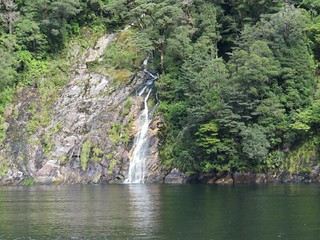
The area was named Doubtful Harbor in 1770 by Captain James Cook because he thought it was doubtful there was sufficient wind to maneuver his vessel into the narrow reaches of the water.  Early explorers wrongly called them sounds instead of fiords.  Sounds are caused by river erosion whereas fiords are carved and gouged out by glaciers.  This probably happened because most of the explorers were English and had never seen fiords before.PicsArt_1427618535277PicsArt_1427618486530PicsArt_1427618762216PicsArt_1427622680614PicsArt_1427621879966PicsArt_1427621780193PicsArt_1427618262431PicsArt_1427618003280

Our cruise started out early in the day when the tour company picked us up at our motel and bused us over to Manapouri where we boarded a boat for an hour ride across Lake Manapouri.  It was a beautiful ride with gorgeous views of the lake and mountains.PicsArt_1427617960648

Once we reached the other side of the lake we boarded a bus which took us through the rain forest over Wilmot Pass.  The only way to reach Doubtful Sound is to cross Lake Manapouri and cross Wimot Pass.  This steep, winding fourteen mile  road is New Zealand’s most expensive road and one of its most remote.  It was built in the 1960’s to provide access for heavy equipment during construction of a power station.  Floods, snows, mud and landslides lengthened the project from 12 months to 2 years.  We had a great bus driver who did a wonderful job maneuvering the mountainous road while keeping us entertained with information about the area.PicsArt_1427617740955PicsArt_1427617873570

The bus dropped us off at the dock at Deep Cove where we boarded a catamaran for a three hour cruise around Doubtful Sound.  At one point we briefly entered the Tasman Sea.  It was pretty chilly but we spent a lot of time on the deck enjoying the views.  We saw a pod of bottlenose dolphins.  There is a pod of about sixty that hang out in the Sound and seldom leave.  These dolphins are among the southernmost in the world.  They enjoyed playing around the boat, occasionally leaping in the air.  They were quick and hard to capture on camera.  We also saw one yellow eyed penguin swimming in the water.  Now we know what those penguins do all day while we are onshore waiting for their return.PicsArt_1427621208896PicsArt_1427621489576PicsArt_1427619519662PicsArt_1427624220489

The catamaran then dropped us back to Deep Cove where we once again rode the bus over Wimot Pass to the boat which took us back across Lake Mansour then to the last bus and back to the motel.  A marvelous ten hour day.  The tour company, Real Journeys, did an exceptional job and all their employees on the buses and boats were very friendly and helpful   They all truly seemed to enjoy their jobs.  And since there is no tipping in New Zealand no one was waiting during any part of the trip with their hand out expecting a tip.

We enjoyed meeting and talking with couples from Australia and France on the trip.

Te Anau, Fiordland National Park and all the area around it is truly a beautiful beautiful place!

Some observations:

  • Diesel fuel is cheaper than gasoline at the fuel pumps.
  • The South Island is more mountainous than the North Island and has fewer people and more sheep, cattle and deer.
  • The South Island is colder, rainier and has many more bugs, especially sand flies.
  • The South Island has more tourists and Americans than we encountered on the North Island.
  • The South Island has more souvenir shops but less fast food restaurants.  Many smaller towns have a Subway restaurant but no other fast food.

March 20, 2015 Aoraki Mount Cook National Park New Zealand

PicsArt_1427254694639

Aoraki Mount Cook 12,316 FT

We had not originally planned on visiting this national park, but after reading about it we realized we were about to miss a real treasure so we changed some reservations and altered our itinerary to allow us to spend a day and night in the park.
In 1851 Captain J. L. Stokes, while mapping the West Coast of New Zealand, sighted a huge mountain which he named Mount Cook after Captain James Cook.  The Maori called the mountain “Aoraki” which means cloud piercer.  In 1998 Mount Cook was renamed Aoraki Mount Cook to incorporate its Maori heritage.  Aoraki Mount Cook is the only place to have its English name preceded by its Maori name.
Aoraki Mount Cook National Park became a park in 1953 and is 270 square miles, with 40% of the area glaciers.  The park has 27 mountains with 140 peaks more than 600 feet high.  Mount Cook at 12,316 feet is the highest in New Zealand.  The park is a gorgeous combination of grasslands, huge river valleys, lakes and snow/glacier covered mountains.PicsArt_1427254251912PicsArt_1427254588800PicsArt_1427254635447PicsArt_1427254517456
Sir Edmund Hillary is New Zealand’s most famous New Zealander.  It was at Mount Cook in 1948 that he climbed his first major mountain, including the difficult south face of Mount Cook.  Hillary trained here for his Everest and Antarctica expeditions.PicsArt_1427255469862
We splurged and stayed overnight at the Aoraki Mount Cook Village – Heritage Hotel with a breathtaking view of Mount Cook from the balcony in our room.PicsArt_1427254836515PicsArt_1427254879336PicsArt_1427255062679
Before heading home the next day we decided to hike the Tasman Glacier Lake Trail which gave  us a view of Tasman Glacier Lake with small icebergs.  Our non-trusty tour book called it an easy 15 minute walk each way.  When are we going to learn not to trust that book?  The hike started out easy enough and we enjoyed meeting a couple from South Carolina along the way.  About a third of the way up the trail we started to come to some rocks to climb on.  Uh oh!  The climb got steeper with a greater number of rocks.  I do okay with steep trails, but I don’t do well with rocks.  I would have never made it to the top without my walking sticks and Bill’s patience and helping hand.  I felt like quite the wimp as young children sailed past me over the rocks and young people rerouted around me.  By the time we got to the top I was sufficiently traumatized and stood frozen to the spot while Bill took pictures of the lake.  The icebergs over the years have dwindled.
While Tasman Glazier is New Zealand’s largest glacier and icebergs periodically tear away from the face of the glacier into the rapidly growing lake,  the effects of global warming and other climatic processes are taking their toll on glaciers.  The Tasman Glacier is melting and calving at an exponentially increasing rate.  In recent years the Tasman Glacier has changed from mainly melting to a calving (pieces breaking from the glacier) and melting resulting in a lake that is rapidly increasing in size.
After Bill enjoyed the view and I pondered how in the world I would ever get down, we began our descent.  Did I mention we also had winds of around 30 mph during the ascent and descent?  Actually the descent wasn’t nearly as bad as climbing up had been but I was relieved to see the car in view.  This was my most difficult hike ever and I was proud of myself for doing it.PicsArt_1427256234540PicsArt_1427255799129PicsArt_1427256558840PicsArt_1427256491055
Some observations:
It feels strange seeing the leaves begin to change color and the farmers clearing their fields as autumn begins in New Zealand.
The drivers in New Zealand are very courteous.  If you turn on your signal to change lanes they immediately back off and allow space for you.  Merging is called “Zip” on traffic signs because you are supposed to merge alternating one lane at a time like a zipper.
Cost of living here is very high.  There is a GST (Goods and Services Tax) of 15% added to all goods and services purchased in New Zealand.
There is no industry in New Zealand so everything is brought in.  For example they ship their logs to Japan where they are made into paper products and shipped back to New Zealand.  Products may be labeled made FROM New Zealand products but it doesn’t say made IN New Zealand.  Everything in New Zealand is centered around farming and horticulture.  One man Bill talked with said a Ford F150 pick up truck here would cost about $95,000 New Zealand dollars.  The man has family in Dallas, Texas that he goes to visit and he said he is amazed how cheap everything is in America.

March 17, 2015 Christchurch, New Zealand

 We left Nelson and headed to Kaikoura.  During the two hour drive we saw many fields of sheep and cattle, as well as several fenced fields with large herds of deer and a field of llamas.  Venison is a popular item on menus here.
Shortly before reaching Kaikoura we stopped at Ohau Point where there were a large number of seals of all ages and sizes on the rocks and in the water.  People were able to walk down on the rocks and get up close and personal with the seals.  They had no fear of people and we hope that people respect the marine life rule: look but don’t touch.  While looking at the seals we talked with a family from New York State.  Always great to meet people from back home!!PicsArt_1426847688649PicsArt_1426845913329PicsArt_1426845997163PicsArt_1426846543154PicsArt_1426846327099PicsArt_1426846766240PicsArt_1426846945101PicsArt_1426847177841
We loved our motel room in Kaikoura.  For the equivalent of $106 American dollars we had a large room with a view of the ocean and small kitchenette, but best of all was the bathroom.  It had heated towel racks, a heated floor and a heater when you turned on the fan so the air was warm when you stepped out of the shower.  Loved, loved, loved it!PicsArt_1426848577753
After a short one night stay in Kaikoura we headed to Christchurch, the largest city on the South Island with a population of 340,000.  The first recorded settlers here were Maori, with European settlers arriving in 1840.  In 1850 the first organized group of English immigrants arrived on four ships and are considered the city founders.  In 1856 it was declared a city and land was set aside to build the first dwelling, a cathedral.
It is called the “Garden City” but today it is very much a city under extensive regrowth and change.  The people of Christchurch are an extremely strong, resilient people full of hope and strength and resolve.  You see, since 2010 Christchurch has been shaken by over 10,000 earthquakes.  One earthquake was 7.1 magnitude, three earthquakes over 6 magnitude, fifty-seven over 5 magnitude, and many thousand more.  The 7.1 earthquake occurred in 2010, but the 6.1 earthquake in February 2011 did the most damage since it was shallow and close to the city center.  The 2011 earthquake killed 185 people and brought down many buildings already weakened from the 2010 quake.PicsArt_1426933713089PicsArt_1426932952379PicsArt_1426932886793
The destruction was evident to us as we walked and drove around the city.  Complete city blocks in the downtown area are now vacant after the destroyed buildings were razed.  In the face of all this tragedy the people have risen to meet the challenge.  Two perfect examples are the Cardboard Cathedral and Re:Start.
When the original Angelica Christchurch Cathedral was badly damaged in the quake, the people of Christchurch, just like the city founders before them, found a way to build a church.  Japanese architect Shigeru Ban designed one of his famous “Emergency architecture” buildings in which a cathedral was built from 96 cardboard tubes, timber beams, structural steel and a concrete pad.  The cathedral opened in August 2013 and is a symbol of innovation, hope, and inspiration.  It is built to last for fifty years while the new permanent cathedral is designed and built.PicsArt_1426933949477PicsArt_1426933846113PicsArt_1426932273487PicsArt_1426931491835PicsArt_1426931983052PicsArt_1426931584830
Another example of the tenacity of the people is Re:Start.  After the quake destroyed their stores in the downtown area, business owners brought in converted steel shipping containers and operated business from these containers.  While many containers remain, we read that the containers are gradually disappearing as more permanent stores are being built.  We walked through the shopping area and had lunch at one of the vendors set up near the containers.  Bill had a lamb souvlaki which he said was very good.PicsArt_1426933050726PicsArt_1426933114187PicsArt_1426933266856PicsArt_1426933387410PicsArt_1426933449255PicsArt_1426933539195
There was evidence everywhere of construction as the city is hard at work rebuilding.  It is somewhat sad to see all the beautiful old buildings razed to make way for the larger new ones because the real charm of the city lies in these past structures.
As we walked their streets, ate in their restaurants, shopped in their stores, stayed at their motel, we were always met with smiling, friendly, cheerful people.  It was our pleasure to meet them.  They are an inspiration!
The next day we took a day trip to Arthur’s Pass which is the highest pass over the Southern Alps, connecting the east and west sides of the South Island.  The Southern Alps is a mountain range which runs along the western side of the South Island and forms a natural dividing range along the entire length of the South Island.  Arthur’s Pass is both a national park formed in 1929 and a small village where we had lunch at a small cafe.PicsArt_1427016427893PicsArt_1427016648557
After lunch we hiked to Devil’s Punchbowl, a 430 foot waterfall.  We use a tour book which we have found tends to underestimate the difficulty of the hikes, and this was another example.  This hike was marked as an easy though steep hike to the waterfall.  Not quite!  We met a couple coming back from the hike and the woman shook her head and sighed and mentioned 289 steps. Didn’t seem a big deal to us until we had started the hike and discovered that some of the 289 steps were cut into the earth and/or high steps which really presents a challenge for my short legs.  It was hard for me but the view at the top was amazing.  While there we met people from Seattle and Tampa, Florida.  For some reason we are meeting many more Americans on the South Island.PicsArt_1427015467225PicsArt_1427015243071PicsArt_1427014879996PicsArt_1427014239506
Some observations:
Most motels have guest laundry and if you don’t want to use the dryers they often have clothes lines outside.  Clothespins are called pegs.
Emergency is 111 not 911.
Reservations are called bookings.  When you go to a restaurant they may ask if you have a booking.
All New Zealand tap (faucet) water is among the world’s best and safe to drink.
On both the North and South Islands the motels all keep electric blankets on the bed.  The blankets are put under the sheet not on top of the sheet.  If you are not careful you will lay on one of the controls which is uncomfortable.  The first time we felt it we thought the springs were coming through the mattress.  We find having the blanket under the sheet where you lay on it with the wires odd.
The cold and hot water faucets are reversed with the cold water on the left and hot water on the right.
They include French fries (chips) with everything on the menu.  Bill ordered chicken parmesan last night and it included chips (no spaghetti). Bill asked if they would substitute mixed vegetables for the chips.  We are both really tired of French fries even though the fries here are always good.  I never thought I would say I am tired of potatoes, but I am!

March 14, 2015 Nelson, New Zealand


We arrived by car ferry in Picton on the South Island.  We were excited to see what how the South Island differed from the North Island.  We knew that less than one fourth of the population of New Zealand lives on the South Island.  We followed the coastline for awhile before starting a steep ascent up a curvy road with many large trucks.  We have learned it is a given that on any day when driving from Point A to Point B, at some time during the trip you are going to be driving on a steep and winding road.  We didn’t know that New Zealand was so mountainous.  The drive to Nelson took longer than we expected and we were tired by the time we arrived.
We were especially glad to be on the South Island since Typhoon Pam was forecast to hit the east coast of the North Island in the next couple of days.  We are expected to only get a little rain.
Nelson is New Zealand’s oldest city and this whole area known as “Marlborough” is known for having more sunshine hours than anywhere else in the country.  The entire region is known for seafood, horticulture and wineries.  This area is New Zealand’s largest grape growing region with 77% of New Zealand’s wine production happening here.  It is said that the wine from here tastes like no other wine anywhere else in the world.
One day we drove to Golden Bay to a beach there called Wharariki Beach.  We had read of a beautiful short hike from the car park to the beach.  The walk turned out to be more than we bargained for as it led us over four fences, through a pasture PicsArt_1426672580970PicsArt_1426672854574PicsArt_1426673018333PicsArt_1426673099564PicsArt_1426675502180with cattle and sheep grazing in the fields and then through up and over several sand dunes to get to the beach.  When we finally reached the PicsArt_1426673426484PicsArt_1426673332884PicsArt_1426673234442PicsArt_1426673555914PicsArt_1426673739899beach it was a beautiful sight to behold.  We walked along the beach and Bill took some pictures of seals on the rocks and PicsArt_1426674076114frolicking in the water.  We walked down the beach to a cave where we saw a mother, father and baby seal.  They were positioning themselves for a nap and didn’t pay us much PicsArt_1426675413421PicsArt_1426674944032PicsArt_1426674802960PicsArt_1426674441368attention.  Bill found a geocache and we headed back to the car.
The next day we went to Abel Tasman National Park, which was made a park in 1942 and is New Zealand’s smallest national park.  It is named for Abel Tasman, the first European in the region.  He never landed in New Zealand but was the first to see the area in 1642, even beating James Cook in 1770.  We thought it rather odd to name a park after someone who never actually set foot on the land!  The park is known for its golden beaches, tranquil lagoons, clear water, walking tracks and forested hills.  It is New Zealand’s most visited National Park.
There are no roads into the park so your options are to get their by boat or park and walk about twenty minutes into the park.  Many people prefer the water option.  You can get water taxis PicsArt_1426746544537PicsArt_1426746097099PicsArt_1426746000734PicsArt_1426745861974PicsArt_1426745573142that will drop you off and come back and pick you up after you have finished hiking and enjoying the beach.  We chose to take a three hour narrated cruise of the 50 kilometers of shoreline.  We passed by Split Apple Rock, Adele Island which is a bird sanctuary, and Pinnacle Island and Tonga Island with seals PicsArt_1426745417054PicsArt_1426745746543PicsArt_1426746450933lounging on the rocks.  Every cove had beautiful beaches with the clearest blue water.  The main rock along the coast is granite approximately 135 million years old.  The granite breaks down and forms the gorgeous golden quartz sand beaches.  We put some people from the States for the first time on our tour of the Parliament in Wellington.  On this cruise of Abel Tasman National Park we met a couple from Houston.
On the way home we stopped to find some geocaches and came upon this sign along the sign of the road.  We loved the picture of the pony on the pottie!PicsArt_1426746626627

Some observations:
Often the motel proprietor walks you to your room, turns on the lights, puts your milk in the fridge, etc.  A nice touch that is not done in the States.
Everywhere we go we notice all the motels have No Vacancy signs by the end of the day.
Many people, especially men have tattoos, some quite large.  Many seem to be typical of the Maori culture.
In order to qualify for citizenship you have to be under the age of 55.