Category Archives: Hiking

hiking

Salem, Oregon May 9, 2018

After leaving Grants Pass our initial plan was to spend four nights in Eugene and three nights in Salem.  The day before our departure we decided to skip Eugene and go straight to Salem, the state capital. It made for a longer than usual travel day but the idea of spending nine nights in one spot without having to move really appealed to us. One of the great things about not having reservations is the ability to change plans at the last minute which we have done several times already this year.

We pulled into the Salem Elks Lodge and were directed into a long full hookup site.  Really nice. Along with sightseeing, the long stay gave us a chance to get labwork done, order several things we needed through Amazon, make some dental appointments and do some planning, cleaning and maintenance on the RV. Somehow we managed to get a chip in the RV windshield so one day we had Safelite come out and repair the chip.

On Friday we drove three miles to the Oregon state capitol building to continue our goal of visiting all the state capitol buildings in the country. We were given a tour by an excellent tour guide. The building was constructed from 1936-1938 and is the third capitol building after the first two were both destroyed by fire. It is an example of Modernistic architecture and looks very different from most state capitol which are usually modeled after the U. S. capitol. Only four other states have Art Deco state capitols – – Alaska, Louisiana, Nebraska and North Dakota. The base is granite and on top is the 23 foot bronze statue gilded in gold leaf of a pioneer. IMG_20180511_131850IMG_20180511_132000IMG_20180511_132028

The pioneer faces north and looks west. IMG_20180511_142730IMG_20180511_142801

Inside the capitol building is a dome with 33 stars painted on the ceiling to recognize that Oregon was the 33rd state admitted to the Union in 1859 after first becoming a territory in 1848. IMG_20180511_132902

The paintings and sculptures in the capitol focused on Euro-European settlement. 

IMG_20180511_132746

Meriwether Lewis and William Clark with Party at Celilo Falls on their way to the Pacific, 1805


We visited the Senate and House Galleries where around the top of both rooms are the names of 158 people significant to the history of Oregon including Thomas Jefferson, Meriwether Lewis, William Clark, Sacajawea, Washington Irving, John Quincy Adams, and James Polk. IMG_20180511_141019IMG_20180511_134807IMG_20180511_141010

In 1843 the people of Oregon territory drew a line in the dirt and the frontiersmen stepped on one side or the other. One side was to remain British and the other to become part of the United States. We know which side won and the concept of a government with open democratic voting began in Oregon.

The Oregon state seal has 33 stars, an eagle with an olive branch and arrows symbolizing peace through strength. Two ships, one American arriving and one British ship leaving symbolize Oregon becoming part of the United States. Oregon’s economy is symbolized with timber, grain, pickax and plow. The covered wagon symbolizes pioneers on the Oregon Trail and the mountains and elk represent Oregon’s natural environment. The state seal is somewhat in the shape of a heart because it became a state on February 14, 1859.  One of the trees growing on the capitol grounds came from a seedling which went to the moon and back! IMG_20180511_140121

We found time to do some geocaching, including finding some very unusual ones! 20180513_140229IMG_20180513_153604

The trees, bushes and flowers in Oregon are just beautiful this time of year. 20180511_131837

We passed several fields of red clover as well as Christmas tree farms. 20180513_141509IMG_20180514_142854

Toward the end of our stay in Salem we drove thirty miles east to Silver Falls State Park, the largest state park in Oregon. It became a state park in 1935 and we enjoyed the trails thanks to the work of 200 CCC workers and skilled workers of the Works Projects Administration. IMG_20180514_142959IMG_20180514_110846We spent the day hiking to several beautiful waterfalls, enjoying the lush environment which included moss covered trees. Two trails even took us behind the waterfalls for a unique view.  We hope to return someday for more hiking.

We visited the South Falls first at 177 feet tall. IMG_20180514_114654IMG_20180514_114926IMG_20180514_115313IMG_20180514_115503IMG_20180514_115705IMG_20180514_123345

The Upper North falls is 65 feet. IMG_20180514_131140IMG_20180514_131809IMG_20180514_135950

We had time for only one more of the ten waterfalls – North Falls at 136 feet. IMG_20180514_133412IMG_20180514_133936IMG_20180514_134400IMG_20180514_135215IMG_20180514_133915IMG_20180514_140410

Next up we head west to spend some time along the Oregon coast.

Below is a link to a waterfall video we made, enjoy the sound of the falling water. https://www.youtube.com/watch?v=x5VRzbF8iA4

Grants Pass, Oregon May 4, 2018

After saying farewell to beautiful Mount Shasta, we headed north towards Oregon. 20180504_105430

We passed over Siskiyou Summit which at 4,310 feet is the highest point on Interstate 5 in the United States. Immediately everything was greener and just gorgeous. 20180504_11161520180504_114359
We arrived in Grants Pass, Oregon, population 34,500. Located along the Rogue River, the town was named after General Ulysses S. Grant. IMG_20180505_143148

The town’s motto is “It’s The Climate”, a reference to this region’s Goldilocks climate: not too hot, not too cold but just rightIMG_20180504_154217

I loved the huge lilac bushes around town as well as the gorgeous white and pink dogwood trees which reminded me of my home state of Virginia. The dogwood is Virginia’s state tree and state flower so Grants Pass reminded me so much of home. 20180504_150810IMG_20180506_140719
While in Grants Pass for three nights we did a lot of geocaching around the town, including one found at the site of the town mascot, a caveman.
One day we drove to Valley of the Rogue State Park for some hiking and geocaching. IMG_20180505_143222

IMG_20180506_142634

This Mural was found in the city of Rogue River

This bridge crosses the Rogue River where a ferry once ran. IMG_20180506_143616
Next stop: Salem, Oregon

Paradise & Weed, CA APR 26, 2018

We left Nicolaus and made the drive north to Paradise, CA. We were excited to visit Paradise because we were going to visit Sara, a former coworker of mine from my teaching days in Charlottesville, VA.  Sara and I last saw each other twelve years ago. IMG_20180427_120221

The Elks Lodge was almost full and was a nice place to stay with full hookup sites. After settling in we met Sara and her family to attend Sara’s daughter’s violin recital. Lucy played ten pieces she had memorized.  She is so talented and it was amazing for someone her age to memorize so many pieces. IMG_20180426_191216

The next day we went on a hike on Table Mountain in nearby Oroville. It was a great day that included waterfalls, beautiful wildflowers and even some kite flying! IMG_20180427_112838IMG_20180427_122309

We finished the day at Sara’s house where her husband Ross showed us his excellent barbecuing skills! One of the many wonderful thing about this lifestyle is being able to catch up with dear friends around the country. Thank you so much Sara, Ross, John, Lucy, Oliver and Franki! We can’t wait to see you again down the road! IMG_20180427_120032

Our next stop as we continued north was Weed, CA.  After almost three months in California, this was our last stop before crossing over into Oregon. As we traveled north we were excited to see Mount Shasta in the distance. 20180501_110027

We were last in Weed in the fall of 2014. A week after we left, a catastrophic wildfire burned hundreds of acres and destroyed more than 150 structures including 140 homes, two churches, the library and community center. But most important, no lives were lost. It has been a long recovery for the town and we were told many people took the insurance money and left instead of rebuilding.

We settled into our campsite with an amazing view of Mount Shasta, elevation 14,179 feet. IMG_20180501_150039

Last time we were here was in September and most of the snow on Mount Shasta had melted. This time was very different. Mount Shasta has seven named glaciers. IMG_1768

One day we drove up Mount Shasta but discovered the upper road was still blocked  by snow. We still managed to go up almost 7,000 feet. Last time we were here we were able to drive all the way up to the Alpine Lodge. IMG_1765IMG_1767

We stopped throughout the day to find many geocaches.  One geocache took us to the headwaters of the Sacramento River.  A really neat and unexpected place which reminded us of the headwaters of the Mississippi River we visited last summer at Itasca State Park in Minnesota. IMG_20180502_14291220180502_142923IMG_20180502_142815

At one point on a beautiful pedestrian bridge a man stopped to ask Bill if he needed any help since Bill appeared to be searching for something lost. Bill decided to take the opportunity to introduce him to geocaching. He thought it was pretty cool. IMG_1770IMG_177220180502_155325

Next stop: Grants Pass, Oregon

Lodi & Sacramento, CA APR 12, 2018

Leaving the Hollister area we drove to the town of Lodi for a stay at the Elks Lodge. Lodi is a major wine producing region with more than 80 wineries located in the area. The town has nicknamed itself the “Zinfandel Capital of the World”. We enjoyed doing some geocaching and found the people to be very friendly.

20180415_152145

Beside the road was this exchange library where we found a geocache hide

Next up was the town of Nicolaus about thirty miles from Sacramento, the capital of California. Even though we drove on major highways, the roads were really rough in some places.  California really needs to spend some money repairing their roads!

On Saturday we drove into Sacramento to visit the state capitol building. It is our quest to visit every capitol building in the country. I will start with the bad comments first.  You may have heard on the news that California has an alarming number of homeless people living on the streets. That fact was very evident in Sacramento. I am not usually frightened by this, but in Sacramento wherever we were there seemed to be several people arguing loudly, cursing, and in one instance approached me for money. It is common to see people wandering the streets with suitcases or carts with all their belongings or sleeping along the roads and in parks. In and around the city, bathrooms in restaurants and stores are locked and you must ask to use the facilities. Their situation is very sad, very disturbing and a little frightening.

California has a lovely state capitol building and we took their tour with an exceptional tour guide. IMG_20180421_111813IMG_20180421_111851IMG_20180421_111919IMG_20180421_115036

He clearly loves his job. California became the 31st state in 1850 and construction on the capitol building began in 1860 and concluded in 1874.  Sacramento was chosen as the capital during the gold rush era because it was located near the highly populated gold rush areas. The capitol is modeled after the U. S. capitol building and has a beautiful 120 foot high rotunda. IMG_20180421_124646

IMG_20180421_124936

A page boy, Queen Isabella and Christopher Columbus

We loved the statue of Ronald Reagan and seeing the legislative chambers. 20180421_11403620180421_121909

IMG_20180421_123958

George Washington portrait overlooking the State Senators

We heard an interesting story about the portrait of former governor Arnold Schwarzenegger. He had the portrait commissioned by an artist in Austria, his birth country. The artist chose not to give it an ornate frame or nameplate like the portraits of other past governors and it was hung that way. Not having a nameplate may not be a problem now, but 100 years from now will people recognize the governor without a nameplate? IMG_20180421_121410IMG_20180421_121433

We went into the gift shop and this bumper sticker caught my eye. 20180421_114419

The capitol building is located on a 40 acre park. We always look for the Liberty Bell located at all state capitals. IMG_20180421_130037IMG_20180421_130100

Next we visited nearby Old Sacramento, a four block area that was the city’s commercial district during the gold rush era and pony express.

The area has cobblestone streets and wooden walkways which give it a feeling of yesteryear. It is very much a tourist area today with restaurants, souvenir shops, carriage rides, paddle boat tours and train rides. We visited the Wells Fargo History Museum. IMG_20180421_143245IMG_20180421_143226IMG_20180421_144242IMG_20180421_144304IMG_20180421_145749IMG_20180421_150506

IMG_20180421_150519

The Sacramento River is crossed by this yellow bridge

Watch their train here: 

We finished the day at Sutter Fort State Historic Park, site of the first European outpost in California. IMG_20180421_155124IMG_20180421_162517

It was established by Swiss immigrant John Sutter with a land grant from the Mexican government and was known as New Switzerland. IMG_20180421_161401

After the discovery of gold the land were taken from Sutter by prospectors. We were surprised to find that the original structures were made by men from Hawaii. IMG_20180421_160405IMG_20180421_160411IMG_20180421_160716

On Monday we made the long drive from Nicolaus to visit Donner Memorial State Park. In order to get there we had to drive over Donner Pass using I-80 and the Lincoln Highway, elevation 7,227. IMG_20180423_12121120180423_143220  

The snow was beautiful on this bright sunny day. IMG_20180423_115410IMG_20180423_122257IMG_20180423_122441

The state park had a very nice visitors center with displays and a movie about the Donner party, a group of pioneers who set out from Missouri for California in May 1846 in a wagon train. 20180423_135733IMG_20180423_135926

The trip usually took four to six months, but due to mishaps and bad decisions they found themselves snowbound in the Sierra Nevada Mountains during the winter of 1846-1947, a record breaking snowy winter.

Of the original 87 pioneers, only 48 survived. It is one of the most famous and tragic tales of pioneer journeys, which included cannibalism to survive. 20180423_135816

On the state park grounds is a monument to the Donner party. IMG_20180423_144029

Next stop: Paradise, CA to see a former co-worker from my teaching days

Yosemite National Park, APR 11, 2018

We left the Hollister area and traveled toward Yosemite National Park. Along the way we passed through more of the California Central Valley agricultural area with fields of crops, pistachio trees, strawberries, many vineyards, sheep and dairy farms with large cattle pens. After stopping for fuel and supplies and dealing with rough roads and steep, curvy mountain passes we pulled into the Mariposa County Fairgrounds. A long day!

When we last visited Yosemite National Park in September, 2014 we stayed in  a campground west of the park which required taking the RV up a very steep curvy road. We chose not to do that again and instead stayed in Mariposa about an hour from Yosemite. Also since the park is at a higher elevation, it is colder in Yosemite with the forecast of snow one night and temperatures in the twenties and thirties.

Our main reason for visiting now was to see the many waterfalls in the park. When we were there the last time, all the waterfalls had dried up from the summer heat and California drought. We were determined to see the waterfalls this time. Ideally it would have been better to wait until May since some of the roads and trails were still closed from the winter snows. But April was the best time for our 2018 travel plans. Another benefit of visiting in April is a lack of tourist traffic and crowds.

It was a little over an hour drive to the park but two road construction delays made the drive longer. It took us all day to drive around the park, stopping often to gaze in awe at the waterfalls and of course take pictures. The recent rains and spring thaws were obvious as we saw high water levels white rapids and gushing waterfalls. Beautiful!IMG_1689IMG_1711

Our favorite waterfall is Yosemite Falls, which has a drop of 2,425 feet and is the tallest waterfall in the United States. The following pictures are taken of the upper and lower Yosemite Falls.IMG_173320180411_103926IMG_1707IMG_1713IMG_1726

No visit is complete without pictures of El Capitan and Half Dome, both famous Yosemite rock climbing landmarks.IMG_1698IMG_1742

We also watched again the movie about the park at the Visitors Center and took a hike to the amazing grand view of Yosemite Falls. We were able to catch the park shuttle bus back to the car.IMG_1715IMG_1717

Here are several other waterfalls for your enjoyment.IMG_1693IMG_1697IMG_1750IMG_1744IMG_1762

Yosemite is an amazingly beautiful place and I am sure we will return again someday.IMG_1757IMG_1758

After leaving Mariposa we will continue to make our way through northern California on our way to Seattle.

Ridgecrest, Buena Vista REC Area, Hollister, CA MAR 30, 2018

After leaving Death Valley National Park we traveled back to Ridgecrest for three nights. Bill visited the China Lake Museum whose mission is to preserve the history of the Navy’s spectrum of weapons research, development and testing. Formerly located at the China Lake Naval Weapons Center, the museum is being relocated off base to make it more accessible to the public. China Lake was started to develop missiles and also was involved in the Manhattan Project. IMG_20180327_123504IMG_20180327_113458

After three days in Ridgecrest we headed north to Buena Vista Aquatic Recreational Area near the tiny town of Taft, California.  Along the way we passed field after field of solar panels and occasionally wind turbines.20180329_114206

The terrain changed from a dry rocky landscape to the agricultural California Central Valley.  We passed field after field of crops, citrus trees and grapes.20180329_132048

We could see aqueducts helping irrigate the fields as well as political signs from farmers asking for more dams instead of the proposed funding for the high speed rail between San Francisco and Los Angeles.20180401_132331

We had a campsite with a view of the lake and enjoyed a peaceful weekend even though it was Easter weekend and the park was full of families. We enjoyed just relaxing and some walks around the park with beautiful sunsets.IMG_20180330_185258

We left Taft and headed to a campground near Hollister, California for a nine night stay.  Hollister is one of three towns in California claiming to be the “Earthquake Capital of the World” because it was built directly on the very geologically active Calaveras Fault, a strand of the greater San Andreas Fault. One evening we felt the earth gently shake and later learned it was a 3.0 earthquake. No big deal.

IMG_20180403_110958Our main reason for visiting this area was to visit Pinnacles National Park. Formerly a national monument established in 1908, it became a national park in 2013, the 59th national park and our newest national park.

The pinnacles are eroded leftovers of the western half of an extinct volcano that was once part of the San Andreas Fault. The park is divided by the rock formations into an east division and a west division with no road connecting the east and west sections of the park.IMG_20180403_113731IMG_20180403_123837

The park has numerous unusual talus caves that are home to more than thirteen species of bats. Talus caves are not like the typical limestone underground caves.  In fact they are not really caves at all. They are formed when steep, narrow canyons are filled with a jumbled mass of boulders from the cliffs above which happened during the ice age. There is no known evidence of the existence of any Native Americans ever living in the talus caves.IMG_20180403_125057

One day we drove to the eastern section of the park which was more easily accessible from our campground. We stopped by the Visitors Center for trail information.  

We discovered there are not a lot of hiking trails in the park, and the trails they have are either rated moderate or strenuous. After talking with a ranger we chose the Bear Gulch Cave and Moses Spring Trails after her assurance it was not a difficult trail. The hike started with a fairly uphill walk until we reached the cave.IMG_20180403_115953IMG_20180403_115236IMG_20180403_120152IMG_20180403_115516

Upon entering the cave we had to rock hop over a series of rocks to keep our feet from getting really wet. Hmm, don’t remember the ranger mentioning this. As we continued on the cave was so dark we had to use a flashlight and light from our cell phone as we began to climb a series of steep steps cut into the cave walls.IMG_20180403_120957IMG_20180403_121224

Hmm, don’t remember the ranger mentioning this. To our left we could hear, but not see running water. Illuminating the area the best we could with the flashlight, we could see a series of waterfall.IMG_20180403_121123

Our path continued either over rocky terrain or steep steps with occasional very narrow passageways we had to squeeze through. At the end of the cave the exit was so low we had to get down on our knees and crawl out. Hmm, the ranger didn’t mention this!20180403_121606IMG_20180403_121655

Once out of the cave we continued on the trail to the reservoir. Once again we climbed steep rocky stairs and at the top emerged into an oasis of water and a few trees. IMG_20180403_123208IMG_20180403_123417IMG_20180403_123422 

After resting a while and enjoying the view we went back down the steep stairs.IMG_20180403_123929IMG_20180403_124035PANO_20180403_12364820180403_124333

Luckily the trail back to the parking lot didn’t not take us back through the cave, though we noticed some people choosing that option. Once was definitely enough. On the way back we passed along some high rocky walks where Bill heard growling from above.  This made us nervous since the area is known as home to bobcats.20180403_130713

We arrived back at the car hungry for our picnic lunch and a rest.

Another day we visited the west side of the park which required a much longer drive from our campground to access the west entrance.IMG_20180409_11544320180409_12532920180409_13024720180409_130948

This side of the park was much quieter and appeared to be less visited. We enjoyed chatting with the friendly park ranger who suggested a brand new trail. This easy one mile loop gave us great views of the pinnacles.

Next up we head to Yosemite National Park to see the many spring waterfalls.

Death Valley National Park, CA MAR 23, 2018

Death Valley National Park has been on our bucket list for a long time. After three days of wind and rain, we woke up to sunny skies as we left Ridgecrest and traveled to Death Valley.  It was not far, but not an easy drive as we passed over two mountain passes, with the second pass at an elevation of almost 5,000 feet. It was then quite a drop down to sea level, a real workout on the brakes!20180323_11575320180323_11110920180323_110939

Death Valley National Park is made up of 3,336,000 acres, making it the largest national park in the lower 48 states and one of the biggest expanses of protected warm desert in the world. There are four National Parks in Alaska which are larger.IMG_20180324_143846

Death Valley is the lowest point in North America and the hottest, driest weather in the country.  It is officially the hottest place on Earth and holds the world record for the hottest air temperature of 134°F.  The valley’s steep mountain walls trap the rising hot air and recirculates it down to the basin for further heating. It has the lowest average rainfall of any place in the country with less than two inches per year, with some years no rain at all. Once again the mountains are to blame.  The mountains capture moisture from passing storms before it can reach the valley.IMG_20180325_170746

Several people have asked us what the weather was like while we were there. This was a great time of year to visit with daily temperatures in the low 70’s with a nice breeze. At night we slept with the windows open.IMG_20180324_141924

One day we stopped by the Visitors Center and saw a twenty minute movie about the park. We then drove through the south end of the park, stopping at Zabriskie Point with beautiful views.  There are many times in our travels over the past five years where places have surprised us with their beauty and exceeded our expectations. Death Valley was definitely one of those places.20180324_130702IMG_20180324_13095420180324_13115520180324_131240IMG_20180324_131357

We took a drive down the Twenty Mule Team Canyon Road which was named for the twenty mule teams which pulled wagon loads of borax across the desert. The mule teams pulled loads weighing up to 36 tons. The rear wagon wheels were seven feet high and the entire mule team was more than 100 feet long.  IMG_20180324_131058

We also drove the Artists Palette Drive with magnificent colors that are impossible to catch with a camera.IMG_20180324_144117IMG_20180324_144155

We visited the Borax Museum where in 1881 borax was found nearby. The Pacific Coast Borax Company mining was done in the area from the 1880’s until the 1920’s when mining slowed down and the area started to become a popular tourist area.  Death Valley became a national monument in 1933 and a national park in 1994.IMG_20180324_120034IMG_20180324_120155IMG_20180324_120858

We hiked a nice trail to Natural Bridge. It seems like almost every park we go to has a natural bridge!IMG_20180324_161223IMG_20180324_161627

A highlight of the day was visiting Badwater Basin, which at 282 feet below sea level is the lowest elevation in North America.  Up on the mountainside was a sign showing sea level.Inked20180324_153230_LIIMG_20180324_152606

As we drove around the park we would see signs showing sea level and various places below sea level.IMG_20180324_141104

Badwater Basin is made up of salt flats. Sodium chloride, or table salt, makes up the majority of the salt at Saltwater Basin.IMG_20180324_152300

Another day we continued exploring by visiting the Harmony Borax Works, the site of one of Death Valley’s first borax operations from 1883-1888.  While searches for gold yielded little success, borax became known as the “White Gold of the Desert “ and was the valley’s most profitable mineral. Borates, or salt minerals, were deposited in the ancient lake beds where water dissolved the borates and carried them to the floor of Death Valley.  Here they recrystallized as borax which was used by blacksmith, potters, dairy farmers, housewives, meat packers and morticians. Many Chinese laborers were recruited from San Francisco to scrape the borax off the salt flats and carry it to wagons to be sent to the refinery. They were paid $1.30 a day minus the cost of lodging and food. They lived in crude shelters and tents.IMG_20180325_111416

Next we walked the beautiful Gold Canyon Trail and enjoyed every second of the hike.20180325_120342IMG_20180325_123917IMG_20180325_12394420180325_12423420180325_13133320180325_130648

Because we hiked at least two trails in the park we each earned a Death Valley decal.IMG_20180325_113621

After lunch we stopped by Salt Creek Interpretive Trail where we walked on the boardwalk through the marshes. Imagine our surprise to find a stream with numerous pupfish. The water originates from brackish springs and marshes more than a mile upstream. The water becomes increasingly salty due to evaporation as it flows downstream. The stream flows alongside the boardwalk in winter and spring and is more salty than seawater. Soon the stream will be dry up until next winter.20180325_14432920180325_144956

The water is too salty for human consumption but manages to sustain life for many plants and animals, including the pupfish. The pupfish have a lifespan of one year or less so they use this time to quickly feed and breed. They are one of the toughest of all fish and are able to survive in salinity several times that of seawater as well as extreme temperatures.IMG_20180325_144350

On our last day we drove in the northern section of the park to the amazing Ubehebe Crater which is only about 2,000 years old. The Crater is a half mile across and about 500 feet deep. If it hadn’t been late in the day we would have walked the trail around the rim.20180325_161426

We had a wonderful time in Death Valley and can now mark it off the bucket list.  We are currently back at the Elks Lodge in Ridgecrest. Thursday we travel to a recreation area in Taft, CA.

Yuma, Palm Desert, Hemet, Acton & Ridgecrest, CA 2018

After our fun time in Quartzsite we headed back to Yuma, AZ for two weeks so Bill could attend the Yuma Hamfest in mid February.  He had a great time and we enjoyed a sort of reunion picnic get together with a large group from the Quartzsite Hamfest as well as a banquet the last night of the Hamfest.
Leaving Yuma we spent a couple days at a casino on the Arizona, California, Mexico border with free RV parking.  We were amazed at the large number of RVs camped out there. We went inside and signed up for a free players card with $5 loaded on it.  Because it was my birthday I was given an additional $5. It didn’t take us long to lose that $10 at the slot machines. I was very content to walk away at that point.  I am glad neither of us have a gambling desire! We actually enjoyed parking at the casino. It was quiet and very secure with lots of roaming 24 hour security.IMG_20180217_155812
On February 20 we continued on to Palm Desert, CA.  Along the way we passed by the Salton Sea which we could see in the distance. We visited the Salton Sea in 2014.  It is a shallow lake located directly on the San Andreas Fault. Its surface is 236 feet below sea level. The lake’s salinity is greater than the water in the Pacific Ocean.  We also saw agricultural areas with citrus trees and plants. I loved the tall palm trees in the distance.IMG_20180221_120847IMG_20180221_121147IMG_20180221_121237

As we drove we noticed the elevation levels on our GPS fluctuating from below sea level to just above sea level. We are in the desert now!IMG_20180221_122506IMG_20180221_123708

We arrived at the Palm Springs Thousand Trails RV Resort where we stayed in 2014.  It is a beautiful area, part of the greater Palm Springs area with streets named Frank Sinatra, Gerald Ford and Dinah Shore.  You can see billboards advertising such services as the ability to freeze your fat and then re-sculpt your body.IMG_20180224_150535IMG_20180224_151003

It is a beautiful area with blue skies and tall palm trees.  On the downside, the traffic is frustrating and since we are now in California, gas is well over $3.00 a gallon.  When shopping you need to remember to take in your own bags so you don’t have to pay for plastic bags; aluminum cans and plastic bottles all have deposits which adds up quickly.

While in Palm Springs we visited a college friend of Bill’s he hadn’t seen in over 40 years.  We had a nice visit and dinner with Leo and his wife Kathy.IMG_20180224_163543

Also while in Palm Springs we drove over to Hemet to Hemet Dermatology to have a skin cancer spot removed from my leg.  On the way we went through a mountain pass where they had snow during the night. It was beautiful. After the surgery I had to take it easy and wear a tight ace bandage on my leg for 10 days. Unfortunately the rest of our time in Palm Springs was spent with my leg elevated and wrapped.IMG_20180227_064905IMG_20180227_071427IMG_20180227_090700

Next up was Hemet for a week at an RV resort we stayed at twice before in 2014.  We really like Hemet and the Golden Village Palms RV Resort. I continued to recover there and one day we drove over to Menifee to meet Bill’s friend Bob for dinner. Bob and Bill worked together in 1980.

We visited the Hemet Public Library to use their free internet.  I was very impressed with their library, including a way to check out books after hours using an outside library access.  You just reserve the books ahead of time and the carousel lets you retrieve your book without going inside. Really impressive!IMG_20180308_112416

Across from the library at the fire station was a pretty mural.IMG_20180307_155935

Our time in Hemet went by quickly and we headed to our next stop at a Thousand Trails Resort in Acton, CA.  20180313_104833

While there, we left the RV and flew to Florida for the wedding of Bill’s youngest son Sean in Vero Beach on St Patrick’s Day.  We took the red eye flight from Los Angeles to Orlando. We arrived early in the morning pretty tired. We picked up the rental car and met our friends Peter and Beth for lunch in Bushnell.  We last saw them at the Albuquerque Balloon Fiesta in October. It is always great to see them. Sure wish we could have spent more time with them but this was a short visit to Florida.

We enjoyed our stay in Vero Beach with Bill’s sweet Aunt Charlotte. We took her to dinner one night to celebrate her 88th birthday. She is truly amazing.20180316_184939

It is always great to see the Atlantic Ocean and the beautiful Florida beaches!IMG_20180316_12040920180316_114800

Saturday, St Patricks Day, we attended the wedding of Sean and Cathy.  A beautiful wedding and joyous day. We wish them many many years of happiness.IMG_20180317_16584220180317_16253520180317_162950

The next day it was back to Orlando and the long flight back to L. A. One reason we chose Acton was because it was only an hour from the L. A. airport and we could safely leave the RV.

The next day we drove into Hollywood to Sunset Boulevard to tour the CNN building.20180319_103245

Bill’s cousin Jeff works there and graciously offered to give us a private tour of the building. Picture taking is not allowed in much of the building for security reasons so we have only a few pictures to share.IMG_20180319_123058IMG_20180319_115604

Jeff did take us to the roof of the building for a great view of Los Angeles and the Hollywood sign.IMG_20180319_110320IMG_20180319_110438IMG_20180319_110222IMG_20180319_110216

We had planned on staying in Acton and visiting Bill’s cousin George in nearby Castaic, but we saw alarming weather forecasts for torrential rains, flooding and mudslides from all the recent fires. So we quickly packed up and moved early to our next destination of Ridgecrest, CA.  We passed by some really cool rock formations on the way. We plan to be back in the Acton area in the fall and will have to check out this area some more.20180320_14002320180320_140047

We are currently at the Ridgecrest Elks Lodge, a great place to stay with full hookups for $20 a night. We have had some rain and the winds are gusting up to 40 MPH. All should be much better tomorrow (Friday) when we head to Death Valley National Park about 100 miles from Ridgecrest for five days.  We are both really looking forward to it since neither of us has ever been there before.

Quartzsite, AZ January 20, 2018

After a fun and busy seven weeks in Yuma, Arizona we headed north to Quartzsite.  Each January and February more than a million RVers converge on this desert community to socialize and enjoy the warm climate.  We were last there in 2015 and had such a wonderful time we have been looking forward to returning ever since.IMG_20180119_181109

For much of the year Quartzsite is a very small community of less than 4,000 people in the hot Arizona desert, but for a couple months during the winter the area swells with visitors in RVs.  There is more than enough desert for all the RVers to have plenty of room to spread out.  Quartzsite is nicknamed the RV Boondocking Capital of the World and the Rock Capital of the World.  During January and February there is a Gem Show, RV show and vendors with anything and everything an RVer could possibly want or need.

Quartzsite was the site of an experiment in the late 1850’s and 1860’s by the U.S. Army who purchased camels and transported them to Arizona to be used as transport animals in the American desert.  The experiment failed mainly because horses and mules feared the camels and panicked when around the large animals.  The camels were eventually auctioned off.  The camel trainer and scout is buried in Quartzsite.IMG_20180130_144654IMG_20180130_144804

Our first day in Quartzsite we attended a large Escapees RV Club Happy Hour event with food and music.IMG_20180117_140722

The next day we moved to a different area where we would spend more than a week at Quartzsfest, a large amateur radio event.  Bill was in his glory with all the amateur radio people, including some friends he had made in Yuma.  A total of 850 amateur radio enthusiasts attended the event with approximately 400 RVs during the week. They had over 118 seminars for Bill to attend as well as daily Happy Hours with door prizes, pot luck dinners and a Hobo Stew.  It was a fun filled time and the days passed very quickly.IMG_20180121_135050IMG_20180121_135133

After Quartzfest ended we joined the Escapees Geocaching Club for a four day rally. Once again our time was filled with daily seminars and Happy Hours, socials, and pot luck dinners.  IMG_20180201_114017IMG_20180201_163653Each afternoon we did some geocaching in the desert, including this one where we searched for “Shorty”, a poor guy whose life ended on the desert while geocaching.IMG_20180201_142826

Unfortunately during my last couple days in Quartzsite I came down with the flu.  By the time we arrived back in Yuma, Bill had caught it from me and had to visit our Yuma doctor.  We have spent the last few days resting and recuperating.  We will be here until February 21st when our time in Arizona comes to an end and we head to Palm Springs, California.

Organ Pipe Cactus National Monument, AZ NOV 28, 2017

We left Casa Grande and headed south to Organ Pipe Cactus National Monument which is seven miles from the Mexican border.  Along the way we passed fields of cotton. 20171128_09342620171128_114235 

We settled in for a three night stay at the National Monument campground  called Twin Peaks (no utilities at their campsites).  Normally we get enough power from our solar panels but it was overcast the entire three days so we had to run our generator twice a day for about 45 minutes to charge the batteries completely.

After getting settled we drove over to the Visitors Center where we watched a movie about the park.  The National Monument is a 516 square mile “biosphere reserve” of rare cacti located in the Sonoran Desert.20171128_14435520171128_150935

One afternoon we drove along part of the southern boundary of the National Monument on the Puerto Blanco Drive which borders Mexico for 31 miles.  We could see some of the wall separating the United States and Mexico in the distance, but were shocked to see this “border” along the boundary of the National Monument!  IMG_1664IMG_1678IMG_1682

We looked and then asked each other if that could really be the only thing separating the two countries??  About that time a Border Patrol vehicle with two border agents came by and stopped to ask us if we were okay.  We asked if that was really the border fence.  They said yes and we commented on what a hard job they have and thanked them for their service.IMG_1669IMG_1675

We drove for about an hour and many many border patrol vehicles passed us as well as helicopters flying overhead.  What a tough and dangerous job they have.  A park brochure said the smuggling of drugs and humans goes on in the park.  In 2013 there were over 4,000 arrests and approximately 100,000 pounds of marijuana seized just in the National Monument alone!  At the Visitirs Center is a monument to a young park ranger named Kris Eggle who was killed in 2002 while attempting to apprehend illegal aliens. The National Monument Visitors Center is named the Kris Eggle Visitors Center in his memory. 20171128_144144 

It was not unusual to see signs like this in the park.  Our first day in the National Monument we talked with a Park Ranger driving through the park and asked him about safety concerns.  He told us most smugglers and migrants want to avoid detection and therefore avoid contact with people.  But we did take extra precautions at the campsite and while hiking.20171128_151319

Speaking of hiking, we learned if we walked at least five miles in the park we would earn a park pin.  We kept track of our hikes and on the last day we stopped by the Visitors Center and picked up our pins. We were pretty proud of them.20171130_152004

During our stay we took several nice hikes which were relatively easy except we had to walk on very rocky trails.  A little hard on the feet but at least I didn’t have to do any rock scrambling which I detest.  20171129_115334IMG_1622IMG_1628IMG_1645IMG_1649IMG_1652

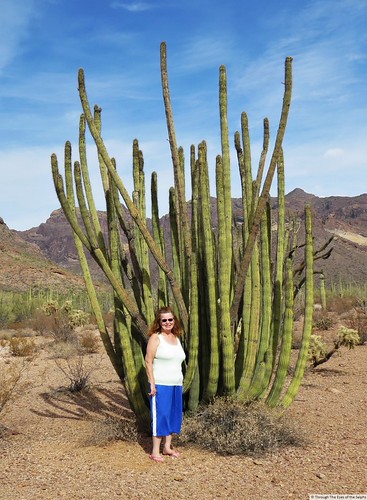
We learned about the various types of cacti, including the organ pipe cactus for whom the park is named. It is easy to see why they are called organ pipe. IMG_1610 

This area is the furthest they grow north of Mexico and the only place they grow in large stands in the United States.  

IMG_1608

These Organ Pipe Cacti Grow On the South Side of the Ridge

On one hike we came across the remnants of an old homestead and corral.IMG_1653IMG_1655IMG_1657

Our second day in the National Monument we drove a scenic road called the Ajo Mountain Drive that wound along the foothills of the Ajo Mountain Range for 21 miles.  It was a dirt and gravel road and our car was really dusty by the time we finished!  The Ranger at the Visitors Center gave us a driving guide that explained various stops along the way.IMG_1619IMG_1631

While we were very happy not to see any snakes, we were disappointed we did not see any wildlife other than birds. We were especially disappointed we did not hear any coyotes at night.  We always heard them while in Tucson and felt certain we would hear them in this very remote park.

Here is the view of the border crossing.IMG_1683IMG_1684

When we left the National Monument we drove through the tiny village of Why.  Next to a gas station we saw a coyote and stopped to take his picture.  Normally they are shy and hard to take their picture.20171201_101028

Next stop: Yuma, AZ where we will be for seven weeks through the Christmas and New Year holidays.

Cactus facts:

  • A Saguaro cactus’ first arm appears at between 95-100 years of age.  It reaches its full height with two or more arms at 200 years of age!IMG_1644
  • Average height of the organ pipe cactus at maturity is fifteen feet.
  • They were named organ pipe by the early settlers who thought they looked like church organ pipes.
  • The organ pipe cactus produces its first flowers at around 35 years of age.
  • Organ pipe cactus, unlike saguaros, live around 150 years.