Category Archives: Hiking

hiking

July 22, 2015 Fishing Bridge, Yellowstone N.P.

We made the hour drive from Grant Village to another campground in Yellowstone in an area called Fishing Bridge.  This is the only full hookup campground in Yellowstone.  By the time we arrived I had a bad headache and didn’t feel well.  Three days earlier I noticed four blister like places on my lower back.  It had the appearance of poison ivy or bug bites, and even though we couldn’t imagine how I got poison ivy or bites there, we didn’t pay them any attention.  After setting up, since the blisters hadn’t gone away and I was not feeling well, we decided to visit one of three medical clinics located in Yellowstone National Park.  Fortunately one of the clinics was a short drive from our campsite.  The diagnosis was shingles, certainly not what we wanted to hear and very surprising.  The doctor put me on 800 mg of Acyclovir five times a day for seven days.  The doctor said she thought it had been caught early but she had no idea whether I would have a full blown outbreak or if the medicine would lessen the severity of the shingles.  We were prepared if necessary to abandon our Yellowstone plans if the outbreak was severe and I needed to be in a town with doctors and stores with supplies.  As it turned out I was very blessed.  One more small blister appeared and that was it.  I was uncomfortable but it was tolerable.  I cannot imagine the agony someone with a full outbreak must endure.

The next day it rained and we stayed home resting and relaxing.  My mind played tricks on me and every time I had an itch I would run to Bill so he could check my back for a new blister.  And every time I felt great relief when he said nothing new was there.

IMG_20150725_142314This post will focus on the animals we saw during our time in Yellowstone.  Since my shingles was under control and I was feeling better, we decided to take a short hike to Natural Bridge.  The signs warned of bears and suggested walking in groups.  We had our trusty whistle, just in case.  Along the way we saw many places where bears had sharpened their claws and marked their territory on trees.

The hike to Natural Bridge was supposed to be short but we took a wrong turn and ended up on a longer trail that took us to the top of the bridge.  The trail became very steep with several switchbacks.  The trail had small gravel that feels like walking on marbles when descending.  I

hate those kinds of

PANO_20150725_134423

Natural Bridge looking down to the trail below

IMG_20150725_140137trails!  Along the way we met a very nice IMG_20150725_140040couple visiting from England and we enjoyed chatting with them while we stopped to catch our breath.  An older lady was trying to make her way down the steepest part of the trail with walking sticks.  We stopped to wait for her to pass and she apologized for holding us up and commented that her walking sticks were not helping.  Since we have walking sticks, Bill asked if she would like him to show her a different way to hold and use them.  He showed her the correct way to hold them, and right away she could feel the difference and felt so much more confident walking on the trail.  She was so happy and as she walked past me she told me how wonderful my husband was for helping her.  Bill is an Eagle Scout and lives by their motto of “Do A Good Deed Every Day”.  We reached the top of the bridge and enjoyed the view, snapped some pictures and began the hard descent down.  When we reached the bottom we saw the shorter trail that led to the view of Natural Bridge from below.  Natural Bridge is a 51 foot cliff of rhyolite rock cut through by Bridge Creek.  In the end we were glad we took that harder trail because we met a nice couple from England and helped the lady with her walking sticks.  It was all good!

Rangers in the park refer to traffic jams by the animals that cause them.  So there are bison jams, bear jams, elk jams, moose jams etc.  Whenever you see traffic stopped or slow moving, it is most likely to be from an animal jam.IMG_0581

IMG_0583There are between 2,300 and 5,000 bison living in Yellowstone.   We got caught in a huge bison jam one day while heading to Hayden Valley which is known to have a lot of wildlife.  We passed through at the time of day a large number of bison were crossing the road to get to the river.  Traffic slowed to a halt or slow crawl as bison blocked the road or people gawked at the bison along the side of the road, everyone trying to get that perfect picture.  At one point we shut off the car engine and just waited.  No worries.  We had plenty of time and enjoyed watching all the bison around us.  Much later in the day we passed through the area again and most of the bison were gone.  One lone bison slowly sauntered down the middle of the road blocking our lane of traffic.  There was nothing to do but follow him and wait for him to move.  He was headed home after a long hard day entertaining crazy tourists.  We had about ten cars in front of us and traffic was piling up behind us.  One driver behind us blew his horn.  He was too far away for the bison to care and just annoyed others patiently waiting.  He is the kind of tourist who should never come to Yellowstone in July.  Eventually, when the bison was good and ready he left the road and wandered up the hillside and began grazing and we were once again on our way!  We have already posted lots of bison pictures in previous posts so we won’t post too many here.IMG_0572IMG_0573IMG_0579IMG_0585

IMG_0591We stopped at Tower Falls and while we were there a small bear walked across the patio area of the gift shop/general store.  A dog barked, scared it and it ran off into a grassy area.  The grass was so tall we could barely see him, not close enough to get a picture.  Later in the day we came upon a bear jam with a mother bear and her cub digging up and eating grubs along the side of the road.IMG_0617IMG_0624

A smaller pronghorn jam occurred later.  Pronghorn are similar to antelope.IMG_0598IMG_0599IMG_0602

We created our own bald eagle jam.  Bill spotted a bald eagle perched on a rock.  Another eagle circled overhead.  As cars noticed us stopped and Bill with his camera, more cars stopped and pulled over.  Before long we had an eagle jam!IMG_0603IMG_0613
During our time in Yellowstone we also saw elk, moose and even a beaver!
IMG_0588

IMG_0729

This beaver was shy!

IMG_0725

Gibbon Falls

IMG_0727

Gibbon River


June 24, 2015 Sundance, Wyoming

After twelve days we left South Dakota and headed to Wyoming. We enjoyed our time in South Dakota but sure experienced some scary weather there. On our next to the last night in South Dakota we were hit with another frightening thunderstorm with winds over 45 mph, lightning, heavy rain and even more hail than we had in the Badlands.

IMG_0249We arrived in Sundance and checked into a nice campground. Wyoming is the least populous state in the country with approximately 544,270 residents spread out over more than 97,000 square miles. It is nicknamed “The Cowboy State” because of the estimated 11,000 farms and ranches. The Black Hills are 90% in South Dakota but this small area of northeast Wyoming, including Sundance, in part of The Black Hills. Our main reason for stopping in Sundance was to visit Devils Tower National Monument. This granite formation rises 1,267 feet from the prairie and has hundreds of parallel cracks making it one of the finest traditional rock climbing areas in North America. The site is sacred to the Lakota and other tribes. Legend has it that the rock rose up just in time to save seven young Indian girls from a bear and the rock rose higher and higher out of reach of the bear. The marks on the tower were caused by the bear’s claws. The girls were pushed up into the sky where they became seven stars (the Pleiades constellation).IMG_0250IMG_0248

The Devils Tower was proclaimed the first national monument in 1906 by President Theodore Roosevelt. Devils Tower is best remembered as the one of the sites in the 1978 Spielberg movie, “Close Encounters of the Third Kind”. I had never seen the movie and as luck would have it the campground office had it for rent so we watched it before going to see Devils Tower.IMG_0252IMG_0253

We walked the Tower Trail that circles the tower where you can see rockfalls of gigantic columns that have fallen. Devils Tower is 1,000 feet in diameter at the bottom and 275 feet at the top.  It was formed 40 million years ago when a column of molten lava pushed through the limestone.  As the rock cooled, it fractured into vertical columns.  The limestone eventually eroded away revealing the towering formation seen today.  It is a wonderful example of erosion.

After leaving Devils Tower we drove to Aladdin, population 15. Yes, you read that right. Population 15. The town is currently for sale if you want a town.IMG_0256

IMG_20150625_151142Sundance, population 1,182 is the largest town in the area. In 1879, Albert Hoge, a Prussian born immigrant staked his claim and named the town Sundance in honor of the “sun dance” performed by the Native Americans.  Perhaps what Sundance is best known for is the Sundance Kid, friend of Butch Cassity. The Sundance Kid, born Harry Alonzo Longabaugh, got his start as an outlaw when he stole a horse, gun and saddle. He spent the next eighteen months in the Sundance jail, earning him his name.  Outside the former jail is a statue of the Sundance Kid lounging in his cell. Not many towns have a statue of a horse thief and notorious bandit as the focal point of their town!

IMG_0261We drove to Belle Fourche (pronounced “Bell Foosh”) which is located in southwest South Dakota and therefore a closer drive from Sundance than from the Badlands. We came here because there is a Center of the Nation Monument in the shape of a compass rose carved out of South Dakota granite.  We were the only ones there at this 21 foot in diameter monument surrounded by the flags of all 50 states.  We love geographical places like this even though the real geographic center is located twenty miles north of Belle Fourche on private property.  IMG_0257This is the geographic center of the United States if you include Alaska and Hawaii.  It was interesting to read that when Alaska was admitted to the union the geographic center shifted 439 miles northwest and when Hawaii was added it shifted 6 miles west-southwest.  Along with the monument was a nice visitors center and an original 1876 log cabin from the gold rush days.  The cabin was hosted by an elderly gentleman, a Korean War Veteran, and since we were the only ones there he had plenty of time for us.  We certainly enjoyed spending time talking with him about the area and we found a geocache behind the cabin.IMG_0259IMG_0260

IMG_20150627_122423While we were in Sundance the ARRL (American Radio Relay League) was having their annual Field Day.  For 24 hours amateur radio operators contact as many other amateur radio operators around the world.  It is a popular contest and challenge among amateur radio enthusiasts.  An AARL group was getting together in the small town of Upton about thirty miles from Sundance so Bill drove over and spent some time with them.  He had a great time talking with fellow amateur radio enthusiasts!

On our last day in Sundance we drove the Spearfish Canyon Scenic Byway which took us briefly back into South Dakota.  We stopped at two waterfalls, the only waterfalls we saw in South Dakota.  The Spearhead Falls was especially beautiful and had a cool refreshing mist blowing on us from the falls.  The sign said Spearhead Canyon was older than the Grand Canyon.IMG_0273IMG_0277IMG_0271

IMG_0280We drove through Deadwood, a western town much like Tombstone, Virginia City or any other tourist attraction with fake gunfights and plenty of places to spend money.  Wild Bill Hickok was killed here in Saloon #10 and is buried in a cemetery nearby.

IMG_0286Before heading back over the border into Wyoming we drove through Sturgis, famous for one of the largest annual motorcycle events held in the world.  Motorcycle enthusiasts from around the world come here in August.  This year will be the 75th anniversary.  We heard the tiny town makes 90% of their income for the year during that one week in August!  The streets were relatively quiet and we could only imagine what the town is like during that week in August!

May 20, 2015 Los Alamos, New Mexico

We left Mancos, Colorado and drove five hours to White Rock, New Mexico just outside of Los Alamos.  There is plenty of nothing between Mancos and White Rock in the way of towns, but the scenery was beautiful.  Southwest Colorado looks very much like New Mexico.  The snow capped Jemez Mountains provided a gorgeous backdrop to the towering red rock formations in northern New Mexico.IMG_20150519_143826IMG_20150519_143837IMG_20150519_144041IMG_20150519_144517

We arrived at the White Rock RV Park which is located next to the White Rock Visitors Center. The park only provides electrical hookups, but since we had originally planned on dry camping in the area and the nights were cold, we were very thankful for the electricity.

We had two main reasons for visiting this area.  One reason was to visit Bandelier National Monument.  Established in 1916, this park is one of the National Park Service’s oldest sites.  Evidence of Ancestral Pueblo people is shown by petroglyphs, multi-story adobe dwellings and dwellings in the rock cliffs going back over 11,000 years.  The park is made up of over 33,000 acres of canyons and mesas.  The Rio Grande River, a mere trickle now, flowed nearby.  To reach the park entrance you have to drive up an elevation change of 1,000 feet and then down 800 feet to the visitor center.IMG_20150520_123526

We first stopped by the Visitors Center in Frijoles Canyon to see a movie about the park.  They had a large area of exhibits about the Pueblo people.  We noticed on the time lines they had BCE or CE after the dates.  I walked over and asked one of the rangers about the initials.  He told us the initials BCE stood for Before Common Era and CE stood for Common Era and those initials now took the place of BC and AD.  Bill and I both found that troubling and will make a point from now on to see what appears on other park displays around the country.

We walked the main loop trail that took us past the remains of ancient homes called the Tyuonyi Village.  IMG_20150520_134508IMG_20150520_135632IMG_20150520_135647IMG_20150520_141119Starting in approximately 1150 AD, the Ancestral Pueblo people began to build homes in this area, the Pajarito Plateau. The interesting walk included walking up and down stone steps through narrow passages which led us to cliff homes built into the rock face.  IMG_20150520_141219We could climb ladders into the homes like the Pueblo did thousands of years ago.  By the mid 1500’s the Ancestral Pueblo deserted these homes and moved further south along the Rio Grande. One thing we especially noticed was the pumice appearance of the rocks in the cliff face.IMG_20150520_140823IMG_20150520_140854IMG_20150520_141440IMG_20150520_141447

IMG_20150520_142522

This is a back wall of a three story high adobe dwelling

By the way, the park is named for Adolph Bandelier, an anthropologist who studied and explored much of the southwest.

Our second reason for visiting the area was to learn more about the Manhattan Project.  It was in Los Alamos that some top scientists and engineers, led by J. Robert Oppenheimer, perfected new nuclear technologies in World War II that led to the world’s first atomic bombs.IMG_20150521_160636

Formerly the Los Alamos Ranch School, established in 1917 and closed in 1943, the buildings and roads from the school were just the right remote location for the United States Government’s Project Y of the top secret Manhattan Project.  “One way the Los Alamos school differed from other health schools at the time was its integration with Boy Scouts. Boys in the school belonged to Los Alamos Troop 22, the first mounted scout troop in the country and now one of the nation’s oldest continuous troops.” see History of the Los Alamos Ranch SchoolIMG_20150521_120129IMG_20150521_115616

We made the short drive from our campsite at White Rock up another 1,000 feet in elevation to the mesas of Los Alamos and first toured the Los Alamos Historical Museum with several rooms of exhibits and artifacts of Los Alamos from the times of the Ancestral Pueblo to the Manhattan Project, with emphasis on the latter.  IMG_20150520_154001IMG_20150521_122204We then drove to the nearby Bradbury Science Museum, a magnificent and impressive museum with movies and over 40 interactive exhibits on the Manhattan Project and the ongoing science and research of Los Alamos National Laboratory. IMG_20150521_153706There were three main galleries focusing on Defense, Research and History.  In the Defense gallery they had models of Little Boy and Fat Man, the first nuclear bombs dropped on Japan that ended World War II.  IMG_20150521_152007IMG_20150521_152042IMG_20150521_151014A movie told us about the Los Alamos National Laboratory and its current mission to maintain the country’s aging weapons without nuclear testing.  In the History section of the museum we saw an excellent movie about the Manhattan Project and Los Alamos from 1942 to 1945 that showed us what life was like back then.IMG_20150521_151503

We have visited many museums over the years and almost all of them have charged an admission.  Both the Los Alamos Historical Museum and the Bradbury Science Museum were free of charge.  The Bradbury Science Museum is funded by the Department of Energy, so I guess we are paying admission in a round about way!

Located today in Los Alamos is the Los Alamos National Laboratory.  The facility is called one of the premier scientific institutions in the world.  It has an annual budget exceeding $2 billion, has 2,100 individual facilities across 38 square miles of Los Alamos, and employs 11,000 people.  The Lab is operated for the U.S. Department of Energy by Los Alamos National Security.  The core mission of the Laboratory is national security in regard to ensuring the safety and reliability of nuclear deterrent, reduce the proliferation of weapons of mass destruction and to counter terrorism.

There are no tours of the Laboratory and security around the facility is tight.  When we were driving from Bandelier National Monument back to our campsite the road took us through land owned by the Lab.  As we were exiting the area we had to go through a checkpoint where Bill had to show his driver’s license and explain where we were going.  The guard then said, “Do you vouch?” Bill said, “What?????” The guard then said, “Do you vouch for your passenger?” Strange.  Why didn’t he just ask for my driver’s license too!

We enjoyed our time in the White Rock/Los Alamos area.  We found the drivers to be especially courteous and the people friendly.  We loved our campsite where we could look out the windows at snow capped mountains.  The weather was chilly during the day and cold at night.  During our time there we had some very heavy rain and a few thunderstorms, one of which presented us with a gorgeous rainbow.PANO_20150521_192044

May 8, 2015 Winslow, Arizona

Driving from the Grand Canyon to Winslow AZ turned out to be more of an adventure than we expected.  As we were preparing to move from the park we were surprised to see an occasional snow flurry.  As we drove towards Flagstaff at an elevation of 7,000 feet, what started as a steady rain quickly turned into snow with the temperature hovering just above freezing.  The snow followed us to Flagstaff where we stopped for gas and lunch.  The dark threatening clouds made us eager to eat fast and get back on the road.  The snow eased up as we descended into Winslow with an elevation just under 5,000 feet.  However the snow was replaced by winds averaging 35 mph at our campground at Homolovi Ruins State Park.  Bill had to strain to push the door open against the wind while I got out.  We checked in at the Visitors Center and proceeded to our site.  Even with the jacks down the wind really buffeted us until the wind calmed down at sunset.  At one point clothes hanging inside on a hook were swaying back and forth from the force of the wind hitting us.

At this campground we are truly in a desert environment with sand, scrub bushes and signs warning of venomous snakes and insects.

The tiny town of Winslow, surrounded by Navajo County, surprisingly had a Walmart Supercenter.  Do you recognize the name Winslow?  It was made famous in the Eagles song “Take It Easy” with the lyrics “Well I’m a standing on a corner in Winslow, Arizona and such a fine sight to see, It’s a girl, my Lord in a flatbed Ford slowin’ down to take a look at me….”. In the middle of town is a statue of a guitar playing guy with the backdrop of a Ford flatbed truck with a girl inside.  Parked on the curb near the statue is a real Ford flatbed truck.  Across the street is a gift shop displaying souvenirs of the guy standing on the corner.  Route 66 runs through this part of Arizona and Route 66 souvenirs are everywhere.IMG_20150509_154913

IMG_20150510_143728

This model represents what it looked like in the 14th century

The Homolovi Ruins State Park has two archeological sites dedicated to preserving the homeland of the Anasazi and Hopi people who first came here between 1260-1400 A.D. The Hopi people today still consider this their homeland and make pilgrimages  to these sites.  This state park was established for the purpose of protecting these sites and the idea was supported by the Hopi people.  The park opened in 1993.

We visited the largest of the two archaeological sites.  Despite a nice paved walkway to the site, there is really not much left to see except some small remains and shards of pottery.IMG_20150510_141732IMG_20150510_142213IMG_20150510_142200

We drove to the Meteor Crater Discovery Center to see the best preserved meteorite impact site on Earth.  50,000 years ago a meteor which had been hurtling through space for 500 million years, crashed into the earth.  The impact left a crater nearly a mile across and more than 550 feet deep.  The crater is so large that a 60 story building would not reach the rim.  It is large enough to hold 20 football games with two million fans watching on the crater walls.  Because the terrain so closely resembles that of the moon and other planets it was once used as an official training site for NASA Apollo astronauts.IMG_20150510_114926IMG_20150510_114905

The Discovery Center had an interesting movie which simulated how the impact may have occurred when the  crater was formed as well as many interactive displays and artifacts.  We were able to see and touch the largest meteorite fragment found at the crater.  In the beginning geologists and scientists determined that the crater was formed by a volcano. After many years new scientists proved the crater was formed by a meteorite and not a volcano.  It was interesting to read that scientists think a meteorite crashing into the earth millions of years ago was the probable cause of the extinction of the dinosaurs.  It is believed the impact in Mexico caused an “impact winter” which eliminated plant and animal life.PANO_20150510_114748

They had two outside viewing areas, an upper and lower deck.  It was difficult to get a picture of the entire crater in one picture.  The site has been designated as a “Natural Landmark” but is privately owned.  As far as we could tell access to the crater is limited to the two observation decks and a paved trail around the rim.

You just never know what you will find in the Arizona desert!

May 5, 2015 Grand Canyon National Park, Part 4

We continued to explore more areas of the park.  It is a huge park with so much to see.  We rode the shuttle bus to the western most point of the park which is only accessible by shuttle bus.  Our first stop was Hermit’s Rest.  In the early 1900’s a French Canadian took up residence in the canyon for twenty years and became known as “the hermit of the Grand Canyon “.  He ended up being a valuable source of information and one of the area’s primary guides.  Hermit’s Rest is named in his honor.  The building is one of seven in the park designed by southwestern architect Mary Jane Colter.  She is known for her Native American architecture and use of materials from the area.IMG_20150505_152001IMG_20150505_152414IMG_20150505_143648IMG_20150505_152759

We hiked part of the way along the Rim Trail and found a few geocaches before hopping back on the shuttle bus.  We were very impressed with the park shuttle bus service during our time in the park.  The bus drivers were friendly and helpful and the buses punctually arrived at convenient stops every 10 to 15 minutes.  Considering it was sometimes standing room only on the buses, they were well utilized by tourists visiting the park.IMG_20150505_152827IMG_20150505_155307IMG_20150505_155318IMG_20150505_155645IMG_20150505_161340IMG_20150505_161550IMG_20150505_161656IMG_20150505_172719IMG_20150505_175119

We stopped at Powell’s Point which is named after Major John Wesley Powell, the first explorer to journey down the entire length of the canyon on the Colorado River in 1869.  This feat is even more amazing considering he lost an arm during the Civil War.  He began the journey with nine men and four wooden boats.  Several months later he completed the trip with five men and one boat.  Several men had deserted the group along the way and were never heard from again and four of the boats had broken up.  Powell made a second trip in 1872.  There is a large monument to Powell and his men at Powell Point.IMG_20150505_181902IMG_20150505_181724

I think the western viewpoints are among the prettiest in the park and we had great views of the Colorado River from the rim.  The Colorado River is one of the only rivers in the world that classifies its rapids on a scale of 1 to 10 instead of 1 to 6 like other rivers.  There are many rapids in this part of the Colorado River with the Lava Rapid being the highest rated commercially run rapid in North America.  The majority of the rapids in the Grand Canyon are caused by debris that is funneled into the river from side canyons.

Another day we drove to the eastern end of the Grand Canyon.  Shuttle bus service does not extend this far.  Along the way we saw a large male elk feeding alongside the road and several other elk close by.  IMG_20150506_135250At the eastern end we visited the Desert View Watchtower, another Mary Colter design and one of the most prominent architectural features in the park.  Built in 1932, it is modeled after ancient Pueblo watchtowers found in the Four Corners region.  The tower is 70 feet tall and since it is the highest point in the South Rim, it provides stunning 360 degree views.  The inside of the tower was amazing with a staircase climbing to the top and walls displaying petroglyphs and murals by a Hopi artist and crafts by local Hopi artisans.IMG_20150506_150228IMG_20150506_144705IMG_20150506_143218IMG_20150506_142701

On the way back from the Desert Tower we stopped at several rim viewpoints.  Here are some pictures from the Grandview Point including a video.

use this if you don’t see the above video “https://www.youtube.com/watch?v=XoXj2VUueks&feature=youtu.be”

IMG_20150506_155119

On our last day in the park we hiked three miles with an elevation drop of 500 feet into the canyon on the Bright Angel Trail.  We had really hoped to do more hiking and biking while at the Grand Canyon, but we both had colds/allergies that lingered for over two weeks, and with the 7,000 foot altitude, we were just not up to it.  But by the last day we were feeling better and were determined to hike a little of the famous trail.  The day was a little cool and windy but had bright blue skies.  The trail is great and the same one is used to take visitors down by mule.  The hike down was fairly easy but the hike back up took twice as long.  We passed two really cool tunnels.  I loved the camaraderie of the people hiking the trail of all ages and fitness levels.  People greeted each other in passing and often asked how far they were hiking or if they had returned from hiking to the river.  We recognized those planning to hike to the river and back since they had large backpacks with supplies.  There were signs warning hikers not to attempt to hike down and back in one day due to the strenuous nature of the hike.  It usually takes half a day to hike to the bottom and a full day to hike back up.IMG_20150507_114638IMG_20150507_115730IMG_20150507_124649IMG_20150507_125323IMG_20150507_131548

Our ten days went by much too quickly and the park is on our list of places to return to someday.

April 11, 2015 Hamilton, New Zealand

We enjoyed our stay in New Plymouth regardless of the rainy weather.  Our last night there Bill was able to connect with some Kiwi ham radio operators on his hand held ham radio he brought with him.  He really enjoyed chatting with them.

The next morning the rain continued and we drove to Otorohanga for an overnight stay on the way to Hamilton.  We don’t usually stay at bed and breakfast lodgings, but this place had excellent reviews and the choices in tiny remote Otorohanga were very limited.  This bed and breakfast was located in the countryside and the proprietors had chickens, horses, a donkey, dog and cat.  We had a nice room with an outside entrance and private bath.  Breakfast was included in the price of the room so the next morning Bill enjoyed Eggs Benedict made with fresh eggs and I chose croissants with homemade jam.  It was nice that the proprietor was a chef by trade.

The next morning we headed to Hamilton for a three night stay.  Not far from the bed and breakfast lodging we came upon a field of several ostriches.  One was particularly friendly and quickly came over to see us.PicsArt_1428824829414 The weather was horrible for most of the drive to Hamilton with heavy downpours and wind.  We planned on visiting a Natural Bridge and a waterfall, both of which required a small hike.  We refused to let the weather defer our plans so we put on rain gear and trudged on.  We knew we couldn’t say “we would do it tomorrow” or “next time”.  It was now or never and we refused to let the rain stop us.

Our first stop was Mangapohue Natural Bridge.  A walk over several suspended catwalks and a swinging bridge led us to a beautiful limestone double archway.  Due to the lack of sunlight on this rainy day and the cave like interior, it was hard to get pictures to do the natural bridge justice. AfterPicsArt_1428825077344PicsArt_1428825293060 a short drive further down the road we came to the trail leading to Marakopa Falls, advertised as one of the most picturesque falls on the north island.  This one hundred foot waterfall was spectacular, made even more so by the heavy rains.PicsArt_1428825424436PicsArt_1428825669990

We were traveling on back roads and passing through small towns.  Our bed and breakfast proprietor did suggest we stop at one tiny restaurant that had great pies.  In New Zealand, pie always means a meat pie, similar to a chicken or turkey pot pie in the States.  There pies are usually beef, steak, lamb or kidney.  They never have fruit pies and you never see a slice of fruit pie on the menu in restaurants.  I find this so strange since they have so many orchards and farms here.  We stopped at the pie shop and Bill chose a steak and cheese pie which he said was “okay”.  I think he expected more since the motel proprietor said they always stop there and buy pies when they pass through the area and commented on how good they were.

We arrived in Hamilton still wet from our hiking excursions and glad to reach the hotel since the weather continued to be wet and miserable.  We have been really really lucky with the weather so far so we can’t really complain. Hamilton is a large college city with a vibrant downtown area with many restaurants to chose from.   Like most downtown areas with an abundance of restaurants within a small area, we had to circle around for awhile looking for a place to park.

Besides having several grocery stores they also had a Dunkin Donuts, our first since arriving in New Zealand.  We were excited and went there for breakfast one morning.  It was a bitter disappointment.  They don’t use Dunkin Donuts coffee blend which was a huge disappointment to Bill.  We buy Dunkin Donuts to fix at home in the States and he was looking forward to some coffee that tasted like home.   Instead he got the same stuff he gets everywhere.  Second disappointment was the price.  $12.50 for a half dozen.  Third disappointment was they were stale.  Bill mentioned this to the clerk and she said they are made at the Dunkin Donuts in Auckland an hour away and trucked in to Hamilton.  On top of that they freeze them.  So after almost two months we are still waiting for a good donut and a decent cup of coffee.

Our main reason for coming to Hamilton was to take the tour of Hobbiton in the nearby town of Matamata.  We drove on Saturday to Matamata for our 12:30 tour.  The Hobbiton bus took us thirty minutes into the countryside to the Alexanders’ spectacular 1,250 acre sheep and beef farm. PicsArt_1428827939323PicsArt_1428825946475PicsArt_1428826131629 This farm was selected by Sir Peter Jackson as the setting for many scenes for the “Lord of the Rings” movies.  The bus took us on a narrow winding road constructed by the New Zealand army so that the set could be constructed.  Sir Peter Jackson sent the Alexander family on an all expense paid vacation for three months and took up residence in their house where Jackson and his team went over daily film takes and conducted business.  Sir Jackson was a stickler for detail.  He didn’t like the sheep on the farm and brought in black face sheep from England.  He had members of the crew walk each day on the path to and from the various clotheslines so the path would look worn down.  He had a huge artificial tree built with over 250,000 fake leaves. When he didn’t like the color green of the leaves he had each leaf repainted to the shade of green he wanted.PicsArt_1428826841017PicsArt_1428826357250PicsArt_1428826981174

After the filming ended the sets were all taken down.  Then in 2009 the sets were all permanently rebuilt for the filming of ” The Hobbit Trilogy”.  PicsArt_1428826231025PicsArt_1428826300832PicsArt_1428826582829PicsArt_1428827150135Today daily tours are given of the movie set.  We had a great tour and at the end of the tour we stopped by the Green Dragon for a complimentary alcoholic beer or non alcoholic ginger beer.  PicsArt_1428827238082PicsArt_1428827790143We were so fortunate that the rain had stopped overnight and it was a beautiful sunny day.

On our last day in Hamilton we found a geocache, walking on a path covered with fallen leaves with leaves softly falling around us in the breeze.  Autumn in New Zealand and springtime awaiting us back home!  One week to go!

April 8, 2015 Wellington, Wanganui, New Plymouth, New Zealand

We left the South Island on Easter Sunday and traveled on the car ferry back to the North Island where we will stay for two weeks before flying home.  We have already toured the east coast of the North Island, driven east to west around the South Island, and now we will drive around the central and west side of the North Island to complete our journey.

The ferry ride was very unpleasant for me.  It started off fine but once we left the channel and got out into the ocean, the choppiness of the water and rocking of the boat made me feel very nauseous, even with two Dramamine in my system.  I spent the last two thirds of the trip sitting outside on one of the upper decks freezing with the cold and wind, but the cold air helped to fight the nausea.  How I envy people who read in moving vehicles and sit in the back seat of a car without getting sick!!

We arrived in Wellington late in the day and found an Italian restaurant within walking distance of our motel that was open on Easter.  The next day before heading out of town we drove around the Wellington Harbor for a last look at this charming capital city.  We were once again captivated by all the houses crowded on the hillsides and surprised to find surfers in the water around the harbor area.PicsArt_1428491181734PicsArt_1428492132046PicsArt_1428492032955PicsArt_1428491672401

We left Wellington and headed along the coast to Wanganui for a one night stay.  The next morning we drove to New Plymouth.  We took a slight detour to visit Egmont National Park where we took a short hike to Dawson Falls.  PicsArt_1428493453500PicsArt_1428493312626Since it was a cloudy day threatening showers, we did not have a clear view of Mt Taranaki in the distance.  Mt Taranaki is the North Island’s most majestic peak.  It is not often you see a conical volcano rising abruptly from sea level surrounded by beautiful beaches!PicsArt_1428493037055PicsArt_1428492499883

We spent two nights in New Plymouth.  We had planned to spend some time walking the beach there but our only full day in the town brought heavy rains.  The rain gave us a good excuse to have a nice “at home” day to relax and watch some tv, work on the blog and rest.PicsArt_1428493596854

Some observations:

  • New Zealand is an agricultural and dairy farming country.  So why are milk, fruits and vegetables so expensive?

March 31, 2015 Franz Josef Glacier and Greymouth, New Zealand

We left Queenstown and drove on the Haast Highway over Haast Pass, stopping along  the way to grab a shot of the Depot Creek Waterfall.  Since it was a long drive to our next destination, we stayedPicsArt_1428055408110 one night in the one horse town of Haast in the middle of nowhere,  and here is the horse to prove it. PicsArt_1428055531406 Haast had just one tiny antique looking gas pump, a couple motels and two restaurants with very limited menus.  One restaurant was the hotel restaurant.  After checking the menu we decided to drive to the other one down the street.  This restaurant had antlers hanging from every available space in the rafters throughout the restaurant.  Must have been over a hundred.  Eating while looking at partial deer carcasses and a limited menu convinced us to go back and eat at the hotel restaurant.  The sign on the restaurant door said “Beyond Your Wildest Expectations”.  We laughed.  Yep, pretty much described the town!  We did drive down to the beach for a look at the Tasman Sea before PicsArt_1428055703378heading inland. The Tasman Sea is a small sea of the South Pacific between Australia and New Zealand.  Since it was supposed to be chilly that night and I am very cold natured, we tried turning on the heat in the room with no response.  We asked at the front desk about the heat and they said it was controlled for the whole building by one control and they hadn’t turned it on for the winter yet.  When we asked about the electric blankets they advertised having, they said they never had electric blankets. They did give us a small radiator heater to take back to the room.  Kind of like a night in the Twilight Zone.

The next morning we continued on to “Glacier Country” and entered Westland Tai Poutini National Park for a three night stay at a town called Franz Josef Glacier.  PicsArt_1428055988695We came here to see the Franz Josef and Fox Glaciers.  We drove first along the seashore and then headed inland up the mountain pass through a rain forest setting with ferns and heavy tree cover.  The forests and woods on New Zealand are very thick.  The tiny town of Franz Josef reminded me of a ski village since it is tucked in the rainforest foothills of the southern Alps.  The town had one gas station, one grocery store and several restaurants.  No fast food here, not even a Subway. The gas here was about fifteen cents more per liter than we have paid anywhere else.

Our motel here was made up of ten little cottages and we enjoyed our cottage in the rain forest with a view of the snow capped mountains from our windows.PicsArt_1428315789605

There are around 140 glaciers that flow from the Southern Alps, however only Franz Josef and Fox Glaciers penetrate as far as the lush lower rainforests only 1,000 feet above sea level.

If you asked any ranger in a national park in the United States or New Zealand they would tell you that due to global warming, the glaciers are retreating at an alarming rate.  They say they are getting too much rain instead of snow in the winter and they will show you pictures of previous winters to prove it.  Yet there areas of the U.S. for example that are receiving record breaking cold temperatures and snowfall.  Global warming or not?  The whole debate gives us a headache.  We can only tell you what we see with our own eyes and let you decide.

As you look at the pictures of our hikes to see the glaciers, keep in mind we are hiking on land once covered by glaciers.  We saw signs showing us where glaciers once were not many years ago.  We passed several areas that used to be viewpoints but as the glaciers retreat, the hike is lengthened and the viewpoints moved in order to continue to see the glaciers.

We drove to a viewpoint where we could see Mt Cook, Mt Tasman and the Fox Glacier.  PicsArt_1428134533958PicsArt_1428134623641PicsArt_1428134687900PicsArt_1428135738823We then drove to the beginning of the Fox Glacier Valley Track to see Fox Glacier up close (meaning 200 meters away).  Fox Glacier is fed by four alpine glaciers and it falls 8,530 feet over eight miles. The hike was longer and steeper than we expected, with rock hopping over four streams and a very steep climb at the end on a rocky path.  Neither Fox or Franz Josef Glaciers are pristine white.  In fact they look quite dirty from the dirt and rocks that fall on them.PicsArt_1428136279437PicsArt_1428136800233PicsArt_1428137282498PicsArt_1428198835506PicsArt_1428136959959

The next day we did the Franz Josef Glacier Valley Track, a slightly longer hike but less steep and without any rock hopping over streams.  What made this hike special were the beautiful waterfalls we passed along the way to the glacier viewing area.PicsArt_1428139836990PicsArt_1428199739506PicsArt_1428199297771PicsArt_1428200164457PicsArt_1428200299322PicsArt_1428200542769

Our time here went by very quickly.  On our last day the owner of the motel brought us a basket of scones, still warm from the oven with butter, strawberry and raspberry jam.  They were delicious and we wolfed them down.

Leaving Franz Josef, we drove to Greymouth, stopping at Hokitika Gorge for a quick hike to the swinging bridge and a couple pictures.  PicsArt_1428315863987PicsArt_1428315966924PicsArt_1428315912045We stayed overnight at a lovely motel owned by a couple originally from the Netherlands.  We arrived in Greymouth on Good Friday and discovered almost everything closed for the holiday.  The two grocery stores in town, the shops and restaurants all closed.  It reminded me of what Christmas was like fifty years ago.  We found a McDonalds open and had dinner there.  While sitting there eating, a jeep pulled up giving us a full view of a dead deer draped over the spare tire on the back.  Didn’t bother Bill but a real appetite suppressant for me!

The next day we drove to Westport.  There are approximately 26 towns in the world called Westport, with many of them being in North America.  This is the only Westport in the southern hemisphere.

On the way to Westport we stopped by the Punakaiki coastal rocks which resemble huge stacks of pancakes and therefore are called Punakaiki Pancake Rocks.  These limestone rocks were formed thirty million years ago and have been sculpted by mildly acidic rain, wind and sea water.  The pancake effect was caused by immense pressure on alternating soft and hard marine life and plant sediment.  By the time we arrived at Pancakes Rocks there was a steady rain and gale force winds so strong it was impossible to keep an umbrella from turning inside out.  I could have possibly flown like Mary Poppins if I had tried to open one.  We put on raincoats and ponchos and refused to let the storm stop us.  We followed a nice paved trail that wound along the rocks with informational signs.  One sign said the rocks are gradually being eroded away by sea and wind.  By the time we returned to the car we were thoroughly soaked from the thighs down.  Unfortunately we still had an hour drive to Westport in wet clothes on a chilly day.  Amazingly even under these weather conditions  Bill was able to get some great pictures of the rocks.PicsArt_1428201370094PicsArt_1428201140224

This overnight stay in Westport ended our visit to the South Island.  We will take the car ferry back to Wellington Easter Day.  We will spend an additional two weeks on the North Island before flying home.

Some observations:

  • Almost all the motels we have stayed at are owner operated.  Along with fresh milk they offer laundry facilities.  Sometimes the laundry facilities are pricey, sometimes cheap and occasionally the washers are free and you can hang the laundry on their line or pay to use the dryer.
  • Internet has been much better than we expected and has been free at the motels.  Often it is unlimited and some limit the amount of usage.  It has enabled us to keep up with the blog and publish posts more often than we expected.
  •  We have noticed a lot of backpacker hitchhikers on the South Island.  Someone told us many of the restaurants employ backpackers on a short term basis while they are passing through the area.  They will work long enough to earn money for food and supplies before moving on.  All the servers in our restaurants have been young people.
  • Most restaurants add a 15% to 20% surcharge to your bill on public holidays, including Good Friday, Easter, and the Monday after Easter.
  •  While in Franz Josef we met several people from Florida on our glacier hikes including one who lives in Miami as well as several University of Florida graduates.  We also met people from Idaho, England and Australia.  There are a lot of Australians here on holiday.

March 22, 2015 Dunedin and Invercargill, New Zealand

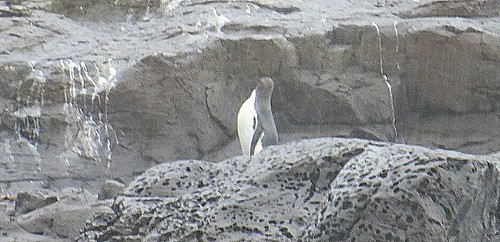
After our visit to Mount Cook we stayed overnight in Timaru.  The next morning we drove towards Dunedin.  Along the way we passed the 45 parallel south which meant we were now closer to the South Pole than the PicsArt_1427353374559equator. We stopped at Katiki Point because our tour  book said we might be able to spot some yellow eyed penguins, the rarest and most endangered penguins in the world and native to New Zealand.   One of our goals while in New Zealand was to see penguins, preferably in the wild in their natural habitat.
We parked and began to walk along the beautiful coastline toward the point.  Suddenly Bill stopped and motioned toward a bushy area.  There, a few feet away, were two yellow eyed penguins.  So exciting!!  They are now at the time of year when they are molting, so they looked a little different from what you might PicsArt_1427256961287expect.  At first we barely moved and didn’t utter a sound for fear of scaring them away.  Once Bill took some pictures we moved closer down the path and they didn’t appear at all afraid of us.  This area is a highly protected reserve and we think they have become accustomed to people and know they have nothing to fear.  The area is under video surveillance and everyone is expected to follow the rules or face stiff penalties.
We proceeded down the trail and came upon one more penguin closer to the rocky shoreline.  What was really neat was there was also a fur seal not far from the penguin so we were able to get a picture of them together.PicsArt_1427257185593PicsArt_1427257249842
We walked to the end of the point passing by huge fur seals lounging on the rocks and upper hillsides.  We could have literally stepped over the seals and they would have cared less.  We enjoyed the view at the end of the point and walked back to the car, so pleased with our penguin discoveries.PicsArt_1427257784210PicsArt_1427257845710

Along the way to Dunedin we saw breathtaking views of the ocean with sheep grazing along the cliffs and people on horseback riding on the beach.   As we crested the top of a steep hill, we had a breathtaking view of the Dunedin nestled next to the ocean.  The first European settlers were Scottish settlers who arrived in 1848. It was originally named New Edinburgh but the name was changed to Dunedin which is an old Celtic name for Edinburgh.

“The people are Scotch.  They stopped here on their way from home to heaven, thinking they had arrived.” Mark Twain
Nearby goldfields generated wealth in the area and New Zealand’s first university, the University of Otago, was established here.  The discovery of gold encouraged the arrival of Chinese miners and by 1871 there were over 4,000 Chinese miners in the area.  Many settled permanently in Dunedin and are an important part of the community today.
We arrived in Dunedin late in the day since our penguin adventure took longer than expected.  We didn’t really have much time to explore the city before dark.  We did drive to Baldwin Street which is named in the Guiness Book of Records as the steepest street in the world.  The street runs from 98 feet above sea level to 330 feet above sea level with a slope of between 20% to 35%. The lower part of the street is asphalt but the upper reaches of the street, which is the steepest, is surfaced in concrete for safety on frosty mornings.2015-03-28_04-36-142015-03-28_04-35-56
Dunedin is often called the eco-capital of the world because of all the nature and wildlife in the area.  The Dunedin Railway Station is said to be the most photographed building in New Zealand.
I wish we had had more time to explore this charming city with its beautiful old Victorian and Edwardian buildings.
Next we headed to Invercargill.  Along the way our tour book suggested we stop by Nugget Point Lighthouse, which is the most photographed lighthouse on the South Island and a location often seen on postcards andPicsArt_1427258167378PicsArt_1427258384986 brochures of New Zealand.  The book said it was possible to see penguins here, though the best time to see them was between 5 and 6 PM  We saw a hide which is a little structure where people can hide so they can see the penguins but they don’t see us. It was early afternoon and we didn’t want to wait around that long since we still had a long drive to Invercargill.  We did trudge to the end of the trail where the lonely lighthouse sat on the edge of a PicsArt_1427258454378rocky cliff.  We enjoyed talking with a couple visiting from England.
Our time in Invercargill was short but Bill did have time to visit the E Hayes Motorworks Collection where there is a remarkable vintage motorcycle and car collection, but more importantly the world’s fastest motorcycle.  Ben Munro, built the World’s Fastest Indian, was born near Invercargill.  In 1920 he bought a Indian motorbike for $120 which he modified and tuned to a record of 190.07 mph, a world record.PicsArt_1427258753624PicsArt_1427258809437PicsArt_1427258654232PicsArt_1427258519862in 2005 the movie “The World’s Fastest Indian” was released and starred Anthony Hopkins as Burt Munro.
Also while in Invercargill we spent one day on another penguin hunting adventure.  Using the tour book tip of best places to look, we first headed to the most southern point in all of New Zealand. Here we were the closest we would get to Antarctica.  While hiking to the point we walked in a field of sheep who at one point trotted ahead of us as if showing us the way.  I tried to get a picture of them up close with Bill but they were very skittish.PicsArt_1427258895661PicsArt_1427258977231PicsArt_1427259017269PicsArt_1427259083780
We intentionally set out late in the day because the best time to see penguins is around dusk when they swim back to shore to their nest after being at sea ALL DAY.  We joined a throng of people waiting anxiously PicsArt_1427259121841for their arrival in a roped off area with a DOC (Department of Conservation) employee there to be sure everyone followed the rules.  We had to stay behind the yellow ropes and no flash photography because they think it hurts the penguins eyes.  We waited an hour PicsArt_1427259916676and a half in a very cold drizzle until we were rewarded with one penguin fairly far away.  Just as we were about to give up someone spotted another one closer.  He washed up on shore and then proceeded to hop across some rocks and then stop and preen.  After watching him for awhile it was getting dark, we were pretty wet and really cold, and we had over an hour’s drive back to the motel.  Was it worth the hour and a half wait in the cold and rain?  Absolutely!!PicsArt_1427445322474PicsArt_1427444362975PicsArt_1427446952935PicsArt_1427445192178
Some observations:
We noticed many trucks with an engine breathing apparatus (snorkel).  Evidently they like to take their trucks and play in the water and need this engine snorkel.PicsArt_1427258088107
You occasionally see a business or house for sale, you never see land for sale.
It is strange to see deer fenced in.  We are used to seeing them only running wild.  Bill has enjoyed eating lamb and venison in New Zealand. Wild deer can be hunted year round.
The motel guest laundry and laundromats use cold water only.  This totally freaks out a germ freak like me!
We are enjoying meeting and talking with people from other countries around the world.  There are many tourists here from Australia, France, Germany and Japan.

March 20, 2015 Aoraki Mount Cook National Park New Zealand

PicsArt_1427254694639

Aoraki Mount Cook 12,316 FT

We had not originally planned on visiting this national park, but after reading about it we realized we were about to miss a real treasure so we changed some reservations and altered our itinerary to allow us to spend a day and night in the park.
In 1851 Captain J. L. Stokes, while mapping the West Coast of New Zealand, sighted a huge mountain which he named Mount Cook after Captain James Cook.  The Maori called the mountain “Aoraki” which means cloud piercer.  In 1998 Mount Cook was renamed Aoraki Mount Cook to incorporate its Maori heritage.  Aoraki Mount Cook is the only place to have its English name preceded by its Maori name.
Aoraki Mount Cook National Park became a park in 1953 and is 270 square miles, with 40% of the area glaciers.  The park has 27 mountains with 140 peaks more than 600 feet high.  Mount Cook at 12,316 feet is the highest in New Zealand.  The park is a gorgeous combination of grasslands, huge river valleys, lakes and snow/glacier covered mountains.PicsArt_1427254251912PicsArt_1427254588800PicsArt_1427254635447PicsArt_1427254517456
Sir Edmund Hillary is New Zealand’s most famous New Zealander.  It was at Mount Cook in 1948 that he climbed his first major mountain, including the difficult south face of Mount Cook.  Hillary trained here for his Everest and Antarctica expeditions.PicsArt_1427255469862
We splurged and stayed overnight at the Aoraki Mount Cook Village – Heritage Hotel with a breathtaking view of Mount Cook from the balcony in our room.PicsArt_1427254836515PicsArt_1427254879336PicsArt_1427255062679
Before heading home the next day we decided to hike the Tasman Glacier Lake Trail which gave  us a view of Tasman Glacier Lake with small icebergs.  Our non-trusty tour book called it an easy 15 minute walk each way.  When are we going to learn not to trust that book?  The hike started out easy enough and we enjoyed meeting a couple from South Carolina along the way.  About a third of the way up the trail we started to come to some rocks to climb on.  Uh oh!  The climb got steeper with a greater number of rocks.  I do okay with steep trails, but I don’t do well with rocks.  I would have never made it to the top without my walking sticks and Bill’s patience and helping hand.  I felt like quite the wimp as young children sailed past me over the rocks and young people rerouted around me.  By the time we got to the top I was sufficiently traumatized and stood frozen to the spot while Bill took pictures of the lake.  The icebergs over the years have dwindled.
While Tasman Glazier is New Zealand’s largest glacier and icebergs periodically tear away from the face of the glacier into the rapidly growing lake,  the effects of global warming and other climatic processes are taking their toll on glaciers.  The Tasman Glacier is melting and calving at an exponentially increasing rate.  In recent years the Tasman Glacier has changed from mainly melting to a calving (pieces breaking from the glacier) and melting resulting in a lake that is rapidly increasing in size.
After Bill enjoyed the view and I pondered how in the world I would ever get down, we began our descent.  Did I mention we also had winds of around 30 mph during the ascent and descent?  Actually the descent wasn’t nearly as bad as climbing up had been but I was relieved to see the car in view.  This was my most difficult hike ever and I was proud of myself for doing it.PicsArt_1427256234540PicsArt_1427255799129PicsArt_1427256558840PicsArt_1427256491055
Some observations:
It feels strange seeing the leaves begin to change color and the farmers clearing their fields as autumn begins in New Zealand.
The drivers in New Zealand are very courteous.  If you turn on your signal to change lanes they immediately back off and allow space for you.  Merging is called “Zip” on traffic signs because you are supposed to merge alternating one lane at a time like a zipper.
Cost of living here is very high.  There is a GST (Goods and Services Tax) of 15% added to all goods and services purchased in New Zealand.
There is no industry in New Zealand so everything is brought in.  For example they ship their logs to Japan where they are made into paper products and shipped back to New Zealand.  Products may be labeled made FROM New Zealand products but it doesn’t say made IN New Zealand.  Everything in New Zealand is centered around farming and horticulture.  One man Bill talked with said a Ford F150 pick up truck here would cost about $95,000 New Zealand dollars.  The man has family in Dallas, Texas that he goes to visit and he said he is amazed how cheap everything is in America.