We left Nelson and headed to Kaikoura. During the two hour drive we saw many fields of sheep and cattle, as well as several fenced fields with large herds of deer and a field of llamas. Venison is a popular item on menus here.
Shortly before reaching Kaikoura we stopped at Ohau Point where there were a large number of seals of all ages and sizes on the rocks and in the water. People were able to walk down on the rocks and get up close and personal with the seals. They had no fear of people and we hope that people respect the marine life rule: look but don’t touch. While looking at the seals we talked with a family from New York State. Always great to meet people from back home!!


We loved our motel room in Kaikoura. For the equivalent of $106 American dollars we had a large room with a view of the ocean and small kitchenette, but best of all was the bathroom. It had heated towel racks, a heated floor and a heater when you turned on the fan so the air was warm when you stepped out of the shower. Loved, loved, loved it!
After a short one night stay in Kaikoura we headed to Christchurch, the largest city on the South Island with a population of 340,000. The first recorded settlers here were Maori, with European settlers arriving in 1840. In 1850 the first organized group of English immigrants arrived on four ships and are considered the city founders. In 1856 it was declared a city and land was set aside to build the first dwelling, a cathedral.
It is called the “Garden City” but today it is very much a city under extensive regrowth and change. The people of Christchurch are an extremely strong, resilient people full of hope and strength and resolve. You see, since 2010 Christchurch has been shaken by over 10,000 earthquakes. One earthquake was 7.1 magnitude, three earthquakes over 6 magnitude, fifty-seven over 5 magnitude, and many thousand more. The 7.1 earthquake occurred in 2010, but the 6.1 earthquake in February 2011 did the most damage since it was shallow and close to the city center. The 2011 earthquake killed 185 people and brought down many buildings already weakened from the 2010 quake.


The destruction was evident to us as we walked and drove around the city. Complete city blocks in the downtown area are now vacant after the destroyed buildings were razed. In the face of all this tragedy the people have risen to meet the challenge. Two perfect examples are the Cardboard Cathedral and Re:Start.
When the original Angelica Christchurch Cathedral was badly damaged in the quake, the people of Christchurch, just like the city founders before them, found a way to build a church. Japanese architect Shigeru Ban designed one of his famous “Emergency architecture” buildings in which a cathedral was built from 96 cardboard tubes, timber beams, structural steel and a concrete pad. The cathedral opened in August 2013 and is a symbol of innovation, hope, and inspiration. It is built to last for fifty years while the new permanent cathedral is designed and built.


Another example of the tenacity of the people is Re:Start. After the quake destroyed their stores in the downtown area, business owners brought in converted steel shipping containers and operated business from these containers. While many containers remain, we read that the containers are gradually disappearing as more permanent stores are being built. We walked through the shopping area and had lunch at one of the vendors set up near the containers. Bill had a lamb souvlaki which he said was very good.


There was evidence everywhere of construction as the city is hard at work rebuilding. It is somewhat sad to see all the beautiful old buildings razed to make way for the larger new ones because the real charm of the city lies in these past structures.
As we walked their streets, ate in their restaurants, shopped in their stores, stayed at their motel, we were always met with smiling, friendly, cheerful people. It was our pleasure to meet them. They are an inspiration!
The next day we took a day trip to Arthur’s Pass which is the highest pass over the Southern Alps, connecting the east and west sides of the South Island. The Southern Alps is a mountain range which runs along the western side of the South Island and forms a natural dividing range along the entire length of the South Island. Arthur’s Pass is both a national park formed in 1929 and a small village where we had lunch at a small cafe.

After lunch we hiked to Devil’s Punchbowl, a 430 foot waterfall. We use a tour book which we have found tends to underestimate the difficulty of the hikes, and this was another example. This hike was marked as an easy though steep hike to the waterfall. Not quite! We met a couple coming back from the hike and the woman shook her head and sighed and mentioned 289 steps. Didn’t seem a big deal to us until we had started the hike and discovered that some of the 289 steps were cut into the earth and/or high steps which really presents a challenge for my short legs. It was hard for me but the view at the top was amazing. While there we met people from Seattle and Tampa, Florida. For some reason we are meeting many more Americans on the South Island.


Some observations:
Most motels have guest laundry and if you don’t want to use the dryers they often have clothes lines outside. Clothespins are called pegs.
Emergency is 111 not 911.
Reservations are called bookings. When you go to a restaurant they may ask if you have a booking.
All New Zealand tap (faucet) water is among the world’s best and safe to drink.
On both the North and South Islands the motels all keep electric blankets on the bed. The blankets are put under the sheet not on top of the sheet. If you are not careful you will lay on one of the controls which is uncomfortable. The first time we felt it we thought the springs were coming through the mattress. We find having the blanket under the sheet where you lay on it with the wires odd.
The cold and hot water faucets are reversed with the cold water on the left and hot water on the right.
They include French fries (chips) with everything on the menu. Bill ordered chicken parmesan last night and it included chips (no spaghetti). Bill asked if they would substitute mixed vegetables for the chips. We are both really tired of French fries even though the fries here are always good. I never thought I would say I am tired of potatoes, but I am!
Category Archives: Hiking
March 14, 2015 Nelson, New Zealand
March 11, 2015 Wellington, New Zealand
March 8, 2015 Napier, New Zealand
March 5, 2015 Turangi, New Zealand
Our next stop was Turangi, about a 45 minute drive from Taupo. We were glad we had timed our visit to Taupo just right since they were having an Ironman Marathon competition there that weekend and hordes of people were beginning to descend on the town, traffic was picking up and the hotels were all displaying No Vacancy signs. I had practiced a little driving while in Taupo and felt comfortable driving to Turangi. Along with driving on the wrong side of the road with the steering wheel on the right, the turn signals are on the right side of the steering wheel with up meaning left turn and down a right turn. The windshield wiper control is on the left side of the steering wheel. The lights on the right. My biggest fear are the round a bouts where you drive on the wrong side of the road going in a clockwise direction in a circle. Back in the States we drive in a counterclockwise direction.
We arrived in Turangi, a sleepy little town known as the “Trout Fishing Capital of the World”. It is known for three things: trout fishi white water rafting, and its close proximity to Tongariro National Park. Can you guess which of those three brought us to Turangi?
We checked into our home for the next two nights which was really a fishing lodge with several cottages spread around the property. We are no longer surprised to receive our complimentary bottle of milk (we always have a choice of whole or skinny). We were pleased with our cottage with a living room area, kitchen, bathroom and separate bedroom.
If you guessed Tongariro National Park as our reason for coming to Turangi, you are correct! Tongariro National Park is the first national park in New Zealand and the fourth oldest in the world. It is a Dual World Heritage Area because of its cultural and physical attributes. It is made up of three active volcanoes, Ruapehu, Tongariro, and Ngauruhoe. It is a 80,000 hecacre park with lava flows, craters, hot springs, forests, and ski areas in the winter. Much of the Lord of the Rings movie was filmed in this park. Mt Ruapehu is New Zealand’s largest volcano with its peak rising to 2797 meters and the largest ski area in New Zealand.
We knew that bad weather was forecast for the next day, so after settling into the cottage we drove part of the way to the park in hopes of getting some pictures of the mountains before they became fogged in the next day. We stopped at an overlook on the way back to grab a geocache and spent a few minutes chatting with some French tourists. We are surprised we have still not met any Americans.

By now we were getting hungry and since the restaurant choices were very limited in Turangi, we decided to stop by the grocery store. There was only one grocery store in town, a chain called New World. They proudly advertise themselves as being 100% New Zealand owned. We prefer Pak n Save since the prices tend to be a little cheaper, but the New World stores are always clean and the people very friendly.
We decided to get some bread, peanut butter and jelly to make sandwiches since eating lunch out was getting old and we needed to pack a lunch to take to the park the next day. We noticed you can buy sliced bread for sandwiches or thicker bread for toast. One of the first things we did after arriving in New Zealand was purchasing a large cooler and that has really come in handy as we travel from place to place.
The frozen dinner selections in New Zealand are extremely limited, no matter which store you go to. We settled on a frozen pizza to cook back at the cottage. I needed something to cook the pizza on so it wouldn’t make a mess in the oven, so I walked up to the office and asked the owner for a cookie sheet and a pot holder. He looked at me like I had three heads since he had no idea what I was talking about. After explaining why I needed them he went into his house adjacent to the office and after consulting with his wife he came out with something resembRings (LOTR) a cookie sheet and a dish towel. Guess they don’t use pot holders/oven mitts in New Zealand.
The next day we awoke to clouds and showers and drove to Tongariro National Park. New Zealand does not charge a fee to enter their National Parks. In return you are not furnished with free maps and information on the park like we receive in the States. We passed the beautiful Tongariro Chalet on our way to the Visitors Center. The rangers at the Visitors Center

were warning hikers about the forecast calling for heavy rain, cold temperatures and gale force winds, especially on the mountain trails which are famous for their hiking, one being the Tongariro Alpine Crossing. They had stopped running the shuttle that takes hikers to the beginning of the trails in an effort to discourage hiking that day. There were still some die hard hikers who failed to heed the warning and headed out. We contented ourselves with seeing two great movies about the park which explained how in 1887 Chief Horonwku presented the land to the Crown for the purpose of a national park to ensure the land’s everlasting preservation. This area of New Zealand was one of the last to be settled. Development was slow until the railroad reached there in 1909 and the first visitors began to arrive. In 1936 WWII servicemen settled in the remote valleys under a government program to transform the forest into farmland. Though initially prosperous, the farmers eventually gave up due to difficult access for trading and the Great Depression. A bridge called “The Bridge to Nowhere” is a memorial to their dreams. Development began to mushroom in the 1950’s and 1960’s with the building of roads.
After finishing at the Visitors Center we decided to drive the loop road around the park and do some geocaching. We had hoped to take some short hikes, but by now the rain had picked up and the wind was really whipping. With temperatures around 50, not factoring in the wind chill, any hikes were unpleasant. The rain did let up long enough for us to take a short hike to Tawhai Falls and we did stop a few times to grab some geocaches close to the car. With the rain and fog we didn’t have a chance to see much except for field after field of sheep. A lot of sheep! By the time we headed home the rain had turned into a steady downpour. We stopped for a quick dinner at a pub and were glad to get home, somewhat wet and cold.


Some more thoughts on food:
If you want a burger most like back home go to a fast food restaurant. All larger towns have a McDonald’s or a Burger King or both. Wendy’s is most like back home but they are harder to find. If you order a burger in a sit down restaurant it is standard for it to come with an egg, beets, carrots, lettuce, tomato and onion all piled on top. If you ask, they will leave off the egg and beets, but we went in one restaurant where the snarly waitress told Bill that is the only way they fix it and told him to order something else. That kind of rudeness is rare here. Most people are eager to please and helpful.
I am supplementing my diet with shortbread cookies, but I am getting tired of them. They have never heard of White Zinfandel wine here so I have adjusted to drinking Rose and it isn’t bad. Wouldn’t you know my one positive adjustment was wine? And I don’t drink that much.
Bill’s biggest adjustment was the coffee. Both the price and the weak taste. He finally decided to buy some instant coffee at the grocery store and uses the pot furnished in all the hotels to heat water. American beer is also ridiculously expensive here or not offered.
Since we have no way to keep ice cream in the tiny freezers, we have broken our habit of eating ice cream at night. Just as well since the ice cream here isn’t as good as back home. There are no donut shops in New Zealand. They have bakeries but things taste different. I think it is the flour. French fries are always good and mashed potatoes are always fresh, never instant.
Some observations:
The government wants to make the country completely smoke free which makes the tourism industry very nervous because they feel it will keep tourists from coming.
Gasoline is averaging about $1.92 a liter. Half of the money goes back to the government. We got a free card from BP which gives us a few cents off at the pump and gives us more money off as we add up points from purchasing fuel. There is no pre-pay at the pump. You pump your gas first and then go inside to pay.
No 7/11 convenience stores here. They have something similar throughout the country called “The Dairy”.
March 3, 2015 Taupo, New Zealand
We drove the Thermal Explorer Highway from Rotorua to Taupo, occasionally seeing steaming vents puffing steam from deep inside the earth amid the scenic farmland. It was easy to see all around us where the land had been pushed up leaving tall pointed hills. After about an hour drive we entered Taupo, a beautiful town hugging the shoreline of huge Lake Taupo. With many shops and restaurants lining the shoreline, this town
appeared more like a resort town.We stopped for lunch and parked in a P60 space (60 minute limit). We noticed what appeared to be sensors in the asphalt under each car. We surmised these must be a kind of device that keeps track of how long you have been in that parking spot.
For the first time since we arrived in New Zealand we saw several souvenir shops. We did not see any in Thames and Rotorua only had one.
We checked into our motel with a small fridge, microwave and private patio with table and chairs where we could sit in the mornings or afternoons and relax with coffee or a drink. No plunge pool. Once again we were given a container of milk for coffee or tea, so Bill uses it for his cereal.
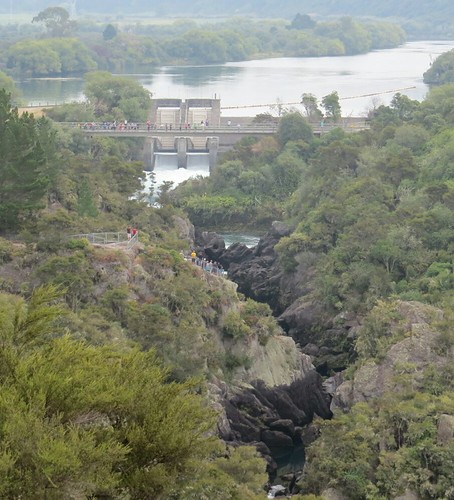
While in Taupo we visited the Aratiatia Rapids. This once natural whitewater gorge was damned up behind the gates of the Aratiatia hydro-dam. Due to public outcry over the loss of the rapids, four times a day the floodgates are raised and a torrent of river water rages again through the Aratiatia gorge. Beginning eight minutes before the gates are 

raised and at two minute intervals, bells and whistles sound. We had a choice of three viewing platforms and chose to hike to the highest one. We arrived early enough to grab a geocache close by the viewing platform. Bill showed a family walking nearby with small children the geocache and explained geocaching. The parents were intrigued and the children thought it was really neat! By the time the gates were raised all three viewing platforms were full of observers.

Also while in Taupo we visited Huka Falls. This is advertised as one of the most beautiful tourist attractions in New Zealand. The Falls are a 100 meter basalt crevice channeling the Waikato River over a 15 meter ledge. The falls were lovely though we felt the viewing areas did not provide a really great view of the falls. The water flows through the crevice or channel at 62,000 gallons per SECOND!
Our last day in Taupo we spent geocaching. We searched the geocaching.com site and chose several caches where people had given the caches many favorite mark. We have found that geocaching in new places takes us to beautiful areas we would not ordinarily know about and see. And this day did not disappoint with two geocaches that led us to a cave and one with a beautiful view of Lake Taupo.

Some observations:
Tipping is not expected and the service reflects this. Once your order is taken and your food delivered, you never see the waiter again. No one checks to see if you need anything or if you like your food. If you need something you flag a waiter down. We learned after waiting for our check a couple times that your check is not delivered to the table. You go inside to the register and they ring up the bill.
Salad and bread is never provided with your entree. They are separate items on the menu.
When you order water with your meal it rarely has ice and they give you a decanter since they won’t be coming back!
If you order a burger and it says it comes with a salad, the salad is the lettuce and tomato on the burger. After waiting a couple times for the salad that never came, we figured it out.
If you order a side salad with your entree it is delivered with the meal, not ahead of time.
The mattresses are on the floor. There is no space between the box springs and the bed.


March 1, 2015 Rotorua, New Zealand
February 28, 2015 Karangahake Gorge, New Zealand
We left Thames and headed to Rotorua (Row-toe-roo-a). Along the way we stopped at Karangahake Gorge. Here the Waitawheta River charges out of its steep rocky canyon
and merges with the Ohinemuri River. Almost all the names of streets, road, cities and towns and geographical places are named by the Maori people. Generations ago canoes of Maori ancestors sailed from East Polynesia and landed in New Zealand. Due to mixed marriages there are now very few Maori of pure Maori descent in New Zealand.
Here at the Karangahake Gorge we elected to do the Windows Walk which took us over two swinging bridges, up many many steps, and through tunnels which required 

flashlights which fortunately we had brought from Phoenix. The mine tunnels had a series of openings or windows which looked down at the remains of the batteries and river below. Panels along the path told the story of how over 100 years ago gold was mined in this area. Gold was extracted from quartz ore and was the nation’s third largest and most productive quartz gold mine. An incredible four million ounces of gold
was removed from this area.
After our hike we stopped to view Owharoa falls then we continued on to Mt Maunganui
which is really a lovely and popular beach town in the shadows of Mt Maunganui, an extinct volcano. This seemed much like a California beach town with many shops and
restaurants as well as sun worshipers. We saw people making the long trek up to the top of the volcano for the
view of the town below, but we found people watching more entertaining. On this day they were having youths between the ages of 10 and 14 competing in an ocean lifeguard event. All of the youth had qualified to be lifeguards and this competition was to recognize the best of the best. We chatted with one of the mothers of the competitors and she said that since New Zealand is surrounded by water, children train at a young age to be lifeguards since they are in high demand.
Some observations:
Everything in New Zealand is metric so we are having to refresh our knowledge of the metric system.
A “track” is a walk and a “tramp” is a hike and expect some challenging terrain.
A “torch” is a flashlight.
A large pizza and a large coffee is the size considered medium in the U.S.
New Zealand does not have many traffic lights or stop signs. Instead there are round-abouts everywhere. Bill loves them and I hate them.
All the beef used in fast food restaurants is 100% New Zealand beef and it is really good.
The New Zealand people are friendly and eager to help. They are curious about where we have been and where we are going in their country. Strangers say hello and wish you a good day.
February 27, 2015 Thames, New Zealand
We left Auckland and headed toward the town of Thames ( pronounced Tims). Along the way we drove to the Coromandel Peninsula. This stretch of scenic highway is considered one of the best on the North Island. The road hugs the coast of the Firth of Thames (a bay) and has narrow roads and several one lane bridges with signs telling you which side has to “give away” (yield). We passed through one particularly harrowing stretch of road that was extremely narrow and we wondered what would have happened if we had passed one of the many large trucks traveling the road.
We stopped along the way at a rest/camping area and talked awhile with a New Zealand couple camping there in their camper van. They owned their camper van but this also 
seems like a popular way for tourists to travel in New Zealand since they are readily available for rent. New Zealand is very friendly to campers and there are several options available with campgrounds as well as places you can camp for free for two nights. This couple was staying in a free two night area near the water where they could swim and fish. We seriously considered this option when planning our trip but decided to go the rental car/hotel route.
We arrived in Thames for a two night stay. We usually do not do bread and breakfast places, but this place had excellent ratings and private chalets. We were greeted warmly by the owner and given homemade shortbread cookies and a bottle of liqueur. We loved our little chalet which was bigger than a hotel room and had a small fridge, microwave and hot plate/convection oven. We had access to the hot tub steps away from our chalet and the use of their large barbecue grill. We certainly enjoyed relaxing in the hot tub and watching the sun set over the Firth of Thames.
The new day we drove to Cathedral Cove and Hot Water Beach. Cathedral Cove is known as the most beautiful small beach on the North Island. We were lucky to find a
parking spot in their very small lot and walked around admiring the beautiful views. It is possible to hike from the parking lot down a very long steep path to the beach, but on this hot day we decided to pass on the hike and admire the beauty from afar.
Our next stop was Hot Water Beach. This is one of the North Island’s biggest tourist attractions. During low tide scalding hot water pulses out of the sand. You can rent a shovel and dig yourself a spot to make your own spa pool. All this must be done within

two hours of low tide and since low tide was 9AM and 9 PM we missed it. Somehow knowing we had a nice clean hot tub waiting for us at the chalet made the thought of wallowing in hot mud less attractive anyway. 


Some observations:
A car park is a parking lot.
The New Zealand sun is very intense and hard on fair skin. It is possible to get a sunburn through the car window and 50 SPF doesn’t help much.
The New Zealand currency is much like the U.S. dollar in some ways. They have coins for one and two dollars instead of paper. The smallest coin they have is 10 cents so if you purchase something and need change less than ten cents they keep the difference. Hey! That adds up!
The days here are 13 hours long.
Bill says the coffee is not very strong.
Living out of a suitcase and moving every two or three days has its challenges. If I had 10 cents for every time we said “I can’t find” or “do you know where….”, I would have enough money to buy me one of those $4 cans of Diet Coke!
A note on immigration. The government here makes it very hard to immigrate to New Zealand. Before we boarded the plane the airlines made it clear to everyone boarding the plane that you better have proof of a return ticket when you got to Customs in New Zealand. When we arrived they did ask us how long we were staying and we signed a customs form declaring that to be true. They did not ask us for any proof.
February 1, 2015 Red Rock Canyon and Valley of Fire State Park, Nevada
Disregard the previous email posting, this replaces that post of the same name.
We were eager to explore the area outside of Las Vegas and our first adventure was to make the short drive to Red Rock Canyon National Conservation Area. This 200,000

acre area in the southern Mojave Desert gets its name from the fantastic red sand formations that can be found in the area. More than 500 million years ago this area was at the bottom of the ocean. For more than 250 million years limestone sediment accumulated and southern Nevada began to emerge from the sea. The great sandstone cliffs at Red Rock, thousands of feet high, are made of Aztec sandstone. The sandstone rocks were slowly uplifted thousands of feet to their current elevation where they have been exposed to weathering and erosion. The red color comes from deposits of iron oxide and calcium carbonate. Exposure to weather caused some of the iron minerals to “rust”, resulting in the beautiful red, orange and brown rocks.

There is a small Visitors Center there and a thirteen mile scenic loop drive with overlooks and places to hike and rock climb.
Paleontologists have confirmed that fossilized tracks made 180 to 190 million years ago in Red Rock Canyon are the first documented dinosaur tracks in Nevada.
There are many mammals which can be found in the area, including the kangaroo rat, blacktail jackrabbit and desert cottontail. We saw numerous road signs warning us to be on the lookout for wild burros and wild horses. These horses and burros originated from animals abandoned by settlers, ranchers, prospectors and Native Indian tribes.
The next day we decided to drive a further distance from our RV resort to Valley of Fire State Park, the oldest state park in Nevada. While we thought Red Rock Canyon was


beautiful, it didn’t begin to compare with the magnificent beauty of Valley of Fire. The red sandstone formations were formed from great shifting sand dunes during the ago of the dinosaurs. The uplifting of the region through faulting followed by extensive erosion created the present landscape. Native Americans such as the Basket People and later the Anasazi Pueblo farmers lived in this region.

While in the park we stopped by the Visitors Center and watched an excellent film on the park. This state park also had a scenic drive with many stops along the way to see gorgeous scenery. Our first stop was Arch Rock followed by Atlatl Rock where we climbed stairs which took us to 
view some petroglyphs carved in the desert varnish. Here we saw depictions of an “atlatl” which is a notched stick used to throw primitive spears. We stopped several times to hike back into the canyon to view more petroglyphs and magnificent views. The day went by quickly and before long the sun was starting to set in the canyon.


We were so glad we visited these two beautiful areas and had a chance to see the area outside of all the lights and casinos in Las Vegas!
Native people lived in this area for thousands of years and evidence of their existence can be found in petroglyphs and pictographs throughout the park. A petroglyph is made by scratching into a rock, revealing the lighter colored rock underneath. The designs are often carved or scratched into the dark coating of “desert varnish” on the surface of the rocks. A pictograph is made by painting designs onto the surface of rocks.