New Mexico & Texas, OCT 2019

After our visit to the Trinity Site we left Socorro and headed to Caballo Lake, New Mexico. We stayed a week at a small RV park owned by an 82 year old lady. It was one of the cleanest parks we have ever stayed at. Every afternoon she had Happy Hour on her covered veranda for everyone. She furnished snacks and each person brought something to drink. By snacks I am talking about meatballs in a delicious sauce, cheese and crackers, chips and guacamole, watermelon, cookies and cakes. Every day! After talking with other people we realized many of them come back for a visit year after year. I think these Happy Hours give the owner some social interaction and also enable everyone in the park to get to know each other. We can see why people come back year after year. 

Next up was Las Cruces, our last stop in New Mexico. When we arrived we unhooked the tow car and discovered the battery was dead. Using the RV, Bill was able to jumpstart the car. We took it to Walmart and since the battery was bad and still under warranty, they gave us another one. But we also learned that the alternator was bad. After learning it would be over $500 plus labor at the Las Cruces Honda dealer, we hired the Walmart mechanic to come to the RV park when he got off work and replace the alternator. For a total of $280 he picked up a new alternator at Autozone, took out the old one and put the new one in. 

After seven weeks, our time in New Mexico came to an end as we crossed into Texas. We took the bypass around the very congested El Paso and after overnighting in Van Horn, we stopped in Marfa, Texas for a three night stay. 

Our reason for spending three nights in Marfa was to visit three nearby places we wanted to visit. 

First up was the Fort Davis National Historic Site. Named after Secretary of War Jefferson Davis, it is one of the best remaining examples of a frontier military post and the role the military played in the settlement and development of the western frontier. IMG_20191023_102128IMG_20191023_102212

From 1854 until 1891 troops stationed at Fort Davis protected pioneers, freighters, mail coaches and travelers on the San Antonio-El Paso Road. The troops spent much of their time protecting area travelers from attack by Comanches and Apaches. During the Civil War the fort was first occupied by Confederate troops in the spring of 1861 until the summer of 1862 when Union forces took possession back. After the war ended the fort once again protected travelers on the San Antonio-El Paso Road from Indian attack. By June, 1891 the fort had outlived its usefulness and was abandoned. It became a National Historic Site in 1963. IMG_20191023_110253
During the summer months they have more activities and living history programs, but on this late October mid week visit things were very quiet. After watching a film at the Visitors Center, we enjoyed walking through the buildings that were open including the enlisted men’s barracks, the commissary, Officer’s kitchen, the post hospital and Officer’s Quarters.

IMG_20191023_111214

Enlisted Barracks

IMG_20191023_114511

Hospital Beds

IMG_20191023_114807

Operating Table

20191023_120148

Officer Housing For Two Families

In the kitchen there was a woman in period costume making chili, corn bread and banana bread over a wood burning stove. She was a little flustered because her wood fire had gone out and she had promised to provide lunch to the staff at the Visitors Center. 20191023_113516

The second attraction was the McDonald Observatory located 45 minutes from Marfa. The observatory is part of the University of Texas at Austin. IMG_20191023_124121

We had booked online a two and a half tour of the observatory. Before our tour started we looked around the Visitors Center and saw a movie. Our tour was a nice small group of fourteen and we had a fantastic tour guide. A former public school science teacher, it was quite obvious that she loves her job. After talking about the sun and showing us a live picture of the sun from one of the telescopes, we all boarded a shuttle bus to tour two telescopes. 20191023_145920

The first telescope we visited was located on Mt Locke which at 6,790 feet is the highest point on the Texas highway system. The view from there was beautiful. The Harlan J. Smith Telescope was completed in 1968 and supported NASA. This telescope’s mirror is 2.7 meters or 107 inches. IMG_20191023_162138IMG_20191023_153918

Our guide told us and showed us about how the telescope and dome moved. She talked about the mirror monthly maintenance which involves cleaning with dry ice. 

We all boarded the bus again to the summit of Mt Fowlkes (6,660 ft) to see the Hobby-Eberly Telescope dedicated in 1997. This telescope, after upgrades, is now tied with another telescope as the second largest optical telescope in the world (11-meter or 433-inch). IMG_20191023_16322020191023_163404IMG_20191023_165500
The mirror looks like a honeycomb made up of 91 hexagonal mirrors.

IMG_20191023_163604

Hexagonal Mirrors – The Curved Bars Are Reflections

IMG_20191023_165555

Our guide was so enthusiastic and eager to answer questions, our tour ended up lasting three hours instead of two and a half. Amazing to get such an interesting and informative tour for $7 (senior rate). IMG_20191023_165224

Mark you calendars – here is the time and places for the next Total Solar Eclipse. IMG_20191023_144009

Marfa is an interesting tiny Texas town. Most of the visitors, like us, pass through here on their way to Big Bend National Park. It has a very pretty courthouse and some interesting sounding restaurants, unfortunately for us most are only open on the weekend. IMG_20191023_095732

We did read about a Mediterranean food truck which had excellent reviews. Bill got a falafel called a Marfalafel named after the town. While Bill enjoys Mediterranean food, it was his first falafel and probably his last.  20191024_123122IMG_20191024_123158

Marfa is also known as having a phenomenon known as the Marfa ghost lights.  The town built a large viewing area outside of town with bathroom facilities and benches. One evening, just to say we did it, we drove to the viewing area and spent about thirty minutes looking for the lights. Other people there were convinced they saw the Marfa lights. We didn’t see anything that couldn’t be explained as man made such as lights from cars in the distance or radio towers. 
IMG_20191023_180434
Our last day in Marfa a cold front blew in. We had wind gusts up to 30 mph and that night a low of 27.  Time to move on! 

Next stop: Big Bend National Park, Texas

New Mexico, Sept 2019

Santa Fe RV Rally

We have had an enjoyable slow paced fall. In early September we attended a Family Motor Coach Association – amateur radio rally in Santa Fe, New Mexico. It was an enjoyable four days with eleven couples, a few we had met before and others for the first time. 20190901_18385320190901_184054
It was fun to see all the RVs with their antennas in the campground. IMG_20190903_103553

Santa Fe is a pretty little capital city. This was our third visit to the area. 

Albuquerque and Hamfest

Next up was a month in Albuquerque. We spent the time getting some medical appointments taken care of and working on travel plans for the rest of 2019 and 2020. IMG_20190918_140903

While we were here the Albuquerque amateur radio group had a three day Hamfest which we attended. I studied hard and was able to pass a test to update my amateur radio license from Technician to General operator class. Bill already has an Extra license, the highest level available. 20190921_155647

Trinity Site

Leaving Albuquerque we traveled south to Socorro, New Mexico for a four night stay. Our main reason for stopping here was to visit the nearby Trinity Site. The site is only open twice a year, the first Saturday in April and October. IMG_5192

We have wanted to visit this historic site for several years and this is the first time we have been in New Mexico at the right time. They only open the site twice a year because the site is located on the United States Army White Sands Missile Range where they often conduct missile tests. White Sands Missile Range is one of the most sophisticated test facilities in the world. IMG_5198

Since the site is only open twice a year, it can attract quite a few visitors. I had read that the site opens at 8:00 A.M. but that cars start lining up to get in as early as 6:30 A.M. Since we had an hour drive we left at 5:45 in darkness and heavy fog. It was so foggy we could hardly see to drive.  But even with the fog we arrived at 7:00 and there were about 25 cars in line in front of us. Instead of 8:00 they didn’t open the gate until 8:30 for reasons unknown. We had to pass through security and show our driver’s licenses and confirm we had no weapons or firearms. IMG_5212

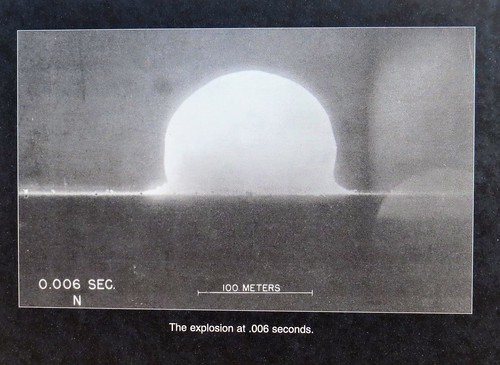
The Trinity Site is where the first atomic bomb was tested early in the morning of July 16, 1945.  The 51,500 acre area where the 19 kiloton explosion occurred was designated a national historic landmark in 1975.  Several potential sites in California, Texas, New Mexico and Colorado were considered but this site was ultimately selected because it was already controlled by the government. It was part of the Alamogordo Bombing and Gunnery Range which had been established in 1942.  The area was secluded which provided secrecy and safety and was also close to Los Alamos where the atomic bomb was designed and built. 

The Trinity Site area where the bomb was placed and exploded is called “Ground Zero”.  It is reached by walking a third of a mile from the parking lot. IMG_5213IMG_5214IMG_5216IMG_5218IMG_5228

An obelisk made of lava stone marks the actual spot. IMG_5226IMG_5229IMG_5233IMG_5225IMG_5222

IMG_5227

This Is What Is Left Of One OF The Tower Legs


They had a replica of Fat Man, the bomb that was dropped on Nagasaki, Japan in 1945. This is the type of bomb tested at the Trinity Site. IMG_5234

We also took a bus from the parking lot to Schmidt/McDonald Ranch House. IMG_5208IMG_5204

This is where the plutonium core to the bomb, about the size of a briefcase, was assembled. IMG_5200

I was interested in the radiation levels at the Trinity Site. They say the radiation levels are very low with the maximum levels about ten times greater than the region’s natural background radiation. Many places on earth are naturally more radioactive than the Trinity Site. A one hour visit to the site will result in a whole body exposure of one half to one millirem. To put this in perspective, Americans receive an average of 620 millirem every year from natural and medical sources. A sequence of pictures taken that day were on display. IMG_5230IMG_5231IMG_5232

As we were leaving the Trinity Site we passed protesters from New Mexico.  They claim families in the area were affected by the testing in 1945 and never received any restitution. We were told the protesters gather every year. 

National Radio Astronomy Observatory – Very Large Array

After stopping home for lunch we decided to make a full day of sightseeing and drove up to see the Very Large Array. IMG_5236IMG_5239

They were having free admission since it was the first Saturday in October. The Very Large Array is one of the world’s premier astronomical radio observatories. It features 27 radio antennas in a Y shaped configuration. Each antenna is 82 feet in diameter and weighs 230 tons. Bill took a 50 minute guided tour of the facility and really enjoyed learning about these radio antennas. IMG_5238IMG_5243IMG_5244IMG_5237

The individual signals are merged to one picture and then colored to add perspective. Here is an example of one picture made from radio wave emissions from outer space. dwarf galaxy UGC5288 gas_large-1006x1024

Here is what radio waves are transmitted when pointed at Saturn. IMG_5240

The Next Generation Very Large Array is underway and will start construction of two hundred plus radio antennas to improve the sensitivity ten times. IMG_5248IMG_5245IMG_5246

We have just a couple more stops in New Mexico. 

Abiquiu Lake, NM AUG 25, 2019

We said a sad farewell to beautiful Colorado and headed to New Mexico. We drove over two passes, our last two passes of the summer. 20190823_111523IMG_20190823_161322

The road was an open range area and we had to watch carefully for cattle in the roadway. IMG_20190823_162730IMG_20190823_16273820190823_112957

As we neared our campground it looked more and more like New Mexico landscape, just beautiful! IMG_20190827_134649IMG_20190827_134931IMG_20190827_135216IMG_20190827_135222IMG_20190827_135320IMG_20190827_135332IMG_20190827_135355IMG_20190827_135948

We had a four night reservation at the Abiquiu Lake Reservoir in the Riana section campground, a COE (Corps of Engineers) facility. We were last here in Sept, 2017. IMG_20190827_142715EFFECTSIMG_20190827_143025IMG_20190827_143436IMG_20190827_143358

I remembered this sign and wasn’t any happier to see it now than I was the last time. Luckily, none were spotted. Whew! But I would be lying if I said I wasn’t on guard every time I stepped out the door. IMG_20190827_143127

Boy was it hot with temperatures in the mid 90’s. It didn’t take us long to miss Colorado even more. 

Abiquiu Lake is a reservoir of water impounded from the Rio Chama River by the earth-filled Abiquiu Dam. The Rio Chama River is a major tributary of the Rio Grande River. We drove over the dam and could see the water in the reservoir is significantly down this visit. IMG_20190827_104002IMG_20190827_104009IMG_20190827_141457IMG_20190827_142122IMG_20190827_142116

Next up: A week long visit to Santa Fe to attend the Family Motor Coach Association Amateur Radio Fall Rally 

Rio Grande National Forest, CO AUG 21, 2019

With just one stop left in Colorado we left Great Sand Dunes National Park and headed to our campground west of Antonito in the Rio Grande National Forest. We had a nice trip except a passing RV threw a rock up and chipped our windshield. This is the third chip in the windshield we have had since May. We will need to call Safelite once again when we reach Santa Fe in a couple weeks. 

Along the way we stopped in Alamosa to stock up on groceries at Walmart. We could see the sky starting to darken in the direction we were headed. Back on the road again we had a lengthy backup due to road construction that brought us to a standstill. The wind picked up and in the distance we saw streaks of lightning.

After the traffic delay we arrived at our campground and discovered a storm had hit thirty minutes before our arrival.  The ground was covered with pea size hail that blanketed the ground like snow and the temperature had plummeted to 48 degrees. We were very thankful that traffic backup delayed our arrival. IMG_20190823_105909IMG_20190823_110158

Ponderosa Campground is a small campground located in a canyon amid tall mountains and is right along a river. It is a popular campground for those who enjoy fishing with many people returning year after year. It was a puzzle to me why people would stand for hours fishing when it is a catch and release campground. To each his own but if you can’t even eat what you catch, why bother? 20190823_170907

We had a nice campsite right along the river and it was very relaxing to see and hear the river. Those fishing didn’t hesitate to enter our campsite to access the river but it didn’t matter since it was entertaining to watch them.  With daytime highs in the low 70’s and lows in the upper 30’s to low 40’s, the weather was perfect. IMG_20190823_10592020190823_16522720190823_165401

After an enjoyable and relaxing four night stay it was time to say farewell to Colorado. We spent six weeks in western Colorado and will certainly miss the cool temperatures, beautiful views and excellent drinking water. 

Next up: New Mexico and hot temperatures once again 

Great Sand Dunes NP & Preserve, CO AUG 16, 2019

We enjoyed our time in Dillon and hated to leave the cool mountain temperatures, but it was time to move south. The journey was not a piece of cake since we had to cross over three mountain passes including Poncha Pass, Trout Creek Pass and Hoosier Pass which was at an elevation of 11,539 and at the Continental Divide. IMG_5129IMG_513120190816_120509IMG_5133

Our destination was Great Sands National Park and Preserve. This national park is located in the middle of nowhere. We had very limited Verizon but Bill was able to improve the signal with our cell phone booster. IMG_5134

Open this image up so you can zoom into the big picture.great sand dunes np

We stayed at a private campground right outside the park entrance with great views of the sand dunes and the Sangre de Cristo Mountains in the distance. IMG_5157IMG_20190819_114420IMG_20190819_113133

The park was first named a National Monument in 1932 and was designated a National Park in 2004. The park is comprised of 107,342 acres with the preserve protecting an additional 41,686 acres. The dunes cover thirty square miles. We stopped by the Visitors Center and saw an interesting movie about the park. IMG_20190820_112158

These sand dunes are the highest in North America both in height and elevation. Some of the dunes are up to 750 feet tall. Who would have thought the highest sand dunes in North America would be found more than a thousand miles from any ocean beach?? The sand dunes have been building and shifting for eons due to the San Luis Valley’s unique wind patterns which trapped the sand along the west face of the Sangre de Cristo Mountain Range. 20190817_143021

The park guide basically says most of the sand comes from erosion of the San Juan Mountains over 65 miles to the west where the sand grains are shattered by freezing and thawing and then tumbled by winds and streams. Larger grains of sand and pebbles also come from the Sangre de Cristo Mountains. Sand and sediment from both mountain ranges washed into a huge lake that once covered the valley floor. As the lake was reduced, southwesterly winds bounced the sand grains against the Sangre de Cristo Mountains where they were trapped by the tall mountain ranges. Northwesterly storm winds blast through mountain passes piling the sand back on itself which creates North America’s tallest sand dunes.

Each spring the Medano and Sand Creeks carry snow melt  through the park at the base of the dunes. The water recycles sand and provide a lifeline for the plants and animals in the park. In late spring and early summer the creeks are swollen and we saw pictures of children swimming and playing in the water. Now, in late summer, the creeks are almost dried up. You can see in the pictures wet looking places where the creeks are almost dry. But still enough water to get our feet wet. It is all so amazing! IMG_5178IMG_514220190817_144811IMG_5144

There were people climbing up the dunes and the park rented sleds and sandboards for sliding down. But with sand temperatures up to 150 degrees in the summer, we passed on hiking the dunes. The dunes were very hot and absolutely no shade. 

There were some fabulous sunsets from our campsite. Hard to decide which ones to include! These were taken during two sunsets. IMG_5147IMG_5161IMG_5169IMG_5185a

These two pictures occurred during sunset facing north over the dunes. IMG_5182aIMG_5191a

While this was a fascinating national park and we are really glad we visited, it is very remote and probably not a park we would return to in the future. 

Next up our last stop in Colorado 

Dillon, CO AUG 13, 2019

This blog posting is as much about the journey as it is about the destination. 20190813_105039

We left too hot Grand Junction and headed east to cooler temperatures. Following the Colorado River we saw amazing rock formations that are much like you would see in New Mexico and Utah.  20190813_10544220190813_10574820190813_11110120190813_11121620190813_11181020190813_111931

Along the roadside every quarter to half a mile we saw wildlife ramps that had been constructed so animals could easily escape the busy highway and not get trapped. 20190813_11225120190813_115634

People were out enjoying the river by fishing, kayaking or in some of the more rocky areas whitewater rafting. 20190813_11584820190813_11585220190813_12090820190813_123901

We drove through two tunnels constructed in the sides of mountains. It is always amazing to think of all the hard labor that goes into constructing these tunnels. 20190813_12093020190813_12430020190813_124310

We passed by the city of Vail, elevation 8,150 feet.  Since Grand Junction had an elevation of 4,600, we were climbing higher and hopefully to cooler temperatures. We noticed all the condominiums, homes and lodges built along the mountainside in this popular ski resort. Visible were the ski slopes, now a beautiful green instead of white with snow. 20190813_13152620190813_13340220190813_13360820190813_13371920190813_13375520190813_133825

Up, up, up we climbed on I-70 until we finally reached Vail Pass Summit at 10,603 feet. 20190813_135625At this point we started to drop down a little to our destination of Dillon, Colorado, elevation 9,087.  We stayed at White River National Forest campground just outside of town for three nights. We were so happy to have cooler temperatures. Our first night the temperature got down to 37 degrees with daily highs in the low 70’s. Perfect! IMG_20190815_163835

The towns of Dillon, Silverthorne and Frisco all run together and are ski resorts with tourism as their main economy. It is a thriving, bustling area with many big name stores and restaurants. Since it was busy in August, I can only imagine what it is like in the winter during ski season. We were amazed at the homes perched right on the edge of the mountains. IMG_511720190813_142303

Dillon Dam and Reservoir, a large freshwater reservoir, has a 25 mile shoreline with a walking /biking path that appeared to be heavily used. It is a reservoir for the city of Denver. The dam diverts water through a 23.3 mile tunnel under the Continental Divide to Denver. During the Great Depression when many Dillon people could not pay their property taxes, the Denver Water Board acquired most of the water rights in the area. In 1956 the Denver Water Board told the remaining citizens of Dillon that a dam was going to be built and they had until 1961 to sell their property and leave. The dam construction began in 1961 and was completed by 1963. The Denver Water Board set aside 172 acres for the new town of Dillon. The citizens and businesses were responsible for moving their own homes and structures. Many chose not to and the population shrank to 57. Today Dillon’s population is 904 not counting the nearby towns of Silverthorne and Frisco. With that sad history, it is so nice to see the thriving community today. 20190813_14222620190813_141751IMG_5115IMG_5127

One day we drove the car on Interstate 70 to the nearby Eisenhower – Edwin C. Johnson Memorial Tunnel which at 11,158 feet is one of the highest vehicle tunnels in the world. It is also the longest mountain tunnel and highest point in the interstate highway system. It is a two bore four lane vehicular tunnel under the Continental Divide in the Rocky Mountains. We first headed eastbound through the tunnel named for Edwin C. Johnson the  Colorado former governor and state senator. We then turned around and drove through the westbound bore which is named the Eisenhower Tunnel after President Dwight Eisenhower, for whom the Interstate System is also named. The Eisenhower Tunnel was built first and took five years to be be completed in 1973. The Johnson Tunnel took four years, was completed in 1979 and was one of the last major pieces of the country’s interstate system. Each tunnel is just shy of 1.7 miles long. The tunnels are sloped at 1.64% grade and have a steep approach of 7% grade on one side and 6% on the other. The tunnel has a clearance of 13 feet 11 inches. In 2012 approximately 28,000 vehicles passed through the tunnel bores each day, or 10.7 million vehicles per year. During construction of each tunnel bore, there were three fatalities in the Eisenhower bore and four in the Johnson tunnel bore. IMG_5088IMG_5090IMG_5093IMG_5096

Next up: Great Sand Dunes National Park and Preserve, CO

Grand Junction, CO AUG 9, 2019

We left Black Canyon of the Gunnison National Park and headed north to Grand Junction, Colorado, pop 59,000. We dropped from 9,400 ft to 4,600 ft and boy did it get hot!! During our time in Grand Junction the temperatures hovered in the low to mid 90’s. We sure did miss those mountain temperatures! 

On the way to Grand Junction we passed interesting sand formations. 20190808_12342420190808_12544820190808_12552020190808_125525

We stayed five nights at the James Robb State Park, a very nice Colorado state park, but there was absolutely no shade and it was HOT! 

One day we crossed the Colorado River and made the short drive to the Colorado National Monument, designated a National Monument in 1911. IMG_20190812_154419IMG_5022

The Monument is 32 square miles of rugged canyon terrain with towering red sandstone monoliths that rise 2,000 feet above the Grand Valley. The colors come from the minerals in the rocks as well as the kinds of lichens and chemical compounds that coat the rocks. IMG_5035

We stopped by the Visitors Center where unfortunately the movie was broken, but we did enjoy their exhibits. It was interesting to read that the Colorado National Monument Area was formed in part by strong earthquakes along the Redlands Fault 40 to 70 million years ago that lifted the layers of sedimentary and metamorphic rocks above the Grand Valley. Erosion has carved the steep walls and flat bottomed canyons. IMG_5028

We drove the 23 mile Rim Rock Drive with breathtaking scenery, tunnels, hairpin curves and eighteen overlooks. The road was begun in 1931 with most of it being done by the Civilian Conservation Corps (CCC) between 1933 and 1942. Construction was halted during WWII and finally completed in 1950.  Due to its cultural significance the road is on the National Register of Historic Places. The road was carved out of solid rock without the benefit of heavy equipment like bulldozers or backhoes. After blasting rock apart they removed rubble by hand or guided horses pulling small dump carts on rails.  About 39,000 cubic yards of rock were removed EVERY MILE to make way for the road bed! During construction of one of the tunnels nine men were killed when a huge slab of overhanging rock gave way. IMG_5030IMG_5032IMG_5038

We especially liked the 450 foot tall Independence Monument where every Fourth of July there is a tradition of climbers ascending the Monument to raise the American flag.

IMG_5048

Side View Of Independence Monument

20190809_101429

20190809_10013920190809_100339

We also liked the Grand View overlook with the Kissing Couple formation.  Do you see them kissing? 20190809_101228

These interesting formations, shaped by erosion, are called Coke Ovens. 20190809_10433520190809_10294520190809_102929IMG_5070_stitch

Also we liked the mummy in the side of the cliff. Do you see it? IMG_5074IMG_5078IMG_5079IMG_5082IMG_508620190809_10432520190809_11260120190809_11273420190809_11280720190809_114338IMG_20190809_114733IMG_20190809_114813

On Saturday Bill attended the Grand Junction Amateur Radio Hamfest. It was a very small Hamfest but Bill always enjoys meeting and talking with other amateur radio enthusiasts. IMG_20190810_093249IMG_20190810_090230

Next stop: Dillon, CO and cooler weather!

Black Canyon of the Gunnison NP, CO AUG 2, 2019

Our time at Ridgway State Park came to an end after six days but we really could have used another two or three days to see everything. Every afternoon we had a rainstorm which hampered our hiking and exploring. There were trails in Ridgway State Park we never got to experience. But our reservation came to an end and we had another reservation waiting at our next destination. 

Next up was Black Canyon of the Gunnison National Park in southwestern Colorado. Formerly designated a National Monument in 1933, it became a National Park in 1999.  IMG_20190802_152647IMG_20190802_154930The Black Canyon is 48 miles long with astonishingly steep walls that rise more than 2,700 vertical feet from the Gunnison River at the base of the canyon. A combination of hard rocks, uplifting, ancient volcanoes and erosion have all played a part in shaping the canyon. It took about two million years to shape the canyon as it is seen today. Fourteen miles of the deepest part of the Canyon are located in the National Park. The narrowest part of the Canyon is 1,100 feet across the top and only forty feet across at the riverbed bottom. IMG_4865IMG_4870IMG_4879IMG_488020190803_135602

The Gunnison River drops over 2,000 feet through the 53 mile canyon. During spring runoff the water can fluctuate from 3,000 to 12,000 cubic feet per second. Water at just 5,000 cubic feet per second can carry rocks up to two feet across and weighing almost 700 pounds. This erosive energy from the river carves the canyon walls deeper faster than it erodes the sides wider. This is what causes the Black Canyon to be much deeper than it is wide. But even at that level of power the canyon only changes about a hair’s width each year. The erosion has been slowed somewhat by construction of dams upstream. IMG_4944IMG_4950IMG_4959

We went to the Chasm View overlook which has the greatest descent of the Gunnison River in the canyon where it drops 240 feet per mile. IMG_4947IMG_4960

The cliff rock is composed of two billion year old metamorphic rock, some of the oldest rock on Earth. It is so steep some parts of the canyon only receive 33 minutes of sunlight a day and the walls are often in shadow making them appear black, hence the name Black Rock Canyon. Gunnison comes from Captain John Gunnison who came to the area in 1853 leading an expedition in search of a route across the Continental Divide for a railroad from St Louis to San Francisco. He was killed by Ute Indians and the river was named in his honor. 

The Ute Indians were the first to live in the canyon long before the first Europeans. They referred to the river as “much rocks, big water” and avoided the canyon due to superstition. 

We camped on the South Rim where there is a Visitors Center and a seven mile paved road with twelve overlooks of the canyon. Most overlooks had a hike to each viewpoint, some short and some longer. Since we were staying six nights in the Park, we were able to take our time. While not terribly hot, at 8,320 feet the sun was very intense. 

We stopped by the Visitors Center with amazing views of the canyon and watched a short movie. IMG_4963

Over the next several days we worked our way along the overlooks. All of the overlooks had dramatic views. From high above we could hear the Gunnison River below, often with whitewater. Definitely not a river you could safely raft in the park. 

One overlook was the Painted Wall, which at 2,300 feet is the highest cliff in Colorado. If the Empire State Building stood on the canyon floor, it would reach only slightly halfway to the top of the cliff. The patterns in the wall were created more than a billion years ago when molten rock was squeezed into fractures and joints of the existing rock, then cooled and hardened. IMG_4979

Another day we took a different drive in the park, the East Portal Road, with a 16% grade and hairpin curves. The road took us down over 2,000 feet to the Gunnison River and two dams. This section of the river was much tamer and could be easily navigated by boat. IMG_4932IMG_4898

Our main reason for driving this road was to see the beginning of the Gunnison Tunnel, built from 1905 to 1909 to carry water to the town of Montrose and the Uncompahgre Valley. Back then the area was suffering from a water shortage due to the influx of settlers. Working underground using only candlelight and manual labor, it took the tunneling crew almost a year to bore through 2,000 feet of water filled rock. IMG_4900IMG_4904The work was so physically demanding and dangerous, even though the pay and benefits were good, men only stayed an average of two weeks before quitting. Twenty six men were killed during the four years of construction. The tunnel was completed in 1909, stretched 5.8 miles and cost three million dollars. The dam is used to fill the tunnel when water is low in the river. The tunnel can carry 495,000 gallons every minute. The Gunnison Tunnel was honored as a Civil Engineering Landmark joining others such as the Statue of Liberty and the Golden Gate Bridge. IMG_4905IMG_4930

Further down East Portal Road is the Crystal Dam built in 1978.  It is a unique structure because it curves from side to side and from top to bottom which gives it exceptional strength. Unfortunately the road to the Crystal Dam was closed and we couldn’t see it close up. IMG_4910IMG_4912IMG_4916IMG_4927

We often saw deer in the park and campground. Because deer often give birth in the campground and are fiercely protective of their fawn, dogs and other pets are not allowed outside each campsite from June 1 to Aug 10th. This year the pet ban was extended to Aug 26th due to late fawning. You are not allowed to carry your dogs in your arms or walk them in the campground outside of your designated campsite. IMG_20190802_160718IMG_20190804_192002IMG_20190807_112233

On our last day in the park we drove to nearby Cimarron to see a restored train that was part of the railroad built in 1882 to pull trains through western Colorado. Here we saw Locomotive #278, its coal tender, a boxcar, and caboose standing atop the last remaining railroad trestle along the Black Canyon of the Gunnison route.  The trestle was constructed in 1895. In 1881 a railroad line was built through the Black Canyon. It took Irish and Italian laborers a year to carve through the tough terrain. It cost $165,000 per mile. In 1882 the first passenger train passed through the canyon. It was said that there were probably not more than a quarter mile of straight track through the canyon. Due to the difficulty in operating and maintaining the track, it was abandoned in the early 1950s.  IMG_5005IMG_5021IMG_5019

Not far from the train display was another dam, the Morrow Point Dam, a 468 foot tall concrete double arch dam. It is the first dam of its type built by the U.S. Bureau of Reclamation and was constructed from 1963-1968. IMG_5016IMG_20190802_204551

Next up:  more time in beautiful Colorado


Ridgway, CO July 28, 2019

After a wonderful time in Rico and Telluride we headed north on the San Juan Skyway to Ridgway State Park. Even though we were going north, we were dropping from 9,000 feet to just under 7,000 feet which meant warmer temperatures. We sure were going to miss the cool temperatures!

Ridgway State Park is located in Ridgway (yes, it doesn’t have an e). Ridgway, Colorado has a population of around 1,000 and an elevation of 6,985.  Beginning in 1891 it was a railroad town until part of the rail line was abandoned in 1953 and then completely abandoned due to a reservoir being built. The original location of the dam for the reservoir would have placed Ridgway underwater. A 1975 decision to put the dam further downstream saved the town, earning it the nickname “The Town That Refused to Die”. Ridgway has the only stop light in Ouray County. 

The Grammy Awards trophy is handcrafted by Billings Artworks in Ridgway. The trophies are hand cast in an alloy called grammium and then hand filed, ground and polished before being plated in 24k gold.

Ridgway and the surrounding area was the setting for John Wayne’s “True Grit” and “How the West Was Won”. In fact more than 100 films have been made in southwestern Colorado. 

Actor Dennis Weaver, from Gunsmoke and McCloud fame had a home in Ridgway and died there in 2006. Weaver was committed to preserving the environment and commissioned an architect to design and build his home from recycled materials such as old automobile tires and discarded cans. The Dennis Weaver Memorial Park in Ridgway is a sixty acre wildlife preserve with several walking trails. 

Ridgway State Park has three campgrounds and our campsite was located in the Pa-Co-Chu-Puk section with full hookups. 

We stopped by the park’s Visitors Center where they had a large display of animals native to the area. IMG_20190727_140437IMG_4836

The highlight of our stay here was the drive we took on the US Highway 550, also called “The Million Dollar Highway”.  I thought it was called this because of the million dollar views but research says the reason is disputed. Some say it is because it took a million dollars to build it in the late 1880’s, while others say it is because the fill dirt contains a million dollars in gold ore. Another idea is that people say you couldn’t pay them a million dollars to drive it during bad winter weather. Regardless of the reason, it is known as one of the most scenic drives in America but is also known as one of the 25 most dangerous roads in America. IMG_4729

US Highway 550 runs from New Mexico and ends/starts at Montrose  Colorado but the most scenic, and dangerous part runs 25 miles between Ouray and Silverton that goes over Red Mountain Pass, elevation 11,018. And that is the part we drove!

The road is cut into the side of a mountain with steep drop offs, narrow lanes, hair pin curves and no guardrails. It takes 100% of the driver’s concentration while passengers hold their breath as they look over the side. Along with 8% grades there are 153 curves! IMG_4742IMG_4778IMG_4755IMG_4811

We first passed through Ouray, known as the “Switzerland of America” and the “Outdoor Recreation Capital of Colorado”. It is a picturesque mountain town at the base of the San Juan Mountains with one main street and no traffic lights. IMG_4715IMG_4707IMG_4710IMG_4717

We stopped by Cascade Falls Park with a lovely waterfall. IMG_4833

Red Mountain Pass at 11,018 feet is one of Colorado’s highest paved passes. IMG_4777

We saw avalanche signs and could see damage to trees that happened during an avalanche. IMG_4766IMG_4765

Along the way we saw waterfalls such as Bear Creek Falls, tunnels and evidence of once active mining in the area. IMG_4730IMG_4720IMG_4827IMG_4762IMG_4764

This area was used by gold and silver miners in the 1870’s.  It produced four million ounces of gold, 21 million ounces of silver and twelve million tons of lead, zinc and copper. It helped fuel the industrial revolution and supplied raw materials to support America’s involvement in two World Wars. 20190728_122602IMG_4822IMG_4770IMG_4824

Our turn around point was Silverton, a former silver mining camp. With a population of 630, its main source of income today is tourism, like Ouray. IMG_4781IMG_20190728_13484520190728_125802IMG_4785IMG_4786

We drove a dirt road that took us to a nice spot overlooking the town and the Christ of the Mines Shrine. 20190728_115943IMG_4791

After lunch at a little barbecue restaurant we headed back home. The road wasn’t quite as scary going the other direction, but we still had the hairpin turns and the occasional steep drop offs. It was the lack of guardrails that made it very unsettling.

Another day we drove a short distance from our campsite to the Dallas Divide Summit, elevation 8,970 ft, to take pictures of the mountains. So beautiful! IMG_4843IMG_4846IMG_4847

One evening we had visitors stop by our campsite. IMG_4854

Next stop: Black Canyon of the Gunnison National Park

Rico & Telluride, CO July 26, 2019

Leaving McPhee Reservoir Recreation Area, we drove an hour on the San Juan Skyway, called “Road to the Sky” to our next destination. Along the way we had beautiful views of the towering 14,000 foot San Juan Mountains and green rolling hillsides. 

We arrived at our campground, Cayton Campground in the San Juan National Forest for a six night stay. We had a very nice electric site along the Dolores River. At night we were lulled to sleep by the sound of softly flowing water. IMG_20190725_153505

The only drawback to this campground was we had absolutely no cell phone service which meant no internet. We were able to get satellite TV so we had news and weather. At an elevation of 9,400 feet, the daytime highs were in the low 70’s and nighttime lows in the mid 40’s.  A wonderful respite from the hot weather we had recently experienced. Each afternoon we had a brief thunderstorm or rain shower. IMG_20190725_153045

Our campsite had 50 AMP power and even though it worked, the 50 AMP power connector was cracked and potentially unsafe. The camp host brought a new one by and Bill offered to replace it. 20190723_123955

Six miles south of our campground was the tiny town of Rico. Twice we drove into town to use the internet access at the public library. Thank heavens for these friendly public libraries that are a big help to travelers like us. IMG_20190725_124100-EFFECTS

Rico was settled in 1879 as a silver mining town. At its peak Rico had a population of nearly 5,000. It had two dozen saloons and a thriving red light district. IMG_20190725_150448IMG_20190725_150425No longer a mining town, today it has a population of 266 and is made up of a main street with an inn, gas station, post office and town hall. 20190725_12072720190725_120802The public library is open four hours a day Monday through Saturday and is located in two rooms of the town hall building. I talked a bit with the librarian who said the public school in Rico closed last year due to declining enrollment. Today the parents have to take their children either 35 minutes north to the town of Telluride or an hour south to Dolores. Parents are responsible for getting their children to and from school. She said most parents work in Telluride and therefore their children go to school there. Quite different from most towns and cities in the United States where children just walk a block or less to catch the local school bus. The librarian said she wonders if the Rico library would ever close and expressed sadness that she no longer has children come by after school. She said the library summer reading program ended a couple years ago. Now she averages six or seven people who visit the library each day, less than fifty a week. The two times we visited we only saw two locals come in to use the library internet. I never saw anyone return a book or check one out. Very sad. We did note that after many many years of significant declining population, the population did rise by 65 people between 2000 and 2010. Maybe there is hope for this sweet little town. 

We visited the Rico post office while we were there and noticed it is also open only four hours a day but it had a steadier stream of traffic. 20190725_120743

On Friday we drove our car north to Telluride for the day. IMG_4611IMG_4622IMG_4625Also once a mining town, what a difference from Rico. With a population of 2,400, Telluride is a busy, active resort community similar to Vail. In the winter it is crowded with skiers staying in the many condominiums, resorts and hotels. In the summer people visit to enjoy the cool weather and gorgeous views. It is nicknamed the “Festival of the Rockies” because of the vast array of cultural events each summer. The name Telluride came from gold telluride minerals found in parts of Colorado. Strangely, telluride minerals were never found in Telluride but zinc, lead, copper, silver and other gold ores were mined there. IMG_4687

One of the best things about Telluride was the FREE gondola rides. We have been on several gondola rides in our travels and they are usually pretty pricey. This is the first free gondola ride we have ever seen and according to Telluride it is the first and only free gondola public transportation in the United States. It was begun in 1996 to address air quality concerns by keeping cars off the eight mile route between Mountain Village and Telluride. Since 1996 it has transported over forty million people. 20190726_142021

We read it is best to park at the free parking garage at Station Village and ride a gondola down to Telluride because street parking is very limited in Telluride. We parked the car at Station Village, elevation 9,545 and rode a gondola to Mountain Village Resort, elevation 9,540. IMG_4664IMG_4632We got off there and got another gondola which took us to Station St Sophia, elevation 10,535 and then continued down to Telluride, elevation 8,750. The whole trip took about thirty minutes. All the gondola workers were extremely friendly and helpful. The tricky thing about gondolas is they never completely come to a stop so you have to quickly jump on and off. Pets, bikes and skis are all allowed on the gondolas. It was interesting to see how the bikes are attached to the outside of the gondolas. 20190726_155906The Big Mountain Enduro bike event was going on during our visit. Bikers ride the gondola up the mountain and they ride bike trails to the bottom. IMG_4636IMG_4639

As we descended to Telluride we could see the town In the distance IMG_464820190726_15273220190726_153028IMG_4649as well as beautiful Bridal Veil Falls, at 365 feet the tallest waterfall in Colorado. IMG_4667IMG_4669

Every Friday they have a Farmers Market with fresh fruits and vegetables, baked goods and beautiful flowers. 20190726_14453020190726_144920We found a geocache at the Galloping Goose, a unique hybrid vehicle that was a truck and train combination.  It was powered by a truck engine that rode on train tracks beginning around 1930. It ran on gasoline and carried both passengers and freight until 1951. We noticed the hybrid buses around town today are nicknamed Galloping Goose.  IMG_4665We really enjoyed walking around Telluride! IMG_467220190726_144419

We caught the gondola back from Telluride to Station St Sophia and got off and walked around the area. In the summer this is a popular area for bike riders to ride up and down the steep slopes. IMG_4676IMG_4679IMG_4686We went in the Nature Center where they had the biggest container of sunscreen I have ever seen. It was freely available to everyone. At 10,535 feet, you burn quickly. By this time our ears were stopped up and I was starting to feel some altitude sickness. I was lightheaded, slightly nauseous and my skin was clammy. We still had to ride two more gondolas to get back to the parking garage. I was dragging by the time we got back to the car. But after drinking an entire bottle of cold water from the cooler, I was feeling much better. We drove into Telluride and had a nice dinner. I think just the act of chewing food helped our ears recover. We both agreed this was the most fun we have had in awhile! 

The mountain views and alpine meadows were beautiful. IMG_4696IMG_4697IMG_4703

IMG_4699

Lizard Head Peak

Next up: Ridgway, CO