Israel Day 5, MAR 26, 2023

Day 5 had us spending the day in Bethlehem, a place we had really been looking forward to visiting for obvious reasons. Along the way from the Dead Sea to Bethlehem, we saw shepherds in the countryside with their flock, along with wild camels and donkeys.

Wild Camels


Sadly we learned that Bethlehem is now part of Palestine and the West Bank. In 2002, Israel built a 26 foot, 440 mile concrete wall separating Bethlehem from Israel. Israel said it built the wall to protect its citizens from Palestinian suicide attacks. The wall has watchtowers and barbed wire and there are 84 gates located along the wall that are manned by the Israeli military. Not all gates are opened daily, usually only 9 or 10.

The Checkpoint

Many Palestinian homes, farmland and businesses were destroyed when the wall was built. Our guide said that many people in Bethlehem, once able to move freely to nearby cities like Jerusalem, now face restrictions in movement and must have permits by the Israeli military and have to endure checkpoints to leave the area. He said approximately 5,000 businesses had to close and people have fled Bethlehem rather than live behind a wall where they felt like they were living in a prison. Tourists can walk freely between Jerusalem and Bethlehem, just passing through a turnstile. 

Our first stop was at Shepherds Field. This is the place where the angels appeared to the shepherds, announcing Christ’s birth. (Luke 2: 8-14)

The main point to be taken from this is that the shepherds, considered to be the lowliest of the people with a boring, despised job no one else wanted, were the first to hear the announcement of Jesus’ birth. This was a sign that the “Good News” was available to all, from the lowliest shepherd to the noblest of kings. 

At Shepherds’ Field, excavations found caves with evidence of human habitation where the shepherds tended their flock. Built above a large cave is the Chapel of the Shepherds’ Field, a Roman Catholic Church administered by the Franciscans, built in 1953.

The church has five recesses in the ceiling and 10 walls that incline inward that give it the appearance of a nomadic tent. The words of the angel to the shepherds are inscribed in gold. The dome is made of concrete and glass that allows light to penetrate it to resemble the divine light revealed to the shepherds.

We went into a nearby cave that dated back thousands of years and was thought to be like the cave where the angel announced the Lord’s birth.

Livestock Food Was Stored Here in the Cave Wall

Livestock Food Was Stored Here in the Cave Wall

Shepherds’ View of the City

Next up was lunch in Bethlehem. Breakfast and dinner each day were provided at the hotels where we stayed. Lunch locations were selected ahead of time each day by our guide so reservations could be made. Lunch today was at a small family owned restaurant where they had a specialty entree, an upside down chicken and rice dish. Lunch was usually pita bread with hummus and a mixture of fresh tomatoes and cucumber. Main dish was usually chicken and rice or chicken and french fries, sometimes fish. I don’t know whether it was because we were American, but we ate a lot of french fries at lunch and dinner. We were all really tired of french fries by the end of the trip.

After lunch we headed to the Church of the Nativity, the site where Jesus was born. This ended up being one of the most frustrating and disappointing stops of the week.

The Far End is the Small Entrance

The church, or basilica, is the oldest church in daily use in the Holy Land.  Under the church is where the actual cave is preserved, that is believed to be the birthplace of Jesus.

Resurrected Jesus with the Disciples

To enter the church you have to stoop low, the entrance being slightly less than four feet high. Inside, the church has no pews but columns and wall mosaics from the 12th century. Clear trapdoors in the floor showed ancient mosaic floors from 339 AD. Today the church is a Greek Orthodox place of worship.

In the 16th century, to prevent people from entering the church with horses and cattle, the main entrance was walled up and transformed into a four feet high door, known as the “Door of Humility”, since visitors are forced to bend down to go through it.

You Can See How The Opening Has Been Reduced

When we entered the church through the small door, we were in the interior of the church, packed with tourists waiting to descend some narrow steps into the cave.

There was a line winding its way along the walls of the church. Our group was all together but really rude people kept trying to break into our line. Our guide kept telling us to stay close together, to lock arms if necessary. We stayed like this, jostled, pushed, shoved and crammed together for an hour and a half. Finally we knew the cave entrance was close. But then our guide yelled for us to push even closer together because security was getting ready to close off the last door before the descent to the cave because a worship service was due to start. Anyone in our group not inside the door would be left behind and it would be an hour before the door opened again. By this time our group was melded together with two other groups. Just when we thought we couldn’t crowd any closer, we did.

The Steep Stairs to the Cave/Grotto

Finally we reached the stairs to the cave which were dark and narrow. We reached the room where you could kneel and touch a star on the ground where Jesus was born.

Close by, lit with candles was the manger.

Our Picture of the Manger Location

This Picture Was From 1900

You were not supposed to stop and take pictures and you had to quickly kneel, touch and immediately leave. The really disappointing and frustrating thing was waiting all that time and not being allowed to take the time to say a prayer and take in the reverence of the moment. I think most everyone in the group felt the same way. It had been crowded all week but today was the worst.

We Saw This Sign As We Got Close to Jerusalem

After that experience we were more than ready to head to the bus and our hotel in Jerusalem for the next three nights. 

Next up: Jerusalem, part 1


Israel, Day 4 MAR 25, 2023

Day 4 found us up early with another busy day ahead. After breakfast we loaded onto the bus for the trip to the amazing Masada National Park.

Masada is an ancient mountainous fortress in the Judean Desert on a massive plateau 1,500 feet above the Dead Sea. It was built around 30 B.C. by King Herod the Great and is the site of the Jews last stand against the Romans after the fall of Jerusalem in 68 A.D. It is thought to be one of the greatest archeological sites in Israel. 

You can access this mountain fortress either by cable car or by foot on the Snake Path Trail. Fortunately we were able to ride the cable car but we were packed in like sardines.

Our pastor, who is a marathon runner, decided to run up the trail to the top. This was after he had already gotten up at 5:00 A.M. and run seven miles! He has taken this personal challenge before and with his son.

Our Pastor Running up to Meet our Cable Car

The Trail Also Had A Group Walking Down

King Herod built two magnificent palaces, one of which was built on three terraces, a huge fortress, swimming pools, water reservoirs, huge amounts of storehouses and an armory all on this mountaintop with spectacular views.

Columns Were Covered to hide The Red Stone

Hot Water was Channeled From the Furnace

Black painted lines are everywhere to show the original wall (below the line) with the reconstructed wall above the painted line.

Painted Walls Were Preserved

A Model Of The Fortress/Palace

Original stones were used during reconstruction.  Masada had its own “watergate”, a path on which beasts of burden carried water from the channels at a gate up to some cisterns at the mountaintop. Stone paving at the gate prevented damage from the animals’ hooves.

Nice Walkways Made Exploring Easy

Decades later, in the last days of the Great Jewish Revolt when the Romans conquered Jerusalem in 70 A.D., a Jewish group took possession of Masada from the Roman garrison there and lived there for three years. This was the last stand for almost 1,000 Jewish Macabbean/Sicarii men, women and children who decided to commit suicide as free people rather than fall into the hands of the Romans.

The siege of Masada by Roman troops occurred from 73 to 74 A.D. The Roman army military camps appear as square areas on the surrounding countryside.

The Square Was a Military Camp

The Square Was another Military Camp

The Roman army (15,000) would not give up so they built a siege ramp to attack the upper wall.

As the Roman battering ram breached the fortress walls, the Jewish rebels realized winning was hopeless. Refusing to surrender and end up as slaves or killed, they set fire to their homes and warehouses and chose ten men by lottery who were to kill the other 960 men, women and children.

The Lots Stones Used to Select the Final Ten

The last ten men then committed suicide. When the Romans made it to the top, they found everyone dead except for two women and five children who survived by hiding. 

Masada was extensively excavated between 1963 and 1965 by an expedition led by Israeli archaeologist and former military Chief-of-Staff Yigael Yadin. One of the most remarkable archeological finds was the synagogue, built during the times of King Herod and one of the oldest on Earth. In one of the rooms they found the oldest parts of Torah scrolls ever found. 

They found perfectly preserved water reservoirs, cisterns, a Roman style bathhouse and the remains of a Byzantine church.  The remnants of a Byzantine church dating from the fifth and sixth centuries have been excavated on the plateau.

The Church Wall

Another Wall in the Church

A Floor in the Church

Masada is a UNESCO site, a symbol of heroism and man’s struggle for freedom. A 1981 American miniseries starring Peter O’Toole described Masada’s last stand. Books have also been written about Masada. 

After lunch we visited the Qaser Al-Yahud Baptism Site, the site where John the Baptist baptized Jesus in the Jordan River. It is also identified with the place where the Israelites crossed the Jordan River after 40 years of wandering in the desert. (Joshua 3)  Ancient traditions also associate this site with the place where Elijah the prophet ascended to heaven in a fiery chariot. (2 Kings 2)

On the way we drove along the border of Israel and Jordan, with landmine warnings dotting the landscape. The Jordan River is the 1994 treaty line between Israel and Jordan.

Historic Greek Flag Brotherhood of the Holy Sepulcher

Years ago our pastor used to baptize people at this location, but over the years the water has gotten more polluted and dangerous. The last time he conducted baptisms here he slipped and cut his foot on some metal. He ended up in the hospital with a very serious infection. Since then his church group baptism site was moved to a different section of the Jordan River that is cleaner and safer.

This is Not Our Group

There were some people being baptized today in the coffee-colored water.

This is Not Our Group

Directly across from us was the country of Jordan with Jordanian soldiers keeping watch. Our pastor read scripture and we sang several hymns, all within listening distance of the watchful soldiers.

Across The River is Jordan with Two Armed Soldiers

This is an Israeli Armed Soldier

We ended the day earlier than usual since it was the Sabbath and many things were closed. The group was thankful because we were all feeling the effects of the long, arduous days. 

Next Up: Day 5, Bethlehem


Israel, Day 3 Part 2 MAR 24, 2023

Day 3 in the afternoon found us at Wadi Qelt, a deep, narrow gorge in the Judean Wilderness that extends 17 miles from Jerusalem to Jericho and is thought to be the location of the Valley of the Shadow of Death (Psalm 23:4) During Jesus’ time, the Romans had built a road through this region, a road so well engineered that it is used by tourists today. The parable of the traveler and the Good Samaritan is thought to have occurred near here. Shepherds today still lead sheep and goats along the path to the spring fed waters of the Wilderness. It is thought that David wrote the 23rd Psalm while sitting in this area.

Today the monastery of St George, built in the late fifth century, is tucked within the walls of the gorge. It is one of the oldest monasteries of the Byzantine desert monks in the Holy Land. It was built around a cave that Greek Orthodox tradition associates with Elijah’s cave of Horeb (1 Kings 19) and the place where an angel revealed to Joachim that his wife Anne would bear the Virgin Mary. The central church of the monastery is dedicated to the Virgin Mary.

Next we visited Qumran National Park. In the 2nd century B.C., Qumran was settled by members of the Essene sect, the writers of the Dead Sea Scrolls. According to stories from that time, a Bedouin boy searching for a lost goat threw a stone into one of the caves along the Dead Sea and heard a jar breaking in the caves. After searching the caves he found first three, and then four jars, the original seven Dead Sea Scrolls.

The Great Isaiah Scroll is one of the original seven Dead Sea Scrolls discovered in Qumran in 1947. It is the largest and best preserved of all the biblical scrolls, and the only one that is almost complete. Dating from 125 B.C., it is currently on display at The Israel Museum, Jerusalem.

More Caves

This led to scholars scrambling to the neighboring caves where over the span of several years, scrolls were discovered in eleven caves, some in jars and some in fragments of jars. It is thought the scrolls were hidden from the Romans in jars in the caves. The scrolls are sections of some 800 books from Second Temple times. Other scrolls may have been brought by priests from Jerusalem for safekeeping when the Holy City was under attack. The scrolls comprise Old Testament biblical books, except for the book of Esther. The discovery of the scrolls led to the excavation of the area where ruins of the Essene and Qumran communities were found.

Water Cistern

It is thought possible that John the Baptist was either part of these communities or visited here, perhaps baptizing members of the communities in the Jordan River north of here. 

We finished the day at the Dead Sea where we would be staying for two nights. The Dead Sea is not a sea at all but a lake. It is 1,412 feet below sea level, making it the lowest elevation on Earth. It is 997 feet deep and 34% salt, making it the world’s saltiest body of water, 9.6 times as salty as the ocean. The salinity keeps any plants or animals from living there, hence the name. It has attracted visitors for thousands of years because of its health benefits. It was a health resort for Herod the Great and attracts tourists today from Israel, Jordan and the West Bank. Our guide, Mike, said his family loves to come here on the weekends because of the health benefits.

We had all been encouraged to float in the Dead Sea (because of the salinity you can’t swim, you float). We were also warned many times not to get the water in your eyes, mouth or nose because of the salt. In other words, keep your face out of the water. It was a pleasant but strange experience.

You walk into the water up to your knees, sit down and you immediately start to float. Getting your feet under you to get out is a bit of a struggle. Tap the picture below to see video.

The Dead Sea was a five minute walk from the hotel. On the walk back we saw a McDonald’s with a revolving sign.

Mike said the first McDonald’s came to Israel in 1997. Interestingly, we asked about Subway shops since they seem to be in every country we have visited over the years. He said there are no Subway restaurants in Israel. In fact we saw very few fast food restaurants of any kind in Israel. 

Next up: Day 4, a cable car ride and the site of Jesus’ baptism

Israel Day 2, Part 2 MAR 23, 2023

In the afternoon of Day 2 we went to Tabgha, Capharnaum (also known as Capernaum) and Mount of the Beatitudes.
The Church of the Multiplication in Tabgha is a replica built in 1982 of the original 5th century church, but much of the mosaic floor is original. Glass panels in the floor reveal remains of the original church. Beneath the altar is a rock, believed to be the rock in which Jesus performed a miracle with the multiplication of loaves and fishes (Mark 6:30-44).

The mosaic in front of the altar is the most famous in the country. 

Mosaics that is preserved from the Byzantine period at the Church of the Multiplication of the Loaves and the Fishes July 23, 2009. Photo by Rishwanth Jayap

Capharnaum, also known as Jesus’s adopted hometown since he spent so much time there staying in Peter’s house, is where many events in the earthly life and ministry of Jesus took place (Matthew 4:13). He performed many miracles here including the healing of the paralytic lowered through the roof of Peter’s house, feeding of the five thousand with just a few loaves of bread and fish, as well as when Jesus preached the famous “I Am the Bread of Life” sermon.

Capharnaum was a key transit point between the land of Herod and his brother Philip and therefore earned substantial revenue from taxes and import duties. The  town was an important pilgrimage center for early Christians.

We visited the site of the House of Peter where a 5th century octagonal church was built over the archeological ruins.

The Mount of Beatitudes is a hill and the traditional site of Jesus’ Sermon on the Mount. It is 82 feet below sea level and 656 feet above the Sea of Galilee, making it one of the lowest summits in the world.

The Church of the Beatitudes is an octagonal building built in 1938. The eight sides of the church represent the eight beatitudes or blessings recited by Jesus in his Sermon on the Mount which are also shown in the eight stained glass windows on each side of the church.

Our next stop was Magdala and then Arbel National Park. Magdala is an ancient Jewish city believed to be the birthplace of Mary Magdalene.

The inside of the first-century A.D. synagogue at the ancient city of Magdala in Israel,

Archeologists found the Magdala stone which has a seven branched menorah carved on it. Presumably, the front and sides of the stone carvings represent the Second Temple in Jerusalem, and the back side depicting wheels and fire represents the Holy of Holies.

the Magdala stone represents the oldest known sculpture of a menorah.

Arbel National Park is a mountain with a dramatic cliff where a cave fortress is carved into the rock, along with ruins of an ancient first century synagogue and the site of a famous battle. The fortification was built by the Galilean Jews who barricaded themselves here around 37 B.C. Herod’s army was sent to overcome the rebels and was only able to do so after he lowered his best warriors in cages suspended by ropes. Arbel has one hundred caves within its mountain slope, scenes of many bloody battles.

This area of Magdala and Arbel is the path Jesus took when he traveled from his hometown of Nazareth to his adopted home at Capharnaum. 

We finished the day walking in Jesus’ footsteps in the Valley of the Doves. Jesus traveled this route many times as he made his way back and forth from the Sea of Galilee to Capernaum. It is called Valley of the Doves because as the wind blows between two mountains into the valley, it makes a sound like the flapping of dove wings. A beautiful, quiet, peaceful area where you could imagine Jesus walking beside you.

Can you believe we covered all this in one day? Spiritually enlightening and physically exhausting. Lots of prayers, Bible readings and hymn singing. Lots of walking and stairs. 

Next up: Jericho, the Dead Sea and so much more!! 

Israel Day 2, Part 1 MAR 23, 2023

Our second day touring Israel had us up for a 5:45 A.M. wakeup call and all aboard the bus by 7:15. Since we were staying at this hotel in Tiberias for two nights, at least we didn’t have to deal with luggage. An extra early wakeup call meant we had lots to see and do today. Many places we visited each day required reservations, so we had a tight schedule to keep.

It was a beautiful start to the day overlooking the Sea of Galilee. First up today was a drive into the countryside to Banias, otherwise known as Caesarea Philippi National Park, a region in the Golan Heights. This is a very fertile area of Israel with snow capped mountains in the distance. We drove very close to Israel’s border with Jordan and Syria and along the side of the road we saw many signs warning of land mines.

Here we found the cave of Pan and the remains of a temple built by King Herod to the Greek god Pan. The huge cave, where a spring is located, was thought to be the gates of Hades, a connection to the Underworld. Pan was thought to be a god of the wild, shepherds and flocks. Sacrifices to the gods were hurled into the cave.

According to the Gospels, after Herod Antipas of Galilee murdered John the Baptist, Jesus took his disciples into this territory. Amid the temples to Caesar and pagan gods, as well as the entranceway to Hades, Jesus asked his disciples, “Who do people say I am?” (Mark 8:27) And Peter responds, “You are the Christ”. (Mark 8:29) Jesus answers, “Happy are you, Simon son of Jonah, because no human has shown this to you. Rather my Father who is in heaven has shown you. I tell you that you are Peter. And I’ll build my church on this rock. The  gates of the underworld won’t be able to stand against it. I’ll give you the kingdom of heaven.” (Matthew 16:17-20).

Next we continued to the Yigal Allon Center which is home to an ancient 2,000 year old boat found off the coast of the Sea of Galilee. During a drought in 1986 the wooden boat embedded in silt was discovered. Archeologists, scientists and volunteers worked for ten days and nights to free the boat from the mud before the water table began to rise again and flood the boat.

A Model of the Boat

2,000 Year Old Rescued Boat

We then took a boat ride on the Sea of Galilee. It is not really a sea but a lake. At 700 hundred feet below sea level, it is the lowest freshwater lake on the planet. It is formed by the Jordan River on its northern shore and is approximately 13 miles long, 7.5 miles wide and 140 feet deep. Surrounded by mountains and valleys, there can be a rise of sudden storms. It supplies Israel with fresh water for drinking and irrigation, as well as a vibrant fishing industry today, as in the time of Jesus.

A Boat Like Ours

The boat ride took us offshore where we had a church service. Before the service, an American flag was hoisted as we sang our national anthem.

Pastor Harold preached a brief sermon and we sang hymns. What a beautiful experience on The Sea of Galilee. 

Many momentous events in the life of Jesus occurred on the Sea of Galilee:

  • Jesus calmed the sea (Matthew 8:23-27, Mark 4:35-41, Luke 8:22-25)
  • Jesus walks on the surface of the Sea of Galilee (Mark 6:45-53, John 6:16-21, Matthew 14:22-33).
  • Other miracles were, when Jesus feed thousands of people  (Matthew 15:29-39, Luke 9:10-17).
  • Jesus taught the crowds by the shore (Mark 4:1-34) and preached while standing in a boat on the Sea of Galilee. (Matthew 13:2)
  • Before his Ascension, Jesus appeared in His resurrected body to seven of his disciples for a final miracle catch of fish by the Sea of Galilee (John 21:1-14)

After all this, it is hard to believe there was more on today’s schedule, but there was!

Next up: Day 2, Part 2

Israel Day 3, Part 1 MAR 24, 2023

Day 3 we were up early, this time with our packed luggage since it was moving day. After breakfast it was time to board the bus where we had morning devotions and sang hymns along the way.

First stop today was Beit She’an National Park. Here, excavations discovered the ruins of at least 15 Roman and Byzantine cities layered on top of one another, estimated at 4,000-6,000 B.C. It is believed the population here was around 40,000 to 70,000 during the first and second centuries.

Model of the City

David’s mentor, King Saul and three of Saul’s sons were hung here on the city wall at the hands of the Philistines. It is thought that Jesus may have visited this area on his way to pilgrimages in Jerusalem.

Heated Water was Under the Floor of the Bathhouse

Mike, our guide, told us the area would be crowded today because 50 busloads of Indonesians were also visiting. As we neared the 7,000 seat Roman amphitheater built at the end of the 2nd century, we heard loud music and singing.

We were surprised to see a large gathering of Indonesians singing and praising Jesus. I recorded part of it with my phone. Tap the picture below to see video.

Later while exploring more of the area behind the amphitheater, we heard them singing “How Great Thou Art”. Just  beautiful. It is these unexpected encounters that are so special! Tap the picture below to see video.

In 749 the city was completely destroyed by a powerful earthquake.

We began to see a distinct change in the topography from fertile valleys to desert as we made our way to the Dead Sea. 

Next was Jericho where we spent quite a bit of time today. At 1,300 feet below sea level Jericho is the lowest city in the world. Archaeologists have unearthed the remains of more than 20 successive settlements in Jericho, the first of which dates back 11,000 years.

With city walls built ten thousand years ago, it is the oldest city on earth. We could see some of the remains of the walls of Jericho. The ancient settlement was surrounded by a massive stone wall over 12 FT high and 6 FT wide at the base, inside of which stood a stone tower, over 28 FT high. The excavated tower in 1930, here is the oldest human structure in the world to date (Stone Age 8,000 B.C.).

This is an Excavated 28 FT Tower

From Jericho we could see Mount Nebo and the area where God showed Moses the Promised Land and Joshua brought the Israelites into the Promised Land.  Jericho was the first Canaanite city they encountered.

Mount of Temptation, is a northwest mountain over the town of Jericho, where Jesus went off to pray and was tempted by the devil.

Mount of Temptation

During our eight days in Israel we were kept so busy we were not given many opportunities for shopping, but we did visit a shop here where they were selling spiced nuts and fresh dates. They had special mud bath lotions from the Dead Sea that are supposed to make you look twenty years younger. One clerk rubbed some on our arms to try it out. He then used a magnet to easily remove it. Of course there were plenty of Dead Sea beauty products to purchase. I passed.

We had lunch in Jericho and then everyone was given an opportunity to ride a camel. Five dollars for a three minute ride around the parking lot. Bill and I had both ridden a camel before so we passed this time. I felt sorry for the one poor camel who had to give rides to two bus loads of people. Our camel in Missouri had stairs to get on/off the camel while this camel laid down and got up for each rider. Our guide said the camel was well cared for by his owner and was taken to the vet for checkups. Sadly he didn’t look that healthy to us.

We stopped at Zacchaeus’ Sycamore Tree. Whether this is the exact tree Zacchaeus climbed is not known, but tests have shown that this tree is over 2,000 years old and stands in the same setting as the Biblical sycamore tree.

Luke 19:1-10 tells how Jesus entered Jericho and encountered Zacchaeus, the rich tax collector. Jesus stayed at Zacchaeus’ home to the dismay of his followers who saw Zacchaeus as a sinner. Zacchaeus then offered half his possessions as a gift to the poor and to compensate anyone he had cheated by four times the amount of money. The story is another example of Jesus reaching out to a sinner and offering salvation. 

Next up: Day 3 Part 2 Valley of the Shadow of Death, the Dead Sea Scrolls and floating in the Dead Sea 

Israel, Day 1 Part 2, MAR 22, 2023

Continuing on with the afternoon of our first day, after leaving Caesarea, we continued on to Tel Megiddo National Park, an ancient fortress ranging from 7000 B.C. to 332 B.C. The word “tel” means a hill created by many generations living and rebuilding in the same spot. Megiddo was one of the strongest and most important cities of Canaan. The remains of the palaces, temples, gates, and the sophisticated water system of the city are evidence of its great power, including the days of David and Solomon.

The symbol of the lion of the tribe of Judah was found at Megiddo. The book of Revelation references this symbol.

Since 1903 different archeological excavations have revealed at least twenty cities buried here, one on top of the other. It is the location of the first major battle recorded in history. Many battles have taken place at this site, including the improbable victory of the Israelite over the Canaanite forces which was celebrated in the oldest poem in the Bible, “Deborah’s Song” (Judges 5). 

View of the Jezreel Valley from the hilltop

In order to make the water supply more accessible and less vulnerable to attack, a 98 foot shaft and 230 foot tunnel was built to the spring. We were able to access this shaft and tunnel using modern steps located to the right of the still visible ancient steps. Our guide, Mike, gave everyone the choice of taking an easy shortcut back to the bus, or taking the longer and more difficult passage through the tunnel. Of course Bill and I took the more difficult route. I just wish Mike had been a little more descriptive of what the harder route was like. We descended 187 steps that were narrow, worn stone steps into a dark vertical shaft. The stone stairs at some point were replaced by open metal stairs with just enough light to see down into the shaft which gave one a sense of vertigo. We exited by climbing up 77 steps that left us winded.

Megiddo was conquered 25 times so it is seen as the likely location of Armageddon, the last great battle between good and evil at the End of Days when the forces of good will triumph over evil as described in Revelation. The word Armageddon is a combination of two words, Har Megiddo. Har means mountain or in this case Tel. Thus, Armageddon is Tel Megiddo. The name Megiddo appears eleven times in the Bible.

Leaving Tel Megiddo we passed through Nazareth on our way to Mount Precipice. We walked on part of The Gospel Trail, a 40 mile historical path that Jesus is believed to have taken when he left his childhood home in Nazareth for Capernicum on the northwestern shore of the Sea of Galilee, which became the center of his ministry. The main section of the trail begins at Mount Precipice, a steep hill on the southern outskirts of Nazareth. We climbed a steep path to the top, and with a beautiful view of Jezreel Valley, our pastor read scripture and we sang several hymns. For Christians, Mount Tabor is believed to be the place of the Transfiguration of Jesus Christ, where Jesus began to radiate light and conversed with Moses and Elijah.

Mount Tabor

Mount Precipice is the location described in the New Testament (Luke 4:29-30) where Jesus angered the congregation of the synagogue in Nazareth when he hinted he was the Messiah. The people led him out of the city and were going to throw him from the top of Mount Precipice but he managed to escape and reach safety. After this, Jesus left Nazareth and headed to the Sea of Galilee. This is where the beginning of Jesus’s ministry really began.

Our First View of the Sea of Galilee

Our last stop of the day was at a baptism site on the Jordan River. Anyone who wanted to be baptized or rededicated could have this done by our pastor, assisted by Pastor Don Piper. Jesus was baptized by John the Baptist in the Jordan River, closer to the Dead Sea. Our baptism site was not the location of Jesus’s baptism.  Years ago our pastor baptized people at the actual site but that section of the Jordan River is more polluted and unsafe. The last time our pastor used that site he slipped on a metal rail and badly cut his foot. It became infected and he was hospitalized. Now he uses a different site that is cleaner and safer with nice facilities. For $15 per person we received the use of a baptism gown as well as clean dressing rooms with restrooms and showers. Bill and I had both been baptized before, so this was technically a rededicating of our life to Jesus. I went first and then stood nearby while Bill was rededicated and we walked out of the water together. We had all been warned the water was very cold, and it was! It was a beautiful, meaningful experience and 85 people from our group were baptized or rededicated!

Our first day ended at Tiberias, where we would spend two nights. As you can already tell, our days were very full, usually up at 5:45 or 6:00 A.M., finishing each day around 5:00 or 5:30. We had been told when we signed up for the trip that it would involve lots of physical activity. But I think everyone, us included, was surprised at the amount of physical exertion expected of us every day. Usually 5+ miles a day of walking over hilly or unlevel terrain, cobblestone walkways and many, many stairs.

Next up: Day 2: a boat ride on the Sea of Galilee, the Beatitudes and City of Magdala


Israel Day 1, Part 1 MAR 22, 2023

Bill and I have wanted to visit the Holy Land for a long time, so when our pastor announced he was going to take a group to Israel, we jumped at the chance. We knew this was going to be a Bible based itinerary since our pastor had made nine previous trips to the area and knew the best guides and important places to visit. 

We had been on a previous bus tour of Europe and knew all too well how tiring it could be; getting up very early, packing and unpacking when changing hotels, becoming accustomed to different food, and most importantly the seven hour time difference. So to help with the adjustment, several weeks before the trip we began to slowly adjust our schedule to Israel time.  By the day of the trip, we were getting up at 2:00 A.M. with breakfast at 2:30 A.M., lunch at 8:00 A.M., dinner at 12:00 P.M. and bedtime at 5:00 P.M. I think it really helped us adjust when we got to Israel. 

On March 20th we left the church parking lot by bus for the trip to the Orlando airport. We had 100 people, along with our pastor, so two buses were needed. We flew from Orlando to Frankfurt, Germany (9 hour flight) where we had a 4 hour layover before our 4 hour flight from Frankfurt to Tel Aviv, Israel.

We arrived in Tel Aviv at 7:15 P.M. on March 21st. We had lost a day due to the time difference and long flight. After collecting our luggage and going through passport control, we were divided into two groups and met our guides for the week. Our guide, Mike, led us through the airport to a waiting bus for the trip to Netanya where we stayed for one night. We arrived at the hotel at 10:00 P.M. and the hotel staff had thoughtfully kept the dining room open for us with an impressive buffet. Everyone was really hungry since the food we had received on our two flights was, everyone agreed, beyond terrible. 

We had a 6:00 A.M. wakeup call (we were really glad we had prepared ahead for the time change) followed by breakfast at 6:30 and all aboard the bus at 7:15 with our luggage. People were dragging after the long flights and seven  hour time change. Our guide, Mike, would often say each morning during the trip, “Wake Up America!!! You can sleep when you get home!” Mike is from Israel, a Christian, has done many of these trips for our pastor and has visited our church in The Village with his family. We were absolutely amazed at the amount of knowledge Mike has about the Bible, the history of Christianity and lots of Israel history.

Mike’s brother Mick was the guide for the other bus (50 people on each bus). Along with our pastor, Harold Hendren, we also had pastor Don Piper, author of the New York Times bestselling book “Ninety Minutes in Heaven“. I highly recommend you read his book. Our pastor is a very good friend of Don Piper and they have done this trip together many times. The two pastors took turns sitting on the buses each day so we always had a pastor to do devotions and read scriptures. 

By the way, since Israel is 73% Jewish, 18% Muslim and only 2% Christian, it became painfully obvious to some people at breakfast that there would be no bacon, sausage or ham at breakfast or any meal for the duration of the trip. Also, according to kosher tradition, any food categorized as meat may never be served or eaten at the same meal as a dairy product. This was evident at various meals as people looked for butter and milk. 

We left our hotel, on the Mediterranean Sea, in Netanya, noticing that roundabouts are popular in Israel just like in The Villages.

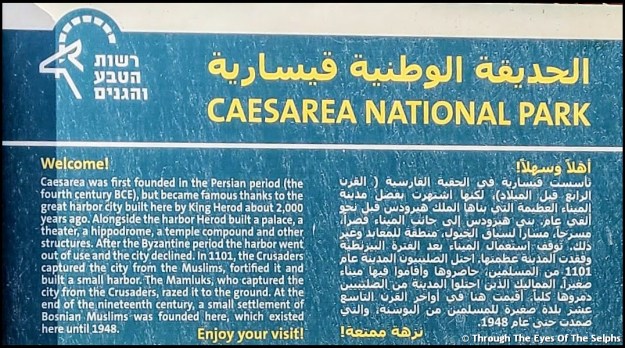
Our first stop was Caesarea National Park located right off the coast of the Mediterranean Sea and considered one of Israel’s great archeological treasures.

Caesarea was a gift to Herod the Great from Augustus Caesar in 30 B.C. Herod constructed a new city here from 22-10 B.C. The Roman amphitheater seated 4,000 people and is where the Caesarea citizens (estimated at 40,000) were entertained. Except for the original first row, most of the seats have been restored. Today the theater is used for concerts.

Pontius Pilate resided here and his name was found inscribed on excavated stones of the theater. The inscription is one of the few physical pieces of evidence of Pilate’s existence other than the Bible.

It was here in Caesarea that Apostle Peter became convinced of the fulfillment of God’s promise to Abraham and Sarah that God would make of them a nation, give them land, and through them the Gentiles would be blessed by coming to know the world’s only true God (Genesis 12:1-3). Christianity as a religion of Jews and Gentiles, the God of Abraham and Sarah, started in Caesarea.

Overlooking the Mediterranean Sea is the remains of a large oval amphitheater where Herod held celebratory games and chariot races.

We were surprised that we were allowed to walk on the remains of the beautiful mosaic tiled floors.

I thought they would have been roped off to preservation. 

Located here is the prison of Caesarea where it is believed Paul was tried and imprisoned for two years according to the New Testament.

Nearby are aqueducts that provided water to the expanding city of Caesarea. The aqueducts originally reached five miles with 3 water channels on top of it and were later extended.

Next up: Tel Megiddo National Park, Mount of Precipice and our baptism/re-dedication 

Cruise Final Days & Daredevil Bill NOV 27, 2022

The day after the Dominican Republic was our final day at sea. As if the off-road vehicle ride wasn’t enough excitement, Bill wanted to enjoy some of the ship’s outside activities. First up was the ship’s ropes course and zip line. Yes, they actually have that on top of the ship. While Bill got harnessed up, I figured out the best positions to get pictures.

It was very windy and it felt like my phone was going to be ripped from my hand. But despite the wind, coughing and wheezing, I managed to get some pictures. I did notice that Bill was the oldest person up there doing this!

Flying Through the Air

Walking the Plank Over the Edge

One section was actually a zip-line, flying through the air suspended!

Next up was the red waterslide. Bill said it felt like he was in that dark tunnel going round and round a long time before coming out the other end. Again, the oldest person there too!

We celebrated his survival from those activities with some time in the hot tub and enjoying the poolside. Quite a few people had the same idea. 

Here is our last sunset from our cruise ship.

We got up early the next morning for the sail into Port Canaveral.

This is Jetty Park Campground

Other Ships Waiting to Leave

We could see the condos where we lived from 2020-2021.

We also saw one of the SpaceX recovery ships: Shannon. This ship is a recovery ship, that is used to recover the Dragon space capsule, the astronauts and then travel back to Port Canaveral. The vessel is equipped with a medical treatment facility and helipad for emergency situations. The name is in honor of NASA astronaut Shannon Walker, the first female astronaut that SpaceX flew.

It was a quick drive home. End of a great trip. 

Next: We have some great trips planned in 2023 beginning in March. Stay tuned. Happy New Year and thanks for following along! 


Puerto Plata, Dominican Republic NOV 26, 2022

After a day at sea, our last port of call was Amber Cove, Dominican Republic. Amber Cove is a private resort used by cruise ships. It is located on the north coast of the country.  Amber Cove is near Puerto Plata, first discovered by Columbus in the 1490s and the site of one of the first forts in the Americas. Amber Cove and Puerto Plata are located on the Atlantic north coast of the island of Hispaniola. The Dominican Republic shares the island of Hispaniola with Haiti on the west.

There was a very long walk on the pier to get to the cruise terminal. The local pier authority provided free rickshaws for those not wanting to walk. We thought the long walk would be good for us after that huge Thanksgiving dinner.

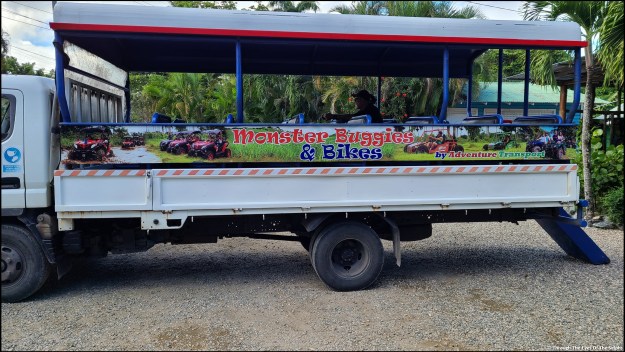
Bill wanted to do a dune buggy/off-road excursion. A group of us took an open air bus to the location where we picked up the Polaris off-road vehicle (ORV).

Each ORV has a driver and passenger side-by-side.

The guides warned us we would probably get dirty. Little did we know! After some brief instructions on operating the ORVs, our convoy set off with several guides leading us. We did not have bandanas, so we bought two.

We rode through tiny towns and down dirt roads, some very muddy.

Cattle grazed on the sides of the road.

We stopped briefly at a little store where they offered us free coffee and of course the opportunity to purchase souvenirs.

We were soon headed back on the road, headed for the beach. Bill and I had just commented to each other that, except for the dust, we had not gotten very dirty. Up ahead was a huge mud puddle that stretched across the road. Bill sped up so we wouldn’t stall out in the deep water. (At least that is what he claimed) And then…..

We were covered in mud and whatever else was in that water. My side of the ORV seemed to get the worst of the mud.

The ORV was covered in mud that quickly dried in the sun.

Thankfully our destination was not far away. Bill and I got in the water and tried to wash some of the nastiness off our arms, legs and face. Luckily the bandanas and sunglasses helped keep it out of our eyes, nose and mouth.

Then it was back in the ORVs for our drive back to the bus. And we were grateful for no more deep puddles.

We Survived!

Back on the ship we got some interesting looks from other passengers on the elevator and hallways. It was quite a job getting ourselves clean and rinsing out our clothes the best we could so we could at least get them back home.

A Beautiful Gazebo As We Sail Away!

Next up: Our last day at sea and Bill is a daredevil !