Category Archives: Private RV Campground

Private RV Campground

SEPT 3, 2015 Zion National Park, Utah

Our last national park in Utah is Zion National Park.  We stayed about thirty minutes from the park in the town of Hurricane, a larger town than previous towns with a Walmart, restaurants  and a movie theater.  Unfortunately we were back in hot weather with no shade at our campsite so we shortened our stay from seven to four nights.

Legend has it the town was named one windy day in the 1860’s by Mormon leader Erastus Snow when a gust of wind blew the top off his buggy.  He said it was a hurricane and decided to name the area Hurricane Hill.  Because of Hurricane’s 2,000 acres of excellent farmland, orchards and vineyards, this area is nicknamed “The Fruit Basket of Southern Utah”.  While we were there they had their annual “Peach Days”, a local celebration with street vendors, farmers markets and fireworks.

IMG_20150904_131220-1Zion National Park was first designated a national monument in 1909 by President William Howard Taft and later became a national park in 1919.  Zion was named by Isaac Behunin, the first permanent European-American settler in the canyon.  Behunin built a one room log cabin in the canyon in 1861.  Behunin said, “A man can worship God among these great cathedrals as well as in any man-made-church this is Zion”.

Zion is known for having some of the most scenic canyon views in the United States with high plateaus, narrow, deep sandstone canyons with 2,000 feet high walls in some places, and huge rock towers and mesas.IMG_1202IMG_20150904_110815IMG_1208IMG_1209IMG_1215IMG_1216

IMG_1206One of the park’s most impressive construction projects and considered an engineering marvel is the 1.1 mile tunnel which was blasted through solid sandstone between 1927 and 1930.  A really neat feature of the tunnel are lookout galleries cut like windows into the tunnel rock so drivers can have views of the canyon as they drive through the tunnel.  There is no stopping allowed in the tunnel so it was hard to get good IMG_1228IMG_1224pictures of the canyon from the windows.  We drove the twelve mile scenic Zion-Mt Carmel Highway which took us up six steep switchbacks and through the tunnel to the east side of the park.  We stopped at various overlooks including one of a large checkerboard mesa, a naturally sculpted rock art.  The horizontal lines are evidence of ancient sand dunes and the vertical lines are from erosion due to rain and melting snow.IMG_1214IMG_1219

In May, 2000 the park began operating a mandatory shuttle bus on the 6.5 mile long Zion Canyon Scenic Drive in one part of the park, making this part of the park accessible by shuttle bus only.  We rode the bus and found it very enjoyable with enough buses running so there was never a long wait.  Our only complaint would be the windows on the bus only partially opened making it really hard to take pictures from the bus windows.  The park instituted the mandatory shuttle bus to

  • eliminate air and noise pollution
  • eliminate visitor stress from traffic backups and limited parking spaces
  • to preserve the area and vegetation from being damaged and eroded by cars parked on the road shoulders

Research shows that 150 years of farming, grazing and recreation has changed Zion’s environment.  The park is working to restore some of the ecological diversity in the park.

Unlike Bryce Canyon where you had to hike down to the canyon, in Zion you are actually driving in the canyon with steep sandstone walls around you.IMG_20150904_110117IMG_20150904_114605IMG_20150904_115408IMG_20150904_143200IMG_20150904_143541IMG_20150904_144425

We rode the shuttle to the last stop, the Temple of Sinawava, a huge natural amphitheater which is the narrowest part of the canyon accessible by vehicle.

Visit this link for a 360 view video: https://youtu.be/stzCNHsVTkM

There we enjoyed the Riverside Walk which followed the Virgin River.  Along the way we saw rock walls with dripping springs and lush vegetation.  At the end of the trail you could enter the river and follow the river up to “The Narrows” where the canyon walls narrow in around you.  The ranger told us earlier that the water level up the river to the Narrows would go from your knees to your thighs to your waist before eventually reaching the Narrows.  Since the water temperature was 60 degrees and we did not have a change of clothes or shoes for the bus ride back to the car, we decided not to hike to the Narrows.IMG_20150904_150401IMG_20150904_150502IMG_20150904_151613

On the way back to the car we saw four climbers scaling the canyon wall.  They looked like tiny ants in the distance.

Tomorrow we plan to take a hike recommended to us by a ranger and take another scenic drive in another part of the park.

August 24, 2015 Bryce Canyon, Utah

IMG_20150827_135957We left Torrey and Capitol Reef National Park and headed to Panguitch, Utah which is about 30 minutes from Bryce National Park.  Panguitch is a small town, population 1,500. Butch Cassidy and his gang was photographed here.

IMG_20150827_141108

Fire water wagon from years past

As expected we were directed to a site with absolutely no shade but we had excellent satellite reception and good WiFi and Verizon coverage.  Since this area is cooler than Moab we were not too concerned about the heat.IMG_20150827_140034IMG_20150827_143042

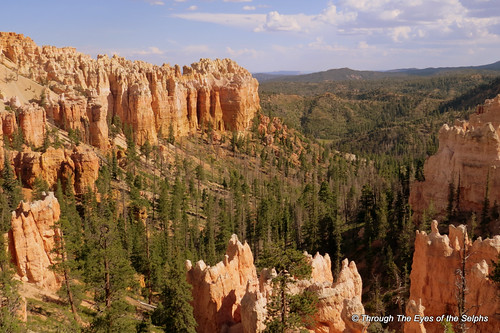
IMG_1138Just when I think it couldn’t get any more beautiful, we go to a new park and we are awe struck by its beauty.  The same was true for Bryce Canyon which really isn’t a canyon but a plateau with a series of horseshoe shaped amphitheaters carved in the edges of the eroding plateau.  Bryce Canyon was settled by Mormon pioneers in the 1850’s and is named for Ebenezer Bryce, a Mormon settler who homesteaded the area in 1874.  It became a national park in 1928.

To get to Bryce Canyon we drove once more on Highway 12, The All American Road, passing through Red Canyon with its beautiful red sandstone and limestone formations and through two tunnels.  IMG_1136IMG_1132IMG_1137Once inside the park we stopped by the Visitors Center to see a movie about Bryce Canyon.  We then drove an 18 mile one way scenic drive through the park with 14 viewpoints with views down into the amphitheater.   Some of the stops had overlooks alongside the road while others involved short hikes along paved trails.  The views at all the overlooks were amazing.  We saw many “hoodoos” which are towering rock formations sculptured over time by ice freezing and thawing, some as much as ten stories tall.  There are approximately 200 days of freezing/thawing at Bryce Canyon each year.  It was fun to let our imaginations run loose and imagine faces or figures in the formations.  The Paiutes, original inhabitants of the area, believed that the rock figures were people turned to stone by angry gods.  If you look closely you can also see fairy tale castle formations.  Iron oxide gives red, yellow and brown tints to the limestone.IMG_1139IMG_1140IMG_1142IMG_1143IMG_1151IMG_1156IMG_1158IMG_1162IMG_1168IMG_1167IMG_1174IMG_1176IMG_1177IMG_1179IMG_1185IMG_1186IMG_1192IMG_1193IMG_1194IMG_1195IMG_1196IMG_1198IMG_1164

Here is a video for you: https://youtu.be/bA-UUBM0rXc

Our goal is to return to the park and hike the popular Navajo Trail which will take us down into the amphitheater for a closeup view of the hoodoos.  More about that in the next blog.IMG_1200IMG_1201

August 18, 2015 Utah Scenic Highway 12

IMG_1122IMG_1118We continued to enjoy the cooler temperatures and beauty from our campsite near Capitol Reef National Park.  One day we took a break from the park and spent the day driving half of Utah State Highway 12, also called “Scenic Byway 12”, “The All-American Road” or “A Journey Through Time Scenic Byway” and known as one of the most scenic drives in America.  One website even called it the 2nd most beautiful highway in the world which I believe is a bit of an exaggeration!  The road took 40 years to complete and has Capitol Reef on one end and Bryce Canyon on the other.  IMG_1111IMG_1112IMG_1114IMG_1115IMG_1124IMG_1121Most of the land is public land as we drove through Dixie National Forest, the largest forest in Utah.  We saw bison, llamas, cattle and deer as we climbed to 9,636 feet. One section of the road was along a neck of the road no more than 30 feet across before dropping back down to Escalante where we stopped by the Grand Staircase-Escalante National Monument Visitor Center.

IMG_1110

Lady I am trying to cross here – move along please!

IMG_1126We enjoyed our time in Capitol Reef National Park and head next to Panguitch, Utah near Bryce Canyon where hopefully it will be even cooler!

August 17, 2015 Capitol Reef N.P. Utah

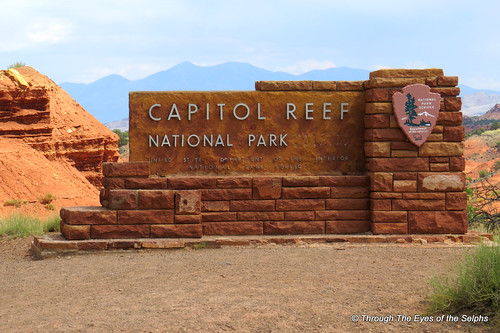
IMG_1092As beautiful as the area is, we were glad to leave Moab and head to Torrey where we would visit Capitol Reef National Park (NP).  Torrey is at a higher elevation than Moab, making it at least 10 to 15 degrees cooler.  We arrived at our campground in Torrey, a short drive from the park.  We settled under some trees which still allowed us satellite reception and we immediately noticed the cool refreshing breezes.  IMG_1108Quite a relief from our last campground with no shade.  Only complaint was no Verizon and the WiFi provided by the campground was spotty and unreliable.  At night we were able to sleep with the windows open and needed a light blanket!
Capitol Reef NP gets its name from the large sandstone domes that have eroded and resemble the U.S. Capitol building. A one hundred mile long wrinkle in the earth’s crust created 65 million years ago is filled with cliffs, gorges, canyons, arches and domes and is called the Waterpocket Fold.  This fold forms a reef like barrier limiting access in the park.   There are many dome like sandstone features in the park but one has been given the name Capitol Dome.

IMG_1101

Capitol Dome

IMG_1105

Castle

One of the prominently named landmarks in the park is The Castle.

There is an eight mile one way scenic drive that takes you down into the canyon where the temperature climbed to over 100 degrees.  Along this road are several dirt or gravel spur road that take you to overlooks or access to hiking trails.IMG_1096IMG_1099IMG_110620150817_10230920150817_102316

This is the first national park which has its own fruit orchards of apple, peach, cherry, pear and apricot trees left over from the days of the late 1800’s Mormon settlement called Fruita. Historic and heirloom fruit is grown here like the pioneer days.   In season you can enter designated orchards and eat for free as much fruit as you can hold.  Any you pick and take out of the orchard is $1.00 a pound.  While we were there apples were available for picking.  In the park are several historic pioneer settlements, still maintained as they were for 100 years, including farmhouse, barn, smokehouse and schoolhouse.

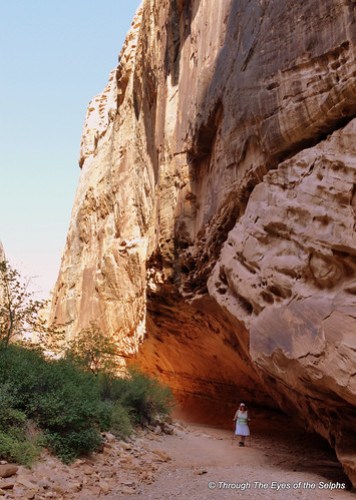
IMG_20150819_090434We walked the Grand Wash Trail which was a delightful flat trail with shady spots where the canyon walls shielded us from the sun.  We hiked to “The Narrows”, a really neat spot where the canyon walls closed in on us, making for some fun echoes.  After the hot steep trails in the other two parks, this trail was a welcome surprise with breathtaking canyon wall views.IMG_20150819_092837IMG_20150819_094453IMG_20150819_094023IMG_20150819_094817IMG_20150819_095132IMG_20150819_095541IMG_20150819_101645IMG_20150819_101808

August 15, 2015 Canyonlands N. P. & Dead Horse Point S.P. Utah

20150816_065519Our last day in Moab we set out very early to try to beat the heat.  The red rock walls surrounding our campsite were beautiful in the early morning light and at sunset as the sun lit up the walls to a bright red.  We had early morning guests to greet us as we were getting in the car.20150816_065759IMG_1013

IMG_1018

These Buttes are named after the Civil War ironclad ships

IMG_1020Canyonlands National Park and Dead Horse Point State Park were both about 45 minutes from Moab in the same direction so we decided to visit both in one day.

Canyonlands National Park, established in 1964 by President Lyndon Johnson, has canyons, mesas and buttes carved by the Colorado and Green Rivers and their tributaries.  There are four areas of the park with “Island In The Sky” being the most accessible, hike-able and favorite of tourists.  Island in the Sky sits atop a massive 1,500 foot mesa with beautiful views and a twenty mile scenic drive, making it truly feel like an island in the sky.IMG_1021IMG_1024IMG_1028IMG_1034

Once again we used Gypsy Guide as our tour guide as we drove the scenic drive through the park.  We were able to get in two hikes before the heat became unbearable by starting early.  First we did a short hike to Mesa Arch.

IMG_1058A much longer hike took us to the Grand View Point Overlook with amazing views.  We had to climb at times over “slickrock” which is the name the early settlers gave the rock because their horses’ metal shoes couldn’t grip the rocks’ surface.

IMG_1045

The trail is well marked with three square blocks

IMG_1046

Zoomed in view of Green River, the Colorado River was not view-able from the trail

IMG_1061IMG_1063IMG_1064IMG_1053

Here is a video of the view: https://youtu.be/smzHZQlX49s

IMG_1071

A jeep trail that leads to the Colorado River

IMG_1075On the way home we stopped by Dead Horse Point State Park.  The overlook, 2,000 feet above the Colorado River, provides breathtaking views of Canyonlands National Park in the distance.  From the viewpoint we could look across the canyon and see the cliff where Thelma and Louise drove their car off the edge at the end of their movie.  Legend says that around the turn of the century cowboys herded wild mustangs roaming the mesa top, surrounded by sheer cliffs on all sides, across the narrow neck of land only 40 yards wide and onto the point.  The neck was then fenced off with branches and brush to make a corral.  However one time, for some unknown reason the horses were left corralled on the water-less point where they died of thirst with the Colorado River within view below them.IMG_1080IMG_1085

IMG_1066

Colorado River

IMG_1081

Colorado River

IMG_1084

Movies filmed in Dead Horse State Park include “The Lone Ranger (2013), Mission Impossible II, Thelma and Louise”.
Here is a video of the view: https://youtu.be/cdQ6LFRX88w

Colorado River Trivia:

  • The Colorado River supplies water to the states of Utah, Colorado, Arizona, California, Nevada and New Mexico.  It starts as a small trickle of snowmelt high in the Colorado Rocky Mountains and begins a 1,450 mile journey through mountain canyons and three deserts.
  • More water is exported from the Colorado River’s 250,000 square mile basin than any other river basin in the world.
  • Seventy percent or more of its water is siphoned off to irrigate 3.5 million acres of crops.
  • At one time every drop of water was pumped or diverted to cities and farms in the U.S. and Mexico before it had a chance to reach the end of its 1,450 mile journey to the ocean.
  • Today that has been changed due to federal laws, court decisions, contracts and regulatory guidelines, including agreements between the U.S. and Mexico which allows Mexico to store water in U.S. reservoirs.

August 14, 2015 Arches National Park, Utah

We left Salt Lake City and headed to Moab, Utah.  We originally planned on staying in Salina, Utah overnight because of the long distance to Moab.  But when we stopped for lunch Bill felt we were making good time and decided he would like to continue the rest of the way to Moab.  We passed through some interesting scenery along the way.

We arrived in Moab with temperatures in the upper 90’s to 105 everyday.  We had looked at the weather forecast and were worried about the heat spell for the next week.  We knew from looking at the campground online that there was no shade.  With all that in mind we reduced our reservation from 7 to 4 days when we arrived.  Just as expected we were directed to a nice site which had no shade.  Even with two rooftop air conditioners it is impossible to keep up with the heat.

IMG_1008Moab, population 5,046, overlooks the Colorado River and is located in a valley surrounded by red cliffs and the La Sal Mountains.  It was a visited by Butch Cassidy and his Wild Bunch as well as author Zane Grey who used the town and surrounding area as the locale for many of his western novels.  There is a brochure devoted just to all the sites in Utah used in films starting in 1939 with “Stagecoach” starring John Wayne followed by “Wagon Master” in 1949 and “Rio Grande” in 1950 starring John Wayne and Maureen O’Hara.  In the Moab/Arches National Park area we have movies such as “The Hulk”, “Indiana Jones and the Last Crusade”, “Lone Ranger” (2013), “Star Trek” (2009), “Thelma and Louise”, “Transformers Age of Extinction”, “Mission Impossible 3” and many more!

In the 1950’s Moab was changed from a quiet agricultural town into a bustling mining and prospecting area with the discovery of uranium.  Today tourism is the main industry.

IMG_1007We had two reasons for coming to Moab.  One was to see Arches National Park and the other was to visit Canyonlands National Park.  We got up early the next morning hoping to beat the heat.  Our destination this day was Arches National Park located three miles from our campground.  We usually stop by the Visitors Center first but we were anxious to get started on our outdoor activities before it got too hot.  When we were in Hawaii we purchased several reasonably priced smartphone audio tours of each island from “Gypsy Guide”.  We felt they did an excellent job and it was like having a personal tour guide in the car.  So we were thrilled to discover Gypsy Guide had tours for both Arches and Canyonlands National Parks.  Bill hooked it up to the car’s Bluetooth so it could be played with the radio. The tour automatically advances based on your GPS location.IMG_0960

IMG_0963

Three Gossips

IMG_0964

Sheep Rock

Arches National Park contains the largest number of natural stone arches in the country with over 2,000.  The park also has beautiful red rock canyons, spires and balanced rocks.  Water and ice, extreme temperatures and underground salt movement over 100 million years are responsible for the beautiful sculptured sandstone rock.  The arches were formed by the weathering of openings in the vertical slabs of sandstone.  Park Rangers consider any opening extending at least three feet in any one direction to be an arch.

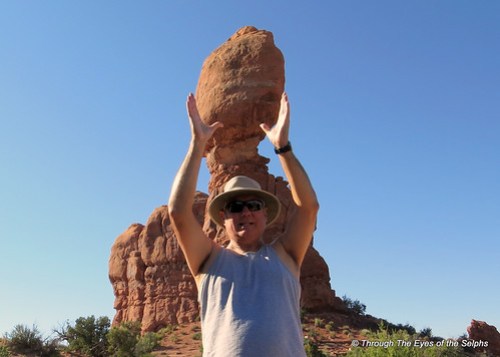
IMG_0970Our Gypsy Guide gave us a running commentary on the geology and history of the area as we drove the 36 mile round trip scenic road through the park.  We stopped at many overlooks and hiked to Balanced Rock and several arches, including Delicate Arch.  At Delicate Arch we had a choice of three hikes to see this famous arch.  There was a really short easy walk with a far away view, a moderate hike up a rather steep path over rock steps built into the pathway with a somewhat closer view, and a three mile strenuous hike for a close up view.  We chose the moderate hike and still had a view a long way from the arch.  I must say the appearance of the arch was rather anticlimatic since Delicate Arch is the unofficial symbol of Utah and seen on many of their license plates.  Whew it was hot!IMG_0972IMG_0975

IMG_0991

Normal View of Delicate Arch

IMG_0995

Zoomed view of Delicate Arch

IMG_0990IMG_0969IMG_1002IMG_0968IMG_1006IMG_1005

IMG_0986

Turret Arch

We stopped at a neat group of arches called the Windows area.  Bill asked a lady to take our picture.  We struck up a conversation with her and the others in her group.  It is always interesting to hear how extensively people from other countries have toured our country and how well they know English.  This group was from Italy.  She told us she was working at the NIH in Baltimore during the 9/11 attack and how badly she felt for our country.  Currently she is a professor at the University of Bologna, the oldest university in the world.  We love chance meetings with interesting people in our travels!

IMG_0983

Sunny Side of North Window

IMG_0984

South Window

IMG_0987

North and South Windows Together

The next day we stayed home and had a “hot day”, our equivalent of a snow day.  Both days the temperature reached 106 outside by late afternoon.  Too hot to go outside plus we wanted to let our bodies recover from the previous day’s hikes since we were hoping to do some hiking the next day at nearby Canyonlands National Park which will be the topic of our next blog.

Trivia:

  • In 1952 Charles Steen, a young geologist, discovered uranium deposits in the Moab area.  This resulted in a rush of miners to Moab increasing the population by five-fold.  By 1955 there were approximately 800 mines producing high grade ore and Moab was nicknamed “The Uranium Capital of the World”.  However by the mid 1970’s foreign competition and federal regulations put an end to domestic uranium mining.  Sixteen tons of uranium remnants formed a massive pile three miles outside of Moab.  Today trains transport these remnants in covered cars to a permanent disposal site 30 miles north of Moab.  We could see in the distance the long line of train cars waited to be loaded.
  • In 1964 one of the large rock towers in Arches National Park was used in a Chevrolet television commercial featuring a car and a Hollywood model.  The car and nervous model were placed atop the tower by helicopter.  After filming, heavy wind prevented the helicopter from landing to take them back down.  The frightened model had to spend hours stranded in the car waiting for the wind to die down.
  • Airplanes are not allowed to fly over Arches National Park because of concern the sound may damage or break the delicate features.  Breaking the sound barrier in and around Moab is forbidden.
  • Arches became a national monument in 1929 and was then designated a national park in 1971.  It is 76,519 acres or 119 square miles.


August 8, 2015 Salt Lake City, Utah

IMG_20150813_113306

Salt Lake City

We made the short drive to a private campground located in North Salt Lake City, about six miles from downtown Salt Lake City which we could see in the distance.   What a difference these private campgrounds are from the state, national and forest campgrounds.  We had to get used to the narrow campsites with close proximity to neighbors that are found in most private campgrounds as well as traffic noise from the nearby freeway.

We settled in and then drove to the nearby Honda dealership to have maintenance done on the Honda.  We were very impressed with the people there.  Even though we were not local, just passing through the area and only having required maintenance done, we could not have been treated nicer.

Our first evening in the area we had a terrible storm with heavy rain and high wind.  Even though the forecast also called for severe lightning and hail, we didn’t experience any of that to our relief.

IMG_20150810_100703

Family History Library

We drove into downtown Salt Lake City on two separate days so Bill could do some research at the Family History Library.  The library was founded in 1894 and is one of the world’s largest genealogical libraries.  The collection mainly focuses on the United States, Canada, the British Isles and Europe, including Scandinavia, however there are genealogy records from other areas of the world.  While we were there many people of different nationalities walked through the door seeking information.  All Family History Library original records are kept at the Granite Records Vault in the mountains near Little Cottonwood Canyon.  Fortunately today many of the records are computerized.  Anyone is welcome to use the library and it is all free!  The library is 145,000 square feet and has more than 300 computers.  They have birth and death certificates, marriage licenses, census returns, property, probate and cemetery records.  HOWEVER, the Library’s collection focuses on people who lived before 1930 so you will need some older information on your family to begin.  I noticed they also have helpers throughout the library who speak other languages to help non-English speaking guests.

When we arrived we were given a first timer name tag and saw a four minute orientation movie (also available in many languages) about the five story library.  We were then ushered into a room full of computers where we were each given our own personal helper to get us logged in and to show us the ropes.  Create your account at familysearch.org then you can do about 99% of the research from the comfort of your home. There are over 4,500 branches of the library located around the world if you want assistance and/or if you want to use their equipment.  After about an hour of family research I had had enough and I went back to the lobby to work on our blog and read.  “… genealogy is the second most popular hobby in the U.S. after gardening, according to ABC News …”. Genealogy is really more Bill’s passion than mine.

IMG_0942

On May 15, 1829, Joseph Smith and Oliver Cowdery went into the woods

When he finished for the day we explored the downtown area some.  Salt Lake City was founded by the Mormons in 1847 and lies at the foot of the Wasatch Mountains.  It is a beautiful setting.  The Great Salt Lake lies to the northwest and the Great Salt Lake Desert to the west.  By the way, the name of the religion is The Church of Jesus Christ of Latter-day Saints.  Mormon is just a nickname.  Joseph Smith, Jr. said an angel entrusted him with golden plates inscribed with symbols which Smith translated into the Book of Mormon.  Smith advocated polygamy.  Although no more than 4% of the Mormons practiced polygamy, advocacy of it led to problems with non-Mormons wherever they tried to settle.  In search of a place where they could practice their religion without prosecution, they tried settling in Missouri and Illinois.  Smith was arrested, jailed and eventually shot to death.

After Smith’s death the church split into two groups with the group opposed to polygamy forming a “Reorganized Church” and returning to Missouri.  A larger group followed Brigham Young, the second president of the Mormon Church to Utah in 1847, establishing Salt Lake City.  By 1869 more than 60,000 Mormons had immigrated to Utah by covered wagon or handcart.  Also in 1869 the transcontinental railroad was completed linking Utah to both coasts.  They applied for statehood in 1849 but their request was not granted until 1896 after the church abolished polygamy.  By the 1900’s there were over 400 cities in Utah.

The streets downtown are laid out in a grid pattern fanning out from Temple Square, the spiritual and historical headquarters of the Mormon Church.  The streets were designed to be “wide enough for a team of four oxen and a covered wagon to turn around”.  The streets are named for their directional distance from the Temple, such as West Temple, North Temple, South Temple and then Main Street.  So one street south of South Temple is 100 South, next street is 200 South, etc.

IMG_0934

Utah State Capitol Building

With a population of 186,440, Salt Lake City is the state capital of Utah.  We stopped by the beautiful capitol building which sits high on a hill overlooking the city below. The Corinthian style building was completed in 1915 and resembles the National Capitol.

Temple Square is advertised as the number one tourist attraction in Utah.  Three of the buildings on the square were built by pioneers; the six-spired granite Salt Lake Temple which took 40 years to complete, the domed Tabernacle which is home to the Mormon Tabernacle Choir and organ, and the Assembly Hall.  Only church members may enter the Temple.  The Mormon Tabernacle Choir began with a small Choir in 1847, twenty-nine days after the first Latter-day Saint pioneers entered the Salt Lake Valley.  Today the choir has 360 members.  The Choir’s first radio broadcast took place in 1929.  Today their broadcast is the longest running continual network broadcast in the world.

IMG_0937

Mormon Assembly Hall

IMG_0943IMG_0945IMG_0947

IMG_0938

Domed Tabernacle Choir Building

IMG_0949We also drove by a small park wedged between two apartment buildings where we found the Mormon Pioneer Memorial park where Brigham Young and several members of his family are buried.  We were surprised to find Young’s grave in such a plain, isolated park not far from the capitol building. Young died in 1877.IMG_0953IMG_0950

IMG_0928

Eagle Gate

On the way to the capitol we passed under the 4,000 pound bronze eagle with a wingspan of 20 feet atop Eagle Gate.  The structure was erected in 1859 and at one time marked the entrance to Brigham Young’s farm.

Unfortunately Salt Lake City has the worst panhandling problem we have seen in our travels.  There are a large number of tourists in the Temple Square area and they are targets of the panhandlers.  While I was waiting for Bill in the lobby of the Family History Library, a lady came in complaining about a panhandler.  Security was called and from what I overheard, it is an ongoing problem with security called almost daily.  Bill and I were approached twice, once when leaving the library and in the parking lot two blocks from the library. Too bad Salt Lake City cannot solve this problem because it is such a turn-off for tourists in an otherwise beautiful city.

Like many cities, Salt Lake City does not have enough parking downtown and what they do have is pretty expensive.  One of the volunteers at the library gave us directions to a parking lot just a couple blocks from the library where the parking was only $1.00 an hour.  We were really glad to find that jewel!

Utah facts:

  • Seven national parks, 45 state parks, 6 national monuments, 8 national forests, 14 ski resorts
  • Population of 2,942,902
  • Symbol is the beehive representing thrift and industry
  • Origin of name is from the Native American Indian Tribe, the Utes

August 2, 2015 Arco, Idaho

IMG_0831It was a long travel day from West Yellowstone to Arco, Idaho with a stop along the way at the Walmart in Idaho Falls to restock supplies.  Arco is a tiny town with a population of 995 and was the first community in the world to be lit by electricity generated by nuclear power.  This occurred on July 17, 1955.  The area is nothing but sagebrush and open fields and the campground selection is very limited so we settled in at a KOA. The local high school paints their graduation year on the rocks above the city.IMG_0829IMG_0832

IMG_0828Our main reason for coming to this desolate area of Idaho was to visit the 750,000 acre Craters of the Moon National Monument and Preserve located eighteen miles southwest of Arco.  In 1924 President Calvin Coolidge used the 1906 Antiquities Act to proclaim the Craters of the Moon National Monument.  In 1923 geologist Harold T. Stearns described the area as “the surface of the moon as seen through a telescope…. where dark craters and the cold lava were nearly destitute of vegetation”.

IMG_0788While lava flows exist on the moon, astronauts confirmed that most lunar craters resulted from meteorite impacts, not from volcanoes.  But the Craters of the Moon are definitely of volcanic origin.  The vast amount of lava did not come from one volcano but from a series of deep fissures, known as the Great Rift, that cross the Snake River Plain.  Beginning 15,000 years ago lava welled up from the Great Rift to produce this vast area of rock.  The most recent eruption occurred 2,000 years ago and geologists believe future eruptions are likely.IMG_0789IMG_0790IMG_0794IMG_0795IMG_0826IMG_0827

IMG_20150803_114816

Satellite view of the lava flows

Years ago the Northern Shoshone Indians passed through this area on their annual migration from the Snake River to the Camas Prairie.  They left behind well worn trails and mysterious stone circles on top of the lava.  Archeological evidence and oral traditions indicate the Shoshones most likely witnessed some volcanic eruptions.

Craters of the Moon can be seen by satellite and we noticed it shows up on the local TV weather maps when we watch the weather.

In the 1800’s European-Americans in search of gold and farmland avoided the lava fields.  In the 1850s and 1860s pioneers followed the Goodale’s Cutoff of the Oregon Trail as an alternate route to avoid conflicts with the Shoshones and crossed through the northern edge of the lava fields.  Idaho was part of the Oregon Territory then.  In 1863 it became the Idaho Territory and a state in 1890.

In 1969 NASA Apollo astronauts learned about volcanic geology here in preparation for their moon missions.

IMG_0796

Splatter cone

After stopping by the Visitors Center we drove the Craters of the Moon Loop Road, stopping at various places along the route.  The final stop had a trail across the lava that led to several lava tubes or caves.  Entering the caves required some tricky rock scrambling so I was happy to leave the cave exploring to Bill.

IMG_0803

Indian Tunnel

IMG_0808

Indian Tunnel

IMG_0811

Indian Tunnel

IMG_0811

Indian Tunnel

IMG_0817

IMG_0812

Boy Scout Cave looking deep

IMG_20150803_140858

Entrance to Beauty Cave

IMG_0824

Beauty Cave

IMG_0833Also while in Arco we drove to see the Experimental Breeder Reactor #1 (known as EBR-1) at the Idaho National Laboratory.  On December 20, 1951 the reactor became the first nuclear reactor to generate a usable amount of electricity using atomic energy.  From that day until the day it was decommissioned in 1964, EBR-1 generated enough electricity to supply all the power for its own building whenever the reactor operated.

We took a guided tour through the building which explained how atomic energy is used to make electricity.  We had an excellent guide, a University of Idaho graduate student in psychology from the Ukraine.  We were surprised she didn’t have a degree in nuclear engineering.  There wasn’t a question asked she couldn’t answer in detail.IMG_0838IMG_0840

President Lyndon Johnson visited the site in 1966 during a ceremony dedicating EBR-1 as a registered National Historic Landmark.

Among many things our guide told us was that the nuclear waste materials from the Three Mile Island accident site was brought to Idaho to be stored.  It was often brought across the country by train in darkness because of protests by people in states who did not want the waste passing through their states, with some states forbidding the passage.

IMG_0842

Physicist Enrico Fermi was the genius behind the “breeder” concept, but Walter Zinn made it a reality.

The Idaho National Laboratory currently employs more than 8,000 people.IMG_0843

Who knew this desolate area of Idaho could hold such fascinating places!

July 12, 2015 Jackson Hole, Wyoming

Welcome to our 200th travel blog post!!

IMG_20150711_155841We left Shoshone National Forest and made the steep climb over the Togwotee Pass, crossing the Continental Divide westward.  Our excitement grew as our first glimpse of the Grand Tetons came into view.  We passed a large 24,700 acre national elk refuge where 7,500 elk live.  Each spring Boy Scouts gather up antlers in the refuge which are then sold at an auction in Jackson.  Half of the proceeds go to the Boy Scouts and the other half is used by the town to provide food for the elk during the long cold winter.IMG_20150712_140426IMG_20150712_135743IMG_20150712_134540

Our destination was Jackson, Wyoming.  It was known as Jackson Hole until the modern zip code system forced the name be changed to Jackson.  Our campground was located outside of Jackson in Wilson.  There are not many campgrounds in the Jackson Hole area and most are located outside of town and ridiculously high priced.  The campsites are very close together, reminding us of why we love to camp in state and national parks and forests.

Jackson Hole gets its name from fur trapper Davey Jackson, one of many fur trappers and mountain men who inhabited the area in the 1800’s.  The town itself was established in 1894.

Occasionally tourists come to Jackson Hole and want to know where the “hole” is.  There is no hole, it is called Jackson Hole because it is located in a valley bordered by mountain ranges.  The town is actually forty eight miles long and eight to fifteen miles wide with the Snake River meandering through the town.  Since 97% of the surrounding Teton County is public land, real estate and housing costs there are very high.  The main industry is tourism, with two thirds occurring during the summer season and one third during the winter ski season.

Jackson Hole has a lot of businesses crammed into a small area.  Traffic is heavy and you have to be very careful not to hit one of the many tourists flooding the streets and sidewalks.

One place of interest was Jackson Square, a park where they have an entryway of elk antlers at each of the four corners.  People were enjoying the cool shade and a band of some sort was playing one day when we drove by.IMG_20150715_152210IMG_20150715_152237

While in Jackson Hole we wanted to go whitewater rafting on the Snake River.  The rafting company picked us up at our campground at 6:15 AM and it was 44 degrees.  Remember, this is July in Wyoming!  We joined a high school math teacher, her husband from Fort Worth, Texas and two families from San Jose, California then boarded a bus down to the river.  Everyone was very friendly and we certainly did have a great time getting to know them.  The first eight miles of the trip was a calm, scenic float down the Snake River where we saw several bald eagles and ospreys.  We then got out of the raft and stretched our legs and had a snack.  The next eight miles of the trip was the exciting whitewater part of the trip as we traveled through many rapids.  The first rapid sent two huge waves of ice cold water over the raft, soaking all of us.  My teeth were chattering!  There were many more times when the freezing water washed over us.  After the trip they provided us with a bagged lunch which we enjoyed while continuing to visit with our new friends before the bus trip back to the campground.  We had a great time!  The only thing that would have made it better would have been temperatures about twenty degrees warmer.  Of course they had a company who takes pictures as you go through one of the larger rapids.  The pictures are pricey but we did splurge and purchase two.IMG_0684IMG_0686

I would like to end on a personal note.  While in Jackson Hole I received word of the passing of my Uncle Arnold.  He was like a father to me and his two sons are like my brothers.  Arnold married my mother’s sister the year I was born, so I have known him my entire life.  We had planned to see him in April 2016 when we pass through Virginia, but God had a better plan for him.  One of the hard things about the full time Rving lifestyle is we are not nearby our family and friends.  It was very hard for me to miss his funeral, but I know I did not have to be present at his funeral for him to know how much he meant to me and how much I love him. -Diane

July 10, 2015 Thermopolis, Wyoming

We stopped in Thermopolis because of the hot springs located there which are advertised as the largest mineral hot springs in the world.  The name Thermopolis comes from the Greek words for hot and cities.  Located at the foot of Owl Creek Mountain and beside the Big Horn River it was once part of the Wind River Indian Reservation.  The town was founded in 1897 and attracted outlaws such as Butch Cassidy and the Sundance Kid.  Today it has a population of around 3,200 and tourists who come for the healing powers of the hot springs.

Hot Springs State Park was purchased from the Arapaho and Shoshone tribes in 1876  for $60,000 as part of a treaty with the provision it remain accessible free of charge to the public.  Native Americans believe the mineral water has therapeutic powers.  Today the park and public bath house are free of charge and it is the most visited state park in Wyoming.
The mineral rich hot water creates colorful geological formations which has occurred over millions of years forming beautiful rainbow terraces.  The hot springs are naturally colored and formed by mineral deposits.  They look like waterfalls and form a 125 degree F lake. The Big Spring in the park has more than 3.6 million gallons of 127 degree F water flow over colorful terraces every day.  The water contains at least 27 different minerals.  Most of the water is IMG_20150710_122608IMG_20150710_122914thought to come underground from the Owl Creek Mountains through the Big Spring.  Rain enters porous rock layers, moves slowly downward and is forced to the surface through crevices in the rock.  The heat and chemicals in the water come from the rock through which it passes and from gases that rise from deeply buried volcanic rocks.  Some geologists think the underground formation that supplies the spring is the same that provides Yellowstone National Park its famous hot waters.IMG_20150710_123625

20150710_114837From the Big Spring the water flows into cooling ponds and runs into swimming pools, jacuzzis and the Big Horn River.  The State Bath House water is 104 degrees F and they have an employee check the water temperature often.  You are limited to 20 minutes in the water.  The pools are filled with 100% mineral water; no chemicals or municipal water is used.  There is an indoor and an outdoor pool and they are both cleaned every 48 hours.  I could not get past the strong sulfur smell of the water and was happy to wait while Bill enjoyed the water.  It took a couple showers to get the sulphur smell out of his skin!

There is a very small bison herd of around eleven buffalo in the park.  We drove around trying to see them but they were hiding.

We stayed one night in Thermopolis and drove towards Jackson Hole.  We drove through the Wind River Indian Reservation through beautiful Wind River Canyon with 2,500 foot walls of rock.  There are informative signs along the route describing the geologic history of over a billion years of geology.

Along the way we continued to enjoy the views of the Wind River Canyon as we followed the Wind River to where it flows into the Big Horn River.  When early explorers came across the river from opposite directions they each named the river.  One named it Wind River and the other named it Big Horn River.  The river changes names just south of Thermopolis.IMG_20150710_144618IMG_20150710_144946IMG_20150710_145050IMG_20150710_145244IMG_20150710_145441IMG_20150710_145455

We  stayed overnight in Riverton at the Wind River Casino.  They allow free overnight parking in their parking lot and even have a few electric (15 AMP) hookups which we were lucky to use.  We went inside the casino and both signed up for a players card which gave us each $10.00 to use at the slot machines.  We had fun playing the machines and ended up winning $8.00 between us.  We had dinner at one of the restaurants in the casino.  We were amazed at how quiet the parking lot was and woke the next morning refreshed and ready to hit the road.

Our next overnight stop was at a national forest campground in Shoshone National Forest. On our route we saw ranches and homes built right up against the canyon walls.  IMG_20150711_134932IMG_20150711_135928IMG_20150711_141212IMG_20150711_141247IMG_20150711_141342We had a nice campsite in the forest with electric only.  For the first time in quite awhile we had absolutely no cell phone service which usually would not have been a problem but we had a family member we needed to check on.  We enjoyed camping in the forest and smelling the pine trees.  IMG_20150711_152105IMG_20150711_161029It has been awhile since we had camped in the forest.  The next day we will finish our drive to Jackson Hole.