Category Archives: National Park or Forest

National Park or Forest

Glacier Bay NP, AK June 26, 2018

Our first full day on the ship was a day at sea, June 25.  Besides plenty of time to relax by the pool or deck and of course eat, Holland America has the day filled with classes you can participate in with everything from computer classes to cooking classes to self improvement sessions. Also available is a library, games, trivia, a casino, live music and nightly entertainment. IMG_20180625_225544

We were continuing to enjoy the long days and short nights.  A noise awoke me and it was Bill on our balcony taking pictures of the sunrise. When I asked him what time it was he said 4:30. What??? Seems like it had just set! IMG_2340

Our second day was cruising Glacier Bay National Park. Several national park rangers boarded the ship to spend the day narrating our time in Glacier Bay using the ship’s public address system. The ship didn’t stop, the park rangers took a very small boat to the ship and boarded by climbing ladders. They joked it was an exhilarating way to begin their day! IMG_20180626_113923IMG_20180626_115005

Glacier Bay National Park is only accessible by boat or plane and is made up of 3.3 million acres of mountain peaks rising over 15,000 feet including Mount Fairweather, forests, waterways and glaciers. IMG_20180626_115141IMG_2390IMG_2384IMG_2412

To protect the Park and the endangered humpback whale, only two cruise ships per day may enter the area each day. The park was first a national monument in 1925 and became a national park in 1980. 

Amazingly 250 years ago, Glacier Bay was all glacier and no bay. In 1750 the glacier had reached its maximum.  When Captain George Vancouver sailed here in 1794 the glacier had retreated five miles. By 1879 conservationist John Muir found the glacier had retreated forty more miles and was no longer “a sheet of ice as far as the eye could see” as described by Vancouver. Instead Muir saw ice that had retreated enough to see wilderness areas. Today the glacier is gone, having retreated north and you must travel 65 miles up the bay to view a tidewater glacier. The bay, having been carved by a glacier, is filled with saltwater as the glacier retreated which created a fjord.  Much of the bay is over 1,000 feet deep and is 65 miles long and 2.5 to ten miles wide. STA_2343

There are seven tidewater glaciers which are great rivers of ice that flow to the sea. We could see chunks of ice in the water that had “calved” from the glaciers. IMG_2361IMG_2374

The highlight of our time in Glacier Bay was seeing Margerie Glacier which is about one mile wide with an ice face that is about 250 feet high over the water and with a base about 100 feet below sea level. IMG_2421IMG_2492IMG_20180626133857DSC_0657

The ship spent an hour at this one spot, giving everyone plenty of time to see Margerie. We were even able to see the glacier calving! See/select the below video:

https://www.youtube.com/watch?v=UDuANpJUhOo

Instead of words, the best way to show you Glacier Bay National Park is through pictures. And thanks once again to Beth for sharing her pictures! IMG_2463IMG_20180626_133829IMG_2477IMG_2446

See/select the below video:

https://www.youtube.com/watch?v=XQSRkI7nl-s

Train Ride to Seward, AK June 24, 2018

Sunday morning we returned the rental car to the Anchorage airport and met up with representatives of Holland America for our week long cruise from Alaska to Vancouver, British Columbia. But first we had to take a bus from the airport to the train station. Along the way we passed the Alaska Statehood Monument which marks President Eisenhower’s signing of Alaska as the 49th state on January 3, 1959. 20180624_115247

From the train station we took a train to Seward to board our cruise ship, the Noordam. IMG_20180624_122150

This blog will describe our five hour train ride through the beautiful Alaska countryside and Chugach National Forest. We had driven from Anchorage to Seward by car our first day in Alaska a week earlier see Seward, Alaska June 17, 2018. But seeing it by train felt entirely different, and much more relaxing than driving. Even better, Bill’s college friend Peter and his wife Beth had flown in from Florida to join us for the cruise. The train was comfortable with a table where the four of us could sit together and chat. IMG_2252DSCN6253

I will let pictures describe the train ride. Some of these pictures are courtesy of Beth. Many thanks Beth for sharing your pictures and allowing us to use them in the blog! 

IMG_2264

An Icefield or Glacier

IMG_2309

The Glaciers are Getting Closer

DSC_0472DSC_0516

IMG_2273

The Eagle’s Nest

IMG_2284

A Zoomed View of a Pretty Glacier

IMG_2288

The Train Followed This River

IMG_2299

Another Pretty Glacier

IMG_2304

The Train Went Through Several Tunnels and Here we Circled Back Over Our Own Tracks

DSC_0521

This is a Pedestrian Bridge Built For Hikers to Go To The Glacier

DSC_0535

Our Train Comes Into View on the Many Curves

IMG_2269DSC_0498DSC_0499DSC_0549DSC_0551DSCN6262

IMG_2326

This Is a School For Training Pilots to Land on Water

About 5:30 pm we arrived in Seward and boarded the ship for this second half of our exciting Alaska adventure. 

PANO_20180624_194639

Panoramic View of Seward Waterfront and Mountain Range

DSC_0557
DSC_0559r

IMG_2327

Our First Glacier We See As We Sail South

Denali National Park June 21, 2018

Denali National Park and Preserve in Alaska, established in 1917, was high on our bucket list for this year.  Dall sheep are the symbol of the park because over-hunting of the sheep and efforts to save them is the reason the park was established.  Hunters were entering the park in large numbers to hunt game to feed gold miners and railroad workers. The park is six million acres of snow-capped peaks, multicolored tundra, clear lakes and rivers, alpine meadows and a multitude of wildlife. The crown jewel of the park is the 20,310 foot peak called Denali, the highest peak in North America. The peak has certainly undergone an identity crisis. It was named Denali in the Native American Athabascan language and means The Great One” or “The High One”.  IMG_2075

President McKinley, 25th President of the U.S. was assassinated in 1901. The park and mountain were named McKinley in his honor. In 1975 an effort was undertaken by the Alaska Board of Geographic Names to change the name back to Denali which is the name preferred by Alaskans.  The effort was blocked by representatives from McKinley’s home state of Ohio. In 1980 President Carter named it the Denali National Park and Preserve and increased the size from two million to six million acres. However he kept the name Mount McKinley.  In 2015 President Obama changed the name of the mountain back to Mount Denali. When talking of the peak today, most people simply say Denali.

With our excitement mounting we left Fairbanks and made the three hour drive to Denali National Park and Preserve.  It also happened to be June 21st, the longest day of the year, meaning we would have about 22 hours of daylight. Even once the sun set, it never got dark enough for streetlights to come on. 20180621_091812

We headed straight to the Visitors Center to check it out and see the movie. IMG_20180621_13471420180621_123232 Denali is not the easiest park to visit. In an effort to preserve the park wilderness as well as the wildlife, private vehicles are only allowed into the first 15 miles of the park or you can take a free park shuttle to this point. If you want to see anymore of the park you have to pay a rather large sum to take a Wilderness Tour. The first day we drove the 15 miles allowed, stopping at various viewpoints and hiking trails.  On the way out of the  park we saw a moose eating leaves from a tree. IMG_2082IMG_2085IMG_2078

We booked several months in advance the Tundra Wilderness Tour so the next day we had to be at the park by 6:30 A.M.  The tour was on a school bus and lasted for 8 hours. There is no food service in that area of the park so we had to take snacks and drinks.  Every 90 minutes we would take a bathroom break and stretch our legs. IMG_2106

There were no flush toilets during the day. Eight hours on a school bus and no flush toilets sounds miserable doesn’t it?  Actually we had a great day and really enjoyed it. We had an entertaining bus driver/guide. Everyone on the bus kept an eye out for wildlife. The bus was equipped with TV monitors.  IMG_2105When wildlife was spotted the driver stopped, and using a camcorder was able to zero in on the wildlife and display it on the TV monitors.  What a tremendous improvement over tours where animals are so far away they look like tiny dots. We saw fox clubs playing, a full grown fox, IMG_2144

many caribou  IMG_2117IMG_2125

IMG_20180622_111506

Caribou photographed from our TV monitor

IMG_2134

Caribou photographed from our TV monitor

 and jackrabbits, moose, many eagles, dall sheep,   

IMG_20180622_114606

Dall sheep photographed on our TV monitor

IMG_2090

This young fox or pup was photographed from our TV monitor

IMG_2096

These ravens appear to having a noisy argument

and towards the end of the day a grizzly bear and her two cubs (probably two years old). IMG_20180622_125138IMG_20180622_125156IMG_2160IMG_2178IMG_2181IMG_2188IMG_2222IMG_20180622_144318

At times the bus ride was scary as we traveled on narrow winding roads at the top of cliffs and had to pass other buses.  We couldn’t take a very good picture to show how scary it was but I found this postcard which shows the road and bus. IMG_2153IMG_2223

We stopped at the Toklat rest stop where there was a National Geographic Outpost.  Bill held caribou antlers on his head. He is such a good sport when I ask him to do things for pictures to entertain you! IMG_20180622_100455IMG_2121IMG_2132

We really really wanted to see the elusive Denali mountain.  Because of the location of the Alaska Range which gets cold, dry air from the north and warm, moist air from the ocean from the south, the two systems collide and cause clouds.  Denali is so high it is often hidden in the clouds. Less than 30% of people actually see Denali. The gift shops even have a T shirt that says something like “I am one of the 30%”.  Unfortunately the chances of seeing it decreases in the summer which is high tourist season. IMG_2102

So did we see it you are probably asking?  Not the first day and not the second day, not even during the Wilderness Tour.  At one point our bus driver looked in his rear view mirror and said he got a peek of the top.  He stopped the bus and everyone scrambled for their cameras. IMG_2191By this time the clouds had covered it again.

The next day we checked out of our hotel and turned the car towards Anchorage.  We still had not seen Denali. The day was cloudy and overcast. We were very disappointed.  Does the Denali story end there? Stay tuned for the next blog.

interesting Facts:

  • By area, Alaska has more than fifty percent of the national parkland in the United States.
  • More than 600,000 people visited the park in 2016, about 30% of visitors to Alaska.  Of the 600,000 visitors, about 59% of them take the bus trip deep into the park.
  • Archeological evidence shows people have lived in this region for over 13,000 years, migrating from Asia over the Bering Strait.   No permanent settlement sites have been found in Denali. For this reason it is believed the area was used for seasonal hunting only.
  • One sixth of Denali’s six million acres is covered by glaciers.  Most of Denali’s glaciers have receded in length and thickness over the past 60 years.
  • Today, America has almost 110 million acres of designated wilderness.
  • More than a thousand climbers attempt to climb Denali each year in April and May when high pressure systems keep storms away and before warmer temperatures causes the threat of avalanches to make it unsafe.  In good weather up to two thirds reach the top. During stormy or less than ideal conditions, only 40% make it.
  • Denali has been described as the “coldest mountain in the world” with record temperatures of -60 degrees F, wind gusts of 100 miles per hour, and wind chills down to -100 degrees F. Only one day in three is storm free.  Most of the world’s high mountains lie at lower latitudes. Denali is just 200 miles below the Arctic Circle. Even though Denali is not as high as Everest or Aconcagua, some say Denali is the hardest mountain to climb because of the Arctic conditions.
  • Alaska has warmed by three degrees F in the last 60 years.  Photos from the 1900’s show areas of open tundra.  Today they are now thick with shrubs and young spruce trees.  If this continues it is estimated the area may become a forest.

Valdez to Fairbanks, AK July 19, 2018

Day three in Alaska began the same way, with rain. And just like the day before, the weather quickly improved and it became a magnificent day.

After breakfast we found a geocache along the picturesque Valdez Harbor located on Prince William Sound and at the foot of the Chugach Mountains. We set out on another long drive from Valdez to Fairbanks. Three hundred and sixty-three miles to be exact. Another long but fun filled day. By the way, we used the famous and invaluable Alaska travel planner/guide called “The Milepost” constantly during our travels. We highly recommend it to anyone planning a trip to Alaska.

We set off once again on the Richardson Highway, and headed up and over Thompson Pass.  As we crossed we could see the tall snow poles which snowplows use as guides. They were as tall as light poles!  Fortunately this time we crossed without the fog. Along the way we passed many gorgeous waterfalls such as Bridal Veil and Horsetail Falls as we drove through Keystone Canyon. We can see why this area is nicknamed “The Land of Waterfalls “.  The road is also known as “The Adventure Corridor “.

Bridal Veil Falls drops 600 feet and Horsetail Falls is 330 feet. They were two of our favorite. IMG_1969IMG_1972IMG_1973IMG_197620180619_103734

Our next stop was at Worthington Glacier where we walked on a short paved trail to view the glacier. IMG_1980IMG_1983

We continued on to Wrangell-St. Elias National Park and Preserve. This park has the country’s largest glacial field and at 13.2 million acres is our largest national park.  Yes, larger than Denali or Yellowstone! In fact it would hold SIX Yellowstone parks! It holds nine of the 16 tallest peaks in the United States. Much of the park is wild, isolated and inaccessible by road so is best viewed by boat or air. It wasn’t established as a national park until 1980.  With a long drive ahead we stopped at the Visitors Center and saw their movie about the park and continued on. IMG_2008

We had great views of the Trans-Alaska pipeline from Valdez to Fairbanks. Oil was discovered in Prudhoe Bay, Alaska in 1968 and by 1977 the Pipeline had been laid. The pipeline carries oil 800 miles from Prudhoe Bay on the Arctic Ocean to the pipeline terminus at Port Valdez. We stopped at several viewing areas with informational boards during our drive.  We were surprised at how the pipeline snaked along, sometimes on the right, sometime on the left, sometime above ground and sometimes below. This mainly depends on soil conditions. Where the warm oil would cause the icy soil to thaw and erode, the pipeline is above ground. If the frozen ground is mostly well-drained gravel or solid rock and thawing is not a problem, the pipeline is underground. The zigzag pattern often seen, as well as Teflon coated crossbeams, allows for pipe expansion or contraction due to temperature changes or movement caused by such things as earthquakes. The pipeline has an earthquake detection system where ground accelerometers at pump stations measure earth movement. There are computers to identify and check important supports, valves and other such items after an earthquake.  The pipeline design was tested in November, 2002 by a large 7.9 earthquake. Today the Pipeline carries less oil but over the last 40 years has transported over 17 billion barrels of crude oil to Valdez. Oil output peaked in 1988 at two million barrels of oil per day. At this rate it took 4.5 days for the oil to travel from one end to another. After the Pipeline was completed in 1977, some workers settled in small towns around the state and the population grew. The infrastructure created by the Pipeline has had a lasting economic impact, especially due to the taxes levied on oil allowing the state of Alaska to increase spending on various needs. IMG_1995IMG_1991IMG_1993IMG_2000IMG_2001IMG_2002IMG_2012IMG_2016IMG_2031IMG_2032IMG_2035

As the day wore on we began to bemoan the fact that in our travels we had not seen any wildlife. Lo and behold shortly after that conversation, up ahead on the side of the road was a moose. Just casually sauntering along the roadway. We slowed down and he looked over at us as if to ask, “What are you looking at? “ I bet he was thinking, “Gee, more crazy tourists! “ IMG_2020IMG_2023IMG_2026IMG_2027IMG_2027

Delta Junction Visitor Center was a nice rest break for us later in the afternoon. This is the official end of the Alaska Highway. The Alaska Highway was finished during WW II  and begins in Dawson Creek, British Columbia and end 1,422 miles later in Delta Junction. In the early 1940’s soldiers built the road in below zero temperatures in winter and muddy conditions in the summer. Many African American troops worked on building the road. IMG_2040IMG_2039

Next was another view of the pipeline. This 1200 foot long section is suspended across the Tanana River between two towers. This is the second longest of 13 major bridges along the 800 mile length. IMG_2044

We also passed Eielson Air Force Base but they had signs along the highway prohibiting the taking of photographs. I did read in The Milepost that the runway there is 14,507 feet to accommodate B-36 aircraft and is the second longest runway in North America.

Our last stop of the day before reaching Fairbanks was at the town of North Pole (pop 2,117). Not THE North Pole but just a town. Supposedly the town was named North Pole in the hopes it would attract tourism and perhaps a toy manufacturer. It didn’t work. We stopped there for a quick dinner at a fast food restaurant where it appeared they had a large group of teenagers hanging out looking for trouble. I blame in part the restaurant manager who could control such behavior if he cared or tried. Anyway, all the light poles are decorated like candy canes. We took a picture of Santa Claus at Santa’s House. It would have been fun to stop by the post office and have something postmarked North Pole. I didn’t think about it at the time. Frankly the town with the candy cane light poles and street names like Rudolph, Santa Claus Lane and St Nicholas Drive seemed tacky and overdone. Anything for tourism and a buck. IMG_2046IMG_2047IMG_2048IMG_2051

We ended the day pulling into the hotel after another 12 hour day. Really tired and really happy with everything we had seen today. As we thought about the day, we reflected on the roads we easily traveled today and the conditions workers encountered as they built those roads over glaciers, icefields and danger of avalanches in sub zero weather and much less than ideal conditions.

Next up: Two days in Fairbanks

Seward, Alaska June 17, 2018

On Sunday, June 17th we left the RV and car behind in Seattle and flew on Alaskan Airlines to Anchorage, Alaska.  20180617_110703

We had a nice three hour flight and as we approached Anchorage the views out the window were amazing, especially of the glaciers.  IMG_20180617_103703IMG_20180617_103722

We picked up a rental car at the airport and after a short stop for lunch at McDonald’s and the Anchorage Walmart for a cooler, ice and snacks. 20180617_122220

We drove two and a half hours on the Seward Highway to the small town of Seward (pop 2,700) The weather was very overcast with occasional drizzle which made it hard to take pictures. It is almost impossible to capture by camera the beauty of Alaska.  20180617_141806IMG_1866IMG_1858

Seward, an ice free port, is named for William Seward who negotiated the purchase of Alaska. In January, 1959 Alaska became our 49th state. Seward is best known for fishing, Kenai Fjords National Park which includes Exit Glacier, and is the town where many cruise ships depart on Alaskan cruises.  20180617_162039

It is also the home of the Alaska state flag. A seventh grader in Seward designed the flag consisting of seven stars of the Big Dipper and the North Star, a guiding light.  20180617_16264720180617_16245020180617_162441

We were very concerned about the weather because the weather forecast said the remnants of a tropical storm (yes, I said a tropical storm) was going to pass through the area the next two days with heavy rain and flooding.

We arrived at our lodge and my heart sank when the owner told us we were booked for a “rustic” cabin in the woods.  She repeated it was “rustic” but had heat, a microwave, small fridge and cable. I just had one question and my heart lifted when she confirmed it did have indoor plumbing. Whew!  What a relief. I neglected to get a picture of our little cabin in the woods but you can picture it since it truly was a little cabin in the woods. My heart sank again when we went in and it was COLD in there. But we turned on the two space heaters and the room warmed up quickly.  In fact at bedtime we turned off both heaters because it was too warm and we never got cold during the night. Our little cabin in the woods was well insulated!

After unpacking the car we headed out to visit the Kenai Fjords National Park Visitors Center located in Seward.  Most of the park is accessible only by a long boat cruise and if the weather had been better and we had more time we would have taken the tour. We had even contemplated booking it well in advance and staying in Seward two days instead of one, but since the weather was so bad with the approaching tropical storm, we were glad we hadn’t. The Visitors Center was very small and didn’t have a movie so we didn’t stay long.  IMG_1893

Next we drove a few miles to Exit Glacier located in the park and walked the short trail to the closest viewing area.  It was drizzling but we put on raincoats and didn’t let a little rain stop us.  IMG_1883IMG_1886

Exit Glacier is part of the Harding Icefield in the Kenai Mountains.  Even though it is one of the smaller of the Harding Icefield glaciers, it is a major attraction in Kenai Fjords National Park and one of the most visited because of its easy accessibility.  IMG_1892IMG_1899IMG_1903IMG_1902

It is named Exit Glacier because it was the exit for the first recorded crossing of the Harding Icefield in 1968.  Whether one believes in global warming and climate change or not, the recession of the glacier is evident. As we walked along the trail, dates along the way indicated where the glacier once reached. For example one date was 1926, the year my mother was born. Exit Glacier has retreated about a mile since 1926.  The glacier retreated approximately 187 feet from 2013 to 2014. Needless to say park rangers are monitoring the glacier. A park ranger told us as the glacier recedes more and more, the park is struggling to find ways to continue to keep the glacier accessible to the public by adding more boardwalks and trails.

After dinner we returned to the cabin and went to bed early. This time of year in Alaska the days are approximately twenty hours of sunlight and four hours of night. When we went to bed it felt so strange because it was still light outside. During the night the tropical storm began to pass through and we were awakened throughout the night by heavy rain and wind. But our little cabin in the woods kept us warm and dry.

Next up: Valdez, Alaska

Yosemite National Park, APR 11, 2018

We left the Hollister area and traveled toward Yosemite National Park. Along the way we passed through more of the California Central Valley agricultural area with fields of crops, pistachio trees, strawberries, many vineyards, sheep and dairy farms with large cattle pens. After stopping for fuel and supplies and dealing with rough roads and steep, curvy mountain passes we pulled into the Mariposa County Fairgrounds. A long day!

When we last visited Yosemite National Park in September, 2014 we stayed in  a campground west of the park which required taking the RV up a very steep curvy road. We chose not to do that again and instead stayed in Mariposa about an hour from Yosemite. Also since the park is at a higher elevation, it is colder in Yosemite with the forecast of snow one night and temperatures in the twenties and thirties.

Our main reason for visiting now was to see the many waterfalls in the park. When we were there the last time, all the waterfalls had dried up from the summer heat and California drought. We were determined to see the waterfalls this time. Ideally it would have been better to wait until May since some of the roads and trails were still closed from the winter snows. But April was the best time for our 2018 travel plans. Another benefit of visiting in April is a lack of tourist traffic and crowds.

It was a little over an hour drive to the park but two road construction delays made the drive longer. It took us all day to drive around the park, stopping often to gaze in awe at the waterfalls and of course take pictures. The recent rains and spring thaws were obvious as we saw high water levels white rapids and gushing waterfalls. Beautiful!IMG_1689IMG_1711

Our favorite waterfall is Yosemite Falls, which has a drop of 2,425 feet and is the tallest waterfall in the United States. The following pictures are taken of the upper and lower Yosemite Falls.IMG_173320180411_103926IMG_1707IMG_1713IMG_1726

No visit is complete without pictures of El Capitan and Half Dome, both famous Yosemite rock climbing landmarks.IMG_1698IMG_1742

We also watched again the movie about the park at the Visitors Center and took a hike to the amazing grand view of Yosemite Falls. We were able to catch the park shuttle bus back to the car.IMG_1715IMG_1717

Here are several other waterfalls for your enjoyment.IMG_1693IMG_1697IMG_1750IMG_1744IMG_1762

Yosemite is an amazingly beautiful place and I am sure we will return again someday.IMG_1757IMG_1758

After leaving Mariposa we will continue to make our way through northern California on our way to Seattle.

Ridgecrest, Buena Vista REC Area, Hollister, CA MAR 30, 2018

After leaving Death Valley National Park we traveled back to Ridgecrest for three nights. Bill visited the China Lake Museum whose mission is to preserve the history of the Navy’s spectrum of weapons research, development and testing. Formerly located at the China Lake Naval Weapons Center, the museum is being relocated off base to make it more accessible to the public. China Lake was started to develop missiles and also was involved in the Manhattan Project. IMG_20180327_123504IMG_20180327_113458

After three days in Ridgecrest we headed north to Buena Vista Aquatic Recreational Area near the tiny town of Taft, California.  Along the way we passed field after field of solar panels and occasionally wind turbines.20180329_114206

The terrain changed from a dry rocky landscape to the agricultural California Central Valley.  We passed field after field of crops, citrus trees and grapes.20180329_132048

We could see aqueducts helping irrigate the fields as well as political signs from farmers asking for more dams instead of the proposed funding for the high speed rail between San Francisco and Los Angeles.20180401_132331

We had a campsite with a view of the lake and enjoyed a peaceful weekend even though it was Easter weekend and the park was full of families. We enjoyed just relaxing and some walks around the park with beautiful sunsets.IMG_20180330_185258

We left Taft and headed to a campground near Hollister, California for a nine night stay.  Hollister is one of three towns in California claiming to be the “Earthquake Capital of the World” because it was built directly on the very geologically active Calaveras Fault, a strand of the greater San Andreas Fault. One evening we felt the earth gently shake and later learned it was a 3.0 earthquake. No big deal.

IMG_20180403_110958Our main reason for visiting this area was to visit Pinnacles National Park. Formerly a national monument established in 1908, it became a national park in 2013, the 59th national park and our newest national park.

The pinnacles are eroded leftovers of the western half of an extinct volcano that was once part of the San Andreas Fault. The park is divided by the rock formations into an east division and a west division with no road connecting the east and west sections of the park.IMG_20180403_113731IMG_20180403_123837

The park has numerous unusual talus caves that are home to more than thirteen species of bats. Talus caves are not like the typical limestone underground caves.  In fact they are not really caves at all. They are formed when steep, narrow canyons are filled with a jumbled mass of boulders from the cliffs above which happened during the ice age. There is no known evidence of the existence of any Native Americans ever living in the talus caves.IMG_20180403_125057

One day we drove to the eastern section of the park which was more easily accessible from our campground. We stopped by the Visitors Center for trail information.  

We discovered there are not a lot of hiking trails in the park, and the trails they have are either rated moderate or strenuous. After talking with a ranger we chose the Bear Gulch Cave and Moses Spring Trails after her assurance it was not a difficult trail. The hike started with a fairly uphill walk until we reached the cave.IMG_20180403_115953IMG_20180403_115236IMG_20180403_120152IMG_20180403_115516

Upon entering the cave we had to rock hop over a series of rocks to keep our feet from getting really wet. Hmm, don’t remember the ranger mentioning this. As we continued on the cave was so dark we had to use a flashlight and light from our cell phone as we began to climb a series of steep steps cut into the cave walls.IMG_20180403_120957IMG_20180403_121224

Hmm, don’t remember the ranger mentioning this. To our left we could hear, but not see running water. Illuminating the area the best we could with the flashlight, we could see a series of waterfall.IMG_20180403_121123

Our path continued either over rocky terrain or steep steps with occasional very narrow passageways we had to squeeze through. At the end of the cave the exit was so low we had to get down on our knees and crawl out. Hmm, the ranger didn’t mention this!20180403_121606IMG_20180403_121655

Once out of the cave we continued on the trail to the reservoir. Once again we climbed steep rocky stairs and at the top emerged into an oasis of water and a few trees. IMG_20180403_123208IMG_20180403_123417IMG_20180403_123422 

After resting a while and enjoying the view we went back down the steep stairs.IMG_20180403_123929IMG_20180403_124035PANO_20180403_12364820180403_124333

Luckily the trail back to the parking lot didn’t not take us back through the cave, though we noticed some people choosing that option. Once was definitely enough. On the way back we passed along some high rocky walks where Bill heard growling from above.  This made us nervous since the area is known as home to bobcats.20180403_130713

We arrived back at the car hungry for our picnic lunch and a rest.

Another day we visited the west side of the park which required a much longer drive from our campground to access the west entrance.IMG_20180409_11544320180409_12532920180409_13024720180409_130948

This side of the park was much quieter and appeared to be less visited. We enjoyed chatting with the friendly park ranger who suggested a brand new trail. This easy one mile loop gave us great views of the pinnacles.

Next up we head to Yosemite National Park to see the many spring waterfalls.

Death Valley National Park, CA MAR 23, 2018

Death Valley National Park has been on our bucket list for a long time. After three days of wind and rain, we woke up to sunny skies as we left Ridgecrest and traveled to Death Valley.  It was not far, but not an easy drive as we passed over two mountain passes, with the second pass at an elevation of almost 5,000 feet. It was then quite a drop down to sea level, a real workout on the brakes!20180323_11575320180323_11110920180323_110939

Death Valley National Park is made up of 3,336,000 acres, making it the largest national park in the lower 48 states and one of the biggest expanses of protected warm desert in the world. There are four National Parks in Alaska which are larger.IMG_20180324_143846

Death Valley is the lowest point in North America and the hottest, driest weather in the country.  It is officially the hottest place on Earth and holds the world record for the hottest air temperature of 134°F.  The valley’s steep mountain walls trap the rising hot air and recirculates it down to the basin for further heating. It has the lowest average rainfall of any place in the country with less than two inches per year, with some years no rain at all. Once again the mountains are to blame.  The mountains capture moisture from passing storms before it can reach the valley.IMG_20180325_170746

Several people have asked us what the weather was like while we were there. This was a great time of year to visit with daily temperatures in the low 70’s with a nice breeze. At night we slept with the windows open.IMG_20180324_141924

One day we stopped by the Visitors Center and saw a twenty minute movie about the park. We then drove through the south end of the park, stopping at Zabriskie Point with beautiful views.  There are many times in our travels over the past five years where places have surprised us with their beauty and exceeded our expectations. Death Valley was definitely one of those places.20180324_130702IMG_20180324_13095420180324_13115520180324_131240IMG_20180324_131357

We took a drive down the Twenty Mule Team Canyon Road which was named for the twenty mule teams which pulled wagon loads of borax across the desert. The mule teams pulled loads weighing up to 36 tons. The rear wagon wheels were seven feet high and the entire mule team was more than 100 feet long.  IMG_20180324_131058

We also drove the Artists Palette Drive with magnificent colors that are impossible to catch with a camera.IMG_20180324_144117IMG_20180324_144155

We visited the Borax Museum where in 1881 borax was found nearby. The Pacific Coast Borax Company mining was done in the area from the 1880’s until the 1920’s when mining slowed down and the area started to become a popular tourist area.  Death Valley became a national monument in 1933 and a national park in 1994.IMG_20180324_120034IMG_20180324_120155IMG_20180324_120858

We hiked a nice trail to Natural Bridge. It seems like almost every park we go to has a natural bridge!IMG_20180324_161223IMG_20180324_161627

A highlight of the day was visiting Badwater Basin, which at 282 feet below sea level is the lowest elevation in North America.  Up on the mountainside was a sign showing sea level.Inked20180324_153230_LIIMG_20180324_152606

As we drove around the park we would see signs showing sea level and various places below sea level.IMG_20180324_141104

Badwater Basin is made up of salt flats. Sodium chloride, or table salt, makes up the majority of the salt at Saltwater Basin.IMG_20180324_152300

Another day we continued exploring by visiting the Harmony Borax Works, the site of one of Death Valley’s first borax operations from 1883-1888.  While searches for gold yielded little success, borax became known as the “White Gold of the Desert “ and was the valley’s most profitable mineral. Borates, or salt minerals, were deposited in the ancient lake beds where water dissolved the borates and carried them to the floor of Death Valley.  Here they recrystallized as borax which was used by blacksmith, potters, dairy farmers, housewives, meat packers and morticians. Many Chinese laborers were recruited from San Francisco to scrape the borax off the salt flats and carry it to wagons to be sent to the refinery. They were paid $1.30 a day minus the cost of lodging and food. They lived in crude shelters and tents.IMG_20180325_111416

Next we walked the beautiful Gold Canyon Trail and enjoyed every second of the hike.20180325_120342IMG_20180325_123917IMG_20180325_12394420180325_12423420180325_13133320180325_130648

Because we hiked at least two trails in the park we each earned a Death Valley decal.IMG_20180325_113621

After lunch we stopped by Salt Creek Interpretive Trail where we walked on the boardwalk through the marshes. Imagine our surprise to find a stream with numerous pupfish. The water originates from brackish springs and marshes more than a mile upstream. The water becomes increasingly salty due to evaporation as it flows downstream. The stream flows alongside the boardwalk in winter and spring and is more salty than seawater. Soon the stream will be dry up until next winter.20180325_14432920180325_144956

The water is too salty for human consumption but manages to sustain life for many plants and animals, including the pupfish. The pupfish have a lifespan of one year or less so they use this time to quickly feed and breed. They are one of the toughest of all fish and are able to survive in salinity several times that of seawater as well as extreme temperatures.IMG_20180325_144350

On our last day we drove in the northern section of the park to the amazing Ubehebe Crater which is only about 2,000 years old. The Crater is a half mile across and about 500 feet deep. If it hadn’t been late in the day we would have walked the trail around the rim.20180325_161426

We had a wonderful time in Death Valley and can now mark it off the bucket list.  We are currently back at the Elks Lodge in Ridgecrest. Thursday we travel to a recreation area in Taft, CA.

2017 End of Year Review

We are still in Yuma, AZ and wanted to do an end of the year blog recap.  We have been traveling around for four and half years. This blog helps us stay in touch with family and friends but also serves as a diary of our travels for us to look back on.

We began our summer travels in Florida, moving the first of May north to Georgia where we visited some of Bill’s cousins.  Then on to Alabama where I was bit by a tick while hiking.  After passing through Mississippi and a corner of Tennessee we reached Little Rock.  At that point the tick bite caught up with me and I became very ill, resulting in a visit to Urgent Care and several weeks of medication.  In spite of my misery we managed to tour Little Rock, visit the Clinton Presidential Library, the Arkansas state capitol building, and made a day trip to Hot Springs. IMG_20170507_092842 20170509_132301

Then it was on to Bentonville to spend time with my dear Aunt Shirley and her family.

After Bentonville we continued on to Missouri where we stopped for several days in Branson.  We enjoyed the Missouri state parks, including a tour of Onondaga Cave.  We really enjoyed our time in St Louis, so much so we extended our stay.  We loved visiting the Gateway Arch, the Anheuser Busch Brewery where we saw the Clydesdales and the fabulous St Louis Zoo.  We visited Grant’s Farm where we both rode a camel for the first time and toured the Ulysses S. Grant National Historic Site and Museum.IMG_20170521_16354020170521_161128IMG_20170525_105005

We enjoyed visiting Hannibal, Missouri and seeing all the Mark Twain stuff before heading to West Branch, Iowa to tour the Herbert Hoover Birthplace and Presidential Library.  While in Iowa we stopped in Forest City at the Winnebago factory to have some repair work done and tour their factory.  While in Forest City we drove to the site of the Buddy Holly plane crash,  “the day the music died”.

Next up was Minnesota, a new state to visit for us.  We toured The Spam Museum, an Eagle Center, some Locks and Dams along the Mississippi and enjoyed many of Minnesota’s beautiful state parks including seeing glacial potholes in Interstate State Park.  IMG_20170606_111725IMG_20170609_113319

We found Duluth to be an interesting city on Lake Superior and enjoyed walking along their waterfront. IMG_20170615_135432

From Duluth we drove north along Lake Superior, enjoying the amazing scenery of three state parks, two lighthouses and beautiful waterfalls.  We also made the short drive into Wisconsin to see Big Manitou Falls, the highest falls in Wisconsin and fourth largest waterfall east of the Rockies.IMG_20170620_121327

The beauty of Grand Marais exceeded our expectations and while there we saw High Falls, the tallest waterfall in Minnesota, learned about the Grand Portage and visited the Grand Portage National Monument.

In Ely, MN we toured the Soudan Underground Mine State Park, our first underground mine tour where we descended 2,341 feet below the surface of the Earth.  We also visited a Wolf Center and Bill attended the Ham Radio yearly Field Day.IMG_20170623_112326IMG_20170623_155448

Next up was Voyageurs National Park, the only national park in Minnesota and only accessible by boat.  We had a great, but chilly boat tour of the park.  We stopped at the Kettle Falls Overlook, one of the few places in the continental U.S. where you look south to Canada.IMG_20170625_143840

While in Baudette we made the long drive to Angle Inlet, the northernmost point in the contiguous United States.  It was quite a day, passing through Canada to get to this small Minnesota village.  We checked into customs remotely by phone entering and leaving!IMG_20170627_170057IMG_20170627_173231

In late June we visited Itasca State Park where the mighty Mississippi begins its flow to the Gulf of Mexico.  Bill walked across the Mississippi!IMG_20170701_120817IMG_20170701_144204

Hard to believe we have covered what you just read in two months.  We amaze ourselves sometimes!

After the Fourth of July we visited the Mall of America, Minneapolis and St Paul.  The traffic was terrible and the one way streets difficult and confusing to maneuver.  I will remember those two cities as having some of the unfriendliest and impatient drivers we have encountered.  We enjoyed seeing the statue of Mary Richards, St Anthony Falls Lock and Dam, Viking Stadium, the state capitol building, Peanuts cartoon statues, and Minnehaha Falls made famous in Longfellow’s “The Song of Hiawatha”.IMG_20170709_110402IMG_20170709_122608IMG_20170709_145710

Then it was back to Forest City, Iowa for their annual Winnebago Rally where we enjoyed attending seminars and spending time with other Winnebago owners.

After the rally we drove to Des Moines where we visited the Iowa state capitol, one of the prettiest we have ever visited. While in the area we made the drive to Winterset to visit the John Wayne Birthplace and Museum.  Winterset is also the setting of the novel and movie “The Bridges of Madison County”.IMG_20170724_122127IMG_20170724_112418IMG_20170725_132534IMG_20170725_162848

We left Iowa and entered Nebraska, another new state for us.  We visited Bill’s cousin in Papillion and toured Omaha.  Omaha was great and we visited the Lewis and Clark National Historic Trail Headquarters, the Pioneer Courage Park and the Gerald Ford birth site.  In the nearby town of Ashland, Bill was amazed by the Strategic Air Command and Aerospace Museum, the largest collection of Cold War aircraft.  Lincoln was another interesting city and we toured the Nebraska state capitol building, another beautiful capitol.  We made the drive to Homestead National Monument of America where we learned about the Homestead Act and early homesteaders.IMG_20170801_104945IMG_20170801_111428

Upon leaving Nebraska we hopped over to Independence, Missouri to tour the Truman Presidential Library and Museum.  While staying in Independence we made the short drive to Kansas City to tour the very impressive National WWI Museum and Memorial.  We finished our day in Kansas City with what else but some great Kansas City barbecue!IMG_20170809_131238

Another new state to us was Kansas and during our stay in Topeka we visited yet another state capitol building and also toured the Brown v Brown Board of Education National Historic Site, the only national park named for a U.S. Supreme Court case.IMG_20170812_095326IMG_20170812_102606

While in Kansas we continued exploring presidential libraries by visiting the Dwight D. Eisenhower Presidential Library, Museum and Boyhood Home.IMG_20170817_154253

One highlight of our summer was making the drive from northern Kansas back into southern Nebraska to see the total eclipse of the sun.  We had a very long drive that day as we dodged the clouds and chased the sun to get a good view, but it was well worth a day of driving.IMG_20170821_132459IMG_20170821_125810

After the eclipse trip we next spent time in Hutchinson, Kansas where we visited the excellent Cosmosphere and Space Center with one of the largest internationally acclaimed space artifact collections in the world. We recommend this space museum for all to see.IMG_20170823_124951IMG_20170823_131129

After Hutchinson was Dodge City, once nicknamed “The Wickedest Little City in America”.  As we continued through Kansas we found a geocache at the tri-state point where Kansas, Oklahoma and Colorado meet.  Cool!  The next day after crossing into Oklahoma we found another tri-state marker where Oklahoma, Texas and New Mexico meet.  Cool again!IMG_20170825_201211

It is now the end of August and we are in Raton, New Mexico where we stayed several days at the NRA Whittington Center, enjoying the New Mexico scenery and Bill used their firing ranges.

After Raton, we drove to Eagles Nest, elevation 8,238 where even in early September we had nightly temperatures in the upper 30’s and low 40’s.  We drove the beautiful Enchanted Circle Scenic Byway and visited the Rio Grande del Norte National Monument.  The Rio Grande Gorge Bridge, used in several movies was magnificent.  Also while in Eagles Nest we drove to Angel Fire where the TV series “Lonesome Dove” was filmed and had an emotional tour of the Vietnam Veterans Memorial.IMG_20170902_122241IMG_20170905_133307

Next, in northern New Mexico we marveled at the gorgeous red rocks and geological beauty of this area. Truly breathtaking!IMG_20170916_135825

In Los Alamos we visited Valles Caldera National Preserve where we drove around a caldera and visited the Manhattan Project National Historical Park.IMG_20170921_124449

As we continued heading back south we visited Santa Fe and its capitol building as well as the nearby Pecos National Historical Park with fascinating archaeological excavations.  We also visited the amazing Kasha-Katuwe Tent Rocks National Monument where we hiked in a slot canyon.IMG_20170926_104514IMG_20170926_114603

October brought a bucket list item and the highlight of our year, the Albuquerque International Balloon Fiesta.  We camped with the Escapees Boomers, worked really hard helping crew a balloon and both enjoyed our first hot air balloon ride.  Our good friends Peter and Beth from Florida flew in to join us, adding to the fun.20171012_080737IMG_20171013_082111IMG_20171008_075723

While in Albuquerque we also visited the National Museum of Nuclear Science and History and toured Old Town Albuquerque.
IMG_20171014_152926

After Albuquerque we needed a rest so we stopped at Valley of Fires park, possibly the youngest lava flow in the continental United States.  We also visited several Pueblo mission ruins as part of the Salinas Pueblo Missions National Monument.  We also had a nice visit with Bill’s cousin Julie and her daughter.

We hadn’t originally planned on visiting Carlsbad Caverns but since we were already so close we decided to drive over for several days and toured the massive cave.

After Carlsbad we stayed several days in Alamogordo where we toured the New Mexico Museum of Space History and beautiful White Sands National Monument.  What an awesome place!IMG_1563

The end of October found us in Arizona with a short stop in Willcox.  While there we made the drive to Chiricahua National Monument where we took some amazing hikes with beautiful views.  We really loved this place!IMG_20171031_144608IMG_20171031_144011

We spent a week in Benson, AZ where we drove to nearby historic Tombstone.  We took a stagecoach ride and enjoyed the Old West town.IMG_20171104_110143

In November we settled in Tucson for a week where we drove through the east and west sections of Saguaro National Park, enjoying the magnificent saguaros.  The Mount Lemmon Scenic drive had amazing scenery.

Bill met up with two amateur radio friends in Tucson, we visited Old Tucson where many movie and TV shows were filmed, and visited the nearby Titan Missile Museum, once an active intercontinental Ballistic Missile complex.IMG_20171113_142457

We spent Thanksgiving in Casa Grande and while we were there we drove to Phoenix to tour the Arizona state capitol.  Bill celebrated his birthday in Casa Grande.

Late November we spent several days at Organ Pipe Cactus National Monument.  We enjoyed hiking in the desert and earned a neat pin for hiking five miles.  We drove along the Mexican border, amazed at the lack of a border wall between our country and Mexico.IMG_1669

December 1st we drove to Yuma where we had our yearly physicals and met up with some members of the Escapees Boomers for several dinners.  Bill has been enjoying getting together with the Yuma Amateur Radio Club.  Christmas Eve we had a social at the park and I fixed Christmas dinner for us Christmas Day.

We are in Yuma until January 17th when we head to Quartzite AZ.

It has been a great year!  We feel very blessed to travel this wonderful, amazing country.  We can’t wait to see what 2018 brings!

Happy Happy New Year to all!!

Organ Pipe Cactus National Monument, AZ NOV 28, 2017

We left Casa Grande and headed south to Organ Pipe Cactus National Monument which is seven miles from the Mexican border.  Along the way we passed fields of cotton. 20171128_09342620171128_114235 

We settled in for a three night stay at the National Monument campground  called Twin Peaks (no utilities at their campsites).  Normally we get enough power from our solar panels but it was overcast the entire three days so we had to run our generator twice a day for about 45 minutes to charge the batteries completely.

After getting settled we drove over to the Visitors Center where we watched a movie about the park.  The National Monument is a 516 square mile “biosphere reserve” of rare cacti located in the Sonoran Desert.20171128_14435520171128_150935

One afternoon we drove along part of the southern boundary of the National Monument on the Puerto Blanco Drive which borders Mexico for 31 miles.  We could see some of the wall separating the United States and Mexico in the distance, but were shocked to see this “border” along the boundary of the National Monument!  IMG_1664IMG_1678IMG_1682

We looked and then asked each other if that could really be the only thing separating the two countries??  About that time a Border Patrol vehicle with two border agents came by and stopped to ask us if we were okay.  We asked if that was really the border fence.  They said yes and we commented on what a hard job they have and thanked them for their service.IMG_1669IMG_1675

We drove for about an hour and many many border patrol vehicles passed us as well as helicopters flying overhead.  What a tough and dangerous job they have.  A park brochure said the smuggling of drugs and humans goes on in the park.  In 2013 there were over 4,000 arrests and approximately 100,000 pounds of marijuana seized just in the National Monument alone!  At the Visitirs Center is a monument to a young park ranger named Kris Eggle who was killed in 2002 while attempting to apprehend illegal aliens. The National Monument Visitors Center is named the Kris Eggle Visitors Center in his memory. 20171128_144144 

It was not unusual to see signs like this in the park.  Our first day in the National Monument we talked with a Park Ranger driving through the park and asked him about safety concerns.  He told us most smugglers and migrants want to avoid detection and therefore avoid contact with people.  But we did take extra precautions at the campsite and while hiking.20171128_151319

Speaking of hiking, we learned if we walked at least five miles in the park we would earn a park pin.  We kept track of our hikes and on the last day we stopped by the Visitors Center and picked up our pins. We were pretty proud of them.20171130_152004

During our stay we took several nice hikes which were relatively easy except we had to walk on very rocky trails.  A little hard on the feet but at least I didn’t have to do any rock scrambling which I detest.  20171129_115334IMG_1622IMG_1628IMG_1645IMG_1649IMG_1652

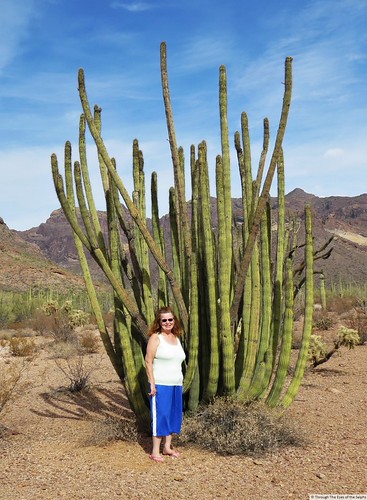
We learned about the various types of cacti, including the organ pipe cactus for whom the park is named. It is easy to see why they are called organ pipe. IMG_1610 

This area is the furthest they grow north of Mexico and the only place they grow in large stands in the United States.  

IMG_1608

These Organ Pipe Cacti Grow On the South Side of the Ridge

On one hike we came across the remnants of an old homestead and corral.IMG_1653IMG_1655IMG_1657

Our second day in the National Monument we drove a scenic road called the Ajo Mountain Drive that wound along the foothills of the Ajo Mountain Range for 21 miles.  It was a dirt and gravel road and our car was really dusty by the time we finished!  The Ranger at the Visitors Center gave us a driving guide that explained various stops along the way.IMG_1619IMG_1631

While we were very happy not to see any snakes, we were disappointed we did not see any wildlife other than birds. We were especially disappointed we did not hear any coyotes at night.  We always heard them while in Tucson and felt certain we would hear them in this very remote park.

Here is the view of the border crossing.IMG_1683IMG_1684

When we left the National Monument we drove through the tiny village of Why.  Next to a gas station we saw a coyote and stopped to take his picture.  Normally they are shy and hard to take their picture.20171201_101028

Next stop: Yuma, AZ where we will be for seven weeks through the Christmas and New Year holidays.

Cactus facts:

  • A Saguaro cactus’ first arm appears at between 95-100 years of age.  It reaches its full height with two or more arms at 200 years of age!IMG_1644
  • Average height of the organ pipe cactus at maturity is fifteen feet.
  • They were named organ pipe by the early settlers who thought they looked like church organ pipes.
  • The organ pipe cactus produces its first flowers at around 35 years of age.
  • Organ pipe cactus, unlike saguaros, live around 150 years.