Category Archives: Historic Landmark

Historic Landmark

July 18, 2016 Contoocook and Hanover, New Hampshire

We left our campground in Brookline, New Hampshire and drove a short distance to Contoocook. Along the way we drove through quaint small towns with Main Streets lined with American flags and stores and homes adorned with red, white and blue bunting from July 4th.
It was hot and we were glad to get settled into our campground. The friendly camp hosts helped us find just the right spot.
20160718_10551120160718_10554420160718_11033720160718_11035220160718_11042320160718_11064320160718_110718Monday we drove to nearby Hillsboro-ugh to visit the Franklin Pierce Homestead National Historic Landmark, the boyhood home of the 14th president. Even though it is a national landmark, it is maintained by the New Hampshire state parks. Along with the 1804 restored mansion, there was a very small Visitors Center/gift shop. The workers in the gift shop really tried to talk us into taking the admission fee tour of the home, but we are not fond of old home tours where you walk down a hallway peaking into roped off rooms. The Visitors Center had a small bust of Pierce and his sleigh. I remarked that Pierce was one of the least liked Presidents which seemed to slightly offend one of the workers, so I quickly added he was one of the least known. Perhaps he is one of the least known because he was the least popular?? Some historians say he is one of the worst presidents but I didn’t want to say something that negative to the workers. Regardless, we have the goal of learning as much as we can about all our presidents in our travels.
Franklin Pierce was president from 1853 to 1857. He was a Democrat who saw the abolitionist movement as a threat to national unity. At first the Democrats saw him as a good compromise candidate who could unite northern and southern interests. However while president some felt his policies helped push the United States into Civil War. The downfall of his presidency is attributed to his championing and signing the Kansas-Nebraska Act and enforcing the Fugitive Slave Act. The Kansas-Nebraska Act opened the territories to settlement and railroad building and repealed the ban on slavery in Kansas mandated by the 1820 Missouri Compromise which prohibited slavery north of latitude 36°30′. This new bill gave the citizens of each territory, not Congress, the right to choose whether to allow slavery and infuriated northerners. His enforcement of the Fugitive Slave Act confused people and he was seen as someone who couldn’t make up his mind and he became very unpopular. All of this confusion led antislavery Democrats and Whigs to form the new Republican party. Kansas soon became a battleground of tensions over sectional slavery. Because of what became known as “Bleeding Kansas”, Pierce was denied the Democratic presidential nomination in 1856. Instead it went to James Buchanan.
Until Kennedy, Franklin Pierce was the youngest president ever elected. His family life was tragic. He married Jane Appleton who was devoutly religious, constantly ill and despised politics which created tension in the marriage. They had three sons, all of whom died in childhood. Their youngest son died at the age of eleven when he was killed in a train accident while traveling with his parents from Boston shortly after Pierce was elected president. According to wikipedia, both Franklin and his wife suffered from severe depression after the accident which most likely affected Pierce’s performance as president. His wife avoided social functions for the first two years of his presidency. She did not attend the inauguration. Pierce chose to affirm his oath of office on a law book rather than swear it on a bible.
In his later years both his wife and author Nathaniel Hawthorne, his close friend died. Pierce drank heavily and died from severe cirrhosis of the liver in 1869 at the age of 64 with no family present.20160718_115745
20160718_112638After leaving the Pierce Homestead we explored the area, enjoying the beautiful stone and covered bridges and finding a couple geocaches.
20160719_10592920160719_105852Tuesday we drove to Concord, capital of New Hampshire since 1808. We like to visit state capitals wherever we go, however this one was a bit of a disappoint-ment because the roof was covered with scaffolding. This state house is the country’s oldest state house in which the legislature continues to meet in the original chambers.

20160719_11050120160719_112342The Memorial Arch was built in 1891 to honor New Hampshire’s soldiers and sailors.
Next we drove to the Franklin Pierce grave site in Old North Cemetery. With no directions as to where to find his grave, we wandered around a bit. Suddenly a lady hustled up the cemetery road and said she noticed us wandering around from the window of her house and wanted to know if she could help. She led us to his grave site, eagerly giving us a history of various citizens interred in the cemetery. She was very kind and helpful and we would have surely wandered for quite awhile before eventually finding his grave site in a more remote section of the cemetery.

On Wednesday we moved a short distance to Hanover, New Hampshire.  We are on our way to an RV rally in Vermont and this was a convenient p!ace to stay for a couple days on the way.  Hanover is the home of Dartmouth College.  Founded in 1769, Dartmouth is the ninth oldest college in the country and the northernmost of the eight Ivy League schools.  We drove around some areas of the beautiful campus.

20160721_115719On Thursday we drove to Windsor, Vermont to see the Windsor-Cornish Covered Bridge.  Along the way we passed through a small corner of Vermont.  Windsor is in Vermont and on the other side of the bridge is New Hampshire.  Windsor is nicknamed “The Birthplace of Vermont” and is where the state constitution was written and adopted on July 8, 1777. The general assembly met in Windsor until 1805 when Montpelier became the permanent capital.  In the 19th century Windsor was the center of invention, including firearms, the hydraulic pump, the coffee percolator and the sewing machine.  We enjoyed driving through this small, picturesque town.

20160721_114655Built in 1866 at a cost of $9,000, the Windsor-Cornish Bridge spans the Connecti-cut River between Windsor, Vermont and Corning, New Hampshire.  It is the longest WOODEN covered bridge in the United States and is the longest two span covered bridge in the world.20160721_11480620160721_11485420160721_115227  The bridge was a toll bridge until 1943.   It is featured on many New England postcards.

July 14, 2016 Boston, Mass.

On Thursday we once again drove to the Airwife station and took the subway into Boston.  Boston had the first national subway system in the nation.  With so much to see we got off at the station near the Boston Common and hit the ground running.  20160714_10014820160714_121656The Boston Common was established as the nation’s oldest public park in America by the Puritans.  Years ago cattle grazed here and British soldiers camped.  We walked up the hill to the State House built in 1798.  This hill, called Beacon Hill, is Boston’s tallest hill.  Samuel Adams and Paul Revere laid the cornerstone for the State House in 1795.  The beautiful dome on top is gilded in 23 carat gold.  Beacon Hill received its name because in the event the city was attacked, a beacon would be lighted on the hill as a symbol for help.
20160714_120326Here on Beacon Hill we caught an open air bus by Old Town Trolley.  Though pricey, it gave us a nice tour of the city, helped us orient ourselves as to what we wanted to see, and allowed us to hop on and off throughout the day which would allow for less walking.  Once we boarded the trolley it took two hours to make the loop through the city, with the driver giving a nice narration of the sites.
There was so much to see and do, it was almost overwhelming.  We got off the trolley and focused on the historical places in the city.
20160714_151927The “first school site” was where the oldest public school in America was established by Puritan settlers in 1635.  Benjamin Franklin, Samuel Adams and John Hancock all attended school here.

20160714_150936

20160714_150852

Old State House

The Old State House was built in 1713.  A cobblestone circle under the balcony marks the spot of the Boston Massacre in 1770 when British soldiers fired on a crowd of Bostonians, killing five. Some say the dispute began over a bar bill that led to a riot with five killed.  The  Patriots used this as propaganda to stir up anti royalist feelings.  Today the building is a museum of Boston history.  From the balcony the Declaration of Independence was first read publicly in Boston on July 18, 1776.20160714_14420320160714_143459
Old North Church, located near the Paul Revere mall, was built in 1723 and is Boston’s oldest church building. It is still an active Episcopalian church today.  On the night of April 18, 1775, Robert Newman hung two lanterns in the 191 foot steeple to warn the patriots the British were coming by sea.  At that time the church was the tallest building in Boston. Interestingly the steeple has twice been destroyed by violent storms and rebuilt.  The church was immortalized in Henry Wadsworth Longfellow’s “The Midnight Ride of Paul Revere”.  20160714_142538A quick side note here: we learned from the guide on our trolley that Paul Revere was married twice and had 16 children, eight children by each wife.
At the Granary Burying Ground are the graves of Paul Revere, John Hancock, Samuel Adams and the victims of the Boston Massacre.20160714_15281220160714_15323420160714_153345

20160714_101026

The tea was dumped overboard in the river behind this building and boat

We rode by the Boston Harbor, site of the Boston Tea Party on December 16, 1773.  20160714_123100We also saw the Boston Trade Center where cruise ships dock.
20160714_115116And of course no visit to Boston is complete without riding by Fenway Park, the oldest operating MLB stadium.  In 1903 the team, known then as the Boston Americans, defeated the Pittsburgh Pirates during game eight of the first modern World Series.20160714_11495020160714_114753
20160714_111324We also rode past the location of the Cheers neighbor-hood bar which inspired the TV series.  The front entrance of the bar was used in the opening scene of the series.

20160714_095649

Park Street Church

The Park Street Church is where the hymn “My Country Tis of Thee” was first sung publicly on July 4, 1832.
20160714_143353As we walked around the city we often followed the Freedom Trail, a brick lined path along a two and a half mile route detailing sixteen significant places and events on the road to freedom.  The Freedom Trail originated in 1951 as a way to help tourists find their way around the city and to promote tourism.  More than 1.5 million people walk the trail a year.

20160714_105420

Faneuil Hall

20160714_150521
We had lunch at the Quincy Market (1825) a historic market complex near Faneuil Hall (an old market building built in 1742).  Town meetings were held here and Samuel Adams and others protested taxes on the colonies at this location.  In fact so many fiery speeches denouncing British rule were delivered here that Faneuil Hall is often called “The Cradle of Liberty”.  At the top of the hall’s bell tower is a gilded copper weather vane in the shape of a grasshopper.  During the Revolutionary War, suspected spies were asked to identify the object atop Faneuil Hall.  If they couldn’t identify this easily recognizable landmark, they were convicted of espionage.  In the 1800’s Frederick Douglass and others spoke here against slavery.
20160714_164729By late afternoon we were really feeling the heat but we still had one more place to go.  We got off the trolley at the closest stop and trudged up the hill to the Bunker Hill Monument located in a section of Boston called Charlestown.  Dedicated in 1843 with a speech by Daniel Webster,  the 221 foot obelisk commemorates the first major battle of the Revolutionary War.  It is actually misnamed because the battle really took place on nearby Breed’s Hill.  Control of these hills on the Charlestown peninsula was critical to the British occupation of Boston.  The British advanced and the Patriots, being low on ammunition gave the legendary order not to shoot until they saw “the whites of their eyes”. The British won the battle but lost half of the 2,200 Redcoats fighting the battle.  The Patriots lost 400 to 600 men.  While the Patriots technically lost the war, psychologically it showed the Patriots they could stand their own against the British.
We walked back down the hill to the closest subway station and rode back to the Alewife station.  By now we were really really hot and tired.  We had parked on the 5th floor of the parking garage and it seemed to take forever for us to work our way down five floors through traffic leaving the garage.  By the time we got out on the road it was past 6:30 and some of the traffic had passed.
The only other thing we really wanted to do but ran out of time was touring the U.S.S. Constitution (Old Ironsides).  Launched in 1797, is a wooden-hulled, three-masted heavy frigate of the United States Navy, named by President George Washington after the Constitution of the United States of America and it is the oldest commissioned warship afloat in the world. It is the engagements with the British in the War of 1812 that earned it the nickname “Old Ironsides”. The 44 gun frigate had its timbers secured by bolts and copper sheathing made by Paul Revere. However it is currently in dry dock undergoing restoration until summer 2018.  Because of this, the tour times and accessibility of the ship has been significantly reduced.  We thought long and hard about going into Boston for an additional day to see it but decided against it. Between the 90+ minutes drive each way to Alewife station and the 30+ minutes each way to get to Boston on the subway, it would mean another four hours of travel time.  Not even Old Ironsides could entice us to make another trip. We will come back again.  The traffic and heat really wore us down.20160714_17094920160714_14581420160714_12083920160714_11322920160714_10543920160714_10470820160714_103825
We really liked Boston.  The city was clean and felt safe.  Walking in the footsteps of those who thought liberty was precious and worth fighting for, was simply amazing!

July 13, 2016 JFK Library & Quincy, Mass.

20160713_095821We heard lots of stories about how narrow the streets are in Boston and how bad the traffic is in the city. Parking for the day runs around $35 in the parking garages. So with all that in mind, we knew we decided to take the subway into the city. We drove to Alewife, the closest station to our campground, which in good traffic is an hour away from Boston. But with traffic it could take 90+ minutes each way just to get to the subway station. Nothing in big cities is ever easy.
20160713_10295020160713_12464420160713_111035On Wednesday we drove to Alewife which with backups took a little less than two hours to get to the subway station. We rode the subway from Alewife to the Kennedy Presidential Library and Museum in Columbia Point just outside of Boston. We were pleasantly surprised to see the Boston subway system is clean and easy to navigate. When we arrived at our stop we rode a free shuttle bus to the Library. The Library is in a beautiful location over-looking the water which Kennedy loved so much. His favorite boat, Victura, was on display outside. The Library was dedicated in 1979 and is the only Presidential Library in New England. President Kennedy was our 35th President of the United States of America.
20160713_112727Much like other Presidential Libraries, this one focused on Kennedy’s early years, his schooling and rise in politics, the 1960 election, and his accomplishments and challenges during his presidency. During his presidency he would give dignitaries a replica of George Washington’s sword. Kennedy’s PT 109 boat during WWII was destroyed and he inscribed a note on a coconut that summoned help for the eleven survivors.  20160713_110902Later the preserved coconut was returned to him and he kept it on his desk in the Oval Office throughout his presidency.20160713_114011
Downstairs was a special Ernest Hemingway exhibit. When Hemingway died in Idaho in 1961, a large portion of his literary and personal estate was in Cuba. Despite a ban on U. S. citizens’ travel to Cuba during the Cold War, President Kennedy facilitated the travel of Hemingway’s widow to Cuba to retrieve his belongings. She shipped crates of Hemingway’s papers and artwork on a shrimp boat back to the U.S. Hemingway’s widow decided to offer the collections to the Kennedy Presidential Library since President Kennedy was instrumental in recovering the possessions. This made the Kennedy Library the world’s principal center for research on the life and work of Ernest Hemingway.
20160713_143431We grabbed a quick and expensive lunch at the café inside the Library and then hopped back on the bus back to the subway for the ride to the town of Quincy, “the City of Presidents”. Here we would discover the town where John Adams (2nd President) and John Quincy Adams (6th President) grew up and lived.
We arrived in Quincy and first went to the small National Park Service Visitors Center conveniently located across the street from the subway station. We watched a movie about the lives of four generations of Adams. We could have taken a two hour guided tour of the inside of several homes but it was very hot and we decided to spend our time exploring the town rather than looking at furnishings in homes.
20160713_141042Everything we wanted to see was within walking distance of the subway system. We walked down to “Peace Field”, The Summer White House, home to four generations of the Adams family from 1788 to 1927, including John and John Quincy. Along the way to the house we passed a bust of John Hancock.

20160713_141828

The Old House at Peace field, built in 1731, became the residence of the Adams family for four generations

20160713_141833(1)

Stone Library, built in 1873

20160713_143456We really wanted to see the grave sites of John and John Quincy because it is the only place where two presidents are buried together. They are buried, along with their wives, in a basement crypt at the United First Parish Church (completed in 1828), known as The Church of the Presidents. Outside of the church we passed statues of First Lady Abigail Adams and a young John Quincy. Across the street was a statue of John Adams which was hard to photograph because of construction in the area.20160713_14340020160713_15042220160713_150401
In order to view the crypt we were required to first listen to a tour guide talk about the history of the church and make a small donation to the church. It was dreadfully hot inside the church and we didn’t really want to listen to the guide, but we followed the elderly guide inside where we were seated in the Adams pew, where a bronze marker said it was the pew the Adams family owned and sat in. The guide did a nice job, explaining how in early times your pew position showed your wealth and importance. At that time you bought your pew in the church and even had to pay taxes on it.  John Adams and John Hancock were both baptized in the original church by Reverend Hancock, father of John Hancock.
20160713_145129The tour guide then took us down a steep flight of stairs to the cool basement where we entered a small crypt with four tombs, John Adams, Abigail Adams, John Quincy Adams and Louisa Catherine Adams. A wreath lay on the tomb of John Quincy, recently placed in honor of his birthday. The guide told us the federal government pays to have wreaths put on the graves of every President on their birthday. He also told us that John and Abigail had originally been buried in graves at the Hancock Cemetery nearby and it was John Quincy who requested they all be buried in a crypt, possibly thinking the graves would be safer from vandalism or theft. Between the small room and the heat, the flowers gave off a heavy scent reminding me of a funeral home. I think I was expecting something a little more presidential in appearance and instead it all seemed a little creepy in the small room of the church basement. During John Adam’s presidency, there were fifteen states so there were fifteen stripes and fifteen stars on the U.S. flag.  You can see this on the flag on his tomb.  At some point it was decided to change to thirteen stripes because it wouldn’t work to add a stripe for every additional state. They settled on thirteen stripes for the original thirteen colonies.  The flag on the tomb of John Quincy Adams has thirteen stripes.20160713_14514420160713_145212

As you probably already know, John Adams and Thomas Jefferson were bitter enemies for many years, in part because Adams lost his presidential reelection to Thomas Jefferson.  After many years, and at the suggestion of a friend, Adams wrote Jefferson and a friendship began again between the two men.  Amazingly, both men died on July 4, 1826, the 50th anniversary of the signing of the Declaration of Independence.  Adams last words were, “Jefferson lives”, not knowing that Jefferson had died hours earlier.

By this time the heat was really getting to us and we were anxious to catch the subway back to the Alewife station and hopefully beat the traffic home. No such luck as we were caught in stop and go traffic and the drive home took over 90 minutes.
Tomorrow we are really looking forward to visiting downtown Boston!

July 11, 2016 Concord, Mass

We were apprehensive about the amount of traffic we would encounter as we left Cape Cod and the rain and fog didn’t help.  Thankfully the traffic wasn’t bad and the worst of the rain ended before we pulled out of the campground.
Our next destination was Brookline, New Hampshire about an hour from Boston.  We were grateful for an easy travel day as we pulled into our new campground.
With so much to see in this area, we headed out Monday to explore Concord, site of “the shot heard round the world”.  Concord is a really lovely little town with beautiful churches and a patriotic feel.
20160711_155215Our first stop was the Minute Man National Historic Park.  There are two Visitors Centers in the park and we wanted to visit both of them.  We stopped first at the North Bridge Visitors Center where we saw a short film.  20160711_14383420160711_143943We walked a quarter mile down to the North Bridge where “the shot heard round the world” was fired.  It is a little confusing because the first shot was actually fired in Lexington by the British at the minutemen, but the minutemen did not fire back.  Eight minutemen were killed and ten wounded.  Because the minutemen did not fire back, this was not considered the start of the war. In Concord at the North Bridge, both sides fired upon each other and thus this is the place where the war began with the shot heard around the world.  There seems to be some disagreement between Lexington and Concord as to where the war began.  What do you think?
We also learned that the correct term to use for the British is “regulars” not redcoats.  They were regular members of the King’s army.  In all our years of reading history, we had never heard them called regulars. Have you? 20160711_14255520160711_14240120160711_142753
At the North Bridge is a nice Minute Man Statue and a tall Minute Man Monument commemorating the events at this location.  There are also the graves of British soldiers, the first British to die.20160711_142838
As we traveled through the 20 miles of road with so much history, we stopped at the site of Paul Revere’s capture.  Did you know he was captured as he made his midnight ride spreading the alarm?  Revere and fellow patriot William Dawes had ridden to Lexington to warn Samuel Adams and 20160711_152245(1)20160711_15260020160711_152543John Hancock and to rouse the militia.  They were on their way to Concord and were joined by a young patriot doctor by the name of Samuel Prescott.  Revere was stopped and captured by a British patrol.  Dawes managed to escape but lost his horse and had to walk back to Lexington.  Prescott escaped and rode to Concord to continue to spread the alarm.  Paul Revere was held for an hour or two until the British were distracted when they heard the guns of the Minutemen as they approached Lexington.
On the way to the second Visitors Center we stopped at two homes.  The first, The Wayside, was where Louisa May Alcott lived as a child and was also once the home of Nathaniel Hawthorne (“The Scarlet Letter”, “The House of the Seven Gables”, etc). We also saw The Orchard House where Louisa May

20160711_150947

Wayside House where Louisa Alcott and Nathaniel Hawthorne once lived

20160711_150632

Orchard House

Alcott lived as an adult and wrote “Little Women”.  There was more to see in Concord than we had time for.  We didn’t have time to visit the homes of Ralph Waldo Emerson and Henry David Thoreau.
Our last stop was at the second Visitors Center where we watched the award winning presentation of “The Road to Revolution”. It was quite different in that it was a multimedia presentation with Revolutionary War props and sets located in the auditorium with us.
In the next blog we will write about our visit to Quincy, Massachusetts to learn about John Adams and John Quincy Adams. We will also tell you about our visit to the Kennedy Presidential Library and Museum.

July 8, 2016 Cape Cod, Mass. Part 2

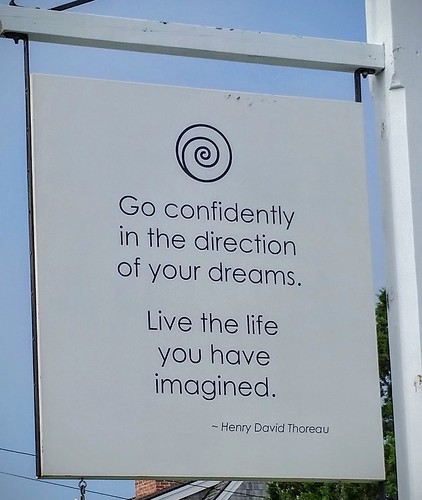
A man may stand there and put all America behind him.” Henry David Thoreau
After seven days in Sandwich we moved further east in Cape Cod to Nickerson State Park in the town of Orleans.  We only reserved two nights at this park since it was dry camping.
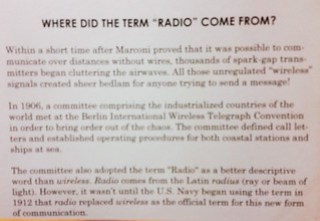
20160707_151108We had a lot to see in this area and a short time so we had no time to waste.  Bill wanted to visit the Chatham Marconi Maritime Center in nearby Chatham.  Here numerous exhibits and short films tells the story of Marconi’s role in the history of wireless communication.  20160707_150752

Marconi’s original 1914 TransAtlantic Wireless Receiving Station where telegrams were sent from ship to shore was on display. Exhibits showed how the U.S. Navy used the station during WWII as well as displaying a highly classified Enigma cypher machine used by the German Navy for communications.20160707_15082320160707_150109
20160709_110033On Saturday we had a busy day exploring the Cape Cod National Seashore Park and the small towns and villages in the upper part of Cape Cod.
Cape Cod National Seashore has two Visitors Centers at each end of the park and we stopped at both of them.  At the first center we toured the museum about the history of Cape Cod and saw a movie detailing how the it  was formed. Cape Cod is a glacial deposit always undergoing natural changes as water and wind move sand along the shoreline, tearing away some places and building up others. The harsh North Atlantic winters contributes to these changes which can quickly take place. Native people began living on Cape Cod about 10,000 years ago. The Pilgrims arrived here in 1620 and briefly stayed before sailing across the bay to Plymouth.
20160709_115333We then stopped at the first Marconi Station Site where the first transatlantic wireless communication was sent from President Theodore Roosevelt to King Edward VII of England. Marconi built his first towers here in 1901. As just described, the forces of nature has eroded much of this high cliff to the extent that the towers and station had to be removed. We visited the plaques and exhibits now placed a safe distance from the edge of the cliffs.20160709_114343
20160709_14025220160709_135347Next we drove to Provincetown at the end of Cape Cod.  Here we found a Pilgrim Tower to commemorate the first landing of the Pilgrims.  We then went to First Landing Park where the Pilgrims first set foot on American soil. (No, it wasn’t at Plymouth Rock).  The area wasn’t to their liking so after a short time on the cape they sailed across the bay to Plymouth.20160709_13543720160709_135310
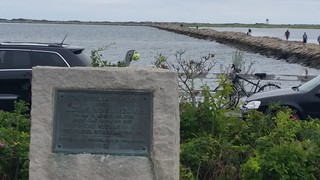
20160709_15374520160709_153643Afterwards we drove back towards home, stopping at three more historic places.  At Corn Hill there is a plaque commem-orating the place where starving Pilgrims stumbled across a stockpile of corn the Indians had left for later use.  The plaque says the Pilgrims said they didn’t know what would have become of them if they had not found the corn. I am sure hungry Indians were not happy to find the corn missing and we read that the Pilgrims later paid restitution to the Native Americans.
20160709_164611Next was Encounter Beach.  Here a plaque commemorates the place where the Pilgrims and Native Americans first encountered each other.  Bill and I both love historical places like this.
Our last stop of the day, very close to home was Nauset Beach.  It is here at Nauset Beach in Orleans, Mass. that a German submarine fired on a tug, four unarmed barges and sank them during WWI.

20160709_173258Nauset Beach is the only place on American soil attacked during WWI.
At several of the historical sites we visited today we found geocaches. What fun!
I mentioned in an earlier blog about meeting Bob and Sue during our trip to Europe and the wonderful afternoon we spent at a cookout at their house.  Our good luck continued since it turned out Sue’s mother and stepfather live 5 minutes from Nickerson State Park where we were staying.  So Friday night we went to Earl and Bea’s house and had a delicious dinner and were able to spend more time with Bob and Sue.  A great time was had by all!  We could get use to this!
Next stop: Boston area.  Can’t wait for more history coming up!!


July 1, 2016 Cape Cod, Mass. Part 1

20160707_153640We left Sturbridge, Massachusetts and headed to our campground at Sandwich, Massachusetts on Cape Cod.  We knew it was the Friday of a long holiday weekend so we left Sturbridge early to beat the traffic.  All was good until we were about two miles from the Sagamore Bridge from the mainland onto the Cape.  It took us an hour in stop and go traffic to get across the bridge.  We were glad to arrive at our campground in Sandwich and get set up.
20160707_120526Sandwich was incorpo-rated in 1638 and is the oldest town on Cape Cod. While in Sandwich we visited the Cape Cod Canal Visitors Center.  The canal is an artificial waterway connecting Cape Cod Bay to Buzzards Bay and is part of the Atlantic Intra-coastal Waterway.  The seven mile long canal moves along the narrow neck of land joining Cape Cod to the mainland.  It is approximately 480 feet wide and 32 feet deep, cutting off 65-166 miles of coastal travel around the tip of the Cape.  Another benefit of the canal was no longer having to sail around the treacherous outer shores of Cape Cod.  At the height of the commercial shipping era from 1880 to 1900 there was nearly one shipwreck every week.   Approximately 14,000 people use the canal yearly.
It was interesting to learn that in1623, Miles Standish of the Plymouth Colony scouted the land for a potential canal route but the idea was too much for the settlers to consider.  Then in 1697 the General Court of Massachusetts considered the first formal proposal to build a canal but no action was taken.  More energetic planning with surveys took place in 1776 with George Washington but none of these actions was completed.
Commercial construction began in 1909, it was first open to vessel traffic in 1914, and has been operated by the Army Corps of Engineers since 1928.  It is designed to be a sea level waterway and is operated 24 hours a day, toll free.  There are no locks even though it connects two bays with very different tidal cycles and ranges.  Two highway bridges and one railway bridge cross the canal from the mainland to the Cape.  During World War I 20160707_120448the canal was used to move shipments when German sub-marines were off the coast of Cape Cod. We enjoyed touring the Visitors Center with their friendly volunteer, movie about the building of the Canal, and numerous exhibits. As a side note, Bill met and talked with some people later in the day who grew up and live on the Cape and they think the canal is too expensive to maintain and keep running and it should be filled in.

20160703_16083120160703_14114420160703_141039On our trip to Europe a couple months ago we met Bob and Sue, a couple who live near Cape Cod.  When they learned we would be visiting their area this summer, they invited us to stop by and visit.  On Sunday we were invited to a cookout at their home.  We had a great time meeting Sue’s mom and step-father, some of their friends and neighbors and of course their adorable bulldog Stella.  Thanks Bob and Sue!!

Another day we drove 34 miles along beautiful, scenic Route 6A (Old King’s Highway), passing through quaint towns and villages. Centuries ago the Route was a Native American Trail and then as Colonial settlements grew, this route became an extension of the Plymouth Colony and later a major route for Cape Cod. Route 6A ranks among the top scenic byways in the country. One thing that struck us was how patriotic all of Cape Cod looked for the Fourth of July holiday with so many homes and businesses displaying red, white and blue buntings and flags. Back in the days of the early settlers the wealthy merchants and sea captains did not covet waterfront property like people do today, so most of the older homes are along this highway rather than the shoreline. Needless to say the area has strict town codes and many efforts have been made to preserve these old homes. It is the newer homes you see along the waterfront.
20160705_13212320160705_12350620160705_12194320160705_12192020160705_13004720160705_13205220160705_14331820160705_143326Cape Cod is divided into fifteen towns, and within those towns are villages. For example Hyannis is a village in the town of Barnstable.
We stopped in the village of Hyannis to visit the JFK Hyannis Museum. This is not the Kennedy Presidential Library but a small museum focusing on the Kennedy family and their time on Cape Cod.
We stopped by the JFK Memorial at Veteran’s Beach. While there we looked for a geocache at the nearby Korean Memorial. We quickly discovered a young couple from Germany were also hunting for the same geocache so we had fun finding it together!
We took pictures in picturesque Wychmere Harbor, one of the most photographed places on the Cape.
The town of Yarmouth is the Cape’s second oldest town with more than 600 buildings of historic architectural significance. At one time more than fifty sea captains had homes in Yarmouth and a one mile stretch of road was known as Captain’s Row. In South Yarmouth we found an eight sided windmill. The windmill was built in 1791 in North Dennis on Cape Cod by Judah Baker to grind corn. In 1886 it was moved to South Yarmouth. Since 1953 the town of Yarmouth has been responsible for the windmill. It has undergone extensive restoration but still contains the original mechanical equipment. It is located in a beautiful setting near the Bass River adjacent to Nantucket Sound.

Our next blog posting will be about our day on Martha’s Vineyard.20160707_16101320160707_16113920160707_15375720160707_153705

June 28, 2016 Springfield, MA & Hartford, CT

We left the campground in Accord, New York and drove to Sturbridge, Massachusetts.  The campground was full and crowded and we were thankful to be placed in one of the few satellite TV friendly sites.  We can tell the northeast is going to be a big challenge to find satellite TV friendly sites among all the beautiful trees.
20160628_131622Our stop in Sturbridge was related to Bill’s interest in guns and radios.  On Tuesday we made the drive to nearby Springfield, Massachusetts to tour the Springfield Armory.  For almost two centuries this place overlooking the Colorado River was an important place for the development and manufacture of arms for American soldiers.  It started as a place where skilled craftsmen built piece by piece one flintlock musket at a time into a center pioneering mass production techniques into finally an institute famous for weapon research and development.
In 1777 a major arsenal was established here after early Revolutionary War battles in the northern states showed the need for a place to store weapons and ammunition that was within reach of the American troops but out of British hands.  A smaller armory for the south was built at Harper’s Ferry but destroyed during the Civil War.   In 1795 the Springfield Armory began weapon production.
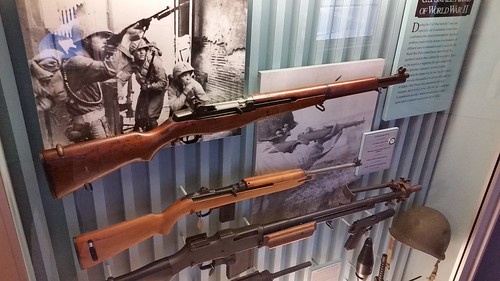
20160628_145612In 1891 The Experimental Department was established at the Springfield Armory with the job of examining and developing all subsequent U.S. rifle designs.  In 1936 the Armory began mass production of the first successful semi-automatic rifle to be put in military service, the M1 rifle designed by John Garand.  During WWI the Armory produced over 265,000 bolt-action Model 1903 rifles for American troops.  It is still considered one of the most accurate weapons ever made.  The installation of mass production machinery in the early 1930’s allows for the manufacture of 3.5 million M1 rifles through 1945.  20160628_145547 It was deemed by General George S. Patton to be “the greatest battle implement ever devised”.  In 1943 the workforce at the Armory totaled 13,500 employees, of which 43% were women.20160628_150038
In 1964 the Defense Department decided that private suppliers could provide necessary weapons and in 1968 the Armory was closed.  In 1960 this “Arsenal of Freedom” was designated a national historic landmark and in 1974 Congress named it the Springfield Armory National Historic Site.
20160630_110658On Thursday we drove into Windsor, Connecticut so Bill could tour the Vintage Radio and Communication Museum of Connecticut.  The museum showed the history of electric communication and how it has changed our lives over the years, including radios, records and television.20160630_11080520160630_11090320160630_11124720160630_11192120160630_11203320160630_12061120160630_11150720160630_11243920160630_11250320160630_11294520160630_11302920160630_113155
20160630_102414We were quite surprised to find a lobster roll on the McDonalds menu in Connecticut so Bill couldn’t resist having one for lunch.  He said it was quite good.
20160630_152536We then made the short drive to Hartford, passing the state capitol building, so Bill could tour the ARRL (American Radio Relay League) headquarters.  He enjoyed visiting with some fellow amateur radio enthusiasts.20160630_141231

20160630_142940
20160630_130232

June 26, 2016 Hyde Park, New York

Our 2016 summer plans were unexpectedly delayed for health reasons.  As some of you know, when we returned from Europe I had a biopsy done on two thyroid nodules.  We were shocked when the results came back showing possible cancer.  So we canceled our plans on the New Jersey coast and sightseeing in Philadelphia and I had my thyroid removed on June 10 at the Martha Jefferson Hospital in Charlottesville, Virginia.  During this unexpected delay we were blessed to be able to stay at my dear friend Jamie’s house.  After a tense ten days of waiting, the pathology report came back with no cancer.  We were once again on our way!
After a short stay in Northern Virginia to have a minor repair done on the RV, we headed north to Pennsylvania.  We stayed two days in Lebanon not far from Hershey.  Since we both had been to Hershey and didn’t want to get in the summer tourist crowds and I was still technically recuperating from surgery, we were content to just relax at home.
20160625_193130Next stop was in Accord, New York. We arrived on a Saturday which happened to be the weekend of the ARRL (Amateur Radio) yearly Field Day.  I stayed home and rested in the air conditioning and Bill made a short drive to the location of the nearest Field Day and enjoyed a few hours with fellow amateur radio enthusiasts.20160625_193218
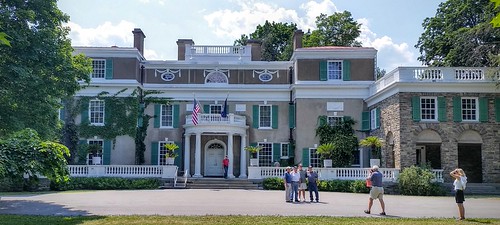
20160626_12290020160626_122927Sunday we drove to Hyde Park to visit the Franklin D. Roosevelt Birthplace and Presidential Library and Museum.  One of our goals in our travels is to visit as many presidential libraries as possible.  On the way we crossed the Hudson River on the Franklin D. Roosevelt Mid-Hudson Bridge.  The Roosevelt Library opened in 1941 making it the first presidential library and the only one used by a sitting president.  20160626_165256It was designed by FDR and is on the grounds of the Roosevelt estate and a short walk from his birthplace.  This year is the 75th anniversary of its opening.  20160626_170110When Roosevelt donated his papers to the Library, he set the precedent for public ownership of presidential papers.  The library has over 17 million pages of documents and over 150,000 photographs.  20160626_134506The Museum which is part of the library has many exhibits detailing the lives of Franklin and Eleanor, the Great Depression, the New Deal, and World War II.
First we took a guided tour of the home where FDR was born and lived throughout his life.  20160626_145916He deeded his home to the National Park Service in 1943. We learned he was a collector of stamps, coins, rare books, ship models, and birds.  As an only child, he led a very privileged childhood and details were given on the role his domineering mother played in his life and marriage.  20160626_153333His physical struggles due to paralysis from the waist down due to polio in 1921, and the great efforts to hide it from the public were discussed.
The Presidential Museum had many exhibits focusing heavily on the New Deal and World War II, including his unprecedented four terms as president.  It was from the museum he held some of his “Fireside Chats”.

20160626_164553

FDR Oval Office Desk

20160626_14515520160626_144917
Eleanor Roosevelt’s role as reformer, teacher, journalist, political activist, advocate for the underprivileged and delegate to the United Nations was detailed.  Today, she is known as “First Lady of the World”.
20160626_164445The Museum did not hold back as they described Eleanor’s difficult childhood with a critical mother, her struggles with a domineering mother-in-law, and her anguish over FDR’s long time relationship with Lucy Mercer, who was with FDR when he died in 1945 from a cerebral hemorrhage.
20160626_150149We also visited the gravesites of Franklin and Eleanor in the nearby Rose Garden.  At his request, the markers are plain white markers with only their names and dates.  FDR’s grave is the one with the flag.
While this was not our favorite presidential library, we certainly learned a lot about the life of Franklin Delano Roosevelt and came away with a greater knowledge of this time in American history.

20160626_17042620160626_15094620160626_15100320160626_155739

October 5, 2015 Heading east AT LAST!

This blog is from events of almost two months ago.  We have been on a fast track east and have had little time for blogging and/or poor internet service.

We only planned to stay in Yuma, Arizona for 5 days.  But due to a series of unplanned circumstances, our stay there turned into over a month.  While we love Yuma, a place very friendly to RVers with great weather this time of year, we were more than happy to finally pull out of the campground.  We had originally planned on taking a slow stroll across the country to Florida. But due to our extended stay in Yuma, now we had to travel at a fast jog. We were forced to skip stops in Austin and Big Bend National Park in Texas and New Orleans. Other stops were shortened with several one night stopovers and an occasional two or three night stop for Bill to rest from all the driving.
It seemed like a long way from Yuma to Florida, and it was at over 1,800 miles. Our first stop was Tucson followed by Deming, New Mexico. Two places we had not canceled were Roswell and Carlsbad Caverns, both in New Mexico.

IMG_20151108_111755Our drive took us through the White Sands Missile Range. The world forever changed here on July 16, 1945 at the Trinity Test Site when the first atomic bomb was detonated. The national historic site is open to visitors just ONE day a YEAR, and today was not the day. We did stop at the White Sands National Monument, the largest gypsum dune field in the world. Considered one of the world’s great natural wonders, the white dunes range over 275 square miles. We stopped at the Visitors Center and saw an excellent movie explaining how the dunes were shaped by natural forces. We decided not to take the scenic drive to see the dunes since we had the car hooked to the RV and we still had a long drive to our destination of Lakewood, New Mexico. We put the White Sands National Monument on our list of places to return to in a future visit.IMG_20151108_114734IMG_20151108_114859

IMG_20151108_134732After passing through Cloudcroft Tunnel, built in 1949 under a rock formation and is the only automotive tunnel in New Mexico, we finally arrived in Lakewood for a three night stay. Lakewood was a convenient destination because it was halfway between two places we wanted to visit in the area.

20151109_114759The next day we set out to see Roswell, New Mexico to visit the International UFO Museum and Research Centers. On July 6, 1947, a local rancher told Roswell authorities about an object that had crashed in his field. Investigating officials at the Roswell Army Air Field reported they discovered a “flying disk”. A few hours later they revised their story, saying it was not a UFO but a weather balloon. What really happened that day is a mystery and a source of speculation and debate to this very day. The UFO Museum mainly consisted of wall after wall of newspaper stories and eyewitness accounts told by local residents. There was a small theater with documentaries and movies, with the most interesting being eyewitness accounts of the days following the crash when townspeople were threatened to keep quiet and those who had supposedly witnessed things the government did not want them to see suddenly disappeared. I entered the museum with disbelief and skepticism and perhaps a somewhat closed mind. I did not see anything in the museum to make me a believer. Bill, on the other hand, has a much more open mind than I do and still entertains the idea of a UFO visit.20151109_12405520151109_124618

20151109_124340

This is a painted picture from eyewitness(s)

20151109_124018

The spaceship and robot from the movie: The Day The Earth Stood Still

20151109_125111
There is more to Roswell than the incident in 1947. In the 1800’s this was an area of frontier living with Apache Indians and often visited by Billy the Kid. Roswell is also the home of one of the largest mozzarella cheese factories in the world.
IMG_20151109_145415Of special interest to Bill was that in the 1930’s, Roswell was the place where Robert H. Goddard, known as the Father of Modern Rocketry, attempted to defy gravity. During this time Goddard worked with Charles Lindbergh and Harry Guggenheim. We stopped by the Roswell Museum and Art Center where we toured Goddard’s actual workshop and saw fascinating home movies made by Goddard’s wife showing Goddard launching his first rockets.IMG_20151109_145221IMG_20151109_145244
IMG_20151110_095248On our last day in the area we drove south from the campground to Carlsbad Caverns. It is considered by many to be the Eighth Wonder of the World with some of the world’s largest underground chambers. The Big Room alone would hold fourteen Astrodomes. We were really looking forward to touring the caverns and it is one of the few places we didn’t eliminate from our revised itinerary. Our plan was to hike the steep 800 foot descent into the cave and then take the elevator back up. Unfortunately, the elevator was broken.IMG_20151110_095301IMG_20151110_112126IMG_20151110_102641

I was fighting a cold and neither of us was in the mood for the steep hike down and especially the climb back out which was equal to climbing 79 stories. We did see a movie at the Visitors Center and walked to the entrance of the cave. We were disappointed to say the least since we had eliminated other places on the itinerary to come here. But we had no choice except to put it on the list for the future. We returned to the campground and prepared to hit the road running tomorrow.

September 17, 2015 Monument Valley, Utah

IMG_1333There is so much to see and do in Page, Arizona.  Before we left we had one last thing  to do.  We wanted to visit Monument Valley and Valley of the Gods in Utah.  We had contemplated taking the RV there and camping for several days but the heat and some changes in our schedule convinced us it was best to make it a long day trip from Page.   And a long day it was with about a three hour drive each way.IMG_1345IMG_1336IMG_1341IMG_1290IMG_1295IMG_1296IMG_1343

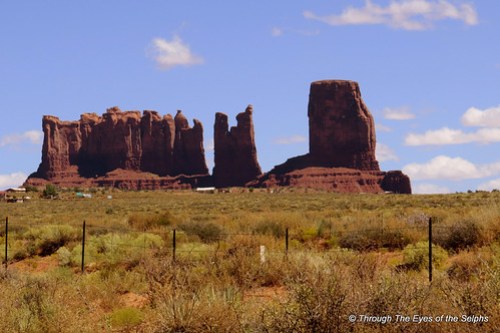
IMG_1351Monument Valley is on Navajo land and part of the Navajo Tribal Park which was established in 1958 to preserve the environment.  Monument Valley sits at 5,564 feet above sea level and is 91,696 acres in Arizona and Utah.  The height of the monuments, natural structures created by erosion, range from 100 to 1,500 feet tall.  There was a fee to enter the park and make the 17 mile loop drive.  The road of sand and dirt was in really bad shape making it almost necessary to have 4 wheel drive vehicle.  Monument Valley was made famous in many western movies, TV shows and commercials including Stagecoach (1939), She Wore a Yellow Ribbon (1949), How the West Was Won (1962), Easy Rider (1968), 2001: A Space Odyssey (1968), Back to the Future III (1990), Forest Gump (1994), The Lone Ranger (2013), Breaking Bad (TV) and Dr Who (TV) just to name a few.  John Wayne called Monument Valley “God’s Treasure”.

IMG_1297

Mexican Hat

We also drove to area of Utah called Valley of the Gods with similar sandstone formations to Monument Valley but on a smaller scale.  This land is public land managed by the Bureau of Land Management and did not require a fee. This too involved a loop drive on a dirt and sand road with less than ideal conditions to say the least.  We had downloaded a map ahead of time which led us to various named formations.  Sometimes it was very easy to see how the formation received its name, while others took an imagination we didn’t seem to have.IMG_1306IMG_1308

IMG_1301

Woman Sitting on Her Bathtub

IMG_1324

Hen on a Nest

IMG_1321

Rooster

IMG_1327

Seven Sailors with Flat Hats

IMG_1315Bill found a geocache in the rocks amid some sagebrush.  I stayed behind and took pictures.  The truth is I was terrified of possible snakes.IMG_1318IMG_1329

IMG_20150917_173850On the way home we stopped to find another geocache and saw John Wayne’s cabin (Captain Nathan Brittles) that was used as part of the set of his movie She Wore a Yellow Ribbon.

It was a full and tiring day.  We have certainly loved our time in Page.  Between Antelope Canyon, Horseshoe Bend, Glen Canyon Dam on beautiful Lake Powell and Monument Valley, Page is a place we look forward to visiting again.