Category Archives: Hiking

hiking

Sept 8, 2016 Seneca Falls, NY

Thursday morning we left the Adirondacks and headed west to Seneca Falls, population 6,700. We thought it was going to be a short three night stop on our way to Niagara Falls without much to see or do. Boy were we wrong!!
We camped at Cayuga Lake State Park near beautiful Cayuga Lake, one of the longest of the Finger Lakes. During the past million years, glaciers covered New York state. As they moved through river valleys they carved deep troughs with steep sides. When the glaciers receded about 10,000 years ago, water filled these troughs, creating eleven Finger Lakes. Cayuga Lake is thirty-eight miles long and 435 feet deep at its deepest spot. Cayuga Lake is named after the Cayuga Indians, one of the Six Nations of the Iroquois in New York.
20160909_110825
I was looking through some literature about the area and came across Watkins Glen State Park about thirty minutes from our campground. I read that in 2015 it was voted the third most beautiful state park in the country in a USA Today poll. All the reviews I read talked about a gorgeous 1.5 mile (three miles roundtrip) hike with 832 steps and nineteen waterfalls. We both love waterfalls so even though the 832 steps seemed a bit daunting, we decided to give it a try.20160909_111629
20160909_093118We headed out early Friday morning. On the way to Watkins Glen we came across a plaque in the small town of Waterloo. We had no idea that Waterloo, NY was the official birthplace of Memorial Day, with the first ceremony held in 1866. Some of the interesting things we just happen to stumble across is amazing to us. 20160909_093044We drove beside Seneca Lake, the largest of the Finger Lakes and the deepest lake in the state.
We didn’t realize that the town of Watkins Glen is renowned for auto racing and is considered the birthplace of American racing.   Since 1948 Watkins Gen has hosted international automobile car racing and in 2015 was voted the best NASCAR track in the country in a USA Today Reader’s Poll.  The town has an International Motor Racing Research Center with 5,000 square feet of racing history.  From April through September they host NASCAR sports car and racing events. This weekend was the U.S. Vintage Grand Prix and as we drove down Main Street they were getting ready to close off the street for a parade. To our dismay we discovered that even though the state park was open, the parking lot was closed. We asked where we could park and they said our only option was to find a parking lot or side street parking, which seemed highly unlikely on a parade day in a tiny town. Across the street from the park was a restaurant and Bill decided to go inside and ask if we could park in their restaurant parking lot for a few hours. I told him there was no way they would allow that on parade day. We pulled into the lot and I stayed with the car while he went inside to ask. He came back a few minutes later and said the owner said no problem and refused to take any money. Yeah!!
We grabbed our walking sticks and headed over to the entrance. We had an idea what was ahead when we saw a beautiful waterfall at the entrance. This park certainly lived up to its #3 best ranking. Everywhere we looked there was beauty. We were apprehensive about the steps but they were nice stone steps put in years ago by the CCC and easy to climb. I had worried they might be uneven and slick, but no problem. The hike on the Gorge Trail was not tiring at all because we were constantly stopping to gaze in wonder and awe at the beauty. We followed the gorge trail as it wound over and under waterfalls.20160909_11111420160909_11403320160909_11431820160909_11592220160909_12072320160909_12192020160909_12201920160909_12264920160909_11234620160909_135502
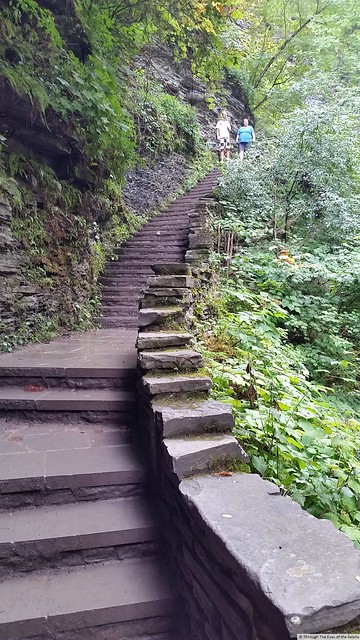
At the end we walked up the last of the stairs which were steel steps called “Jacob’s Ladder”. Once at the top we could either walk back down the 832 steps or take the easy “Indian Trail” back. We chose the easy hike and once we were back to the car we put our hiking gear away and decided to go into the restaurant for a late lunch. We thought it was a small way to thank them for letting us park in their lot. Bill had lunch and I had a big slice of fresh blueberry pie! On the way home we took a different route and followed Cayuga Lake seeing wineries along the lake.20160909_154053
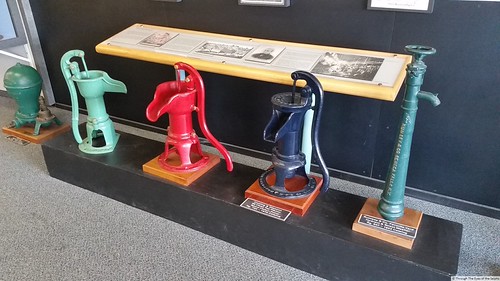
20160910_14073820160910_142224On Saturday we decided to spend our last day in Seneca Falls exploring the small town and finding some geocaches. First we stopped by the town Visitors Center which had a fantastic museum detailing the history of the town. European settlers first moved to the area and began farming. In the 1820’s the construction of the Erie Canal changed Seneca Falls to an industrial and shipping center. We were surprised to see all the items designed and manufactured there from water pumps, TV picture tubes to wooden rulers.20160910_13314820160910_13425520160910_13505320160910_140408
20160910_150328Seneca Falls is the birthplace of the Women’s Rights Movement led by resident Elizabeth Cady Stanton. The first women’s rights convention was held here on July 19-20, 1848. Today there is a Women’s Rights National Historical Park, established in 1980, in the middle of town. We stopped by the park, saw a film and looked at the exhibits. Amelia Bloomer, for whom bloomers were named, lived in Seneca Falls. She didn’t invent bloomers but wore them and promoted them in magazines.20160910_15050020160910_150738
20160910_14312620160910_143112Our last stop of the day was at the “It’s a Wonderful Life” museum. In 1945 Frank Capra stopped by Seneca Falls to get a haircut on his way to visit his sister. It is said that he was so taken with the quaint little town that it was his inspiration for the fictional town of Bedford Falls in the famous Christmas movie. There are several similarities between Seneca Falls and the fictional Bedford Falls, including they are both mill towns, had a grassy median down Main Street, homes of Victorian architecture, a large Italian population and a toll bridge. The free museum opened in 2010 and is full of memorabilia from the film that fans have donated or loaned to the museum. We were the only visitors there when we stopped by and enjoyed talking with the guide who obviously loves the movie. He said he has lost track of the number of times he has seen it. Every year in December they celebrate with a parade and all sorts of events. This year will be a big celebration since it is the 70th anniversary of the movie.20160910_144641 20160910_14471220160910_14474820160910_142407The guide so enthusiastically described the upcoming celebration it almost made me want to brave the snow to attend. Almost, but not quite!
Yes, tiny Seneca Falls far exceeded our expectations. We could have stayed a couple more days but Niagara Falls was calling!

August 23, 2016 Bar Harbor & Acadia N. P. Part 2

We spent most of our time in Acadia National Park but we did go into Bar Harbor a couple times. Bar Harbor was originally incorporated in 1763 and named Eden after Sir Richard Eden, an English statesman. It was renamed Bar Harbor in 1918 because of a sand bar that is visible at low tide. In the 1800’s tourists were attracted to Bar Harbor by the writings of Henry David Thoreau and paintings showing the Maine landscapes by famous painters. The area attracted families such as the Astors, Fords, Morgans, Rockefellers and Vanderbilts. The Great Fire of 1947 destroyed nearly half of the eastern side of Mount Desert Island. Sixty-seven of the 222 palatial summer homes and five grand hotels were destroyed in addition to 170 year round homes. The town’s business district survived the fire. More than 10,000 acres of Acadia National Park was destroyed.
Parking in Bar Harbor is scarce so a free shuttle bus called the “Island Explorer” is available to residents and tourists. The shuttle stops at several campgrounds near Bar Harbor, including ours. There are also shuttle buses that travel throughout Acadia National Park to encourage people not to drive. The shuttle buses are all free and funded by local, state and federal tax dollars, including a sizable donation from L. L. Bean whose flagship store is located in Freeport, Maine.
We usually don’t do many activities geared to tourists because they tend to be expensive, but two activities caught our eye. The first was a horse drawn carriage ride along one of the carriage roads in the park. John D Rockefeller Jr was one of the main contributors of Acadia National Park, donating about a third of the park’s land. In his efforts to preserve the park he had over 45 miles of crushed stone roads built between 1913 and 1940. The roads are sixteen feet wide with crowns that provide drainage. The roads are considered the best example of broken stone roads in the United States. Local workers quarried granite from the island to build the roads and seventeen stone bridges. No motor vehicle traffic is allowed on the carriage roads throughout the park, allowing for a safe and peaceful roadway for hikers, bikers and horses.
20160823_08241820160823_09005720160823_09055020160823_09504820160823_100914We decided to take a one hour carriage ride on a carriage road and made a reservation with Wildwood Stables located in the park. The morning of our ride we arrived early enough to see some of the horses having a morning bath. I must say I have been opposed to horses being used in places like Central Park where they spend hours each day pulling people around in carriages in all kinds of weather. I was very glad to hear that there are 26 horses and only three tours conducted each day. The horses work no more than four hours a day, twice a week. They also only work five months of the year. We were assured they really have an easy life and are very well cared for. There were three families on the tour with us with children ranging in age from twelve years to thirteen months. They were all very well behaved. We really enjoyed our ride along the tree lined shaded road with occasional views of the ocean shimmering in the morning sun.20160823_09501720160823_095153
20160820_14203220160820_14111020160820_13393920160823_144745Our second activity was a two hour excursion on a sailboat. Bill had mentioned he would really like to go on a sailboat while in Bar Harbor, so we were excited to find the 151 foot Margaret Todd, the first four masted schooner to sail the New England waters in over half a century. We knew parking in the afternoon would be hard to find so we took the shuttle bus from the campground into Bar Harbor and then back home after our cruise. So convenient! Our voyage took us around Frenchman’s Bay with beautiful views of Acadia National Park. We saw lobster boats, many many lobster pots, a porpoise and several seals. They are so quick it is impossible to get a picture. We loved our time on the boat!

20160823_142833

All these floats are connected to lobster traps

20160823_14345720160823_143759

20160823_142338

The view of Cadillac Mountain from Bar Harbor and our ship

20160824_16031720160824_145428Our last day in Bar Harbor we decided to drive around the “quiet” side of the island. This part of the island is less visited by tourists and is more like what the island was like before Bar Harbor became so touristy. 20160824_160005We enjoyed riding through the small villages finding geocaches and taking a picture of the most photographed bridge in Maine.  We took our last hike of the visit on the Wonderland Trail.  It was an easy trail and we were rewarded with a beautiful ocean view at the end. On the way home we stopped at a restaurant where Bill had a lobster dinner. We left the camera in the car so I missed getting a picture of him with the lobster bib!

Bar Harbor Facts:

  • Bar Harbor and two other Mount Desert towns have light ordinances to protect the quality of the night skies.
  • Bar Harbor was the birthplace of vice president Nelson Rockefeller.
  • The Bar Harbor area was used for naval practices during World War II when nearby Bald Porcupine Island was fired upon by live torpedoes from the submarine USS Piper.
  • President William Howard Taft enjoyed playing golf in Bar Harbor.
  • Current residents include Martha Stewart and Roxanne Quincy, the co-founder and CEO of Burt’s Bees.


August 18, 2016 Bar Harbor & Acadia National Park, Maine

On August 18th we left the easternmost area of the United States and headed south to Bar Harbor and Acadia National Park. I have mentioned before how bad the roads are in Maine, and this trip was no better. The roads do not seem that bad in a car, but in a large vehicle it is a bumpy and rocky trip. By the time we reached the campground the cap on our exhaust pipe had once again worked loose.
20160819_104734Bar Harbor and Acadia National Park are both located on Mount Desert Island. There are no fast food restaurants, box stores or large grocery stores on the island, so just before crossing the Trenton Bridge we stopped at a Walmart Supercenter and stocked up. Before leaving New Hampshire three weeks ago we planned ahead and bought a month’s worth of any drinks that come in bottles and cans because Maine has deposits on all of them. We also liked New Hampshire’s no state sales tax and stocked up on paper products, canned goods etc, keeping in mind we only have so much room in the pantry and freezer.
20160819_12041820160819_12200120160819_133241We then crossed Trenton Bridge onto Mount Desert Island. The views were amazing. Mount Desert Island is the third largest island on the eastern seaboard and the largest rock based island on the Atlantic coast. It is 108 square miles; sixteen miles wide and thirteen miles long. It also has “Some Sound”, the only national fjord on the east coast.
Our major reason for coming to this area was to visit Acadia National Park. We had so much to see and do, we hit the ground running the next day. We stopped by the Visitors Center first and bought an audio tape tour of the park to listen to as we drove around the Park Loop Road. Unlike most parks, they did not have a free list of hiking trails so we bought a book on hiking trails in the park that listed details such as length and difficulty.
20160819_141217Acadia National Park is the second most visited national park in the country with over two million visitors a year (Smoky Mountain is the most visited) and one of the smallest. It covers over 2/5 of Mount Desert Island and is 35,000 acres in area with 41 miles of spectacular coastline. Established in 1916 by President Woodrow Wilson, it is the oldest American national park east of the Mississippi River, the only national park in the northeast, and the first park where land was donated to the federal government (most notable being 11,000 acres by John D Rockefeller, Jr). The park has a diverse landscape with glacial mountain ridges, rivers, lakes and streams carved from receding glaciers at the end of the last Ice Age, woodland forests and miles of dramatic rocky coastline.
French explorer Samuel Champlain documented the first European record of this area in 1604. Attempts were made to settle the island after his visit but 150 years of war between the French and British made the area unsafe for habitation until 1761 when English colonists established a permanent settlement. Colonists farmed, fished, quarried granite and engaged in shipping. When tourists began to arrive in the mid 1800’s, tourism became a new and important source of income. The small farming and fishing villages were transformed with hotels and large extravagant summer cottages for wealthy summer residents.
This first day our plan was to drive the 27 mile Park Loop Road and listen to the audio tour.

20160819_131150

Two Beaver Lodges are across the lake they made

This took pretty much all day because of all the overlooks where we passed some beaver lodges and admired the magnificent beauty of the park.

20160819_151137

Bar Harbor is located on the left

Our last stop of the day was on Cadillac Mountain which at 1,530 feet is the highest point on the eastern seaboard north of Rio de Janeiro. Bill and I spent two days in Acadia back in 2011. It was rainy and foggy and we couldn’t see a thing from Cadillac Mountain. What a difference today was! We had a 360° view of Bar Harbor, Frenchman Bay and Cranberry Isles (see our video below). One bit of drama was I left my cell phone in the restroom. Thirty minutes later as we were getting ready to leave I remembered. Fortunately some kind person has turned it in to the gift shop personnel.
20160820_094251We knew we wanted to do some hiking and with 120 miles of hiking trails in the park we had several to choose from. Our first choice was the Ocean Path Trail which we started at Sand Beach, a popular spot in the park. In order to get a parking spot this time of year you have to arrive no later than 10:00 A.M. The trail was an easy hike along the cliff with views of Sand Beach and the coastline.20160819_14121720160819_14131720160819_14134220160819_142824
20160821_132813Sunday was our one foggy day and we drove past a harbor and hiked up 200 primitive rock steps and along a trail to find two geocaches. What we thought was going to be an easy walk turned into a longer hike along a rocky trail with big tree roots in the path. But we found two geocaches!
On Wednesday we hiked the popular Jordan Pond Trail which took us around the beautiful peaceful pond where we saw kayakers.
In the next blog we will talk about Bar Harbor and a couple special activities!20160824_10074920160824_10080820160824_10110820160824_10113620160824_10115620160824_10200520160824_11074320160824_11141320160824_111500
Maine Facts:

  • Maine has 3,500 miles of coastline.  That is all the way across the United States and halfway back.
  • There are over 3,000 islands along Maine’s coast.
  • Maine’s coastline has so many deep harbors, it could provide anchorage for all the navy fleets in the world.
  • Smoking is prohibited in a motor vehicle by the driver or passenger when a person under the age of 16 is present.

Our Video http://www.youtube.com/watch?v=VEi7pWtz3nk

July 29, 2016 Glen, N.H. & Millinocket, ME

20160730_143604On July 29th we left the RV rally fairgrounds in Essex Junction, Vermont and headed back to New Hampshire for a week in the White Mountains. Along the way we saw many signs on the highway warning of moose crossings, but we never saw any moose. We arrived at our campground in Glen, New Hampshire. This is a touristy town in the White Mountains advertising among other things snowmobile rentals and scenic train rides. The town is busy year round with summer tourists, fall foliage viewing and winter skiing.
20160730_13115120160730_131212We were in this area back in September, 2011 and took the cog railroad to Mt Washington so we passed on doing it. We did drive the scenic Kancamagus Highway, the first National Scenic Byway in the northeastern United States. The highway is named for Kancamagus, the grandson of Chief Passaconaway. The road was first begun in 1837 and much of the work was completed by the CCC. It was opened in 1959. Along the drive we passed many areas with people lounging on the rocks or swimming in the Swift River. Over time the Swift River has worn a narrow cleft in the rock forming a rocky gorge. We walked two short trails to the Rocky Gorge Falls and Sabbaday Falls, so named because it was discovered on a Sunday.20160730_13234420160730_13235720160802_12022420160802_12024520160802_12072520160802_12080320160808_102433
On August 5th we left Glen and headed to Maine. A few days before we left, Bill discovered there was an amateur radio gathering, called a Hamfest, in Milo along our route. I had thought many times about taking the exam to get my amateur radio license with the FCC, but never took the time to prepare. When I learned they would be doing testing in Milo, I decided to go for it. I got busy studying using the test preparation materials available online. It wasn’t easy for me because I do not have any background in electronics or radios. I studied hard and had lots of questions for Bill. The morning of the test I was pretty nervous. Three examiners are required to be present during the written exam. It turns out one of the examiners attended medical school at UVA many years ago. What a small world. I passed the exam and was pretty proud of myself! As Bill said, I am now radioactive!
After enjoying the Hamfest festivities we continued on to tiny Millinocket, Maine for five days. This was a pretty remote area of Maine and our most northern point for 2016. The roads in this part of Maine are pretty bad from frost heaves which causes the roads to buckle. We bounced our way along over bumps and dips, swaying from side to side. When we finally arrived at our campsite, our exhaust pipe cap had worked its way loose and the ladder attached on the back of the RV had shifted!
20160808_103349While in this area we wanted to visit Baxter State Park. The park is unique because it isn’t really a state park. It was a gift to the people of Maine by former Maine Governor Percival P. Baxter in 1931 on the condition it remain a wilderness. The park is made up of 209,644 acres, including Katahdin, Maine’s highest mountain. Baxter Park is Maine’s largest public trust and is administered by a special authority and is independently funded.
According to Baxter, the land and animals are primary and people secondary. Therefore visitors are responsible for their own safety and there are no facilities available except for the occasional pit toilet. There are signs throughout the park warning to treat the water before drinking. When we entered the park and paid the entrance fee (Maine residents are free), the worker took our names and emergency contact information. We were given a card to turn in when we left so they would know we left safely. When we asked about the possibility of seeing moose we were told it was the wrong time of year. In the summer they are further up in the mountains where it is cooler.
20160808_114256We wanted to take a hike in the park but it was hard to find a hike that was not too difficult. Keeping with the land and animals first theme, the trails throughout the park have not been altered to make hiking easier. The most famous trail in the park is the Katahdin Trail to the mountain peak. It is also the beginning/end of the 2,200 mile Appalachian Trail. I had read that the most difficult sections of the Appalachian Trail are in New Hampshire and Maine. In fact Maine and New Hampshire are the two most forested states in the country. It is recommended that hikers not start the trail in Maine. Less than 1,300 people have ever finished the famous Appalachian Trail if they started in Maine, which makes up 280 miles of the Trail.
We knew that trail was too intense so we decided on the trail to Small Niagara and Big Niagara falls. At the beginning of the trail was a sheet where you signed in and later signed out, just in case. The trail was less than three  miles round trip, but it kicked my butt. It wasn’t as hard for Bill but I think he was glad when it was over too. We had to watch our footing constantly as we clambered over huge tree roots and rocks. In the beginning we balanced ourselves on narrow boards placed over marshy areas to protect the fragile plants. The worst part of the hike was at the Small Niagara Falls and later at Big Niagara where some tricky footing was required to get down to see the falls. At Big Niagara we watched a woman hiking alone fall on her face before we could assist with a helping hand. Bill helped her up and she was fine.20160808_12461420160808_12454220160808_13152220160808_131534
Back at the car we had a late lunch and continued our drive through the park before leaving at the far entrance. Unfortunately we never saw a moose. Besides being the wrong time of year I also read that the moose population has significantly declined in recent years due to calves dying from an illness caused by ticks.20160808_16170320160808_161734
Maine Facts:
Geographically, Maine is larger than the other five New England states combined.

  • The state animal is the moose and there are more moose per square mile than any other state.
  • Maine has over 32,000 miles of rivers and streams and over 6,000 lakes and ponds.
  • Maine has over 542,629 acres of state and national parks.
  • Maine produces 99% of all wild blueberries in the country, making it the largest producer of blueberries in the country.

Next stop: Eastport, Maine

January 16, 2016 Everglades N.P.

IMG_20151214_104921First, a quick catch up.  Since our last posting we have really been on the go.
We spent eight days in Jacksonville at Kathryn Hanna City Park.  While in Jacksonville we visited my Uncle Bill and Aunt Peggy and were able to spend time with their daughters, granddaughter and three adorable great grandchildren.  It is always a real treat to visit my Jacksonville family.  They are always so gracious, welcoming and fun.  You haven’t truly lived until you experience one of their Sunday family dinners.20151207_163828
Bill grew up in Jacksonville Beach so while we were there we were able to catch up with several of his good friends.  Old friends are such a treasure!  We enjoyed some of the area Christmas decorations.
It was hard to leave family and friends behind but our next stop was St Augustine for a short stay.  The Spaniards created the City of St Augustine 450 years ago (1565), making it the oldest settlement in America, not to be confused with the settlement of Jamestown (1607), the oldest English settlement in America. We didn’t have enough time to explore and do the town justice so it is on our list of places to visit again.  Since it was December we were able to enjoy all the white lights and Christmas decorations, especially beautiful at night!  We enjoyed dinner with Bill’s ex boss Robert and his lovely wife Donna.IMG_20151210_193736IMG_20151210_205706~2
Flagler Beach was next on the list where we stayed at Gamble Rogers State Park.  Wow we loved this park on the Atlantic Ocean.  The state park has done a nice job of providing several boardwalks leading down to the water.  We enjoyed walking on the beach.  We can never get too much beach time!!
After a short stay in Titusville we arrived in Vero Beach for a week long stay over Christmas.  We were so happy to spend time with Bill’s son Sean and his girlfriend Cathy.  We enjoyed some beach time on Christmas Day.  Notice Santa relaxing on the beach after a busy night.  He was still wearing his Santa hat!IMG_20151225_142835
New Years found us in Clearwater, the area we lived in before beginning our grand adventure.  We caught up with friends and some of Bill’s former coworkers.  We were thrilled to spend New Years Eve with our friends Ben, Anne, Denise and Ralph at their annual party.  During the party we launched Chinese lanterns after making New Years wishes. Yes, good friends are truly a treasure!20151231_230834
20160104_103510January found us in southwest Florida in Fort Myers.  What a beautiful area along the Gulf of Mexico!  We liked our RV park even though it was crowded and tight.  We had great neighbors and hope to return next year to the same spot.  The beaches are beautiful and there is a trolley which you can ride from the campground to the beach for 75 cents.  What a bargain, especially considering parking at the beach is expensive and limited.  While there we had a bad storm and our cell phones shrieked with weather alerts of tornado warnings.  Bill monitored the storm on the local TV station. The weatherman I used to watch for years on the local tv station in Charlottesville is now the chief senior weatherman in Fort Myers.  We found out the next day that a tornado touched down about four miles from our campground.  This weather is unusual for Florida in January.  Thanks a lot El Nino!  While in Fort Myers we drove north to meet Bill’s cousin Shirley, her husband Jim, and two of their friends for dinner.IMG_20160108_194024~2
We reluctantly left Fort Myers and headed to a campground near Miami.  Our main reason for stopping here was to visit my cousin Duane.  IMG_20160113_194602~2We hadn’t seen each other in almost five years and I was beyond excited to see him.  We made the short drive to Coral Gables to meet him for dinner.  The time went by much too quickly.  There is never enough time to spend with family and friends!
IMG_20160119_104730Well, you are caught up on our travels and now on to the subject of this blog, Everglades National Park.  We had reservations at Flamingo Campground at the very tip end of the park.  Once you enter the park entrance it is 37 miles to the campground.  From the time we left Miami until we reached the campground we drove through torrential rain with poor visibility.  Thanks again, El Nino!
We stopped at the Visitors Center at the entrance of the park.  We put on our rain gear and splashed our way to the door.  They had nice displays and we saw a movie about the park.  Our national park system throughout the United States sure has great and informational movies.  We always come away impressed!
The movie said many people think of the Everglades as looking like a swamp, and I was one of them.  It is actually mostly grasslands along with jungle like tropical hardwood hammock, massive mahogany trees, mangrove trees and subtropical pine forest.  It is the only place in the world where both alligators and crocodiles live.  The park was established in 1934 to protect the fragile ecosystem and was dedicated by President Truman in 1947.  At 1.5 million acres it is the third largest national park, the largest tropical wilderness in the U.S. and the largest mangrove ecosystem in the Western Hemisphere.  It is the most significant breeding ground for tropical wading birds in North America and home to 36 threatened or protected species including the Florida panther, the American crocodile and the West Indian manatee.
With the heavy rain we were glad to arrive at our campsite.  Once we left the Visitors Center near the park entrance we lost all cell phone service.  Flamingo Campground has electric sites but no water or sewer at each site.
Since neither of us had ever seen a crocodile in its natural habitat, we were biting at the bit to see one.  The Ranger told us there were “over a million alligators in the Everglades but only about four thousand crocodiles”.  We didn’t think our odds of seeing one was very good but we got a tip that there were two over behind the marina store.  So we hopped in the car and made the short drive to check it out.  First we saw some manatees near the parking lot in a little docking area of the marina.  IMG_20160116_114740IMG_20160116_115414They sure are shy, quick and hard to photograph.  It didn’t help that the water was murky.  We were still on a crocodile hunt.  We saw a huge osprey nest with one lone bird peeking out of the top.  IMG_20160116_120538We walked around the back of the marina store looking in the water but saw nothing.  Suddenly we glanced on the bank and there were two huge crocodiles basking in the sun.  What joy!  The area near them was blocked off so we had to settle for some long distance shots and help from the zoom lens.IMG_20160116_120255
IMG_20160118_155728Another day we drove almost back to the park entrance to walk the Anhinga Trail which we were told was the best place to see alligators.  We only saw four, including this beauty who was completely oblivious to the people around him.  He appeared to be sleeping with his eyes open or playing possum, waiting to pounce when someone turned their back.  One older lady near me commented on how cute he was.  I would have to agree!IMG_20160118_162039~2IMG_20160118_155714
We were told that usually winter in the Everglades is the dry season and it is usually possible to see alligators by the dozens on the banks and even in the roadways.  Thanks to El Nino it has been a very cool, wet winter and alligator sightings are way down.  Sigh.
One fear I had when in the Everglades was encountering snakes.  Bill can’t understand why I have no fear of alligators but am terrified of snakes.  I have read stories of people who buy pythons for pets and when they  get too big or they tire of caring for them, they release them in the Everglades.  It has become a real problem and hunters come to hunt them.  I have seen the pictures of the 200+ pound pythons in the Everglades.  I am happy to report I left the Everglades without seeing a single snake.  But boy was I careful where I walked!
IMG_20160118_153018IMG_20160118_150815One surprise was to discover that Everglades National Park houses one of the best preserved relics of the Cold War in Florida.  The historic Nike Hercules Missile Base, dubbed HM-69, remains virtually the same as when its use was terminated in 1979.  The missile base was built by the US Army Corps of Engineers in 1964 at the height of the Cold War, immediately following the Cuban Missile Crisis in 1962.  The United States Army chose this strategic site within Everglades National Park because of its location 160 miles from the Cuban coast.
The missile site was listed on the National Register of Historic Places in 2004.  Bill took a 90 minute tour of the site conducted by a  park ranger. IMG_20160118_153334IMG_20160118_143836IMG_20160118_150656 IMG_20160116_141924Since we arrived in Florida the mosquitoes and especially the no-see-ums have just about eaten me alive.  Bill found a solution at the Everglades gift shop.
Our next stop is a week long stay at Big Pine Key, about thirty miles north of Key West.

September 15, 2015 Page, Arizona Part 2

PANO_20150915_140001After our Antelope Canyon tour we drove over to the trailhead to Horseshoe Bend.  We had seen pictures of this beautiful place and it was another place high on our list to visit.  Though not a long hike, this wasn’t an easy hike since it was a hot day and involved a steep climb up, then down a sandy hill and a steep climb up the hill back to the car.  Horseshoe Bend is a horseshoe shaped turn of the Colorado River.  Once you reach the end of the trail you are standing on a rocky overlook 4,200 feet above sea level.  IMG_20150915_135944IMG_20150915_135927The Colorado River is 3,200 feet above sea level so there was a dizzying 1,000 foot drop from the viewpoint to the water below.  With the rocky ledges and no handrails or fencing, it made me more than a little nervous.  IMG_20150915_140210I was definitely out of my comfort zone and Bill had to encourage me to smile for this picture.  Do you see the fear on my face?   Bill wasn’t fazed by the height or the drop.  Horseshoe Bend is a beautiful place but I was glad to get back to the car.IMG_20150915_140535

A video for you: https://youtu.be/fyWAPgM_9nM

IMG_20150915_123250We also visited the Glen Canyon Dam, which was started in 1957 and didn’t reach full capacity until 1980.  Lake Powell reaches a depth of over 500 feet and is capable of producing 1,320,000 kilowatts of electricity.  The Dam serves as a major water source for a number of states.
Lake Powell is 186 miles long with over 2,000 miles of shoreline, more than the west coast of the United States.  It has over 90 canyons with five rivers feeding into Lake Powell.  Major John Wesley Powell led an expedition into the area in the summer of 1869, exploring the area now known as Lake Powell and the Glen Canyon National Recreation Area on his way to exploring the Grand Canyon.IMG_20150915_125333IMG_20150915_123043IMG_20150915_123621

IMG_1273We are also including pictures of the Navajo Bridge, a lovely bridge we crossed on our way to Page from Jacob Lake several days ago.IMG_1281IMG_1275IMG_1280IMG_1277

September 15, 2015 Antelope Canyon, Page, AZ

We left delightfully cool Jacob Lake at an elevation of almost 8,000 feet and drove to Page, Arizona which at an elevation of 4,300 feet was definitely warmer.  This is a touristy town due to its proximity to such attractions as the Grand Canyon, Antelope Canyon and Glen Canyon Dam.

20150915_114545Our main reason for camping here was to see Antelope Canyon, a slot canyon and one of the most photographed places in the world.  We had seen pictures and were really excited about visiting the canyon.  We booked our tour over a month in advance.  Antelope Canyon is located on Navajo land, the largest and most populous Indian reservation in the country.  In order to see Antelope Canyon you must have a Navajo guide with you.

IMG_20150915_114903

Irene our guide

The night before our tour we had thunderstorms and very heavy rain throughout the evening and night.  We knew because of the danger of flash floods in the canyon our tour would be canceled if the rain did not stop.  Sadly before going to bed we heard on the news about flash flooding that killed several hikers in Zion National Park and the small town of Hildale on the Utah/Arizona border.  We had recently been in Zion and had passed through Hildale on our way to Jacob Lake a week earlier.  Though we felt our campground location was safe, it was still somewhat unnerving to hear the pounding rain well into the night.

The day of our tour we awoke to sunny blue skies, a perfect day for a canyon tour.  We drove to where we would be transported into the canyon.  Before getting in the back of the pickup truck we were treated to a traditional Navajo rope dance.  IMG_20150915_101818IMG_20150915_101815IMG_20150915_101724We then climbed on the back of a truck which had seating for fourteen.  The couple sitting next to us was from Winchester Virginia and their granddaughter is attending JMU, my alma mater.  It is rare to meet someone from Virginia so it was a delight for me!  We have noticed that especially in the fall when  U.S. children are back in school, the number of foreign tourists seem to rise to the point that we often hear more foreign language being spoken than English in campgrounds, parks and trails.  On our Antelope Canyon tour we also had tourists from Canada, France and Italy.

IMG_20150915_114859

These are the pickup trucks used by our tour company. The opening of the canyon is in the background.

In the back of the truck were two long benches, back to back.  Two thirds of the road was unpaved, and the heavy rain the night before cut down on the dust but left some washes in the road, making for quite a bumpy ride.  We had read beforehand that there could be sand falling inside the canyon so we picked up a couple of bandanas at the store the day before to protect our nose and mouth if needed.IMG_20150915_11292420150915_114740

IMG_20150915_110618

This shape is “Lincoln’s Nose”

Antelope Canyon, even though we had seen pictures, far exceeded our expectations in its beauty.  The entrance was rather unimpressive but once inside all we could say over and over was “WOW!” We had an excellent Navajo guide who showed us the best places and angles to take pictures.  There are a lot of people who visit the canyon each day and she kept us all moving and in our group since it was hard not to linger and marvel at the beauty before us.  In some places the canyon was very narrow, less than three feet wide.  It was formed by the erosion of Navajo sandstone, primarily due to flash flooding.  Rainwater, especially during IMG_20150915_10471120150915_105146IMG_20150915_10493820150915_10502320150915_105058IMG_20150915_105040IMG_20150915_105159IMG_20150915_10531620150915_105939IMG_20150915_105414IMG_20150915_11002720150915_112653IMG_20150915_110411IMG_20150915_114351IMG_20150915_114408IMG_20150915_114421monsoon season, runs into the basin above the slot canyon and then picks up speed as it rushes into the narrow passageways.  Over time the passageways eroded away making the corridors deeper and smoothing hard edges into beautifuil shapes in the rock.  Our guide pointed out ways the floor of the canyon had changed just since yesterday from the heavy rains the previous night.  The canyon is only about an eighth of a mile long but we stopped to take so many pictures it seemed longer.  We came out the other side and regrouped and then walked back through the canyon again, this time much faster since we had hopefully gotten most of our pictures on the way through the first time.  By now it was near high noon and the sun was beginning to shine down into the canyon.  Our guide threw sand up in the air so we could capture some sunbeams.

20150915_114559

In the middle of this picture is a sunbeam

20150915_114521

In the middle of this picture is a sunbeam

20150915_113030

The other end of the canyon

Too quickly we climbed back onto the truck for the trip back.  This was an awesome experience and we would like to visit Antelope Canyon again someday.20150915_113524

September 7, 2015 North Rim Grand Canyon NP

On Labor Day we sadly left our campsite in Hurricane, Utah and drove to Jacob Lake, Arizona.  Jacob Lake is a tiny unincorporated community named after Mormon explorer Jacob Hamblin.  The town is known as the “Gateway to the Grand Canyon” because the town is at the starting point of Route 67, the only paved road leading to the North Rim of the Grand Canyon National Park.  Jacob Lake strangely does not have a lake but it does have an inn and a gas station.  The closest post office is over 30 miles away.  The only campground anywhere near the North Rim with full hookups is in Jacob Lake which is our reason for camping here.
We had planned on dry camping a few days in the North Rim of the Grand Canyon but their campground was full so we decided to stay at Jacob Lake.  We were a little nervous about the campground because it had mixed reviews.  But no worries as got settled in the midst of tall pine trees in the Kaibab National Forest and were still able to get satellite TV and good Verizon coverage.  Best of all, since our elevation here is over 7,000 feet, the temperature was at least ten degrees cooler than Utah.  One night it got down to 39 degrees but it warmed up quickly in the morning with the sun.
IMG_1229Our main reason for stopping in this remote area of Arizona was to visit the North Rim of the Grand Canyon.  We visited the South Rim back in May.  The two Rims are very different.  The South Rim gets many more tourists and is much more commercialized with lodges and several campgrounds, a large general store, and several restaurants and gift shops.  The North Rim gets 15% of the IMG_1260IMG_1234number of tourists as the South Rim. As the crow flies only ten miles separate the two Rims, however the trip by road is over 200 miles.  The South Rim is mainly desert while the North Rim is heavily forested with pine, spruce and fir.  The North Rim is 1,200 feet higher in elevation and has a longer winter season with an average of twelve feet of snow per year compared with five feet on the South Rim. There is one lodge called the Grand Canyon Lodge, a very small Visitors Center, one gas station and limited food service.
We drove from our campground to the North Rim and immediately upon entering the park we saw a herd of bison.IMG_1230IMG_1231
IMG_1237We drove the scenic road stopping at various viewpoints along the way, including Point Imperial, the highest point in the park at 8,803 feet.  IMG_1240

IMG_1238

This formation is known as Battleship

IMG_1242We especially liked Angels Window at Cape Royal where we walked the short trail that took us over the top of Angels Window to a spectacular viewpoint.  We were able to see the Colorado River from this viewpoint. There were several really nice short trails that took us to beautiful views of the canyon.IMG_1246IMG_1248IMG_1250IMG_1263IMG_1257IMG_1259IMG_1253IMG_1243
On the drive home we saw so many deer we soon lost count.  Sometimes they were standing right on the side of the road, poised as if waiting to jump in front of us.  It made for a somewhat nerve wracking trip home.
IMG_20150911_170802One day we did some geocaching in the Jacob Lake area.  One geocache was really unusual.  It was high in a tree with a string hanging down.  When you pulled the string a tape measure unrolled with the container holding the log sheet for us to sign.  Some people placing geocaches are IMG_20150911_155557really creative, making for really fun finds! I told Bill his sunhat hat looked really dorky so he showed me a couple other ways he could wear it.  What do you think?

IMG_1232

Sailor Bill

IMG_1233

Cisco Kid!

IMG_20150911_161236Bill noticed a squirrel with a long white tail running around the campground.  We saw another one at the North Rim.  This kind of squirrel is only found in this part of Arizona!IMG_1236IMG_1266IMG_1268
We really enjoyed our time in the Jacob Lake and North Rim area.  Our last day at Jacob Lake we had a thunderstorm that included enough hail to coat the car and roads like looked more like snow.  The temperature dropped over twenty degrees in less than an hour.  IMG_20150913_160206IMG_20150913_160233Regardless, the weather was delightful at Jacob Lake and a big relief after the Utah heat.   Unfortunately we are headed back into hot weather since our next location is at a much lower elevation in Arizona.

SEPT 4, 2015 Zion N.P. Part 2

IMG_20150905_090614One of the rangers suggested a hike on one of the trails in a quieter more tranquil area of the  park.  We set out early to beat the heat and after reaching the community of Virgin we drove the steep Kolob Terrace Road to an elevation of 7,000 feet.  At that elevation the air sure felt cooler early in the morning!  From there we hiked the Wildcat Canyon Trail to the Northgate Peaks Trail, a lovely tranquil hike that took us to a beautiful view of the Kolob Plateau.IMG_20150905_101756IMG_20150905_101851IMG_20150905_101903IMG_20150905_102235IMG_20150905_102429

We then decided to drive to the north entrance to Zion N.P. to take the scenic drive past spectacular canyons and red rocks to the Kolob Canyons Viewpoint.  The views from the top and along the drive were amazing.IMG_20150905_132249IMG_20150905_132818IMG_20150905_132823IMG_20150905_132828IMG_20150905_134036PANO_20150905_134707

The next day we rested and decided to go see the new Mission Impossible movie which we really enjoyed.  Sadly this was our last day in Utah after over a month of amazing  national parks and breathtaking scenery.  Utah far exceeded our expectations and we can’t wait to return in the future!

Everything in Zion takes life from the scarce waters of the Virgin River which over time has helped shape the landscape of the park.  As in other Utah national parks, there are signs everywhere warning of the possibility and danger of flash flooding in the narrow canyons.  Visitors are warned to keep a close eye on the weather as storms far away can produce flash floods in the park.  At the trailhead of the Riverwalk Trail we took yesterday there was a sign indicating what the likelihood of flash flooding was in the park for the day.  The signs are similar to Smoky the Bear signs you might have seen indicating fire danger, except these signs warned of flash floods.   The sign for yesterday indicated the moderate “Flash Flooding Possible” warning. This was especially important for those hiking into The Narrows where flash flooding is especially life threatening.  Every year there are visitors to the Utah parks killed due to falls from cliffs and flash floods.

Trivia:

IMG_20150905_123925It is believed but not documented as fact that the Virgin River was named by Spanish Catholic missionaries in honor of the Virgin Mary.  Others say it was named for Thomas Virgin, a member of the first American party to see it in 1826.  John Fremont, an explorer and mapmaker named it after Thomas Virgin.  This seems to be the more historically documented explanation though my research found more references to it being named for the Virgin Mary.  The 162 mile river runs through parts of Utah, Arizona and Nevada.  The North Fork of the river begins north of Zion at Cascade Falls which comes out of a cave near Navajo Lake, elevation 9,000 feet. The north and east forks of the Virgin River run through Zion National Park and empties into Lake Mead which then empties into the Colorado River.  The Colorado River then empties into the Gulf of California/Sea of Cortez.  The Virgin River was designated Utah’s first wild and scenic river.

SEPT 3, 2015 Zion National Park, Utah

Our last national park in Utah is Zion National Park.  We stayed about thirty minutes from the park in the town of Hurricane, a larger town than previous towns with a Walmart, restaurants  and a movie theater.  Unfortunately we were back in hot weather with no shade at our campsite so we shortened our stay from seven to four nights.

Legend has it the town was named one windy day in the 1860’s by Mormon leader Erastus Snow when a gust of wind blew the top off his buggy.  He said it was a hurricane and decided to name the area Hurricane Hill.  Because of Hurricane’s 2,000 acres of excellent farmland, orchards and vineyards, this area is nicknamed “The Fruit Basket of Southern Utah”.  While we were there they had their annual “Peach Days”, a local celebration with street vendors, farmers markets and fireworks.

IMG_20150904_131220-1Zion National Park was first designated a national monument in 1909 by President William Howard Taft and later became a national park in 1919.  Zion was named by Isaac Behunin, the first permanent European-American settler in the canyon.  Behunin built a one room log cabin in the canyon in 1861.  Behunin said, “A man can worship God among these great cathedrals as well as in any man-made-church this is Zion”.

Zion is known for having some of the most scenic canyon views in the United States with high plateaus, narrow, deep sandstone canyons with 2,000 feet high walls in some places, and huge rock towers and mesas.IMG_1202IMG_20150904_110815IMG_1208IMG_1209IMG_1215IMG_1216

IMG_1206One of the park’s most impressive construction projects and considered an engineering marvel is the 1.1 mile tunnel which was blasted through solid sandstone between 1927 and 1930.  A really neat feature of the tunnel are lookout galleries cut like windows into the tunnel rock so drivers can have views of the canyon as they drive through the tunnel.  There is no stopping allowed in the tunnel so it was hard to get good IMG_1228IMG_1224pictures of the canyon from the windows.  We drove the twelve mile scenic Zion-Mt Carmel Highway which took us up six steep switchbacks and through the tunnel to the east side of the park.  We stopped at various overlooks including one of a large checkerboard mesa, a naturally sculpted rock art.  The horizontal lines are evidence of ancient sand dunes and the vertical lines are from erosion due to rain and melting snow.IMG_1214IMG_1219

In May, 2000 the park began operating a mandatory shuttle bus on the 6.5 mile long Zion Canyon Scenic Drive in one part of the park, making this part of the park accessible by shuttle bus only.  We rode the bus and found it very enjoyable with enough buses running so there was never a long wait.  Our only complaint would be the windows on the bus only partially opened making it really hard to take pictures from the bus windows.  The park instituted the mandatory shuttle bus to

  • eliminate air and noise pollution
  • eliminate visitor stress from traffic backups and limited parking spaces
  • to preserve the area and vegetation from being damaged and eroded by cars parked on the road shoulders

Research shows that 150 years of farming, grazing and recreation has changed Zion’s environment.  The park is working to restore some of the ecological diversity in the park.

Unlike Bryce Canyon where you had to hike down to the canyon, in Zion you are actually driving in the canyon with steep sandstone walls around you.IMG_20150904_110117IMG_20150904_114605IMG_20150904_115408IMG_20150904_143200IMG_20150904_143541IMG_20150904_144425

We rode the shuttle to the last stop, the Temple of Sinawava, a huge natural amphitheater which is the narrowest part of the canyon accessible by vehicle.

Visit this link for a 360 view video: https://youtu.be/stzCNHsVTkM

There we enjoyed the Riverside Walk which followed the Virgin River.  Along the way we saw rock walls with dripping springs and lush vegetation.  At the end of the trail you could enter the river and follow the river up to “The Narrows” where the canyon walls narrow in around you.  The ranger told us earlier that the water level up the river to the Narrows would go from your knees to your thighs to your waist before eventually reaching the Narrows.  Since the water temperature was 60 degrees and we did not have a change of clothes or shoes for the bus ride back to the car, we decided not to hike to the Narrows.IMG_20150904_150401IMG_20150904_150502IMG_20150904_151613

On the way back to the car we saw four climbers scaling the canyon wall.  They looked like tiny ants in the distance.

Tomorrow we plan to take a hike recommended to us by a ranger and take another scenic drive in another part of the park.