Category Archives: Geocaching

Geocaching

Bismarck, ND Part 1 AUG 22, 2020

We left Medora and headed to Bismarck for a ten night stop. It continued to be very hot, with the heat spell finally ending a few days before we left. When the weather finally changed it went from very hot days to days with beautiful blue skies, pleasant temperatures and cool nights. At last! 

Along the way to Bismarck we saw signs of oil drilling, wind turbines and fields of canola and sunflowers. IMG_20200822_110144_1IMG_20200822_112131IMG_20200822_114322IMG_20200822_134603

Several roadside signs warned us to wear masks. IMG_20200822_110404

We also passed over the Missouri River where we saw a parade of boats celebrating President Trump. IMG_20200822_133249

We took these two pictures from our TV on our local news.IMG_20200822_224220MVIMG_20200822_224335

As you know by now, we also like to visit state capitol buildings. Since North Dakota is a new state for us, we had a new capitol building to visit. IMG_20200828_151749

IMG_20200828_151848

Statue Honoring Frontier Families

This capitol building was very different from others we have visited. Most of them are modeled after the US Capitol with columns and a dome. This capitol looked like an office building. With 19 floors, it was the only high rise building in the city of Bismarck (pop 61,000) and therefore easy to see wherever you are in the area.

The capitol tours were canceled because of the pandemic but we were allowed to take a self guided tour. After having our temperatures taken and answering three questions we were allowed through security. The building, built from 1932-1934, is just as plain on the inside as it is on the outside. Other than a series of photographs on walls on their North Dakota Hall of Fame hallway, there were no other statues, paintings or murals anywhere in the building. The Hall of Fame included Lawrence Welk, Angie Dickinson and Roger Maris to name a few. 

IMG_20200828_141315

Lawrence Welk

IMG_20200828_141445

Angie Dickinson

IMG_20200828_141357

Roger Maris

We saw the Senate and House of Representatives galleries.

IMG_20200828_143624

Senate Gallery

IMG_20200828_143615

Lobby

In the House of Representatives gallery the lighting called “Stars and Moon at Night” was very different. IMG_20200828_143533

These two pictures were taken from the 18th floor observation deck. IMG_20200828_142008IMG_20200828_142018

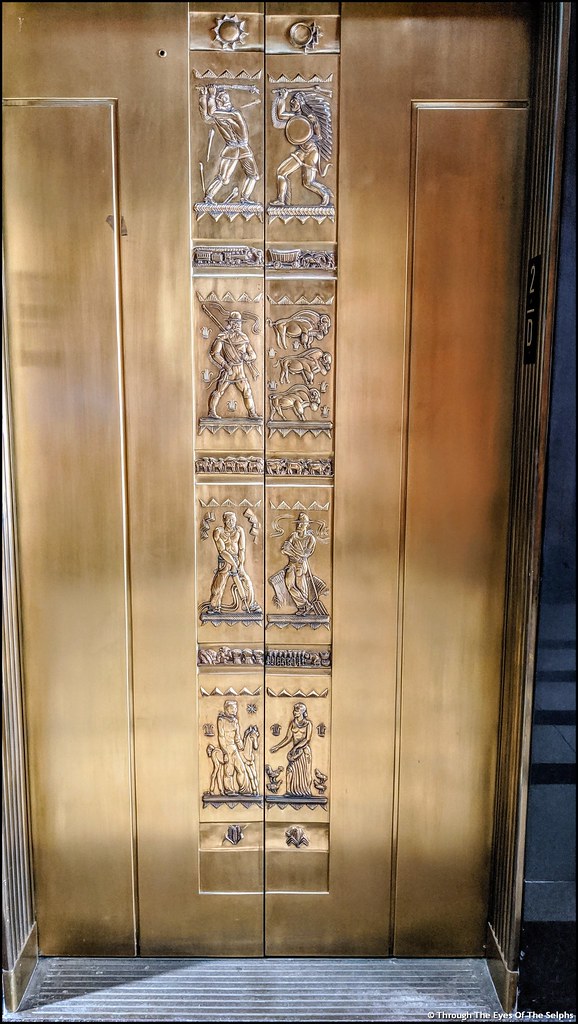
The elevators doors leading to the observation deck had raised sculptures representing pioneers. IMG_20200828_142539IMG_20200828_143049

North Dakota was the 39th state (1889), but at the time the seal was designed it was unknown when they would be granted statehood so the seal has 42 stars. IMG_20200828_143202IMG_20200828_143210

On the grounds of the capitol is a statue of Sacajawea (also spelled Sakakawea, a Lemhi Shoshone woman) and her baby son which was dedicated in 1910. IMG_20200829_150818

Mink (Hannah Levings) of the Arikara, Hidatsa, Mandan Nation posed as a model for the statue. IMG_20200829_150914

It is believed Sacajawea was sixteen years old when she first met Lewis and Clark in 1804. She was married to a French fur trapper by the name of Charbonneau. Her son was born in 1805 and traveled with her on the Lewis and Clark Expedition. It is believed she died just south of what is now the border of North and South Dakota in December, 1812 at the approximate age of 25 (believed to happen during childbirth). We recently learned that William Clark adopted Sacajawea’s son and they lived in St Louis. 

Next up: Bismarck Pt 2

Billings, Montana AUG 11, 2020

We drove from Lewistown to Billings (pop 104,000) for a one week stay. The weather during our stay was hot, with temperatures reaching 100 degrees on our last day! 

Billings most striking feature is the Rimrock, a natural feature rising 500 feet above the Yellowstone Valley. Legend says that in 1837 two Crow warriors, dressed in their finest and singing death songs, rode a solid white blindfolded horse over Sacrifice Cliff from the Rimrocks. They did this to appease their gods in order to halt the spread of smallpox among their people. The Native Americans call the cliff “The Place Where the White Horse Went Down“. The Crow, who had no immunity to the disease, had contracted smallpox from the people of the American Fur Trading Company. The disease caused great loss to the Crow people between 1837-1838. IMG_20200814_142111

The Rimrocks sandstone formations were formed 80 million years ago. The Western Interior Seaway, where Billings is today, slowly rose and fell over time, leaving behind compressed sand that became this massive formation. The Yellowstone River has been cutting into it for a million years, leaving a canyon in the bedrock. IMG_20200814_144013

We drove along the top of the Rimrocks with nice views of the city of Billings below. MVIMG_20200814_143927

Then we visited Riverfront Park where we found a geocache and got a glimpse of the Yellowstone River. We had several views of the Yellowstone River flows through Billings. IMG_20200814_155839IMG_20200814_152617

We also stopped by Boothill Cemetery, the final resting place between 1877-1881 of three dozen individuals, many who died with their boots on. This is one of many such named cemeteries throughout the west. Buried in this cemetery was Muggins Taylor, the scout who brought the world the news of Custer’s last stand. There was a large rock memorial with quotes on each of the four sides.

Quote 1:
“This Monument Marks A Historic Site
Where Thirty-Five Lie Buried
For Fortune and Fame
Lost Their Lives Lost Their Game” 

Quote 2:
“Upon This Rugged Hill
The Long Trail Past 
These Men Of Restless Will
Find Rest At Last” 

Quote 3:
“The Stream Flows On But It Matters Not
To The Sleepers Here By The World Forgot
The Heroes Of Many A Tale Unsung 
They Lived And Died When The West Was Young” 

Quote 4: was unfortunately too worn to read IMG_20200814_154906

On Saturday we drove to Red Lodge, Montana to begin driving the Beartooth Highway (All-American Highway) which goes from Montana into Wyoming. Charles Kuralt called this “the most beautiful roadway in America“. IMG_20200815_143822

IMG_20200815_125628-EFFECTS

Can You See The Bear’s Tooth?

It is also designated one of the most dangerous roads in America as it climbs to 10,947 feet with numerous switchbacks.

On our GPS you can see the five switchbacks which gain about four thousand feet. IMG_20200815_125116IMG_20200815_111529PANO_20200815_115105.vr

Completed in 1936, it provides views of some of the most rugged and wild areas in the lower 48 states.  Along the way are visible twenty peaks over 12,000 feet, 950 alpine lakes, glaciers, Rocky Mountain goats, waterfalls and wildflowers. It took us eight hours to make the round trip drive with all the scenic overlooks. What a beautiful drive! IMG_20200815_121312IMG_20200815_122042IMG_20200815_131837IMG_20200815_122318IMG_20200815_131631IMG_20200815_130922

This is a herd of Rocky Mountain Goats, many are still shedding their coats. IMG_20200815_125852_1IMG_20200815_125854

MVIMG_20200815_141849

Pilot and Index Peaks

We saw Lake Creek waterfall and snagged a short video with sound. MVIMG_20200815_140748


Lake Creek Waterfall
Select this above link to see and hear the video. MVIMG_20200815_140844

We went to Crazy Creek waterfall and turned back for home. IMG_20200815_142828

We liked this old wrecker we found in one of the small towns we passed through. It looks like one of the cars (Mater) in the animated movie “Cars”. Mater is the rustiest, trustiest tow truck in Radiator Springs. IMG_20200815_165750
And an interesting sculpture as well! IMG_20200815_165828

After two wonderful months in Montana, it is time to move on to North Dakota. 

Next up: Medora, North Dakota 

Lewistown, Montana AUG 4, 2020

Our next stop in Montana was in the small town of Lewistown (pop 5,800) for a seven night stay. 

It continued to be very hot (mid 90s) but the hot spell finally broke our last couple of days here and we had some pleasant temperatures. One nice thing about Montana is that even though the summer days are very hot, it cools down quickly after sunset. The last couple of nights in Lewistown we had nightly lows in the middle 40’s.

No matter where we travel we always find interesting and unique places to visit. First we visited the National Register of Historical Places: Lewistown Satellite Airfield Historic District. This satellite airfield was constructed in Lewistown during World War II as one of four training facilities for B-17 Flying Fortress aircraft crew members. IMG_20200807_133431IMG_20200807_140351IMG_20200807_140030c

It included a small one story building constructed of concrete which was the storage site for the top secret Norden Bombsight used by the bombardiers during their training. The top secret Norden Bombsight is a synchronous stabilized bomb aiming device. Divided into two vaults, the Norden device was only accessible through bank vault doors. This Bombsight storage shelter which housed the Bombsight is one of the few such buildings left in the country. IMG_20200807_140336IMG_20200807_140320

The Lewistown satellite field was built as a satellite field for Great Falls Air Base and was completed in 1942. Squadrons were trained in the navigation of the B-17 as well as receiving gunnery and bombing practice. Once their training was finished, the men were sent to Europe. The Lewistown airfield was operated for twelve months between 1942 and 1943 and then deactivated. The historic district has 23 original structures still standing including the recreation building, large hangar, operations building, armament building and housing. Today the area serves as the town’s municipal airport. IMG_20200807_134309IMG_20200807_140131IMG_20200807_140103IMG_20200807_140224

The 1996 John Travolta movie “Broken Arrow” was filmed near Lewistown. Some of the more dangerous scenes were filmed along 40 miles of railroad track on the privately owned Central Montana Railroad. IMG_20200809_152329

The above trestle is not available by car. We had looked forward to riding the Charlie Russell Chew Choo dinner train which travels 56 miles through the countryside on a spur track built in 1912-1913. Unfortunately like so many other things this summer, the train ride was a casualty of the coronavirus and all trips for the rest of the summer season have been canceled. Here is a picture Bill took of the Chew Choo train sitting lonely without any riders. If we had been able to ride this train it would have gone over the trestle used in the movie. IMG_20200809_135518

Instead we had to settle for this nearby trestle. IMG_20200809_140118IMG_20200809_140230

On this end of the tracks was over 100 empty railroad cars used for petroleum oil. IMG_20200809_135529

Another day we stopped by Symmes Park for a geocache. It was a nice city park with a replica of the Statue of Liberty. This statue was erected in the early 1950s as part of a Boy Scout project across the country to help celebrate 40 years of scouting. There were more than 200 Liberty replicas put up around the country and Lewistown purchased one of them. MVIMG_20200807_145336

Also in Symmes Park was a LGM-30A Minuteman I missile. The Minuteman I missiles were placed in their silos in the early 1960s and in late 1966. This Minuteman I missile was placed here to commemorate the fifty Minuteman III intercontinental ballistic missiles deployed in this area. Underground silos containing the nuclear-warhead missiles are spread across northern Montana. IMG_20200807_145733IMG_20200807_145609c

The park also had a 240 mm Howitzer on display since 1959. It could shoot a 360 pound projectile fourteen miles! IMG_20200807_145950IMG_20200807_145925

Another beautiful park was Frank Day Park with a Labyrinth garden where we found another geocache. IMG_20200809_152152

Nearby were exhibits on the history of central Montana railroads. The first train arrived in Lewistown in late 1903. Due to the World War 1 years and Montana’s poor economy during the 1920s, expansion of the rail line into North Dakota was never completed. The railroad era in Lewistown ended in 2003. IMG_20200809_152259

On Sunday we visited the Veterans Memorial Park. We found a geocache here and enjoyed walking around the park. IMG_20200809_155342IMG_20200809_155200IMG_20200809_155702IMG_20200809_155742IMG_20200809_155803IMG_20200809_155845

It is one of the few veterans parks which has a statue to remember the mothers left behind. Very touching place to spend time. IMG_20200809_160051IMG_20200809_160040

We enjoyed our time in Lewistown in spite of the excessive heat. It is amazing to see all the interesting places that can be found in these small towns. We are often led to these places when searching for geocaches. 

Next up: Billings, our final stop in Montana

Great Falls, Montana July 21, 2020

We arrived in Great Falls, Montana, (pop 59,000) for a two week stay. Great Falls is the third largest city in Montana. IMG_20200803_131659

It is located along the upper Missouri River where the Lewis and Clark Expedition had to portage around five waterfalls in June 1805 and then again during their return trip in 1806. IMG_20200802_133342L&C Portage Route MTIMG_20200803_131817Within a 15 mile stretch of the Missouri River there is an elevation change of 500 feet. This very difficult 18 mile portage around the falls took over 31 days. This portage was one of the most difficult of their journey. Great Falls gets its name from these five waterfalls. Today the city is called “The Electric City” because each of the falls has a hydroelectric dam. 

We spent time exploring the different falls and dams that make up Great Falls. The falls look much different today than they did during the time of Lewis and Clark because they were altered by the construction of the dams. The falls which at one time was seen as a great obstacle by Lewis and Clark is now seen as of great benefit to supply energy and power to the city. 

Of the five falls, one is not accessible by car and one is submerged. We were able to visit the other three. IMG_20200725_110316

Great Falls/Ryan Dam was the first we visited. When first seen by Lewis and Clark, a measurement of the height was taken by Clark using a sextant and a rod using geometry. Clark estimated the height to be 97 feet and ¾ inches which is remarkably accurate to the 96 feet shown by recent electronic measurements. Clark was only off by a foot! IMG_20200725_111308rThe Big Falls Missouri River MT 1910

To best view the dam and falls we walked across a suspension bridge across the Missouri River to Ryan Island Park. The upper part of the falls were covered by the 1,336 foot Ryan Dam. At first the dam was called Volta Dam after the Italian Alessandro Volta for whom voltage was named. It was later renamed Ryan Dam. IMG_20200725_105958IMG_20200725_110123PANO_20200725_111525.vr

Next up was Rainbow Falls/Rainbow Dam. Captain Lewis referred to this as “Beautiful Cascade”. The dam was constructed in 1910. IMG_20200726_115412IMG_20200726_105423IMG_20200726_105659MVIMG_20200726_105711

The last falls we visited was Black Eagle Falls/Black Eagle Dam. This falls is 26 feet high and 600 yards wide and was the first to be dammed in 1890.  We viewed the falls and dam from the Black Eagle Memorial Island Park which was accessed across a bridge. IMG_20200725_124239IMG_20200726_122717

On the riverfront trail along the Missouri River was a statue of Lewis, Clark and Sacajawea. IMG_20200726_122751-EFFECTSIMG_20200726_122948IMG_20200726_123109IMG_20200726_110616

We also visited Giant Springs State Park, a beautiful state park. Clark first found this great spring in June, 1805 and called it the largest fountain or spring he ever saw. It is one of the largest freshwater springs in the United States. Over 150 million gallons of water flow from Giant Springs into the Missouri River everyday. MVIMG_20200726_111554IMG_20200726_112343IMG_20200726_112419

The springs are the source of the Roe River, which at one time was recognized by the Guinness Book of World Records as the shortest river in the world. Whether or not that record stands today, at only 201 feet in length it is definitely one of the shortest. The Roe River flows into the Missouri River, the longest river in the United States. IMG_20200726_111547IMG_20200726_111655IMG_20200726_112602

Next up we visited the Lewis and Clark Interpretive Center. It was disappointing that both the theater and entire lower level of the Center were closed due to the pandemic. IMG_20200726_114936IMG_20200726_120309IMG_20200726_120309(1)

There were still interesting exhibits and displays here about the Expedition. Meriwether Lewis wrote that he saw more buffalo in this area than he ever witnessed before. Buffalo was a staple diet for the local Native Americans and became a favorite meal for the members of the Expedition. IMG_20200726_115758IMG_20200726_115853

We stopped by the Great Falls Visitors Center which was closed but we did see a nice statue of Lewis, Clark, Sacajawea, York a slave and Seaman the dog. We also found a geocache there. IMG_20200726_135500

We found a nice police memorial nearby. IMG_20200726_135702

On another very hot day we drove to the Upper Portage Camp Overlook. This area overlooks the site of the 1805 Lewis and Clark Upper Portage Camp on the banks of the Missouri River. Even though the landscape has changed over the centuries, it was still a place where we felt a deep sense of history.

IMG_20200802_133524

A Reenactment Of The Boat; In the Background In the Trees Is the Campsite

While Clark directed the portage around the falls, at this site Lewis supervised the assembly of a boat they had hauled in pieces from Harpers Ferry, Virginia. Considered an experiment, the iron boat frame was designed by Lewis in 1803. The canoe shaped frame was 36 feet long and 4 ½ feet wide with nearly 200 pounds of iron strips connected with screws. It was further strengthened with willow limbs and covered with animal skins. It was designed to carry 8,000 pounds. Lewis’ crew labored for weeks preparing 28 elk and four bison hides. Unfortunately during a trial run the boat at first floated like a cork and then sank. Lewis was devastated by the failure and ordered the boat to be buried here.

They then quickly moved upstream and made two large cottonwood boats as a replacement. The iron boat and failed experiment was never mentioned in their journals. A replica of the boat experiment is located here today. 

Meanwhile at the Lower Portage Camp, Clark and the rest of the Corps of Discovery struggled around the five falls. Four times they loaded baggage into six canoes laid upon carts and then pushed and pulled the heavy loads across 18 miles of rugged terrain. They used sails to help them whenever strong winds allowed and endured brutal hail storms. At one point they documented hail as large as seven inches in diameter that bounced 12 feet and landed 30 feet away. It left them bruised and bloodied. They endured heat, rain, prickly pear cactus, and mosquitoes. Through it all Sacajawea, having recently been deathly ill, carried her four month old baby. 

The Expedition all gathered together at the Upper Portage to rest and plan the rest of their journey before leaving on July 13, 1805. They stockpiled meat, wrote lengthy journal entries, made detailed maps, and dug a cache to store items and equipment they wouldn’t need until their return trip when they camped here again from July 13-26, 1806. It was here they celebrated the nation’s 30th Independence Day on July 4, 1805 with a feast of bacon, beans, dumplings, and bison meat as well as singing and dancing. They wrote they fought off mosquitoes and grizzly bears that harassed them daily. 

We also found a geocache here after a long search in the hot sun. 

We enjoyed our time in this historic city except for the extremely hot temperatures. 

Next up: Lewistown, Montana

Cascade, Montana July 16, 2020

This blog posting is dedicated to our good friend and blog reader Bob M. who grew up in Great Falls and Helena. Bob, you have a really beautiful home state. We are certainly enjoying our time here! 

Our current stop was south of the tiny town of Cascade, Montana near the Missouri River about thirty miles south of Great Falls for a six night stay.

This is such a beautiful part of Montana. Interstate 15 goes back and forth over the Missouri River.

One day we went sightseeing and geocaching. We saw lots of fishing and people enjoying the water. MVIMG_20200716_133334IMG_20200716_144620IMG_20200716_144955IMG_20200716_145027

Bill found a geocache located at the 1930 Hardy Bridge which crosses the Missouri River. This bridge was used in the 1987 movie “The Untouchables”. This area was portrayed as Canada in the movie. During filming a sign saying “Welcome to Canada” hung from the bridge. After filming ended they left the sign on the bridge which really confused people traveling through the area! The sign is gone today. IMG_20200716_132551IMG_20200716_132603IMG_20200716_150747

On Sunday, July 19th we took a two hour boat trip with the Gates of the Mountains boat tour company. The marina is located on the Missouri River in the foothills of the Rocky Mountains between Helena and Great Falls. IMG_20200719_094659IMG_20200719_09531600000IMG_00000_BURST20200719100145261_COVER

In July of 1805, the Lewis and Clark Expedition traveled down this section of the Missouri River, marveling at the limestone cliffs at a height of 1,200 feet. The Expedition was traveling against the current as they sought the headwaters of the Missouri River. 00100lrPORTRAIT_00100_BURST20200719100346470_COVERIMG_20200719_100729IMG_20200719_100815IMG_20200719_102147IMG_20200719_103309IMG_20200719_103349IMG_20200719_110619IMG_20200719_105404

From a distance, the bends in the waterways made the great stone walls appear to block passage only to then open up like gates as the expedition approached. IMG_20200719_104707IMG_20200719_105545IMG_20200719_105514

Meriwether Lewis wrote in his journal, “I shall call this place: Gates of the Mountains”. 

Our boat was named Sacajawea 2. This tour boat company has been giving tours for over 100 years and the two hour tour was a great deal at only $14 a person (senior price). We saw four eagles, a huge eagle nest and bighorn sheep. IMG_20200719_103900IMG_20200719_103948IMG_20200719_113404IMG_20200719_113603

This actual boat was used in the Clint Eastwood 1974 movie “Thunderbolt and Lightfoot”. In the movie the boat was named “Idaho Dream” a mailboat on the Snake River. Several scenes were filmed on our section of the tour. As the guide pointed out the Snake River does not look like the Missouri River. MVIMG_20200719_111637

We also saw a Native American pictograph of a bison which was hard to see in the distance. IMG_20200719_104339

We also have rock formations that appear to be various animals.

IMG_20200719_103147

This Looks Like a Person

MVIMG_20200719_103512

Do You See an Elephant?

IMG_20200719_112802

This Looks Like Groot from the Marvel Movies

IMG_20200719_112903

Do You See a Monkey’s Face?

We stopped briefly at the Meriwether Picnic Area, named for the area where the Lewis and Clark Corps of Discovery camped on July 19,1805, exactly 215 years ago on the day we took the boat trip. IMG_20200719_110553IMG_20200719_111156IMG_20200719_111004

One evening from our campsite we could see a doe and her fawn. We love Montana! IMG_20200719_185038IMG_20200719_185029

Next up: Great Falls

Butte and Helena, Montana July 5, 2020

Leaving Bozeman we headed north to a small town (Basin) about thirty miles south of Helena for a ten day stay. 

One day we drove south to the town of Butte, Montana, pop 5,700. Butte was once known as the “richest hill on earth” because of the mineral wealth that made hundreds of men wealthy and gave jobs to thousands and thousands of immigrants. While gold and silver brought the first wealth to the area, it was copper that helped it earn its nickname. It produced more than 20 billion pounds of copper, more than any other in the United States. Due to the demand for copper during the industrial revolution, Butte had electricity before NYC and other major cities. At the turn of the century it was the richest and largest city in the northwest. By 1955 most of the high grade copper was gone so they turned to extracting ore, with 48 billion dollars worth of ore extracted. As of 2017, Butte has the largest population of Irish Americans per capita of any city in the United States. IMG_20200708_124548

Just outside of Butte we stopped at an overlook to get a geocache and noticed “Our Lady of the Rockies”, a 90 foot high statue of the Virgin Mary which sits on the Continental Divide and overlooks the town. It is a nondenominational tribute to motherhood that took six years to build and was airlifted into place in 1985. It is the third tallest statue in the United States. IMG_20200708_124522IMG_20200708_124533

Our main reason for coming to Butte was to hike on the Milwaukee Road Rail-Trail, a former railroad for the former Chicago, Milwaukee and St Paul Railroad which was converted to a walking and biking trail. This section of the railroad was one of the first in the country to be electrified, with Thomas Edison coming out to Butte to ride the railroad. IMG_20200708_141422IMG_20200708_143604

The trail includes two tunnels and a trestle and is 9.5 miles round trip. We made it to the two tunnels and then walked back for a total of five miles. We were tired!

IMG_20200708_144312

First Tunnel is 550 Feet Long

IMG_20200708_152224

Second Tunnel is 1,100 Feet Long

IMG_20200708_152107

Another view of the Longer Tunnel

We really wanted to walk to the trestle but ten miles was too much for us. So after we got back to the car we drove to see the trestle which is 600 feet long and rises 130 feet above the valley.  IMG_20200708_170026

We had one more stop to make at the grave of Evel Knievel, the stuntman and daredevil who was born and grew up in Butte. IMG_20200708_171743IMG_20200708_171533IMG_20200708_171554

Another day we drove north from our campground to Helena, the capital of Montana, pop 28,000. If you follow our blogs you know that visiting and touring capitol buildings is always on our list of things to do. Montana became a state and Helena, became the capital in 1889. IMG_20200710_111306-EFFECTS

In 1864 four tired and discouraged prospectors looking for gold stumbled down a gulch and decided to take one last chance to strike gold. On their last chance they hit gold and a town flourished. The area became known as “Last Chance Gulch”. Today that area is Helena’s main street. The gold rush lasted long enough for 3.6 billion dollars (in today’s dollars) of gold to be extracted from Last Chance Gulch over two decades, making it one of the wealthiest cities in the United States by the late 19th century. This wealth is evident by the grand Victorian mansions we saw today. By 1888 about fifty millionaires lived in Helena, more per capita than in any city in the world. Today the majority of people in Helena are Irish and Catholic. It is the fifth least populous state capital in the United States and the sixth most populous city in Montana. By the way, in the late 1970s when repairs were being made to a bank, a vein of gold was found under the bank’s foundation. Actor Gary Cooper, actress Myrna Loy and fashion designer Liz Claiborne are from Helena. 

We took the hour long “Last Chance Tour Train” for a historical tour of Helena. IMG_20200710_105943IMG_20200710_110638Originally built as a Shrine temple in 1920, the Helena Civic Center is now owned and operated by the City of Helena.

IMG_20200710_112704_1MVIMG_20200710_113115IMG_20200710_114125IMG_20200710_114320IMG_20200710_114418MVIMG_20200710_114604IMG_20200710_115219

After the train tour we did a self guided tour of the capitol building. The guided tours were canceled because of the pandemic and the capitol building was very quiet. Even the security desk was empty. IMG_20200710_120915
IMG_20200710_122002

This painting represents the Lewis and Clark Expedition in July 1805 arrival at the Three Forks (headwaters of the Missouri River). Sacagawea’s recognition of her people’s hunting grounds from which she had been abducted five years earlier. Clark (at left) and Lewis flank Sacagawea; to the right is her husband, interpreter Toussaint Charbonneau. At the far left are explorer John Colter and Clark’s African American slave, York.
IMG_20200710_123514On September 8, 1883, at Gold Creek (approximately half way between Helena and Missoula). Former president Ulysses S. Grant wields the sledgehammer that he will use to drive the last spike for Northern Pacific Railroad.
IMG_20200710_123938

Jeannette Rankin (1880–1973) became the first woman to serve in the United States Congress in 1916.

IMG_20200710_124345IMG_20200710_102703IMG_20200710_124006

We always look for the Liberty Bell and Ten Commandments at each capitol site. IMG_20200710_104745IMG_20200710_105827

We could see the sleeping giant in the distance. Do you see him? IMG_20200710_123720

Next we visited the beautiful Cathedral of St Helena completed in 1914. The stained glass windows were made in Munich, Germany. IMG_20200710_141104IMG_20200710_135943IMG_20200710_140104IMG_20200710_140215IMG_20200710_140705IMG_20200710_135953IMG_20200710_140123IMG_20200710_140342IMG_20200710_140508

Next up: Great Falls, Montana


Bozeman, Montana July 1, 2020

Leaving our campground in Gardiner, Montana just outside the Yellowstone NP, we headed north to Bozeman, Montana pop 49,000.  It is the fourth largest city in Montana and the home of Montana State University. 

Bozeman was named for John Bozeman who brought the first wagon train of settlers to this area and founded the town in 1864. He blazed the trail which later became known as Bozeman Trail which was the way west for many settlers and miners. The area was a sacred hunting area to Native Americans and there were constant attacks on the settlers. When John Bozeman was killed by the Sioux, his trail remained unused for nine years because of repeated attacks. Today the Bozeman area is one of the state’s prime agriculturally productive regions.

After an easy 90 minute drive we pulled into what turned out to be our least favorite campground this year. We are not picky and do not have high expectations, but this campground was situated between an interstate highway and a railroad track. If the constant traffic noise didn’t keep you awake, the train whistles would. Added to that was an almost nonexistent Verizon signal and a high price. We told ourselves it was only for six nights and could tolerate it that long.

When I was looking for geocaches in the area, I found one located at the Little Bear School House and Museum. The one room school house is made from logs, built in 1912 and was used until 1950. In 1998 it was opened as a museum with authentic desks, ink wells, writing slates, teacher’s desk, black boards and learning materials from the early 20th century. There were also antique lunch boxes and fountain pen collections and an antique merry go round. As a former teacher I was really looking forward to the visit. It was located ten miles outside of Bozeman. IMG_20200701_120011IMG_20200701_120530

We arrived to find it closed due to the pandemic. I had checked before we left and their Facebook page said it was open. Come on people, it is not that hard to update a website’s information. We tried to look in the windows but the bright sunlight and thick screens prevented us from seeing much. These pictures were taken through the windows. IMG_20200701_120250IMG_20200701_120308

The wooden walkway leading to the front door had the names of students who had attended the school. IMG_20200701_120024

On Sunday we drove thirty miles to Missouri Headwaters State Park where the Gallatin, Jefferson and Madison Rivers converge to form the Missouri River, the longest river in North America. IMG_20200704_140556

It flows 2,341 miles before entering the Mississippi River north of St Louis, Missouri. The Mississippi River is the second longest at 2,141 miles. If you add the lengths of the Missouri and Ohio Rivers to the Mississippi, it would makes the Mississippi River the third longest river system in the world. 

In 1805, Lewis and Clark camped at the Missouri River headwaters for three days and thought their exploration of the Missouri River to its source as one of the major goals of their expedition. Lewis and Clark agreed to named the three rivers:

  • the Jefferson River after President Thomas Jefferson,
  • the Madison River after Secretary of State James Madison, and
  • the Gallatin River after Secretary of the Treasury Albert Gallatin. IMG_20200704_142636

Sacagawea, the Shoshone woman who traveled with Lewis and Clark, had roots in this area. At the age of twelve, while camped here with her people, she was kidnapped by another tribe and taken to what is now North Dakota as a slave. Charbonneau, a fur trader, purchased her. Charbonneau was hired for the Lewis and Clark Expedition as an interpreter. He brought along Sacagawea with her infant son. Her presence helped convince the Native Americans of the group’s peaceful intentions. Later Sacagawea helped them find the Shoshones where she was reunited with her brother. The Shoshone agreed to sell them the horses they desperately needed to cross the mountains. The Shoshone asked for payment in guns which they needed to fight their enemies. IMG_20200704_144927

During the Civil War entrepreneurs started a small town here in hopes of establishing a major transportation center with steamships connecting with stage lines. This never took hold and the area became a ghost town before becoming a state park in 1951.  Here stands the remnants of the Gallatin City hotel, about 1862. IMG_20200704_140753

Over the centuries the three forks of the Missouri River was a natural crossroads and meeting place for many different Indian nations to come together. Later traveling bands of hunters used the area to meet, trade and camp. Today we saw it as a popular place for people to tube down the water, pandemic or no pandemic! IMG_20200704_143028IMG_20200704_151315

Next up was the nearby Madison Buffalo Jump State Park. This is an extremely small state park accessed on a gravel road. Neither state park we visited today was manned by any park rangers. We just put our entrance fee in an envelope in a box and continued on. IMG_20200704_153934

Starting two thousand years ago and used as recently as two hundred years ago, the Madison Buffalo Jump was used to kill buffalo. Before Indians acquired horses, they sometimes stampeded large herds of buffalo off this high limestone cliff and Indians waiting at the base killed them with spears. This was most often done in the fall of the year when buffalo cows were prime and the tribes were gathering food and supplies for the winter. Highly skilled young men trained for speed and endurance wore buffalo, antelope or wolf skins to lure the buffalo to the cliff. They would excite or frighten them into a stampede over the edge. Buffalo bones are still buried at the base of the cliff. We thought about hiking to the top of the cliff but gathering storm clouds convinced us otherwise. IMG_20200704_154915IMG_20200704_154336

Another day we visited the American Computer and Robotics Museum in Bozeman. Known as the oldest continually operating museum of its kind in the world and labeled by a Harvard professor as “Inch for inch, the best museum in the world”, and given that Bill is a computer engineer, you know we just had to visit! It is a museum of the history of computers, communications, artificial intelligence and robotics. IMG_20200701_143958MVIMG_20200701_140730IMG_20200701_141708r

With that said, I have to step aside and let Bill take over from here with this part of the blog!

The museum has many real items like one of Isaac Newton’s original book 1687, Philosophiæ Naturalis Principia Mathematica.  On loan is a Enigma Machine which the Germans believed was impossible to break but Alan Turing and his team in England developed technology to decrypt most of the German war messages during the war.

IMG_20200701_133351IMG_20200701_133343IMG_20200701_133701

IMG_20200701_135644

Alan Turing (1912-1954) ideas were used to create the modern computers and conceived of the field of “Artificial Intelligence”.

IMG_20200701_135611

John von Neumann (1903 -1957) was a mathematician regarded as the one of the greatest mathematician in modern history. He made major contributions to many fields. His concept of data and program stored in the computer memory space has become the de facto standard for most computers that exist today (called the von Neumann architecture).

Here are some of the many early personal computers of the 1980’s. IMG_20200701_141847IMG_20200701_141857IMG_20200701_141904IMG_20200701_142027

One of my favorite devices is the Curta four function hand held, mechanical calculator (about the size of a soup can.) Developed in the 1930 was built until electronic calculators in the 1970s displaced them. IMG_20200701_132910

Next up: Montana’s capitol area Helena and Butte city.

Yellowstone NP part 4 June 28, 2020

On our last day in Yellowstone NP we drove from our campground to Mammoth Hot Springs. On the way we passed the 45th parallel sign. IMG_20200627_092030

As we entered the village of Mammoth Hot Springs we were delighted to see a large herd of elk grazing in the traffic circle. We especially enjoyed seeing all the calves. IMG_20200627_092725MVIMG_20200627_092838IMG_20200627_092754

We continued on to the Mammoth Hot Springs terraces area. MVIMG_20200627_100856IMG_20200627_101630

Mammoth Hot Springs has mineral laden hot water from deep within the Earth’s crust which finds its way to the surface and builds beautiful tiers of cascading, terraced stone.  Hot water and gases ascend through limestone deposits, sculpting the rock.  Once exposed to the air, calcium carbonate from the limestone is deposited as a rock called travertine.  These hot springs do not erupt but instead build these spectacular terraces.  The terrace sculpting has been going on for thousands of years as thousands of gallons of water well up and deposit large amounts of travertine, or limestone, daily and as quickly as three feet per year! IMG_20200627_093730IMG_20200627_094605IMG_20200627_094707IMG_20200627_100314IMG_20200627_100616

We walked around the extensive boardwalk area, up and down many steps as we made our way around the area. Just beautiful! IMG_20200627_100840IMG_20200627_100958IMG_20200627_101150IMG_20200627_101308IMG_20200627_101313IMG_20200627_101416

Near the parking area is what they call “Liberty Cap”, a dormant hot spring cone 37 feet tall. The 1871 Hayden Geological Survey strangely named the cone after the peasant caps worn during the French Revolution. They were also depicted on early American coins. IMG_20200627_093722

The village of Mammoth Hot Springs is where the Yellowstone park headquarters is located and it has a village of stores, gift shops, a Visitors Center and a couple restaurants.  In the early days of Yellowstone National Park’s existence the park was protected by the U.S. Army from 1886 to 1918. From what you might wonder. From people damaging the geothermal areas and hunting the wildlife.  The original buildings of Fort Yellowstone such as the guardhouse, jail and soldiers’ barracks are preserved and still standing in Mammoth Springs today. IMG_20200627_101706IMG_20200627_101816IMG_20200627_102322IMG_20200627_105550

This concludes our time in Yellowstone NP. Next we continue our summer travels into Montana. 


Yellowstone NP part 3 June 24, 2020

Yellowstone is such an amazing national park. Whatever your interest, it has something for everyone. Geysers, hot springs, animals galore, gorgeous scenery and waterfalls. On our third day into the park we focused on waterfalls. IMG_20200627_105328

Yellowstone has a grand canyon. Not as huge or magnificent as THE Grand Canyon, but still fabulous and beautiful with not one but two magnificent waterfalls. The Grand Canyon of the Yellowstone River was created from a lava flow 484,000 years ago.  It is mainly made of rhyolite rock.  Past and current hydrothermal activity weakened and altered the rock, making it softer.  The Yellowstone River eroded these weakened rocks to deepen and widen the canyon, a process continuing today.  The canyon is twenty miles long, more than a thousand feet deep, and between 1,500 and 4,000 feet wide with two waterfalls. IMG_20200624_100902

One end of the canyon begins at the 308 foot tall Lower Falls which may have formed because the river flows over volcanic rock more resistant to erosion than rocks downstream.  The same is true for the 109 foot Upper Falls. IMG_20200624_100707IMG_20200624_110656

When we were here five years ago we hiked several trails around the falls and one strenuous hike with 13 switchbacks that took us to the top of the falls. This time the trail was closed due to the pandemic. Just one of many things still closed throughout the park. But we still had plenty to see and do to keep us busy. IMG_20200624_105630IMG_20200624_110752

Along with visiting the canyon we drove through Hayden Valley where we saw plenty more bison, some elk and a bear. IMG_20200624_141025IMG_20200624_142401

We didn’t get a picture of this bear since he was too far away to get a clear picture. IMG_20200624_123955IMG_20200624_123747

This area took us along Yellowstone Lake (elevation 7,733 feet) with stunning views of water with snow capped mountains in the distance. IMG_20200624_124355

We stopped at an area with rapids where we actually talked with a park ranger, our only real interaction with a ranger all week. He told us if we looked closely we could see fish. This time of year is when the water flows at its highest. The fish were waiting because they knew as the water flow decreased during the hotter summer months, it would be time to swim back to the lake. We enjoyed some time there, watching the fish near the surface occasionally jumping out of the water. Too fast to catch with a camera! MVIMG_20200624_132732IMG_20200624_132824

This hill side is called Roaring Mountain. On the hill side if you zoom in you can see two active steam vents. IMG_20200624_150410IMG_20200624_150855

We stopped at a mud volcano area with a nice boardwalk around the hot springs. There were plenty of signs warning people to stay on the boardwalk because thermal areas have a thin crust above boiling hot springs and scalding mud. Some of the pools are acidic enough to burn through boots! More than twenty people have been scalded to death and hundreds more badly burned or scarred because they left the boardwalks. Imagine our surprise when we saw three bison very close by as we reached the halfway point around the boardwalk. A ranger was there and stopped people from continuing to get close to the bison out of fear of them becoming agitated.  We saw this happen on our first day when a lady with a camera got too close, and we were glad of the strong fence.  One was rubbing against a small tree, evidently trying to rub off the last of his winter coat. IMG_20200624_135718

Another was drinking water from a small pool of muddy water, yuck!! IMG_20200624_135544

The third was actually inside a mud pot area and we wondered how hot the ground was on his hooves. Eventually another ranger came with yellow caution tape and stopped anyone from entering that area of the boardwalk.  IMG_20200624_135520

The elevation drops significantly by a waterfall on the Gardner River as we travel to Mammoth Hot Springs and eventually to the North Entrance at 5,314 feet. MVIMG_20200624_153847

Near this waterfall we saw a lone Dall sheep high on the hillside feeding on the grass. He was so high up it was difficult to get a clear picture. IMG_20200624_154120IMG_20200624_154219

The next day Bill took a half day white water rafting trip on the Yellowstone River with the Yellowstone River Raft Company located in Gardiner MT.  IMG_20200627_111804MVIMG_20200626_095218

They went right behind our RV and I was waiting to take his picture. IMG_20200626_103952IMG_20200626_104012~2

The river was running with a good volume/flow of 10,000 cubic feet per second. He had a great time/ride and was glad to add the Yellowstone River to the lists of rivers he has rafted. IMG_6614~2IMG_0815~2IMG_6604

Next up: Our last day in Yellowstone NP


Yellowstone NP part 2 June 22, 2020

After our two night stay in Island Park to see the south part of Yellowstone and Old Faithful, we moved to a new location north of the park. In order to get to our next campground we drove into the west entrance of the park, quickly crossing from Idaho into Wyoming, through the park crossing from Wyoming into Montana and came out the north entrance. Three states in a short distance. Remember in the last blog I said Yellowstone is in Idaho, Wyoming and Montana with the largest section of the park located in Wyoming. Along the way we ran into a brief “buffalo jam” which is always fun! MVIMG_20200622_105255MVIMG_20200622_105352IMG_20200622_105355IMG_20200622_105401

Near the north side of Yellowstone we saw this coyote. IMG_20200622_120101

We went by the Park’s Post Office and noticed the bears had on face masks! IMG_20200623_152756
IMG_20200623_152725In this picture you can see the historic arch at the North entrance to the park and there is Bill making the turn in front of me. The cornerstone was laid down by President Theodore Roosevelt in 1903.
IMG_20200622_122045

Our next campground was located in the tiny town of Gardiner, Montana, conveniently located just outside the park. We checked into the campground and started to get settled into our new campsite along the Yellowstone River. Bill was outside getting things set up and talking to our new neighbors, also from Florida. Suddenly I heard a commotion and the lady next door was very upset. Going to the window I discovered a large snake had slithered up the tree behind us and was going after a nest of baby birds. Her husband grabbed a long pole and knocked the snake with a baby bird out of the tree. The snake coiled up and began to hiss. IMG_20200622_150256

Everyone backed off and the snake quickly ate the baby bird and then continued to coil and hiss. The neighbor managed to use the pole to flick the snake over the river bank. The mother bird was quite upset screeching and circling overhead. The neighbor looked at us and said, “Welcome to the neighborhood”. If we hadn’t prepaid and had nowhere else to go, I would have been tempted to pack up and leave. I wondered if there were more baby birds in the nest and the snake would come back. After some discussion it was determined it was most likely a bull snake since it didn’t have a rattle. In case you are wondering, we thankfully never saw the snake again and after a couple days I forgot about it. 

The next day we left the campground early and spent the day touring one of my favorite places in the park, Lamar Valley, known as the  premium place to see wildlife. This is a blog where pictures can describe better than words. We saw many bison, pronghorn sheep and even a bear. We loved every second of this day! IMG_20200623_121641IMG_20200623_112503IMG_20200623_112808IMG_20200623_113401IMG_20200623_113440IMG_20200623_141729IMG_20200623_123620IMG_20200623_142742IMG_20200623_144434IMG_20200623_144034IMG_20200623_142813IMG_20200623_142641IMG_20200623_133751IMG_20200623_133254IMG_20200623_120056IMG_20200623_142130MVIMG_20200623_142006IMG_20200623_132720IMG_20200623_140013IMG_20200623_135954IMG_20200623_132608


Next up: Yellowstone part 3 Waterfalls and more animals