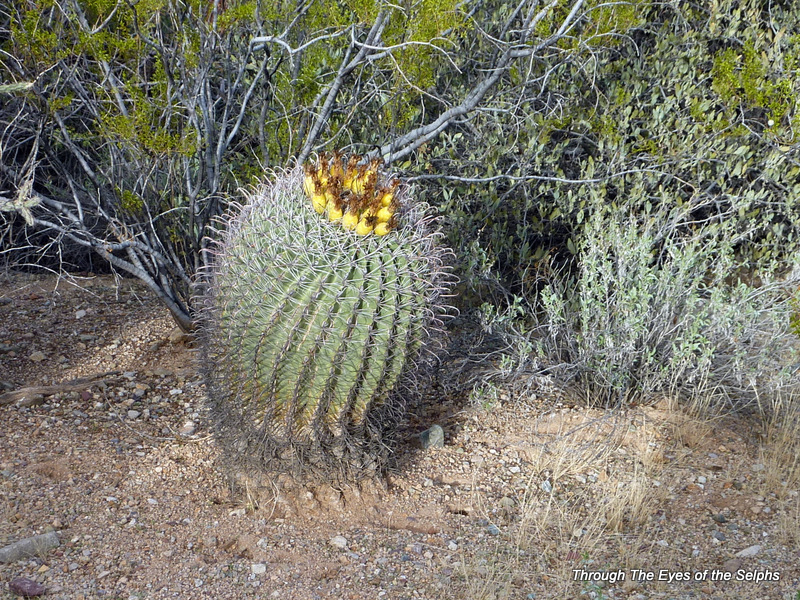
We love Arizona! From Tucson to Casa Grande, and now a final stop in Yuma, our stay in Yuma has been wonderful! During the short drive from Casa Grande to Yuma, we continued to enjoy the interesting rock formations and views. 
 Yuma is in an area near the borders of Arizona, California and Mexico. Guinness Book of World Records describes Yuma as “the sunniest place on earth” with an average of 339 days of sunshine and 3.01 inches of rain a year. Years ago Yuma was a popular place for gold rushers to cross the Colorado River because of the Yuma Crossing. Here there are two large granite outcroppings which squeezed the river into a narrow channel, allowing for a safer and easier crossing of the river. Over the years the Hoover Dam, as well as other dams have altered the flow of the Colorado River and therefore the water supply to the area. For example the Yuma Territorial Prison was once surrounded by water on three sides but today that area is dry desert. Other dams such as the Laguna Dam diverts water for crops into the Yuma area. The Colorado River is one of the most controlled and litigated rivers in the world because it is shared by 7 western states and Mexico. It serves about 25 million people and 90% of its water has been directed by the time it gets to Yuma, and it disappears as it enters Mexico. Yuma is home to the world’s largest reverse osmosis desalting plants which was completed in 1992 by the Bureau of Reclamation to ensure that the U.S. could meet their treaty obligations to deliver water to Mexico. The plant can produce 72.4 million of gallons of desalted water per day. The plant never has run at full capacity because it is expensive to operate and Mexico has enough water from normal river flow without the plant. Throughout Yuma, seemingly at every street corner, there are small buildings offering desalted water for sale.
The Yuma Proving Ground, formerly Camp Laguna, trains troops, and tests weapons and systems, as well as bridges on the Colorado River, before battle. It is located on 1,300 square miles of desert terrain. Also nearby is a Marine Crops Air Station. Yuma’s economy is made up of agriculture, the military, and tourism.
Speaking of agriculture, today farming is a $3 billion industry in Yuma. It is known as the winter lettuce capital of the world. Chances are very good that if you eat salad anywhere in the U.S. during the winter, it came from Yuma. This helps make Arizona second in the U.S. in the production of all kinds of lettuce, cauliflower and broccoli.  At the peak of the season, 2,000,000 pounds of lettuce is processed at EACH of the NINE salad plants DAILY! Every day we saw busloads of migrant workers out in the fields working and fields of lettuce and other greens was a common sight. They flood the fields for irrigation and also have irrigation equipment actively watering the fields.
While in Yuma we celebrated Christmas. The RV resort where we were staying had a lovely Christmas Eve service which included placing luminaries along all the streets in the resort. It made for a beautiful Christmas Eve atmosphere.  On Christmas Day the resort provided a delicious Christmas dinner of prime rib and ham. We were able to meet and talk with many snowbirds, and we are finding that many of then come down from Canada, Washington state, and Oregon. We have found people to be friendly here and we were inviting to Happy Hours and enjoyed talking with our neighbors.
The Yuma Territorial Historical Park opened in 1876, with the first prisoners building their own cells.  The prison was open for 33 years and housed 3,069 prisoners, including 29 women. It was truly a hell hole, especially in the summer months with unbearable heat. It was surrounded on 3 sides by water and the other side by desert and quicksand. As mentioned earlier, today there is no longer water there, just dry desert.
There were few escapes.  One area, called The Dark Cell, was a dark cave-like area where prisoners who didn’t follow the rules were placed for

different lengths of time, depending on the severity of the misbehavior. It was such an unpleasant place that few prisoners were repeat

 offenders and some were model prisoners after the Dark Cell experience.
 Next door to the museum is a visitors center and museum. Nearby on the grounds was a small cemetery where they buried those who died there.
  Bill and I found visiting the prison a sad and somewhat discomforting experience. The Yuma Territorial Prison was home to the Yuma High School from 1910 to 1912 after a fire burned down their school. During a football which Yuma won in the final moments of the game, one of the announcers said it was criminal the way the team stole the game. At first the townspeople were insulted, but then decided to go with area history and they became known as the Yuma Criminals.
Close to the Yuma Territorial Prison Historical Park was the Ocean to Ocean Bridge. This bridge opened in 1915 and was the first and only vehicular traffic bridge over the lower Colorado River for 1,200 miles. Until then, people had to wait for a ferry to cross the river and it was the final link from the Atlantic to the Pacific. Later a railroad bridge was added.
We had heard so much about Quartzsite, so we drove the 75 miles to check it out. It normally has a population of 3,700. but during the months of January to March, the population swells to over one million as the area is inundated with RVers who mostly boondock in the desert on Bureau of Land Management property for no or little cost. Many vendors come to the area for those months and set up huge tents where you can buy jewelry and gems, antiques, arts and crafts, and anything and everything an RV owner could possibly need or wish for. We drove around and looked at some of the potential camping areas and checked out some of the vendors. Since it was late December, the area was still relatively quiet with few RVs and vendors. Calm before the storm for sure. We still can’t decide whether the experience in January would be for us. Before leaving Quartzsite we did stumble upon a historic part of the area while geocaching. Once again, finding a geocache caused us to find an area we not normally have found. The Hi Jolly Memorial is a memorial to Ali Hadji. In 1856 thirty-three camel were brought from Syria with Ali Hadji as their caretaker. They were brought to the U.S. aboard a federal supply ship as an experiment to be used for transportation in the desert. The idea was originally that of Jefferson Davis, but he was soon preoccupied by the Civil War and lost interest in the project. Later an additional 41 camels were brought over with the idea of using them to build a wagon road from Arizona to California. The camels were found to be difficult to manage and it is said that the sight of them caused horses and cattle to stampede. Some were sold to circuses and some were left in the desert to fend for themselves. Because of a communication problem, Ali Hadji became known as Hi Jolly. He remained in the area near his camels and worked as an army scout and miner. After 30 years of service to the U.S. government, he died at the age of 64 in Quartzsite. The Arizona Highway Department constructed the pyramid like memorial from chucks of ore minerals in the area, with a metal silhouette of a camel on top in his memory. It is now listed on the National Register of Historic Places. 
We also heard a lot from fellow RVers about the small Mexican town of Los Algodones. We first started hearing about it when we were in Casa Grande and people continued to talk about it in Yuma. The town is very dependent on snowbirds and is therefore seen as a safe and friendly place to visit. We decided to give it a try. Los Algodones is 7 miles west of Yuma. It is known for having more doctors, dentists, opticians and pharmacies within a 4 block area than any other similar 4 block area in the world. It is very common for Americans to go across the border for dental work, to get eyeglasses,  and their supply of pharmacy drugs at a fourth to a third of the prices they would pay in the U.S.
  Many of the doctors and dentists are trained in the U.S. and give similar care to what you would receive in the U.S. Next to the border entry is a large casino on an Indian reservation where you can safely park your car for the day for $6.00. We parked and walked across the border. We were a little surprised that no one in Mexico was at the border to check us. It was amazing to see all the stores advertising dental and optical care. There were many vendors offering you just about anything you could want to buy.
  We had been warned to haggle and never pay full price, and we bought each of us a jacket and Bill a hat and belt for great prices. Bill wanted some prescription reading glasses so we went to an optical business recommended to us by fellow RVers. For $29 he received an eye exam and prescription glasses which were ready in 2 hours. They have single vision, bifocals and progressive lenses available for low prices. Bill likes his new glasses and sees fine with them. We had a nice Mexican lunch where a margarita is included in the price of the entree,
  and the entree price is cheaper than you would pay in the U.S. later in the day before heading back across the border we decided to have another margarita and relax and enjoy the sights and sounds of the town.


 The two margaritas were the price of what you would pay for one here, and we found margaritas there much stronger than those made in the U.S. We struck up a conversation with two couples sitting near us. They were snowbirds here for the winter from Canada. After great margaritas and conversation, we got in line to re-enter the U.S. We were told this could take minutes or hours depending on the day and time of day. We only had about a 15 minute wait and then showed our passports to the custom agent. She did ask us what was in our packages and why we had visited Mexico, but that was it.
Star Wars Episode IV: A New Hope; Star Wars Episode VI Return of the Jedi; Flight to Phoenix, and Space Balls were all filmed in and around Yuma.
As I mentioned earlier, we have loved our time in Arizona. It can be a bit dusty from all the tilling and plowing of fields and lack of rain. It has seemed strange to see dirt, sand and cacti instead of grass and trees. But we agreed it is someplace we definitely want to come back to again and probably stay longer.
Campground: Araby Acres RV Resort
 Located over an hour from Palm Desert, the park is named for the trees that grow there called Joshua trees. Legend has it that the trees were names in the mid 19th century by Mormon pioneers who named the tree after the prophet Joshua because of the trees outstretched limbs.


 We were able to drive through both sections of the park and enjoyed the different landscapes.
 It was not unusual to see campers boondocking throughout the desert in Arizona and California.
 The rock formations in the park were amazing and we spent some time watching rock climbers scaling the sides of these mammoth rocks. The park is known for being one of America’s best climbing sites.


 On a clear day you can see to Mexico as well as the Salton Sea, the San Andreas Fault, the San Jacinto Peak behind Palm Springs, as well as the Santa Rosa and San Gorgonia Mountain.
  The day we visited had some haze from Los Angeles smog, but we still had a breathtaking view. Sadly one of the rangers told us, and we saw a sign at Keys View, that due to poor air quality, the park is one of the unhealthiest places to hike during certain times of the year. We have noticed this smog for several weeks in our travels.


 Owl
Owl

 Harris Hawk
 3 of 5 Harris Hawks flying as a family during the program
 Mountain lion
 Mountain lion
 Mexican wolf….today fewer than 50 Mexican wolves remain in the wild
 Sleeping javelinas
 Desert Bighorn Sheep
 Coati
Coati Today some are found in the wild of Arizona…they are grassland squirrels…we noticed his feet are like fingers
 Black-Tailed Prairie Dogs..once lived on approximately 1 million acres in Arizona but were gone by 1930’s


 The campground was not as deserted as we expected, but we still had our pick of campsites. After choosing one with a beautiful view of the mountains and saguaros, we quickly set up and headed to the nearby Saguaro National Park Visitors Center. We watched a movie there on the plants and animals of the desert. We have watched movies at many visitors centers in the past, but this one had an amazing ending. After enthralling us with the sights and sounds of the


 At points along Interstate 10 the road had been but through towering cliffs of limestone.