Author Archives: billNdiane selph

January 17, 2014 Oceanside, California

We decided to get some routine maintenance on the RV which caused us to be late leaving San Dimas on a Friday at the start of a holiday weekend.  This is the view of the I-15 traffic headed on the freeway in the opposite direction…a constant line of headlights backed up for many, many miles. 1-IMG_20140119_200251 Luckily for us it wasn’t quite that bad in our direction.  We arrived at our campsite after dark which is something we both hate to do.  We settled in at a nice regional park in Oceanside.

Ah……the Pacific Ocean!  Huge and beautiful. 4-P1030811 3-P1030809 1-P10308072-P1030808

We enjoyed the feeling of the beach town and enjoyed a glorious sunset. 3-IMG_20140118_165543 4-20140118_165307 We even found a street sign with my maiden name….a town where everyone knows my name!2-IMG_20140118_164622

One thing we are getting used to in California is having to pay a deposit on plastic and glass bottles and containers.  When we were in Michigan we were also required to pay a deposit, but we were able to take the bottles back to each local Walmart where they had a recycling area inside the store and if you paid a deposit of 5 cents per bottle, you got back the entire 5 cents.  In California you have to find a recycling center and they weigh the items and give you back about half of the deposit per item.  Items are worth different amounts; for example a pound of plastic Diet Coke bottles or plastic milk containers are worth more than a pound of beer bottles, and beer bottles are worth more than wine bottles.  They also take aluminum cans which we rarely buy, as well as paper, etc.  It is challenging for us in a couple ways.  We have limited room to store empty containers, especially large milk containers, and it is hard for us to find recycling areas when we move every few days.  We took a load to the recycling center near San Dimas and got back a whopping $1.84.  We estimated we received about half of the deposit we had paid in the stores.  Just doesn’t seem fair.  But considering the amount of smog and pollution in California, they need to do something.  We did notice EC gas being sold in the LA area which is an emission control gasoline.  On every street corner are businesses advertising smog testing stations which is required in California.

In spite of this, we do love California, especially the weather and the incredible beauty of the mountains, valleys, and beaches!

January 13, 2014 San Dimas, California

We left Palm Desert and headed west toward the Los Angeles basin area.  It has been fun seeing all the street names in the Palm Desert area! 1-P1030708 Not far from Palm Desert, in the community called Cathedral City, we came upon an amazing sight.  There were thousands of windmills as far as the eye could see as we drove along the interstate. 2-P1030715 3-P1030722 4-P1030725 5-P1030744 Some of the windmills were operating and some were not working on this particular day.  We had been seeing windmills in our travels for quite some time, particularly in Arizona and California, but none compared to this sight.

We pulled into the East Shore RV Park, a regional park in San Dimas, about a 30 minute drive from Los Angeles, If you pick the right time to drive the freeway.  I have driven on many traffic clogged roads in and around D.C. as well as throughout the country, and I have never been as unnerved by traffic as I was by the California freeways!  Bill, on the other hand, is unfazed by the traffic.  I don’t know how he drives an RV through all that traffic!!!  We were totally in love with our campsite which had a breathtaking view of the valley below, as well as a paved pad, shade trees, and even grass! 6-IMG_20140113_135842 It has been awhile since we saw much in the way of grass and trees!  At night we could see twinkling lights from the valley below, clear skies shining with stars, and a beautiful full moon.

On Tuesday we drove into the Los Angeles area 01-P1030766and toured the Brer Tar Pits, 02-P1030776  and then drove through Beverly Hills past a statue of John Wayne, 03-P1030777 11-IMG_20140114_135918 05-P1030782 cruised down Rodeo Drive, 04-P1030780 10-IMG_20140114_134318and enjoyed the sights in Hollywood. 06-P1030786 We then went over to Studio City to be part of the audience during the taping of “Last Man Standing” which airs on ABC on Friday nights. 09-P1030803 08-P1030801 Miriam Trogdon, a high school friend of mine, is a writer on the show and got us VIP tickets to the taping.  We had great seats; front row, center, and we thoroughly enjoyed seeing how a tv show is taped.

While in the LA area we spent some time shopping around for some solar panels for the RV so that we too can be desert boondockers!

Thursday morning we awoke to the sound of helicopters flying overhead and when we opened the curtains we could see a considerable amount of smoke in the distance. 1-IMG_20140116_095319 A fire, started by some careless campers, spread during the day to over 1700 acres and more than a dozen homes were destroyed.  We were about 6 miles from the area of the fire and just outside of the evacuation area.  We watched helicopters land on the lake below us to reload water and we kept a watchful eye on the local news throughout the morning.  California is suffering from a 3 year drought and there is a constant threat of fire.  The entire southwest seems very dry…in fact we can’t remember the last time we had rain.  Every day brings clear, bright blue skies with no hint of clouds or the possibility of rain.

Thursday evening we drove the short distance to Sierra Madre where we had dinner with Miriam and her husband Michael. 5-IMG_20140116_223449 3-IMG_20140116_221846 They have a beautiful home in the foothills.  It was so good seeing a high school friend and reminiscing about the past and sharing details about our lives today.

You never know what you will see in California! 2-IMG_20140117_100749 Our time in San Dimas went by much too quickly and we have plans to return in November.  With the exception of freeway traffic, we love California!!

January 10, 2014 Palm Desert, California

We are truly in awe of the mountains and canyons we are seeing in the desert of California.  We left Anza-Borrego Desert State Park and arrived in Palm Desert where we are staying at a Thousand Trails RV Resort.  Usually the Thousand Trails parks are located in fairly remote areas, however this one is located right in Palm Desert.  We prefer parks that are further away from traffic and road noise, however this park was not too noisy and sometimes it is convenient to be near stores and restaurants.

The highlight of our three nights in Palm Desert was our visit to Joshua Tree National Park on Saturday. 1-P1030629 Located over an hour from Palm Desert, the park is named for the trees that grow there called Joshua trees.  Legend has it that the trees were names in the mid 19th century by Mormon pioneers who named the tree after the prophet Joshua because of the trees outstretched limbs.

Roosevelt designated the park a National Monument in 1936 and it was re-designated a national park in 1994.  One interesting thing about the park is that two deserts come together to make Joshua Tree National Park.  The Colorado Desert with an abundance of creosote bush makes up the eastern half of the park.  06-P103064605-P1030644 04-P1030643 03-P1030636 02-P1030635

The higher, cooler and wetter Mojave Desert with Joshua trees, make up the western half of the park. 13-P1030671 15-P1030679 12-P1030669 14-P1030672 11-P1030668 We were able to drive through both sections of the park and enjoyed the different landscapes.

We hiked a short trail to Arch Rock where campers had hiked among the rock formations. 10-P1030665 09-P1030661 It was not unusual to see campers boondocking throughout the desert in Arizona and California. 07-P1030654 08-P1030659The rock formations in the park were amazing and we spent some time watching rock climbers scaling the sides of these mammoth rocks.  The park is known for being one of America’s best climbing sites. 20-P1030696 19-P1030695 18-P1030691 21-P1030699 22-P1030700

We drove to the top of Keys View with an altitude of 5,185 feet. 17-P1030683 On a clear day you can see to Mexico as well as the Salton Sea, the San Andreas Fault, the San Jacinto Peak behind Palm Springs, as well as the Santa Rosa and San Gorgonia Mountain.  16-P1030681The day we visited had some haze from Los Angeles smog, but we still had a breathtaking view.  Sadly one of the rangers told us, and we saw a sign at Keys View, that due to poor air quality, the park is one of the unhealthiest places to hike during certain times of the year.  We have noticed this smog for several weeks in our travels.

Palm Desert is a beautiful place with ideal winter weather.  Another place to add to the return someday list!

January 7, 2014 Borrego Springs, California

We fell in love with beautiful Anza-Borrego Desert State Park in Borrego Springs the minute we arrived. 4-P1030582 We had a wonderful view of the mountains right outside our front window, and our campsite was arranged so we could leave our front shades up and not worry about our privacy.  The first hour we were there we saw a big jack rabbit. We enjoyed the view from the time we woke up each morning until darkness settled in each night.  1-IMG_20140108_104103 2-IMG_20140108_104137Sadly, we were only there 3 nights.  Anza-Borrego Desert State Park is the largest state park in California with 500 miles of dirt roads, 12 wilderness areas, and many miles of hiking trails.  The park is named after the Spanish explorer Juan Bautista de Anza and the Spanish word “borrego” which means bighorn sheep.  As we drove from El Centro to Borrego Springs, we noticed many campers who had set up camp in the desert.  Some set up solitary sites while others seemed to form little wagon trains in the desert. 1-P1030572 We also noticed that we continued to be below sea level for part of the drive west.  5-IMG_20140111_202425

The first day we made the 45 minute drive that took us over a ridge of 4,200 feet to Warner Springs to see Bill’s cousin Sandra and her husband Ed. 7-P1030601 The view was amazing but the road was very winding with steep drop offs. 5-P1030597 4-P1030590 We enjoyed spending time with Sandra and Ed in their lovely home.

On Thursday we spent the day exploring Borrego Springs by doing some hiking and geocaching.   After stopping by the Visitors Center which included an interesting movie about desert plant and animal life, we took a hike which turned out to be more challenging than we expected as it took us over a fairly rocky trail that was longer in length than was shown on the park map. 1-P1030607 2-P1030613 We always enjoy our desert hikes with the beautiful plant life, however we did not encounter the birds and wildlife we had hoped to see.  We were amazed to see his and her bathrooms in the middle of the desert!  3-P1030614

After the hike we spent the rest of the day geocaching in Borrego Springs where there are more than 130 free standing steel metal sculptures created by Ricardo Breceda of Perris, California spread over a 3 mile area of desert landscape.  Luckily for us, several of these sculptures had geocaches hidden in them, and we were able to enjoy both the sculptures and get in some geocaching!  The size and detail of the sculptures were truly amazing!  6-P1030619 4-P1030615 9-P1030628 8-P1030622 7-P1030621 5-P1030618

Our list of places we want to return to someday is growing, and Anza-Borrego Desert State Park is definitely on that list!


January 3, 2014 El Centro, California

California here we come!  We loved Yuma, but we had been eagerly anticipating our arrival in California, so it was with much excitement we crossed the border from Arizona into California. We noticed the landscape went from flat, desert dirt with small shrubs and cacti, to a more sandy appearance with huge sand dunes with little or no plant growth.  We saw some dune buggies in the distance climbing the high sand dunes.

Sand dunes with dune buggies in the distance. taken from car window

Sand dunes with dune buggies in the distance. taken from car window

4-IMG_20140103_115108

.

3-IMG_20140103_115100

Campers boondocking in the desert

5-IMG_20140104_171342

Dune buggy paths

1-IMG_20140106_222656
one of many canals in the desert

Our first stop was the small farming community of El Centro.  In this area we noticed more evidence of farming, especially lettuce and other greens.  We also noticed huge covered bales of hay along the side of the road in several places.  There is not much to do in El Centro and the RV resort where we are staying is geared more to golf and not much else, so we used our time there doing paperwork and trip planning for January.  The resort was very quiet and we enjoyed the relaxing time there.

6-IMG_20140104_171005

.

The highlight of our time in El Centro was when we drove 60 miles north to see the Salton Sea. At 45 miles and 25 miles wide it is one of the world’s largest inland seas and the largest lake in California.  It is also 227 feet below sea level which makes it one of the lowest spots on earth.  With its marine, freshwater, desert, wetland, and agricultural habitats, it has the second highest number of different species in the country with over 400 species.  More importantly is the dependence of a large bird population on the lake because just below the surface is an abundance of fish.  Scientists called the Salton Sea “California’s Crown Jewel of avian biodiversity” and is thought to be one of the most productive fisheries in the world.  1-2014-01-05

The Salton Sea is currently 25% saltier than the ocean and getting saltier every day because the lake has no outlets.  Water flows into the lake from the Whitewater, Alamo and New rivers which brings salt from the Colorado River.  The only way water can leave the Salton Sea is by evaporation.  There is estimated to be 500 million tons of salt in the Salton Sea.  This salinity is seen as a time bomb to the future survival of fish and birds. There are government projects underway to reduce the salt.

The Salton Sea was the setting for the 2002 movie, “The Salton Sea”.  We enjoyed our visit there very much.  We had read before going that the smell there can be very bad, especially during windy days as the wind dredges up all the sediment and dead materials from the bottom of the sea.  The wind was calm during our visit and we detected no unpleasant odors.  They have a very nice visitors center at the park 04-IMG_20140105_140215 02-IMG_20140105_133459 06-IMG_20140105_131558 03-IMG_20140106_222511 where we enjoyed a nice picnic lunch 05-IMG_20140105_131546

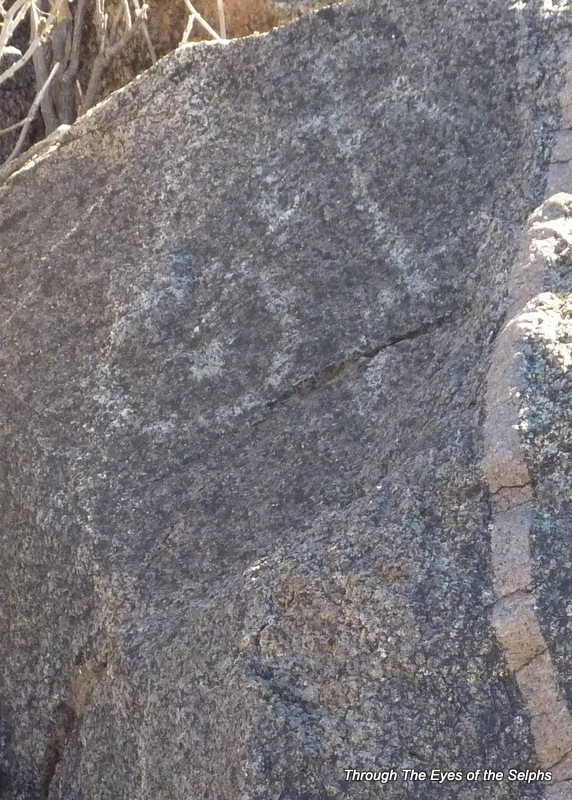
Rock with petroglyphs

Rock with petroglyphs


07-IMG_20140105_133559

and saw a short movie about the history of the area.  The park has full hookup sites but for a third of the cost you can boondock at one of their wilderness areas.  While driving around we stopped and chatted with a couple from Oregon who had come down to the Salton Sea for 2 months and were hosts at one of the wilderness areas on the sea.  With the closest grocery store being 30 miles away, and the only place to get water and dump our fluids being 7 miles each way, we decided this was not a location we would come back to camp.

After leaving the visitors center we drove to nearby Mecca where we did some desert canyon geocaching.  We completed finding 200 geocaches in 2013 and now are starting our goal of another 100 in 2014. We had a great time and saw some truly beautiful areas.  This is a good time to do some desert geocaching because we feel fairly confident that we will not encounter any crawling creatures, though we are always vigilante about where we place our feet and hands no matter where we are geocaching. 12-IMG_20140105_144743 09-IMG_20140105_143458 13-IMG_20140105_144751 14-IMG_20140105_144839 10-IMG_20140105_143623 11-IMG_20140105_144437 15-IMG_20140105_144953 16-IMG_20140105_153610

1-20140105_161251One geocache was hidden inside a plastic duck hidden in this canyon


December 20, 2013 Yuma, Arizona

We love Arizona!  From Tucson to Casa Grande, and now a final stop in Yuma, our stay in Yuma has been wonderful! During the short drive from Casa Grande to Yuma, we continued to enjoy the interesting rock formations and views. 01-IMG_20131220_132032 02-IMG_20131221_000122  Yuma is in an area near the borders of Arizona, California and Mexico. Guinness  Book of World Records describes Yuma as “the sunniest place on earth” with an average of 339 days of sunshine and 3.01 inches of rain a year.  Years ago Yuma was a popular place for gold rushers to cross the Colorado River because of the Yuma Crossing.  Here there are two large granite outcroppings which squeezed the river into a narrow channel, allowing for a safer and easier crossing of the river.  Over the years the Hoover Dam, as well as other dams have altered the flow of the Colorado River and therefore the water supply to the area.  For example the Yuma Territorial Prison was once surrounded by water on three sides but today that area is dry desert.  Other dams such as the Laguna Dam diverts water for crops into the Yuma area.  The Colorado River is one of the most controlled and litigated rivers in the world because it is shared by 7 western states and Mexico.  It serves about 25 million people and 90% of its water has been directed by the time it gets to Yuma, and it disappears as it enters Mexico.  Yuma is home to the world’s largest reverse osmosis desalting plants which was completed in 1992 by the Bureau of Reclamation to ensure that the U.S. could meet their treaty obligations to deliver water to Mexico.  The plant can produce 72.4 million of gallons of desalted water per day.  The plant never has run at full capacity because it is expensive to operate and Mexico has enough water from normal river flow without the plant.  Throughout Yuma, seemingly at every street corner, there are small buildings offering desalted water for sale.

The Yuma Proving Ground, formerly Camp Laguna, trains troops, and tests weapons and systems, as well as bridges on the Colorado River, before battle.  It is located on 1,300 square miles of desert terrain.  Also nearby is a Marine Crops Air Station.  Yuma’s economy is made up of agriculture, the military, and tourism.

Speaking of agriculture, today farming is a $3 billion industry in Yuma.    It is known as the winter lettuce capital of the world.  Chances are very good that if you eat salad anywhere in the U.S. during the winter, it came from Yuma.  This helps make Arizona second in the U.S. in the production of all kinds of lettuce, cauliflower and broccoli.  05-IMG_20131227_144802 At the peak of the season, 2,000,000 pounds of lettuce is processed at EACH of the NINE salad plants DAILY!  Every day we saw busloads of migrant workers out in the fields working and fields of lettuce and other greens was a common sight.  They flood the fields for irrigation and also have irrigation equipment actively watering the fields.  04-IMG_20131229_004101

While in Yuma we celebrated Christmas.  The RV resort where we were staying had a lovely Christmas Eve service which included placing luminaries along all the streets in the resort.  It made for a beautiful Christmas Eve atmosphere. 03-IMG_20131224_182802 On Christmas Day the resort provided a delicious Christmas dinner of prime rib and ham.  We were able to meet and talk with many snowbirds, and we are finding that many of then come down from Canada, Washington state, and Oregon.  We have found people to be friendly here and we were inviting to Happy Hours and enjoyed talking with our neighbors.

The Yuma Territorial Historical Park opened in 1876, with the first prisoners building their own cells.  10-IMG_20140101_200451The prison was open for 33 years and housed 3,069 prisoners, including 29 women.  It was truly a hell hole, especially in the summer months with unbearable heat.  It was surrounded on 3 sides by water and the other side by desert and quicksand.  As mentioned earlier, today there is no longer water there, just dry desert. 09-IMG_20140101_200035
There were few escapes.   14-IMG_20131229_004419One area, called The Dark Cell, was a dark cave-like area where prisoners who didn’t follow the rules were placed for

15-IMG_20131229_004600


different lengths of time, depending on the severity of the misbehavior.  It was such an unpleasant place that few prisoners were repeat

13-IMG_20131228_15171012-IMG_20131229_004327offenders and some were model prisoners after the Dark Cell experience.

11-IMG_20131228_151135 Next door to the museum is a visitors center and museum. Nearby on the grounds was a small cemetery where they buried those who died there. 16-IMG_20131229_004640 Bill and I found visiting the prison a sad and somewhat discomforting experience.  The Yuma Territorial Prison was home to the Yuma High School from 1910 to 1912 after a fire burned down their school.  During a football which Yuma won in the final moments of the game, one of the announcers said it was criminal the way the team stole the game.  At first the townspeople were insulted, but then decided to go with area history and they became known as the Yuma Criminals.  08-IMG_20140101_195702

Close to the Yuma Territorial Prison Historical Park was the Ocean to Ocean Bridge.  This bridge opened in 1915 and was the first and only vehicular traffic bridge over the lower Colorado River for 1,200 miles.  Until then, people had to wait for a ferry to cross the river and it was the final link from the Atlantic to the Pacific.  Later a railroad bridge was added.06-IMG_20140101_195046

We had heard so much about Quartzsite, so we drove the 75 miles to check it out.  It normally has a population of 3,700. but during the months of January to March, the population swells to over one million as the area is inundated with RVers who mostly boondock in the desert on Bureau of Land Management property for no or little cost.  Many vendors come to the area for those months and set up huge tents where you can buy jewelry and gems, antiques, arts and crafts, and anything and everything an RV owner could possibly need or wish for.  We drove around and looked at some of the potential camping areas and checked out some of the vendors.  Since it was late December, the area was still relatively quiet with few RVs and vendors.  Calm before the storm for sure.  We still can’t decide whether the experience in January would be for us.  Before leaving Quartzsite we did stumble upon a historic part of the area while geocaching.  Once again, finding a geocache caused us to find an area we not normally have found.  The Hi Jolly Memorial is a memorial to Ali Hadji.  In 1856 thirty-three camel were brought from Syria with Ali Hadji as their caretaker.  They were brought to the U.S. aboard a federal supply ship as an experiment to be used for transportation in the desert.  The idea was originally that of Jefferson Davis, but he was soon preoccupied by the Civil War and lost interest in the project.  Later an additional 41 camels were brought over with the idea of using them to build a wagon road from Arizona to California.  The camels were found to be difficult to manage and it is said that the sight of them caused horses and cattle to stampede.  Some were sold to circuses and some were left in the desert to fend for themselves.  Because of a communication problem, Ali Hadji became known as Hi Jolly.  He remained in the area near his camels and worked as an army scout and miner.  After 30 years of service to the U.S. government, he died at the age of 64 in Quartzsite.  The Arizona Highway Department constructed the pyramid like  memorial from chucks of ore minerals in the area, with a metal silhouette of a camel on top in his memory.  It is now listed on the National Register of Historic Places.  17-IMG_20140101_200841

We also heard a lot from fellow RVers about the small Mexican town of Los Algodones.  We first started hearing about it when we were in Casa Grande and people continued to talk about it in Yuma.  The town is very dependent on snowbirds and is therefore seen as a safe and friendly place to visit.  We decided to give it a try.  Los Algodones is 7 miles west of Yuma.  It is known for having more doctors, dentists, opticians and pharmacies within a 4 block area than any other similar 4 block area in the world.  It is very common for Americans to go across the border for dental work, to get eyeglasses, 8-IMG_20140101_194532 and their supply of pharmacy drugs at a fourth to a third of the prices they would pay in the U.S. 7-IMG_20140101_194250 Many of the doctors and dentists are trained in the U.S. and give similar care to what you would receive in the U.S.  Next to the border entry is a large casino on an Indian reservation where you can safely park your car for the day for $6.00.  We parked and walked across the border.  We were a little surprised that no one in Mexico was at the border to check us.  It was amazing to see all the stores advertising dental and optical care.  There were many vendors offering you just about anything you could want to buy. 6-IMG_20131230_135527 We had been warned to haggle and never pay full price, and we bought each of us a jacket and Bill a hat and belt for great prices.  Bill wanted some prescription reading glasses so we went to an optical business recommended to us by fellow RVers.  For $29 he received an eye exam and prescription glasses which were ready in 2 hours.  They have single vision, bifocals and progressive lenses available for low prices.  Bill likes his new glasses and sees fine with them.  We had a nice Mexican lunch where a margarita is included in the price of the entree, 1-20131230_131013~2 and the entree price is cheaper than you would pay in the U.S.  later in the day before heading back across the border we decided to have another margarita and relax and enjoy the sights and sounds of the town. 4-IMG_20131230_135754 5-IMG_20131230_211616 3-IMG_20131230_134148 2-IMG_20131230_134134 The two margaritas were the price of what you would pay for one here, and we found margaritas there much stronger than those made in the U.S.  We struck up a conversation with two couples sitting near us.  They were snowbirds here for the winter from Canada.  After great margaritas and conversation, we got in line to re-enter the U.S.  We were told this could take minutes or hours depending on the day and time of day.  We only had about a 15 minute wait and then showed our passports to the custom agent.  She did ask us what was in our packages and why we had visited Mexico, but that was it.

Star Wars Episode IV: A New Hope; Star Wars Episode VI Return of the Jedi; Flight to Phoenix, and Space Balls were all filmed in and around Yuma.

As I mentioned earlier, we have loved our time in Arizona.  It can be a bit dusty from all the tilling and plowing of fields and lack of rain.  It has seemed strange to see dirt, sand and cacti instead of grass and trees.  But we agreed it is someplace we definitely want to come back to again and probably stay longer.

Campground:  Araby Acres RV Resort

December 13, 2013 Casa Grande, Arizona

We reluctantly left our desert campground in Tucson Mountain Park and headed west.  We saw more farmland, mainly corn and cotton as we traveled toward Casa Grande.  We arrived at our new home, an RV resort, far different from our previous desert home.  This resort is now filled with snowbirds, many from Canada who have come down for 6 months.  There are many activities to chose from to keep everyone busy, and we have enjoyed getting to know some of them by attending a church service and playing Mexican Train dominoes two evenings.  We realized that if we ever decide to winter in one place for several months, these kinds of resorts can keep us very busy and active.  Sunday night they had a Christmas parade with a float 1-P1030540 3-P1030547 2-P1030541and

many people 

4-IMG_20131217_173917decorated their golf carts and had them in the parade.  The Christmas spirit was contagious and we decorated our rig too!  

Monday we drove to Casa Grande Ruins, from which the city got its name.  The Casa Grande Ruins National Monument 01-20131216_135535 02-20131216_140131has the remains of a prehistoric Hohokam farming village where the Hohokam people lived from 1300-1400 AD.  The main building called Casa Grande, was four stories high, 60 feet long, contains nearly 3,000 tons of caliche mud, and is the largest known structure of the Ancestral People of the Sonoran Desert.  06-IMG_20131216_145937 05-IMG_20131217_203551 04-20131216_142703 03-20131216_142037 08-IMG_20131217_203823 07-IMG_20131217_203451 09-20131216_143046


model of the Casa Grande

model of the Casa Grande

The Hohokam people are referred to as the “First Masters of the American Desert”.  Shortly after the time of Christ, these people became the first farmers of the American Southwest.  They were influenced by the great Mexican civilizations to the south and using stone age tools and the strength of their backs, they dug hundreds of miles of canals across the desert.  One interesting thing was that the holes in the upper walls aligns with the sun and moon, indicating that the people would study the positions of celestial objects and use that for planting, harvesting and celebrations.   At one time the village was surrounded by a 7 foot wall.  13-IMG_20131216_143025 12-IMG_20131216_142341 11-IMG_20131216_142136Time, weather, and vandalism has harmed the structure and the park service put a roof over the big structure to try to prevent the destruction from weather.  No one knows what happened to the Hohokam people, but among various theories are that floods destroyed the canals they built for water and then a drought forced them to move.

A Jesuit missionary discovered the ruins in 1694 and between then and 1889, visitors vandalized the area. In 1889 Congress took action to protect the ruins and wooden beams and steel rods were put in to reinforce the walls.  In 1892 it was designated as a natural preserve and in 1932 the roof was added to protect the structure from weather.

On one of our days in Casa Grande we drove thirty minutes to Chandler, Arizona to ride on the Paseo bike trail, a wonderful paved trail that runs along a golf course and through neighborhoods.  It was a great day for biking! 1-P1030554 2-P10305563-P1030553

We enjoyed our time in Casa Grande, and like Tucson, think it would be a nice place to return to someday.

4-P1030560


December 12, 2013 Arizona-Sonora Desert Museum

Right down the road from our campsite at Gilbert Ray Campground in Tucson Mountain Park 01-P1030448 02-P1030496was the renowned Arizona-Sonora Desert Museum.  We were told by many people we met along the way that we had to go to this museum.  It is listed as the top attraction in the Tucson area, one of the top 10 museums in the world, and one of the top 10 U.S. Public Gardens.  03-20131212_150204 04-P1030514

We got an early start for what we thought would be a three hour visit.  Six hours later we headed back home.  This is a phenomenal museum, though I think a more exact name would be the Arizona-Sonora Desert Zoo because the content is outdoors and alive.  It showcases the Sonoran Desert which is the lushest desert on earth.  Located in the middle of the desert, it is on 21 acres with 2 miles of walking paths, and has 230 animal species, 1200 types of plants with 56,000 individual species.  It is home to one of the world’s most comprehensive regional mineral collections.  The museum has a zoo, botanical garden,

Agave plant which is used to make tequila

Agave plant which is used to make tequila

and art gallery, a natural history museum, an aquarium, and an aviary. 18-P1030509

Hummingbird

Hummingbird

Hummingbird

Hummingbird

Our favorite part of the museum was the Raptor Free Flight where they released birds in the desert and they were trained to fly to trainers, usually close enough over our heads that we could feel the brush of air from their wings.  One of them came close enough to brush the top of Bill’s hat.  They had a morning and afternoon show, and we were so impressed with the morning show that we made a point to return for the afternoon performance since they were featuring different birds at each show. 24-P1030473 25-P1030476 26-P1030482 27-P1030493 28-P1030495

29-P1030485Owl

30-P1030490 31-P1030527

32-P1030451Harris Hawk


33-P10305363 of 5 Harris Hawks flying as a family during the program

34-P1030538

We loved walking in the desert on a warm day and seeing all the beautiful animals and plants.

07-P1030454Mountain lion


06-P1030452Mountain lion


09-P1030459Mexican wolf….today fewer than 50 Mexican wolves remain in the wild


10-20131212_142611Sleeping javelinas

11-P1030470

17-P1030506Desert Bighorn Sheep


15-P1030501Coati


22-P1030520Today some are found in the wild of Arizona…they are grassland squirrels…we noticed his feet are like fingers


23-P1030519Black-Tailed Prairie Dogs..once lived on approximately 1 million acres in Arizona but were gone by 1930’s

35-P1030513

I would like to copy the mission statement of the museum because I feel this best describes our feelings about our 3 days camping in the desert:  “The mission of the Sonora-Desert Museum is to inspire people to live in harmony with the natural world by fostering love, appreciation, and understanding of the Sonoran Desert.”

This visit ended our stay in the desert and in the Tucson area.  We truly loved Tucson and vowed to return here again someday.

December 10, 2013 Tucson Mountain Park

We arrived at Gilbert Ray Campground in Tucson Mountain Park and immediately fell in love with this campground. 3-P1030373 14-P10304112-P1030371 The campground was not as deserted as we expected, but we still had our pick of campsites.  After choosing one with a beautiful view of the mountains and saguaros, we quickly set up and headed to the nearby Saguaro National Park Visitors Center.  We watched a movie there on the plants and animals of the desert.  We have watched movies at many visitors centers in the past, but this one had an amazing ending.  After enthralling us with the sights and sounds of the 1-P1030364desert, they ended the movie by having the screen raise and the huge drapes open to show a breathtaking view of the desert outside.  it was a very dramatic way to end of movie.  I wish I had the words to express the affect it left on us.  Above all else, it left us with an appreciation for how we as visitors to to the desert, need to respect and care for such an amazing resource entrusted to us.  After the movie and touring the rest of the visitors center we attended a talk on desert life given by one of the park volunteers.  We ended the day by taking the scenic Bajada Loop Drive.  That evening the Space Station was visible overhead and we heard coyotes howling.

Our second day in the desert park we wanted to do some hiking and additional scenic driving.  We hiked the Desert Discovery Trail where we learned more about desert plant and animal life.  We then hiked to the top of Signal Hill to see some petroglyphs which were created by the prehistoric Hohokam people more than a thousand years ago.  I kept telling myself the rattlesnakes had hibernated for the winter!  02-P1030386 04-P1030398
05-P103040006-P1030401 07-P1030403 13-P1030410

09-P1030405

08-P103040410-P1030406

After lunch at a picnic table made by the Civilian Corps men many years ago, we went back to the Visitors Center for a talk about the history and life of the Hohokam people.

We spent the rest of the afternoon grabbing a geocache in the desert and then rode along Picture Rocks Road which included narrow Gates Pass and some amazing scenery. 15-P1030419 3-P1030373 4-P1030376 5-P1030377 6-P1030378 When we arrived home we enjoyed sitting outside watching the sunset and listening to the coyotes.  They were especially vocal tonight!  16-P1030444 17-P1030445

December 6, 2013 Tucson, Arizona

We loved Tucson!  The beautiful mountains in the distance and the tall saguaros were fascinating sights as we pulled into the Mission View RV Resort in Tucson 1-P1030347  which is located on an Indian reservation.  2-P1030350

The weather was a little chillier than we had hoped for, but their was the promise of warmer days to come.

We rode downtown and found some interesting photo opportunities.  3-IMG_20131207_150357

Our last day in Tucson we went to the beautiful Mission San Xavier, a short drive from our campground.  1-P1030352 2-P1030360  Construction of the mission began in 1783 and was completed in 1797.  6-P1030358 4-P1030356 7-P1030359 5-P1030357  At that time Arizona was part of New Spain and became part of Mexico in 1821 following Mexican independence.  The mission became part of the United States in 1854 and became a National Landmark in 1963. It is the oldest intact European structure in Arizona and is still an active church with a K-8 mission school with an enrollment of 135.   3-P1030353

Bill found a county park nearby in the desert –  Tucson Mountain Park which will give us an opportunity to experience camping in the desert, so we decided to leave Mission View and head to the desert.