Author Archives: billNdiane selph

Ridgway, CO July 28, 2019

After a wonderful time in Rico and Telluride we headed north on the San Juan Skyway to Ridgway State Park. Even though we were going north, we were dropping from 9,000 feet to just under 7,000 feet which meant warmer temperatures. We sure were going to miss the cool temperatures!

Ridgway State Park is located in Ridgway (yes, it doesn’t have an e). Ridgway, Colorado has a population of around 1,000 and an elevation of 6,985.  Beginning in 1891 it was a railroad town until part of the rail line was abandoned in 1953 and then completely abandoned due to a reservoir being built. The original location of the dam for the reservoir would have placed Ridgway underwater. A 1975 decision to put the dam further downstream saved the town, earning it the nickname “The Town That Refused to Die”. Ridgway has the only stop light in Ouray County. 

The Grammy Awards trophy is handcrafted by Billings Artworks in Ridgway. The trophies are hand cast in an alloy called grammium and then hand filed, ground and polished before being plated in 24k gold.

Ridgway and the surrounding area was the setting for John Wayne’s “True Grit” and “How the West Was Won”. In fact more than 100 films have been made in southwestern Colorado. 

Actor Dennis Weaver, from Gunsmoke and McCloud fame had a home in Ridgway and died there in 2006. Weaver was committed to preserving the environment and commissioned an architect to design and build his home from recycled materials such as old automobile tires and discarded cans. The Dennis Weaver Memorial Park in Ridgway is a sixty acre wildlife preserve with several walking trails. 

Ridgway State Park has three campgrounds and our campsite was located in the Pa-Co-Chu-Puk section with full hookups. 

We stopped by the park’s Visitors Center where they had a large display of animals native to the area. IMG_20190727_140437IMG_4836

The highlight of our stay here was the drive we took on the US Highway 550, also called “The Million Dollar Highway”.  I thought it was called this because of the million dollar views but research says the reason is disputed. Some say it is because it took a million dollars to build it in the late 1880’s, while others say it is because the fill dirt contains a million dollars in gold ore. Another idea is that people say you couldn’t pay them a million dollars to drive it during bad winter weather. Regardless of the reason, it is known as one of the most scenic drives in America but is also known as one of the 25 most dangerous roads in America. IMG_4729

US Highway 550 runs from New Mexico and ends/starts at Montrose  Colorado but the most scenic, and dangerous part runs 25 miles between Ouray and Silverton that goes over Red Mountain Pass, elevation 11,018. And that is the part we drove!

The road is cut into the side of a mountain with steep drop offs, narrow lanes, hair pin curves and no guardrails. It takes 100% of the driver’s concentration while passengers hold their breath as they look over the side. Along with 8% grades there are 153 curves! IMG_4742IMG_4778IMG_4755IMG_4811

We first passed through Ouray, known as the “Switzerland of America” and the “Outdoor Recreation Capital of Colorado”. It is a picturesque mountain town at the base of the San Juan Mountains with one main street and no traffic lights. IMG_4715IMG_4707IMG_4710IMG_4717

We stopped by Cascade Falls Park with a lovely waterfall. IMG_4833

Red Mountain Pass at 11,018 feet is one of Colorado’s highest paved passes. IMG_4777

We saw avalanche signs and could see damage to trees that happened during an avalanche. IMG_4766IMG_4765

Along the way we saw waterfalls such as Bear Creek Falls, tunnels and evidence of once active mining in the area. IMG_4730IMG_4720IMG_4827IMG_4762IMG_4764

This area was used by gold and silver miners in the 1870’s.  It produced four million ounces of gold, 21 million ounces of silver and twelve million tons of lead, zinc and copper. It helped fuel the industrial revolution and supplied raw materials to support America’s involvement in two World Wars. 20190728_122602IMG_4822IMG_4770IMG_4824

Our turn around point was Silverton, a former silver mining camp. With a population of 630, its main source of income today is tourism, like Ouray. IMG_4781IMG_20190728_13484520190728_125802IMG_4785IMG_4786

We drove a dirt road that took us to a nice spot overlooking the town and the Christ of the Mines Shrine. 20190728_115943IMG_4791

After lunch at a little barbecue restaurant we headed back home. The road wasn’t quite as scary going the other direction, but we still had the hairpin turns and the occasional steep drop offs. It was the lack of guardrails that made it very unsettling.

Another day we drove a short distance from our campsite to the Dallas Divide Summit, elevation 8,970 ft, to take pictures of the mountains. So beautiful! IMG_4843IMG_4846IMG_4847

One evening we had visitors stop by our campsite. IMG_4854

Next stop: Black Canyon of the Gunnison National Park

Rico & Telluride, CO July 26, 2019

Leaving McPhee Reservoir Recreation Area, we drove an hour on the San Juan Skyway, called “Road to the Sky” to our next destination. Along the way we had beautiful views of the towering 14,000 foot San Juan Mountains and green rolling hillsides. 

We arrived at our campground, Cayton Campground in the San Juan National Forest for a six night stay. We had a very nice electric site along the Dolores River. At night we were lulled to sleep by the sound of softly flowing water. IMG_20190725_153505

The only drawback to this campground was we had absolutely no cell phone service which meant no internet. We were able to get satellite TV so we had news and weather. At an elevation of 9,400 feet, the daytime highs were in the low 70’s and nighttime lows in the mid 40’s.  A wonderful respite from the hot weather we had recently experienced. Each afternoon we had a brief thunderstorm or rain shower. IMG_20190725_153045

Our campsite had 50 AMP power and even though it worked, the 50 AMP power connector was cracked and potentially unsafe. The camp host brought a new one by and Bill offered to replace it. 20190723_123955

Six miles south of our campground was the tiny town of Rico. Twice we drove into town to use the internet access at the public library. Thank heavens for these friendly public libraries that are a big help to travelers like us. IMG_20190725_124100-EFFECTS

Rico was settled in 1879 as a silver mining town. At its peak Rico had a population of nearly 5,000. It had two dozen saloons and a thriving red light district. IMG_20190725_150448IMG_20190725_150425No longer a mining town, today it has a population of 266 and is made up of a main street with an inn, gas station, post office and town hall. 20190725_12072720190725_120802The public library is open four hours a day Monday through Saturday and is located in two rooms of the town hall building. I talked a bit with the librarian who said the public school in Rico closed last year due to declining enrollment. Today the parents have to take their children either 35 minutes north to the town of Telluride or an hour south to Dolores. Parents are responsible for getting their children to and from school. She said most parents work in Telluride and therefore their children go to school there. Quite different from most towns and cities in the United States where children just walk a block or less to catch the local school bus. The librarian said she wonders if the Rico library would ever close and expressed sadness that she no longer has children come by after school. She said the library summer reading program ended a couple years ago. Now she averages six or seven people who visit the library each day, less than fifty a week. The two times we visited we only saw two locals come in to use the library internet. I never saw anyone return a book or check one out. Very sad. We did note that after many many years of significant declining population, the population did rise by 65 people between 2000 and 2010. Maybe there is hope for this sweet little town. 

We visited the Rico post office while we were there and noticed it is also open only four hours a day but it had a steadier stream of traffic. 20190725_120743

On Friday we drove our car north to Telluride for the day. IMG_4611IMG_4622IMG_4625Also once a mining town, what a difference from Rico. With a population of 2,400, Telluride is a busy, active resort community similar to Vail. In the winter it is crowded with skiers staying in the many condominiums, resorts and hotels. In the summer people visit to enjoy the cool weather and gorgeous views. It is nicknamed the “Festival of the Rockies” because of the vast array of cultural events each summer. The name Telluride came from gold telluride minerals found in parts of Colorado. Strangely, telluride minerals were never found in Telluride but zinc, lead, copper, silver and other gold ores were mined there. IMG_4687

One of the best things about Telluride was the FREE gondola rides. We have been on several gondola rides in our travels and they are usually pretty pricey. This is the first free gondola ride we have ever seen and according to Telluride it is the first and only free gondola public transportation in the United States. It was begun in 1996 to address air quality concerns by keeping cars off the eight mile route between Mountain Village and Telluride. Since 1996 it has transported over forty million people. 20190726_142021

We read it is best to park at the free parking garage at Station Village and ride a gondola down to Telluride because street parking is very limited in Telluride. We parked the car at Station Village, elevation 9,545 and rode a gondola to Mountain Village Resort, elevation 9,540. IMG_4664IMG_4632We got off there and got another gondola which took us to Station St Sophia, elevation 10,535 and then continued down to Telluride, elevation 8,750. The whole trip took about thirty minutes. All the gondola workers were extremely friendly and helpful. The tricky thing about gondolas is they never completely come to a stop so you have to quickly jump on and off. Pets, bikes and skis are all allowed on the gondolas. It was interesting to see how the bikes are attached to the outside of the gondolas. 20190726_155906The Big Mountain Enduro bike event was going on during our visit. Bikers ride the gondola up the mountain and they ride bike trails to the bottom. IMG_4636IMG_4639

As we descended to Telluride we could see the town In the distance IMG_464820190726_15273220190726_153028IMG_4649as well as beautiful Bridal Veil Falls, at 365 feet the tallest waterfall in Colorado. IMG_4667IMG_4669

Every Friday they have a Farmers Market with fresh fruits and vegetables, baked goods and beautiful flowers. 20190726_14453020190726_144920We found a geocache at the Galloping Goose, a unique hybrid vehicle that was a truck and train combination.  It was powered by a truck engine that rode on train tracks beginning around 1930. It ran on gasoline and carried both passengers and freight until 1951. We noticed the hybrid buses around town today are nicknamed Galloping Goose.  IMG_4665We really enjoyed walking around Telluride! IMG_467220190726_144419

We caught the gondola back from Telluride to Station St Sophia and got off and walked around the area. In the summer this is a popular area for bike riders to ride up and down the steep slopes. IMG_4676IMG_4679IMG_4686We went in the Nature Center where they had the biggest container of sunscreen I have ever seen. It was freely available to everyone. At 10,535 feet, you burn quickly. By this time our ears were stopped up and I was starting to feel some altitude sickness. I was lightheaded, slightly nauseous and my skin was clammy. We still had to ride two more gondolas to get back to the parking garage. I was dragging by the time we got back to the car. But after drinking an entire bottle of cold water from the cooler, I was feeling much better. We drove into Telluride and had a nice dinner. I think just the act of chewing food helped our ears recover. We both agreed this was the most fun we have had in awhile! 

The mountain views and alpine meadows were beautiful. IMG_4696IMG_4697IMG_4703

IMG_4699

Lizard Head Peak

Next up: Ridgway, CO

Canyons of the Ancients NM, CO July 20, 2019

During our time at McPhee Reservoir Recreation Area, along with visiting Mesa Verde National Park, we also visited other nearby Pueblo dwellings. Down the road from our campground was the Canyons of the Ancients National Monument Visitors Center. We stopped there and watched a movie and picked up a map of Pueblo dwellings within driving distance. IMG_20190716_141257IMG_20190716_14021820190720_122133

The next morning we set out for a day of exploring along part of the 116 mile road named Trail of the Ancients, the only National Scenic Byway in America dedicated solely to archaeology. The first place we visited was Lowry Pueblo, an ancient pueblo site with forty rooms and eight circular kivas. IMG_4540IMG_4541IMG_4551IMG_4555IMG_4557

A roof has been placed over the main dwelling to preserve it. We were able to walk inside for a close up view. IMG_4543IMG_4544IMG_4548IMG_4549

Next we drove to Hovenweep National Monument which lies in both Colorado and Utah.  Hovenweep is a Ute Indian word meaning “deserted valley” which adequately describes the area. There are many multi room dwellings, small cliff dwellings and towers scattered over the canyon slopes. These were constructed by Ancestral Puebloans more than 700 years ago, around the same time as Mesa Verde. Like at Mesa Verde, extended droughts forced the people to abandon the area around 1300 A.D. IMG_455920190720_115011IMG_4562IMG_456020190720_130335

We first stopped at the Visitors Center and watched a movie before taking the Little Ruin Trail to see some of the dwellings and towers. They believe the towers could have been used as storage silos for crops, defensive forts or for ceremonies. IMG_4575IMG_4573IMG_4572IMG_4582IMG_4584IMG_4591IMG_4589IMG_4590IMG_4595IMG_4597IMG_4598

When we returned from our hike we saw a very interesting talk on coyotes by a Ranger. 20190720_122255

We certainly enjoyed our time in southwestern Colorado. IMG_4602IMG_4603IMG_4605IMG_4610

Next up: Rico, CO and cooler temperatures at last

Colorado Tidbits:

  • There are 58 peaks in Colorado 14,000 feet above sea level, more than any other state.
  • Colorado’s nickname is the Centennial State because Colorado was admitted into the union in 1876, the centennial anniversary of the United States.

Mesa Verde NP, CO July 16, 2019

We left Monument Valley and headed to Colorado and hopefully cooler temperatures. It was a beautiful drive with more rock formations and occasional farmland with horses and cattle. We were surprised to see some working oil pumps. 20190714_12572320190714_130203

Our destination was the McPhee Reservoir Recreation Area in the San Juan National Forest for a seven night stay. We had a lovely, private campsite with electric only located at an elevation of 7,200 feet. In the distance we saw snow capped mountains. IMG_20190715_155701

Near our campsite is an overlook of the reservoir.  Where you see water now is where at one time the lumber company town of McPhee stood. In the late 1920’s McPhee was Colorado’s largest lumber mill town with a population of 1,400 and produced over half of the state’s lumber output. In 1948 after a second major fire in a decade destroyed the sawmill, it was not rebuilt. Today the former lumber town is submerged by reservoir waters. 20190719_201653

One day we drove over to Mesa Verde National Park. As we were leaving our campground early in the morning we saw a very large herd of cattle being led down the road to another pasture. It was hard to get a good picture of the large herd because we were facing into the sun. IMG_20190716_070819

We were last at Mesa Verde National Park in 2015 (see link: Mesa Verde National Park, CO).  The 52,000 acre park is one of the country’s major archeological preserves with almost 5,000 archeological sites including 600 cliff dwellings. Mesa Verde, Spanish for “green table”, was the home of Ancestral Pueblo people for more than 750 years. IMG_20150517_110223 IMG_4506

They lived in the area from around 500 A.D. to 1276 A.D. It was approximately around 1200 when they began to build the cliff dwellings that Mesa Verde is best known for today. When a drought struck that lasted for twenty-four years, it eventually forced the people to leave the area and migrate to New Mexico and Arizona in search of water and better living conditions. IMG_4509

Last time we were here we drove the loop road where some of the larger cliff dwellings are viewed from a distance. In order to see the cliff dwellings up close you have to go on a park ranger led tour for the very reasonable fee of $5.00. IMG_20190716_095017IMG_20190716_095042IMG_20190716_100143IMG_20190716_094632IMG_4516

This time Bill decided he wanted to take the hour long tour of the largest cliff dwelling in the United States, Cliff Palace. He had a reservation for 9:30 A.M. in order to avoid the hottest part of the day. Even though we were now in southwestern Colorado we were still having afternoon temperatures in the upper 80’s. The tour was labeled as strenuous with steep, uneven stone stairs both going and coming and you had to climb four steep ten foot wooden ladders to access the cliff dwelling. I decided not to go and waited in a shady seating area while he was gone. It was the idea of the four steep ten foot wooden ladders that got to me. IMG_20190716_094517IMG_20190716_103253IMG_20190716_103247

Bill had a great time but he did say the walk out was pretty strenuous. He said the ranger did a nice job describing what everyday life was like at the Cliff Palace over 800 years ago. Cliff Palace consisted of about 150 rooms made of sandstone and mortar made of sand, clay and ash. Water had to be hauled in to make the mortar. It is almost inconceivable to imagine how they accomplished this herculean effort in twenty years. In addition to the 150 rooms they had 75 open spaces and 21 kivas, below ground circular rooms used for ceremonies and gatherings. IMG_20190716_101341IMG_20190716_101239

IMG_20190716_101231

Kiva – Round Room Without Roof

IMG_20190716_102739

Picture Taken From Window Of Three Story Tower – Shows Floor Logs


IMG_20190716_102758

After Bill’s tour we stopped at the archeological museum to see a movie about the park and view exhibits and artifacts on the Ancestral Puebloans. IMG_4524
We stopped by the Far View Sites where homes were built on the top of mesas.

IMG_4521

Far View House

IMG_4528

Far View House Walls

IMG_4523

Kiva at Far View House

IMG_4527

Unique Stone In Outer Wall Of Pipe Shrine House

After a late lunch it was starting to get quite hot and we were very glad we had gotten an early start.

Mesa Verde National Park is an amazing place!

Next up: more exploring in southwestern Colorado

Monument Valley, UT July 13, 2019

We left Prescott, AZ and headed toward Monument Valley. After an overnight stop in Flagstaff we left Arizona and entered Utah. Even before we reached Monument Valley we began to see the majestic rock formations. 20190712_145822

The campground for our two night stay was a pricey, dusty campground with no shade. The choice of campgrounds is very limited in the area so they can all charge high prices for very basic services. At least it was a full hookup campground and when we saw the beautiful view of the formations from our site, it definitely took away some of the pain from the high cost. 20190712_183708

The last time we were here was in the fall of 2015 and we just drove up for the day.

IMG_20190713_102646

Looks Like A Indian Head With Feathers?

IMG_20190713_103017

Looks Like A Rabbit On The Right?

IMG_20190713_110250

Looks Like A Chicken On A Nest?

IMG_20190713_102651

Monument Valley is located on Navajo land and is part of the Navajo Tribal Park which was established in 1958 to preserve the environment.  Monument Valley sits at 5,564 feet above sea level and its 91,696 acres is located in both Arizona and Utah. The monuments or rock formations are natural structures created by erosion and range from 100 to 1,500 feet tall.  There was a $20 fee per car to enter the park and make the seventeen mile loop drive. The road is made of soft sand and dirt with deep ruts making it almost necessary to have a four wheel drive vehicle.

IMG_20190713_113256

Elephant Butte – Trunk On The Left

20190713_130141

Rain God Mesa – This Is Where Water Flowed Occasionally

20190713_130337

We Saw Horses In Many Areas

20190713_132142

Spearhead

IMG_20190713_122529

Merrick Mesa

IMG_20190713_123641

Camel Butte

20190713_115556(0)

East Mitten Butte, West Mitten Butte and Merrick Butte

IMG_20190713_130600

Totem Pole

IMG_20190713_131342

Balance Rock

IMG_20190713_133000

Thumb

IMG_20190713_133907

Battleship?

IMG_20190713_134653-EFFECTS

West Mitten Butte

It was fun as we drove around to see the names of the various formations, some reasons for the names more obvious than others. More popular formations are the mittens and the three sisters. The three sisters are supposed to be three nuns, with one nun being the teacher talking to her two pupils. IMG_20190713_124146-EFFECTSIMG_20190713_12445720190713_124651IMG_20190713_124238

We stopped by a couple visitors centers. One center had a nice display on the western movies directed by John Ford, many starring John Wayne. IMG_20190713_111522IMG_20190713_111508IMG_20190713_111847IMG_20190713_111719

The other center had an excellent display featuring the Navajo Code Talkers of World War II. The Navajo Code Talkers provided accurate, fast, sophisticated and secure means of communication during WWII. There were nearly 400 Navajo Code Talkers spanning six Marine divisions. They spoke in a code derived from their native language which baffled the Japanese and greatly helped win WWII in the Pacific.

Another popular place is located on the road leading away from Monument Valley. It is the setting of a scene from the movie “Forrest Gump” when Forrest was running through Monument Valley. There were many people who had stopped their cars on the side of the road so they could stand in the middle of the road and reenact the scene from the movie. Some stood in the road with cars and trucks approaching waiting until the last minute to get out of the way! I was glad Bill wisely chose to stand on the side of the road! 20190713_104541IMG_20190713_104304IMG_20190713_110319

20190714_113212

Mexican Hat

It was very hot in Monument Valley and we are headed next to Colorado and hopefully cooler temperatures! 20190714_12451220190714_115726  

IMG_20190713_204302

Sunset From Our Campsite


Prescott, AZ JUN 30, 2019

We spent the month of June in Prescott, AZ, elevation 5,300.  After the cool, rainy May in Show Low, Prescott was hot and dry.  South of Prescott is Phoenix, Yuma and Tucson all were really hot 100+ degrees!

Prescott claims to have the oldest and longest running rodeo dating back to July 4,1888 and was the first to charge admission. In 1964 Barry Goldwater launched his presidential campaign from the Prescott courthouse steps. IMG_20190705_144834

The nearby Granite Dells is known for large boulder outcroppings of granite and our campground was located near this area. While the campground was geographically unique in appearance, it was hot and very very dusty. IMG_20190627_154804IMG_20190627_155544IMG_20190629_145623-EFFECTSIMG_20190629_145659IMG_20190629_145556IMG_20190629_145411IMG_20190627_154901

Our time in Prescott was relaxed and low key. It was too hot to hike or even geocache. Bill enjoyed meeting Amateur Radio members in the Prescott area and became good friends with one member who helped Bill improve the radio antenna he uses on our RV. While we were in Prescott the annual radio event known as “Field Day” occurred and Bill and I attended two local events including a great barbecue. We had such a good time we forgot to take pictures!

Next up: Our summer travels pick up speed with a visit to Monument Valley, Utah


Show Low, AZ May 15, 2019

Beginning May 1st we spent six weeks in Show Low, AZ in the White Mountains of northeast Arizona. At an elevation of 6,400 feet we thought it would be a pleasantly cool place to spend some time in the spring without the need for air conditioning. After arriving we discovered the month of May in the White Mountains is known to be very windy. At the same time, we heard on the local weather that all of Arizona was experiencing 20+ temperatures BELOW normal. We didn’t need air conditioning but we sure needed the heat on. During our six weeks there we had winds almost every day of 25-30 mph with occasional gusts of 45+.  We had nighttime temps in the 30’s, more rainy days than we thought possible in Arizona and to our amazement we had snow on the 20th of May! IMG_20190520_145345

May 1st, the day we arrived was our eighth wedding anniversary and we celebrated with dinner at a steakhouse in Show Low. It was a very nice meal but I was really feeling under the weather. Five days later Bill insisted I go to the Urgent Care in Show Low where I was diagnosed with acute bronchitis. They gave me a breathing treatment and sent me home with lots of prescriptions. I don’t know if the elevation along with the cold rainy weather complicated things, but I was really down for the count and it took me most of May to recover.

Bill kept himself busy doing maintenance inside the RV such as cleaning vents, replacing the water and ice maker filters and flushing the hot water heater. He attended a few Show Low amateur radio events and enjoyed their nightly radio net call-ins.

As May turned to June it was like a switch was turned off and the winds died down. The weather warmed up and I was finally feeling better. With only a week left in Show Low, we wanted to spend some time exploring the area and doing some geocaching. IMG_20190607_144448

Show Low is an unusual name for a town. You may be wondering where the name came from and so were we! The answer came in a tiny little city park where we found statues of two men sitting at a table. In 1876 two ranchers by the last names of Cooley and Clark claimed and became partners in managing 100,000 acres of land in this area. As it became evident that the land could not support two families, neither man was willing to buy the other out. To settle the matter, the two men agreed to play a friendly card game of Seven Up at the kitchen table in Colley’s house across from where this small park stands today.  As the game neared completion, Cooley needed just one point to win. Clark held a three card and feeling he had nothing to lose said, “show low and you win the ranch”. Cooley drew the deuce of clubs and won the game. He renamed the ranch “Show Low” and today the main street through town is called Deuce of Clubs. 20190607_150205

Another day we walked the Mongollon Rim Trail, a nice easy paved trail with lovely views. The Mongollon (pronounced Muggy-Own) Rim is a topographical and  geological feature that cuts across Arizona and forms the southern limit of the Colorado Plateau. It extends 200 miles eastward and ends near the New Mexico border. While it can’t begin to be compared to the views at the Grand Canyon, it does have some nice far reaching views of the Plateau Country and Desert Canyon of Arizona with drops of up to 2,000 feet in places. After so much time inside it was nice to be outside and get some fresh air and exercise! IMG_20190607_161227

Show Low is a really nice town with small town friendliness while having the convenience of many stores and restaurants, including a Walmart Supercenter. We would not mind returning again, though we would wait until after the May windy season!

Currently we are in Prescott, AZ until mid July.

Grand Canyon NP South Rim Part 2 APR 25, 2019

Grand Canyon National Park has a great free shuttle bus service. Since private vehicles are not allowed in the Hermit’s Rest western area of the Park between March 1 and November 30th, it is the only way to get around and see the area. The buses arrive at each the many stops throughout the Park every 10 to 15 minutes and the bus drivers are friendly and helpful. The first eight seats are reserved for seniors or the disabled and the drivers are pretty aggressive about keeping those seats available for those who need it. The buses are well utilized and stay very crowded and a few times we had to stand which wasn’t a big deal to us. As I mentioned in the last post, the Park was very busy the week after Easter. Most of the people we heard talking on the buses or trails were non-English speaking tourists.

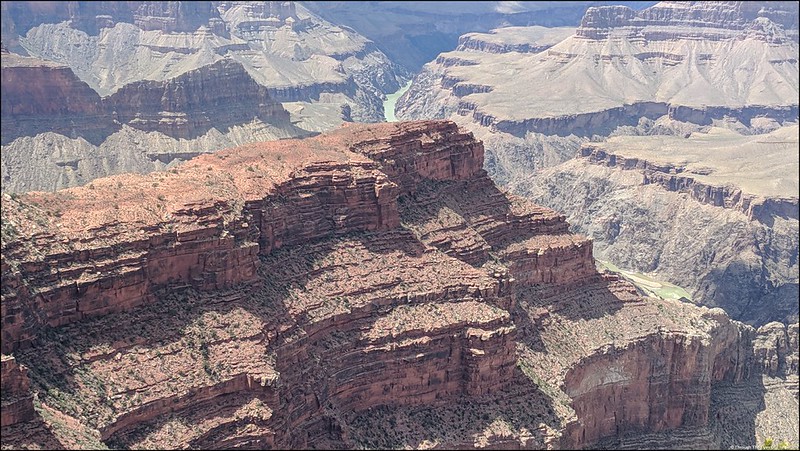
One day we walked part of the thirteen mile paved path along the Canyon rim. In the distance we could see snow on the mountains (San Francisco Peaks) near Flagstaff.  IMG_20190424_134720We had a view of all the buildings that make up the Grand Canyon Village which includes the Visitors Center, lodges, restaurants, a grocery store and a train depot. IMG_20190424_135047PANO_20190424_135414.vrAs we walked along the rim we could see all the trails that lead down into the canyon. We could see people like tiny ants walking on the trails. As you look at the pictures look for all the trails. IMG_20190424_135618Also look for glimpses of the Colorado River. In how many pictures can you spot a piece of the river at the bottom? IMG_20190424_13155220190424_13250220190424_13274420190424_132900IMG_20190424_13503220190424_141703

After walking on the trail and enjoying the views we hopped on a bus and rode to Hermit’s Rest, the westernmost point and end of the bus line. Hermit’s Rest was built in 1914 and is another Canyon structure designed by architect Mary Jane Colter. It was built as a rest stop for tourists who came by train to visit the area years ago. img_20150505_152001a

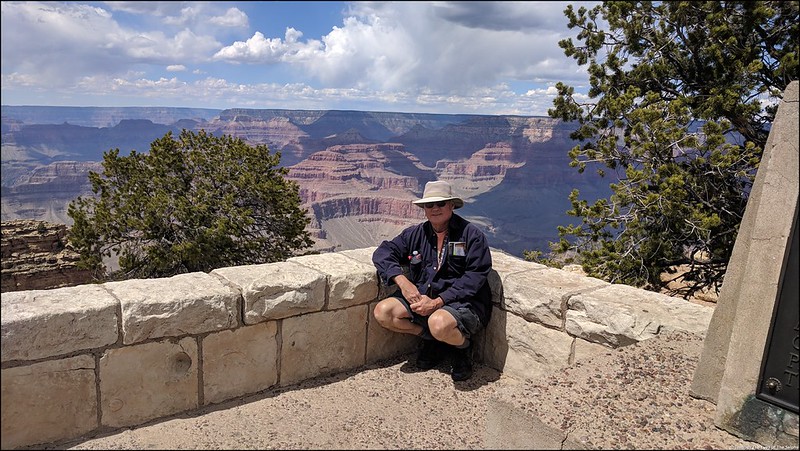
Another day we took the bus to several popular viewpoints. It was easy to hop on and off the buses since we knew another one would be along in 10 to 15 minutes. IMG_20190426_140555IMG_20190426_14355420190426_14445200006IMG_00006_BURST20190426134308One stop was Powell Point where there is a large granite memorial to Major John Wesley Powell. In 1869 Powell led one of the first documented explorations down the Colorado River through the Grand Canyon. He led another exploration in 1872. 20190426_133916IMG_20190426_134050IMG_20190426_134020

We also stopped at Hopi Point, Mohave Point and Pima Point, all with amazing views. Do you see the trails and Colorado River in the pictures? IMG_20190426_135833IMG_20190426_144010IMG_20190426_135933IMG_20190426_135925IMG_20190426_143957

We loved our five days in Grand Canyon National Park and can’t wait to go back. IMG_20190424_135142

Next up: We are currently in Show Low in the White Mountains of northeastern Arizona for the month of May.

Grand Canyon NP South Rim, part 1, APR 24, 2019

The week after Easter we visited the South Rim of Grand Canyon National Park for five days. 20190422_125006We didn’t realize it when we made the reservation, but the week before and the week after Easter are very busy in the park. We knew that to be true by the long line of cars waiting at the entrance gate to enter the park. We last visited Grand Canyon in 2015 and this time we stayed at the same campground inside the park. I was delighted to see elk roaming free throughout the campground, just like last time. 20190422_170133IMG_20190422_172348These Rocky Mountain elk were brought to the park from 1913-1928 from Yellowstone National Park. They appear to be tame and unafraid of people or cars. Regardless of how tame they are, we obeyed the rules and kept our distance and didn’t feed them. 20190422_174618

We couldn’t wait to get to popular Mather Point for our first view of the Canyon. One of the Seven Wonders of the World, there are no words to adequately describe the Grand Canyon. Amazing, vast, awe inspiring, beautiful are words that do not do it justice. It is hard to comprehend that the Colorado River carved this magnificent canyon. IMG_20190425_145521The canyon is 277 miles long, four to 18 miles in width and one mile deep. IMG_20190423_143350IMG_20190423_14352620190423_143536IMG_20190423_144807

The Colorado River flows below at an average speed of four miles per hour. The river averages 300 feet wide and 100 feet deep. It flows through the Canyon and eventually empties into the Gulf of California in Mexico. From the rim of the Canyon the Colorado River is small and hard to see. However there are whitewater areas that make rafting on the river challenging and dangerous. The depth of the Canyon erodes about the width of a sheet of paper each year, so the Canyon is continually changing. IMG_20190425_132216

The Grand Canyon became a national park in 1919 so this is the 100th anniversary of the 1.2 million acre park. 20190423_152136Recently there have been three deaths in the park due to people falling to their death. The day after we arrived we heard a 70 year old woman fell to her death. Some people ask why the park rangers can’t do more to prevent this from happening. The park is huge and with over six million visitors a year, there is no way the park service can prevent accidents from happening. There are warnings everywhere about not getting close to the edge. The Grand Canyon can be a dangerous place and people have to accept responsibility for their actions. In the five days we were there we observed people doing crazy, dangerous things. And in all cases it was because of picture taking. A few times I had to walk away for fear of seeing a tragedy I wouldn’t be able to forget. No picture is worth risking your life. IMG_20190423_145040

Most of the areas of the park can be reached by their free shuttle buses. But Desert View Watchtower has to be driven to by car. So one day we made the 25 mile trip to the eastern most developed section of the park to see the tower and the beautiful views of the Canyon. The four story 70 foot stone tower was built in 1932 and designed by architect Mary Elizabeth Jane Colter. 20190425_120815IMG_20190425_121119-EFFECTSIMG_20190425_121654IMG_20190425_121627-PANO

We climbed to one of the lookout points in the tower and then had a picnic lunch. 20190425_12331420190425_124825

We really enjoyed the drive there and back because there are scenic viewpoints along the way. As we started home, heavy clouds began to form which can dramatically change the lighting and appearance of the Canyon. No two days there are the same. IMG_20190425_131343-EFFECTSIMG_20190425_132228IMG_20190425_140634

Next up: part two of our visit to Grand Canyon National Park

Las Vegas, NV APR 18, 2019 REVISED

Our next stop was Las Vegas. Bill and I are not the typical Vegas tourists. We are not gamblers or big drinkers. We did not even find a show we were interested in seeing this time. When we were last here in 2015 we went to a Rod Stewart show.

This visit was more about family. Bill has a cousin (his Dad’s Mother’s side) who lives in Las Vegas and we spent a lot of time with Marion and her husband Bob. 20190419_12061120190419_130421
We also were able to visit the homes of their sons, Mark and Troy, and their wives and children. Bill and Marion are really into genealogy so they had a great time comparing notes, looking at pictures and filling in the blanks.
IMG_20190419_115329IMG_20190419_115357-EFFECTS

One day Marion and Bob drove us to Mt Charleston, elevation 7,510, where we had lunch and enjoyed the views. This was a place we probably never would have thought to visit on our own and it was just the kind of place we love. It is a great year round destination with camping and hiking during the warm months and skiing in the winter.  Marion and Bob have many fond memories of coming here with their family, and their sons and grandchildren still enjoy visiting Mt Charleston, especially during the winter to ski. IMG_20190419_134337

IMG_20190419_135235

Looking North Into the Nevada Atomic Testing Area


One evening Bill and I drove to the Las Vegas Strip to see the outdoor Bellagio fountain show. It is always beautiful and Bill was able to capture some pictures and video. Since there are shows on the hour and half hour we were able to see two shows and we were pleased to see each show was different with different music.

click to see video https://www.youtube.com/watch?v=lwoNl-A9oLY

click to see video https://www.youtube.com/watch?v=f-jcslxBJeM

IMG_20190418_203703-EFFECTSIMG_20190418_204334IMG_20190418_20473700009IMG_00009_BURST20190418204656IMG_20190418_204738

click to see video https://www.youtube.com/watch?v=_erzZKhy3e8

We walked around for awhile but it was wall to wall people, making it hard to walk down the street. It felt uncomfortably warm and claustrophobic with so many people. When we were here in 2015 we toured Fremont Street and didn’t feel the need to do that again. IMG_20190418_20294020190418_203609IMG_20190418_203546IMG_20190418_204319

We did see the construction of the new domed Las Vegas Stadium for the Oakland Raiders NFL team which is moving to Las Vegas and will be called the Las Vegas Raiders. It is estimated the new stadium will be ready for the 2020 season. 20190412_13114620190412_13115320190412_130846IMG_20190418_21032320190418_202037

Next up : The Grand Canyon!