July 1, 2016 Cape Cod, Mass. Part 1

20160707_153640We left Sturbridge, Massachusetts and headed to our campground at Sandwich, Massachusetts on Cape Cod.  We knew it was the Friday of a long holiday weekend so we left Sturbridge early to beat the traffic.  All was good until we were about two miles from the Sagamore Bridge from the mainland onto the Cape.  It took us an hour in stop and go traffic to get across the bridge.  We were glad to arrive at our campground in Sandwich and get set up.
20160707_120526Sandwich was incorpo-rated in 1638 and is the oldest town on Cape Cod. While in Sandwich we visited the Cape Cod Canal Visitors Center.  The canal is an artificial waterway connecting Cape Cod Bay to Buzzards Bay and is part of the Atlantic Intra-coastal Waterway.  The seven mile long canal moves along the narrow neck of land joining Cape Cod to the mainland.  It is approximately 480 feet wide and 32 feet deep, cutting off 65-166 miles of coastal travel around the tip of the Cape.  Another benefit of the canal was no longer having to sail around the treacherous outer shores of Cape Cod.  At the height of the commercial shipping era from 1880 to 1900 there was nearly one shipwreck every week.   Approximately 14,000 people use the canal yearly.
It was interesting to learn that in1623, Miles Standish of the Plymouth Colony scouted the land for a potential canal route but the idea was too much for the settlers to consider.  Then in 1697 the General Court of Massachusetts considered the first formal proposal to build a canal but no action was taken.  More energetic planning with surveys took place in 1776 with George Washington but none of these actions was completed.
Commercial construction began in 1909, it was first open to vessel traffic in 1914, and has been operated by the Army Corps of Engineers since 1928.  It is designed to be a sea level waterway and is operated 24 hours a day, toll free.  There are no locks even though it connects two bays with very different tidal cycles and ranges.  Two highway bridges and one railway bridge cross the canal from the mainland to the Cape.  During World War I 20160707_120448the canal was used to move shipments when German sub-marines were off the coast of Cape Cod. We enjoyed touring the Visitors Center with their friendly volunteer, movie about the building of the Canal, and numerous exhibits. As a side note, Bill met and talked with some people later in the day who grew up and live on the Cape and they think the canal is too expensive to maintain and keep running and it should be filled in.

20160703_16083120160703_14114420160703_141039On our trip to Europe a couple months ago we met Bob and Sue, a couple who live near Cape Cod.  When they learned we would be visiting their area this summer, they invited us to stop by and visit.  On Sunday we were invited to a cookout at their home.  We had a great time meeting Sue’s mom and step-father, some of their friends and neighbors and of course their adorable bulldog Stella.  Thanks Bob and Sue!!

Another day we drove 34 miles along beautiful, scenic Route 6A (Old King’s Highway), passing through quaint towns and villages. Centuries ago the Route was a Native American Trail and then as Colonial settlements grew, this route became an extension of the Plymouth Colony and later a major route for Cape Cod. Route 6A ranks among the top scenic byways in the country. One thing that struck us was how patriotic all of Cape Cod looked for the Fourth of July holiday with so many homes and businesses displaying red, white and blue buntings and flags. Back in the days of the early settlers the wealthy merchants and sea captains did not covet waterfront property like people do today, so most of the older homes are along this highway rather than the shoreline. Needless to say the area has strict town codes and many efforts have been made to preserve these old homes. It is the newer homes you see along the waterfront.
20160705_13212320160705_12350620160705_12194320160705_12192020160705_13004720160705_13205220160705_14331820160705_143326Cape Cod is divided into fifteen towns, and within those towns are villages. For example Hyannis is a village in the town of Barnstable.
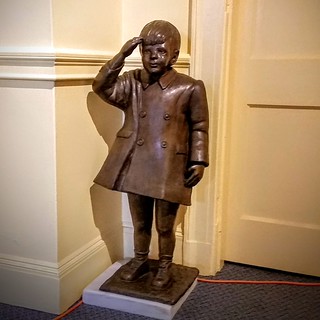
We stopped in the village of Hyannis to visit the JFK Hyannis Museum. This is not the Kennedy Presidential Library but a small museum focusing on the Kennedy family and their time on Cape Cod.
We stopped by the JFK Memorial at Veteran’s Beach. While there we looked for a geocache at the nearby Korean Memorial. We quickly discovered a young couple from Germany were also hunting for the same geocache so we had fun finding it together!
We took pictures in picturesque Wychmere Harbor, one of the most photographed places on the Cape.
The town of Yarmouth is the Cape’s second oldest town with more than 600 buildings of historic architectural significance. At one time more than fifty sea captains had homes in Yarmouth and a one mile stretch of road was known as Captain’s Row. In South Yarmouth we found an eight sided windmill. The windmill was built in 1791 in North Dennis on Cape Cod by Judah Baker to grind corn. In 1886 it was moved to South Yarmouth. Since 1953 the town of Yarmouth has been responsible for the windmill. It has undergone extensive restoration but still contains the original mechanical equipment. It is located in a beautiful setting near the Bass River adjacent to Nantucket Sound.

Our next blog posting will be about our day on Martha’s Vineyard.20160707_16101320160707_16113920160707_15375720160707_153705

June 28, 2016 Springfield, MA & Hartford, CT

We left the campground in Accord, New York and drove to Sturbridge, Massachusetts.  The campground was full and crowded and we were thankful to be placed in one of the few satellite TV friendly sites.  We can tell the northeast is going to be a big challenge to find satellite TV friendly sites among all the beautiful trees.
20160628_131622Our stop in Sturbridge was related to Bill’s interest in guns and radios.  On Tuesday we made the drive to nearby Springfield, Massachusetts to tour the Springfield Armory.  For almost two centuries this place overlooking the Colorado River was an important place for the development and manufacture of arms for American soldiers.  It started as a place where skilled craftsmen built piece by piece one flintlock musket at a time into a center pioneering mass production techniques into finally an institute famous for weapon research and development.
In 1777 a major arsenal was established here after early Revolutionary War battles in the northern states showed the need for a place to store weapons and ammunition that was within reach of the American troops but out of British hands.  A smaller armory for the south was built at Harper’s Ferry but destroyed during the Civil War.   In 1795 the Springfield Armory began weapon production.
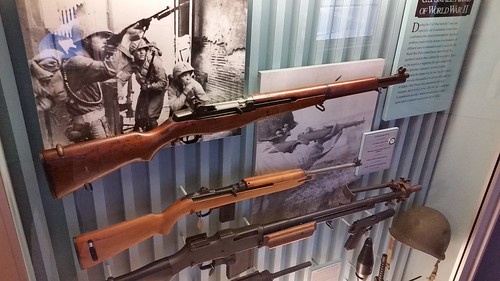
20160628_145612In 1891 The Experimental Department was established at the Springfield Armory with the job of examining and developing all subsequent U.S. rifle designs.  In 1936 the Armory began mass production of the first successful semi-automatic rifle to be put in military service, the M1 rifle designed by John Garand.  During WWI the Armory produced over 265,000 bolt-action Model 1903 rifles for American troops.  It is still considered one of the most accurate weapons ever made.  The installation of mass production machinery in the early 1930’s allows for the manufacture of 3.5 million M1 rifles through 1945.  20160628_145547 It was deemed by General George S. Patton to be “the greatest battle implement ever devised”.  In 1943 the workforce at the Armory totaled 13,500 employees, of which 43% were women.20160628_150038
In 1964 the Defense Department decided that private suppliers could provide necessary weapons and in 1968 the Armory was closed.  In 1960 this “Arsenal of Freedom” was designated a national historic landmark and in 1974 Congress named it the Springfield Armory National Historic Site.
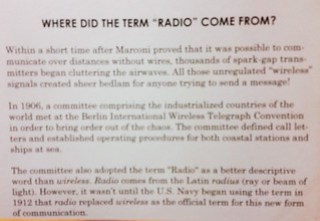
20160630_110658On Thursday we drove into Windsor, Connecticut so Bill could tour the Vintage Radio and Communication Museum of Connecticut.  The museum showed the history of electric communication and how it has changed our lives over the years, including radios, records and television.20160630_11080520160630_11090320160630_11124720160630_11192120160630_11203320160630_12061120160630_11150720160630_11243920160630_11250320160630_11294520160630_11302920160630_113155
20160630_102414We were quite surprised to find a lobster roll on the McDonalds menu in Connecticut so Bill couldn’t resist having one for lunch.  He said it was quite good.
20160630_152536We then made the short drive to Hartford, passing the state capitol building, so Bill could tour the ARRL (American Radio Relay League) headquarters.  He enjoyed visiting with some fellow amateur radio enthusiasts.20160630_141231

20160630_142940
20160630_130232

June 26, 2016 Hyde Park, New York

Our 2016 summer plans were unexpectedly delayed for health reasons.  As some of you know, when we returned from Europe I had a biopsy done on two thyroid nodules.  We were shocked when the results came back showing possible cancer.  So we canceled our plans on the New Jersey coast and sightseeing in Philadelphia and I had my thyroid removed on June 10 at the Martha Jefferson Hospital in Charlottesville, Virginia.  During this unexpected delay we were blessed to be able to stay at my dear friend Jamie’s house.  After a tense ten days of waiting, the pathology report came back with no cancer.  We were once again on our way!
After a short stay in Northern Virginia to have a minor repair done on the RV, we headed north to Pennsylvania.  We stayed two days in Lebanon not far from Hershey.  Since we both had been to Hershey and didn’t want to get in the summer tourist crowds and I was still technically recuperating from surgery, we were content to just relax at home.
20160625_193130Next stop was in Accord, New York. We arrived on a Saturday which happened to be the weekend of the ARRL (Amateur Radio) yearly Field Day.  I stayed home and rested in the air conditioning and Bill made a short drive to the location of the nearest Field Day and enjoyed a few hours with fellow amateur radio enthusiasts.20160625_193218
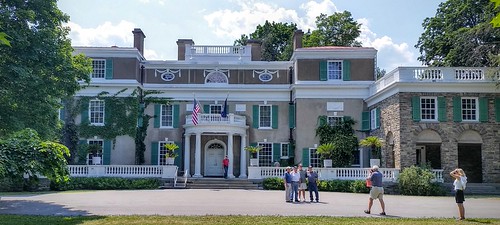
20160626_12290020160626_122927Sunday we drove to Hyde Park to visit the Franklin D. Roosevelt Birthplace and Presidential Library and Museum.  One of our goals in our travels is to visit as many presidential libraries as possible.  On the way we crossed the Hudson River on the Franklin D. Roosevelt Mid-Hudson Bridge.  The Roosevelt Library opened in 1941 making it the first presidential library and the only one used by a sitting president.  20160626_165256It was designed by FDR and is on the grounds of the Roosevelt estate and a short walk from his birthplace.  This year is the 75th anniversary of its opening.  20160626_170110When Roosevelt donated his papers to the Library, he set the precedent for public ownership of presidential papers.  The library has over 17 million pages of documents and over 150,000 photographs.  20160626_134506The Museum which is part of the library has many exhibits detailing the lives of Franklin and Eleanor, the Great Depression, the New Deal, and World War II.
First we took a guided tour of the home where FDR was born and lived throughout his life.  20160626_145916He deeded his home to the National Park Service in 1943. We learned he was a collector of stamps, coins, rare books, ship models, and birds.  As an only child, he led a very privileged childhood and details were given on the role his domineering mother played in his life and marriage.  20160626_153333His physical struggles due to paralysis from the waist down due to polio in 1921, and the great efforts to hide it from the public were discussed.
The Presidential Museum had many exhibits focusing heavily on the New Deal and World War II, including his unprecedented four terms as president.  It was from the museum he held some of his “Fireside Chats”.

20160626_164553

FDR Oval Office Desk

20160626_14515520160626_144917
Eleanor Roosevelt’s role as reformer, teacher, journalist, political activist, advocate for the underprivileged and delegate to the United Nations was detailed.  Today, she is known as “First Lady of the World”.
20160626_164445The Museum did not hold back as they described Eleanor’s difficult childhood with a critical mother, her struggles with a domineering mother-in-law, and her anguish over FDR’s long time relationship with Lucy Mercer, who was with FDR when he died in 1945 from a cerebral hemorrhage.
20160626_150149We also visited the gravesites of Franklin and Eleanor in the nearby Rose Garden.  At his request, the markers are plain white markers with only their names and dates.  FDR’s grave is the one with the flag.
While this was not our favorite presidential library, we certainly learned a lot about the life of Franklin Delano Roosevelt and came away with a greater knowledge of this time in American history.

20160626_17042620160626_15094620160626_15100320160626_155739

January 16, 2016 Everglades N.P.

IMG_20151214_104921First, a quick catch up.  Since our last posting we have really been on the go.
We spent eight days in Jacksonville at Kathryn Hanna City Park.  While in Jacksonville we visited my Uncle Bill and Aunt Peggy and were able to spend time with their daughters, granddaughter and three adorable great grandchildren.  It is always a real treat to visit my Jacksonville family.  They are always so gracious, welcoming and fun.  You haven’t truly lived until you experience one of their Sunday family dinners.20151207_163828
Bill grew up in Jacksonville Beach so while we were there we were able to catch up with several of his good friends.  Old friends are such a treasure!  We enjoyed some of the area Christmas decorations.
It was hard to leave family and friends behind but our next stop was St Augustine for a short stay.  The Spaniards created the City of St Augustine 450 years ago (1565), making it the oldest settlement in America, not to be confused with the settlement of Jamestown (1607), the oldest English settlement in America. We didn’t have enough time to explore and do the town justice so it is on our list of places to visit again.  Since it was December we were able to enjoy all the white lights and Christmas decorations, especially beautiful at night!  We enjoyed dinner with Bill’s ex boss Robert and his lovely wife Donna.IMG_20151210_193736IMG_20151210_205706~2
Flagler Beach was next on the list where we stayed at Gamble Rogers State Park.  Wow we loved this park on the Atlantic Ocean.  The state park has done a nice job of providing several boardwalks leading down to the water.  We enjoyed walking on the beach.  We can never get too much beach time!!
After a short stay in Titusville we arrived in Vero Beach for a week long stay over Christmas.  We were so happy to spend time with Bill’s son Sean and his girlfriend Cathy.  We enjoyed some beach time on Christmas Day.  Notice Santa relaxing on the beach after a busy night.  He was still wearing his Santa hat!IMG_20151225_142835
New Years found us in Clearwater, the area we lived in before beginning our grand adventure.  We caught up with friends and some of Bill’s former coworkers.  We were thrilled to spend New Years Eve with our friends Ben, Anne, Denise and Ralph at their annual party.  During the party we launched Chinese lanterns after making New Years wishes. Yes, good friends are truly a treasure!20151231_230834
20160104_103510January found us in southwest Florida in Fort Myers.  What a beautiful area along the Gulf of Mexico!  We liked our RV park even though it was crowded and tight.  We had great neighbors and hope to return next year to the same spot.  The beaches are beautiful and there is a trolley which you can ride from the campground to the beach for 75 cents.  What a bargain, especially considering parking at the beach is expensive and limited.  While there we had a bad storm and our cell phones shrieked with weather alerts of tornado warnings.  Bill monitored the storm on the local TV station. The weatherman I used to watch for years on the local tv station in Charlottesville is now the chief senior weatherman in Fort Myers.  We found out the next day that a tornado touched down about four miles from our campground.  This weather is unusual for Florida in January.  Thanks a lot El Nino!  While in Fort Myers we drove north to meet Bill’s cousin Shirley, her husband Jim, and two of their friends for dinner.IMG_20160108_194024~2
We reluctantly left Fort Myers and headed to a campground near Miami.  Our main reason for stopping here was to visit my cousin Duane.  IMG_20160113_194602~2We hadn’t seen each other in almost five years and I was beyond excited to see him.  We made the short drive to Coral Gables to meet him for dinner.  The time went by much too quickly.  There is never enough time to spend with family and friends!
IMG_20160119_104730Well, you are caught up on our travels and now on to the subject of this blog, Everglades National Park.  We had reservations at Flamingo Campground at the very tip end of the park.  Once you enter the park entrance it is 37 miles to the campground.  From the time we left Miami until we reached the campground we drove through torrential rain with poor visibility.  Thanks again, El Nino!
We stopped at the Visitors Center at the entrance of the park.  We put on our rain gear and splashed our way to the door.  They had nice displays and we saw a movie about the park.  Our national park system throughout the United States sure has great and informational movies.  We always come away impressed!
The movie said many people think of the Everglades as looking like a swamp, and I was one of them.  It is actually mostly grasslands along with jungle like tropical hardwood hammock, massive mahogany trees, mangrove trees and subtropical pine forest.  It is the only place in the world where both alligators and crocodiles live.  The park was established in 1934 to protect the fragile ecosystem and was dedicated by President Truman in 1947.  At 1.5 million acres it is the third largest national park, the largest tropical wilderness in the U.S. and the largest mangrove ecosystem in the Western Hemisphere.  It is the most significant breeding ground for tropical wading birds in North America and home to 36 threatened or protected species including the Florida panther, the American crocodile and the West Indian manatee.
With the heavy rain we were glad to arrive at our campsite.  Once we left the Visitors Center near the park entrance we lost all cell phone service.  Flamingo Campground has electric sites but no water or sewer at each site.
Since neither of us had ever seen a crocodile in its natural habitat, we were biting at the bit to see one.  The Ranger told us there were “over a million alligators in the Everglades but only about four thousand crocodiles”.  We didn’t think our odds of seeing one was very good but we got a tip that there were two over behind the marina store.  So we hopped in the car and made the short drive to check it out.  First we saw some manatees near the parking lot in a little docking area of the marina.  IMG_20160116_114740IMG_20160116_115414They sure are shy, quick and hard to photograph.  It didn’t help that the water was murky.  We were still on a crocodile hunt.  We saw a huge osprey nest with one lone bird peeking out of the top.  IMG_20160116_120538We walked around the back of the marina store looking in the water but saw nothing.  Suddenly we glanced on the bank and there were two huge crocodiles basking in the sun.  What joy!  The area near them was blocked off so we had to settle for some long distance shots and help from the zoom lens.IMG_20160116_120255
IMG_20160118_155728Another day we drove almost back to the park entrance to walk the Anhinga Trail which we were told was the best place to see alligators.  We only saw four, including this beauty who was completely oblivious to the people around him.  He appeared to be sleeping with his eyes open or playing possum, waiting to pounce when someone turned their back.  One older lady near me commented on how cute he was.  I would have to agree!IMG_20160118_162039~2IMG_20160118_155714
We were told that usually winter in the Everglades is the dry season and it is usually possible to see alligators by the dozens on the banks and even in the roadways.  Thanks to El Nino it has been a very cool, wet winter and alligator sightings are way down.  Sigh.
One fear I had when in the Everglades was encountering snakes.  Bill can’t understand why I have no fear of alligators but am terrified of snakes.  I have read stories of people who buy pythons for pets and when they  get too big or they tire of caring for them, they release them in the Everglades.  It has become a real problem and hunters come to hunt them.  I have seen the pictures of the 200+ pound pythons in the Everglades.  I am happy to report I left the Everglades without seeing a single snake.  But boy was I careful where I walked!
IMG_20160118_153018IMG_20160118_150815One surprise was to discover that Everglades National Park houses one of the best preserved relics of the Cold War in Florida.  The historic Nike Hercules Missile Base, dubbed HM-69, remains virtually the same as when its use was terminated in 1979.  The missile base was built by the US Army Corps of Engineers in 1964 at the height of the Cold War, immediately following the Cuban Missile Crisis in 1962.  The United States Army chose this strategic site within Everglades National Park because of its location 160 miles from the Cuban coast.
The missile site was listed on the National Register of Historic Places in 2004.  Bill took a 90 minute tour of the site conducted by a  park ranger. IMG_20160118_153334IMG_20160118_143836IMG_20160118_150656 IMG_20160116_141924Since we arrived in Florida the mosquitoes and especially the no-see-ums have just about eaten me alive.  Bill found a solution at the Everglades gift shop.
Our next stop is a week long stay at Big Pine Key, about thirty miles north of Key West.

November 21, 2015 Gulf Shores, ALA & FLA at last

We left Lakewood, New Mexico and hit the road running toward Florida. After overnight stops in Fort Stockton and Junction, Texas, we pulled into a nice campground in Columbus, Texas for a three day rest. We planned to leave Columbus early on a Sunday morning to avoid the weekday traffic nightmare around Houston. So much for that plan. We got up early and had everything ready to go. Bill got in the driver’s seat, turned the ignition key, and NOTHING happened. We had a broken starter. Of course nothing is open on Sunday, so we had no choice but to tell the campground we would be staying another day. We were SO lucky this didn’t happen somewhere along the road when we stopped for gas or at a rest area. We were so thankful to be in a nice campground with helpful people offering us any tools we might need and plenty of advice. This bad starter was just one of several bad luck events that happened to us, beginning back in September when a passing truck threw up a rock and chipped our windshield just as we were getting ready to turn into a campground. At our next stop in Phoenix in early October the motor on the large motorized windshield night shade broke and the shade would not go up. So while in Phoenix we had the windshield fixed and a new motor installed in the night shade. Now the starter! Whew!

20151116_142935Luckily we have roadside service on the RV so the next day the RV was towed in the rain to a repair facility in a nearby town. It kind of makes a big lump in your throat to see your home being towed away. Ford was able to get right to work on the warranty replacement of the starter. By late afternoon we were back on the road. That was the good news. The bad news was it put us going through Houston at rush hour. It took a giant margarita to get me through that without freaking out.

We stopped for the night at a casino in Vinton, Louisiana. We had a nice boondocking spot in a back parking lot with several other RVs doing the same thing to keep us company. By the time we got there it was late and we were pretty exhausted so it was a very easy, safe spot to stop for the night.
The next morning we headed to a campground in Livingston, Louisiana, passing through Baton Rouge which had some traffic back up due to an accident. We originally had planned to drive down to beautiful Palmetto Island State Park for several days, but since we were now on a fast track east, the state park was too far off I-10 for just a couple days. Another place to add to our growing list of future places to visit. We were not thrilled with our campsite at this Livingston campground. The site they put us on backed up to a busy road and traffic noise was a problem day and night. While we were there we had heavy wind and torrential rain and the bad luck continued when one of the windows began to drip water. Not a big deal since Bill could fix the problem with some additional caulking once everything dried. Just one of those nuisance problems.
IMG_20151120_161853IMG_20151120_161906Next stop was a nice campground near Gulf Shores, Alabama for a two night stay. While there we drove down to the beach. Our first beach in quite awhile. The beach was surprisingly deserted. We don’t know why except it was a weekday in late November. We enjoyed the views but the biting flies were terrible.
While in Gulf Shores we celebrated Bill’s birthday (NOV 22). I bought a birthday cake at Publix and we had dinner at Longhorns, one of Bill’s favorite restaurants. The steak was exceptionally good!IMG_20151122_182855
We enjoyed our stay in Gulf Shores but were anxious to get back on the road and see the Florida border. Bill honked the horn as we passed from Alabama into Florida. We were back after 877 days on the road. I think Bill was especially happy to be back in his home state.
Our first stop in Florida was a week at Rocky Bayou State Park in Niceville. We had a great campsite except for the oak tree towering above us which deposited acorns on the roof of the RV day and night, sometimes waking us up with loud pinging as they hit the roof.
While in Niceville we enjoyed visiting Bill’s cousin June, her husband Randy and their family. June fixed us two really delicious meals and we enjoyed watching the Alabama/Auburn football game with them. We can’t wait to see them again next November!

Our next stop was a COE (Army Corp of Engineers) campground called Eastbank, just over the border in Georgia.

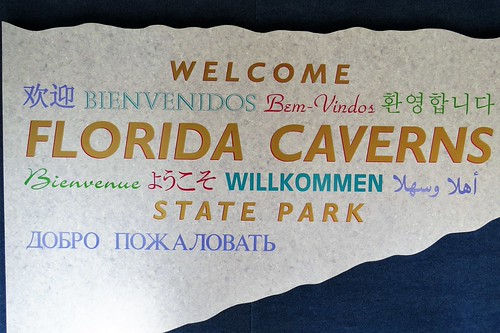
IMG_1366We left Niceville early and stopped by the Florida Caverns State Park on the way to the campground. Who knew Florida had caverns! We took a tour of the caverns with a great guide. Some of the places on the tour had really low ceilings so Bill had to do quite a bit of bending over while walking. It wasn’t equal to Carlsbad Caverns, but still a great place to visit!IMG_1367IMG_1368IMG_1369IMG_1372IMG_1374IMG_1377
IMG_1379The Eastbank Campground was on a lake overlooking a dam. We enjoyed views of the lake with ducks and birds splashing in the water. It was a very quiet and peaceful campground and we enjoyed our time there. So far Florida has been pretty chilly and the mosquitoes are biting!IMG_1380
We left Georgia and were back in Florida, heading to Osceola National Forest for a three day stay in the forest. We had hoped to get one of the electric sites in the Ocean Pond Campground, but since hunting season has begun and snowbirds are migrating back, all the electric sites were taken at this nonreservable campground. No problem since we were able to get a site with water hookup and open sky for our satellite TV and solar panels. The solar panels we had installed in Phoenix are really coming in handy.
We are enjoying our time in the forest. Tomorrow we head to Jacksonville to see family and friends. Remember earlier in this post I mentioned the bad luck we experienced? All of that is behind us and we feel really blessed to have made it safely back over those 1,800+ miles and back in Florida!!

October 5, 2015 Heading east AT LAST!

This blog is from events of almost two months ago.  We have been on a fast track east and have had little time for blogging and/or poor internet service.

We only planned to stay in Yuma, Arizona for 5 days.  But due to a series of unplanned circumstances, our stay there turned into over a month.  While we love Yuma, a place very friendly to RVers with great weather this time of year, we were more than happy to finally pull out of the campground.  We had originally planned on taking a slow stroll across the country to Florida. But due to our extended stay in Yuma, now we had to travel at a fast jog. We were forced to skip stops in Austin and Big Bend National Park in Texas and New Orleans. Other stops were shortened with several one night stopovers and an occasional two or three night stop for Bill to rest from all the driving.
It seemed like a long way from Yuma to Florida, and it was at over 1,800 miles. Our first stop was Tucson followed by Deming, New Mexico. Two places we had not canceled were Roswell and Carlsbad Caverns, both in New Mexico.

IMG_20151108_111755Our drive took us through the White Sands Missile Range. The world forever changed here on July 16, 1945 at the Trinity Test Site when the first atomic bomb was detonated. The national historic site is open to visitors just ONE day a YEAR, and today was not the day. We did stop at the White Sands National Monument, the largest gypsum dune field in the world. Considered one of the world’s great natural wonders, the white dunes range over 275 square miles. We stopped at the Visitors Center and saw an excellent movie explaining how the dunes were shaped by natural forces. We decided not to take the scenic drive to see the dunes since we had the car hooked to the RV and we still had a long drive to our destination of Lakewood, New Mexico. We put the White Sands National Monument on our list of places to return to in a future visit.IMG_20151108_114734IMG_20151108_114859

IMG_20151108_134732After passing through Cloudcroft Tunnel, built in 1949 under a rock formation and is the only automotive tunnel in New Mexico, we finally arrived in Lakewood for a three night stay. Lakewood was a convenient destination because it was halfway between two places we wanted to visit in the area.

20151109_114759The next day we set out to see Roswell, New Mexico to visit the International UFO Museum and Research Centers. On July 6, 1947, a local rancher told Roswell authorities about an object that had crashed in his field. Investigating officials at the Roswell Army Air Field reported they discovered a “flying disk”. A few hours later they revised their story, saying it was not a UFO but a weather balloon. What really happened that day is a mystery and a source of speculation and debate to this very day. The UFO Museum mainly consisted of wall after wall of newspaper stories and eyewitness accounts told by local residents. There was a small theater with documentaries and movies, with the most interesting being eyewitness accounts of the days following the crash when townspeople were threatened to keep quiet and those who had supposedly witnessed things the government did not want them to see suddenly disappeared. I entered the museum with disbelief and skepticism and perhaps a somewhat closed mind. I did not see anything in the museum to make me a believer. Bill, on the other hand, has a much more open mind than I do and still entertains the idea of a UFO visit.20151109_12405520151109_124618

20151109_124340

This is a painted picture from eyewitness(s)

20151109_124018

The spaceship and robot from the movie: The Day The Earth Stood Still

20151109_125111
There is more to Roswell than the incident in 1947. In the 1800’s this was an area of frontier living with Apache Indians and often visited by Billy the Kid. Roswell is also the home of one of the largest mozzarella cheese factories in the world.
IMG_20151109_145415Of special interest to Bill was that in the 1930’s, Roswell was the place where Robert H. Goddard, known as the Father of Modern Rocketry, attempted to defy gravity. During this time Goddard worked with Charles Lindbergh and Harry Guggenheim. We stopped by the Roswell Museum and Art Center where we toured Goddard’s actual workshop and saw fascinating home movies made by Goddard’s wife showing Goddard launching his first rockets.IMG_20151109_145221IMG_20151109_145244
IMG_20151110_095248On our last day in the area we drove south from the campground to Carlsbad Caverns. It is considered by many to be the Eighth Wonder of the World with some of the world’s largest underground chambers. The Big Room alone would hold fourteen Astrodomes. We were really looking forward to touring the caverns and it is one of the few places we didn’t eliminate from our revised itinerary. Our plan was to hike the steep 800 foot descent into the cave and then take the elevator back up. Unfortunately, the elevator was broken.IMG_20151110_095301IMG_20151110_112126IMG_20151110_102641

I was fighting a cold and neither of us was in the mood for the steep hike down and especially the climb back out which was equal to climbing 79 stories. We did see a movie at the Visitors Center and walked to the entrance of the cave. We were disappointed to say the least since we had eliminated other places on the itinerary to come here. But we had no choice except to put it on the list for the future. We returned to the campground and prepared to hit the road running tomorrow.

September 18, 2015 Flagstaff and Phoenix, AZ

It was hard to leave Page with beautiful Antelope Canyon, Horseshoe Bend and Monument Valley.  What a gorgeous area of Arizona!!  The weather was really hot so we decided to spend five days in Flagstaff, which at an elevation of almost 7,000 feet was going to be cooler.

We thought we would just hang out in Flagstaff and enjoy the weather, but there turned out to be more to do than we expected.

A short drive from our campground was Wupatki National Monument, Sunset Crater Volcano National Monument and Walnut Canyon National Monument.

IMG_1364Sunset Crater Volcano National Monument is a 2,200 square mile volcanic field with more than 400 cinder cones.  Sunset Crater is the youngest volcano in the area, having exploded in 1065 AD.  Because it was pretty hot and we had already experienced a lot of lava fields at Craters of the Moon in Idaho and in Hawaii, we didn’t spend a lot of time here.  We saw a movie at the Visitors Center and we found a really cool geocache.  The geocache was located inside an extinct fumerole (an opening in the earth’s crust which emits steam and gases).  Since the fumerole was extinct it was no longer emitting steam and gases, but I was still surprised Bill jumped down into the fumerole to find this geocache.  Really, Bill??!!IMG_1362IMG_1361

IMG_1360Within Wupatki National Monument are 800 ruins, the homes and villages of the Sinagua and Ancient Puebloans.  These ancient people felt the warning tremors before the volcano erupted in 1065 AD.  The lava flows forced them to vacate the land they had cultivated for over 400 years, and they moved to Wupatki and Walnut Canyon.  Here they lived for another 100 years before moving to other areas of the Colorado plateau.  The agricultural potential of the area actually improved after the eruption because the thin layer of ash absorbed moisture and helped prevent evaporation in the hot, dry landscape.  By 1250 AD the pueblos in Wupatki stood empty.  While there we walked a paved trail which took us up close to several dwellings.IMG_1352IMG_1353IMG_1355IMG_1358

In the early nineteenth century settlers and visitors to the Flagstaff area explored the Wupatki and Sunset Crater National Monuments, looting the area for souvenirs and damaging the landscape.  In 1928 filmmakers planned to use explosives at Sunset Crater to create a landslide for filming.  This led to a public outcry and a push to preserve the area.  In 1930 President Herbert Hoover established Sunset Crater National Monument as part of the national park system.  Wupatki had already been designated a national monument in 1924 after extensive looting of the dwellings.

IMG_1365I think our favorite trip was to nearby Walnut Canyon National Monument.  Here there are dwellings sheltered by overhanging cliffs inhabited here in Walnut Canyon for over 800 years.  The people, known as Sinagua, meaning without water in Spanish, lived by farming, hunting deer and small game, and gathering plants.  It is amazing how they were able to turn this dry land into a homeland.  It is not known why they left, perhaps due to a severe drought.  It is thought they traveled southeast and assimilated into the Hopi culture.

In the 1880’s the railroad brought souvenir hunters to the region, and like Wupatki and Sunset Crater,  looting and destruction of the area caused alarm and dismay.  In 1915 Walnut Canyon was protected as a national monument.IMG_20150921_113003IMG_20150921_105715PANO_20150921_120825

We intended to only walk the Rim Trail around the top of the canyon which would have given us a distant view of the cliff dwellings.  The day was cloudy and cooler, so we decided to walk the Island Trail which was listed as a strenuous trail mostly because of the 240 steps each way which would take us closer to some of the cliff dwellings.  As it turned out it was more moderate than strenuous and we found the walk pleasant and very informative.IMG_20150921_115331IMG_20150921_110159IMG_20150921_111032IMG_20150921_112243IMG_20150921_111259IMG_20150921_112607

We left Flagstaff and drove to Phoenix and our elevation dropped 6,000 feet.  Boy could we feel a difference in temperature!!  Now the temperature climbed to 111 degrees during the day.  After several days of this, the local weatherman said it was going to be cooler with temperatures “only” around 100 degrees.  We were practically the only ones in the campground resort.  The snowbirds will not be arriving for at least another month.

PicsArt_10-08-06.54.23While in Phoenix we did drive into the downtown area on a Sunday to see the state capitol building.  We found some geocaches including one at the Liberty Bell located on the capitol grounds.  This Liberty Bell is identical in dimensions and tone to the Liberty Bell in Philadelphia.  The bell is one of 53 cast in France in 1950 and given to the United States government by several copper mining companies. PicsArt_10-08-06.58.20 It is dedicated to us, free citizens in a free country.  Every September the Bell is moved to Gilbert, Arizona where it is displayed as part of Constitution Week.  Close to the capitol grounds we found Wesley Bolin Memorial Plaza where there are many memorials honoring important people in Arizona history as well as memorializing wars and significant historical events.  We found a geocache at the USS Arizona anchor (see our post of the USS Arizona memorial).   The 16,000 pound anchor was part of the ship which was bombed and sank during the attack on Pearl Harbor.  The ship still lies at the bottom of Pearl Harbor.  In the plaza is also the USS Arizona signal mast and gun barrel.  Inside the capitol museum is a superstructure salvaged from the ship and the US flag which flew on the battleship when it sank.PicsArt_10-08-06.55.00PicsArt_10-08-07.00.19

Next we head to Yuma, Arizona for a few days before we begin our slow trek back east.

September 17, 2015 Monument Valley, Utah

IMG_1333There is so much to see and do in Page, Arizona.  Before we left we had one last thing  to do.  We wanted to visit Monument Valley and Valley of the Gods in Utah.  We had contemplated taking the RV there and camping for several days but the heat and some changes in our schedule convinced us it was best to make it a long day trip from Page.   And a long day it was with about a three hour drive each way.IMG_1345IMG_1336IMG_1341IMG_1290IMG_1295IMG_1296IMG_1343

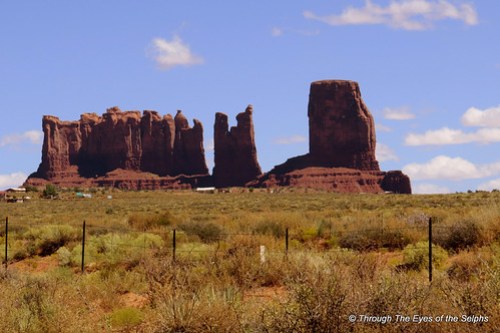
IMG_1351Monument Valley is on Navajo land and part of the Navajo Tribal Park which was established in 1958 to preserve the environment.  Monument Valley sits at 5,564 feet above sea level and is 91,696 acres in Arizona and Utah.  The height of the monuments, natural structures created by erosion, range from 100 to 1,500 feet tall.  There was a fee to enter the park and make the 17 mile loop drive.  The road of sand and dirt was in really bad shape making it almost necessary to have 4 wheel drive vehicle.  Monument Valley was made famous in many western movies, TV shows and commercials including Stagecoach (1939), She Wore a Yellow Ribbon (1949), How the West Was Won (1962), Easy Rider (1968), 2001: A Space Odyssey (1968), Back to the Future III (1990), Forest Gump (1994), The Lone Ranger (2013), Breaking Bad (TV) and Dr Who (TV) just to name a few.  John Wayne called Monument Valley “God’s Treasure”.

IMG_1297

Mexican Hat

We also drove to area of Utah called Valley of the Gods with similar sandstone formations to Monument Valley but on a smaller scale.  This land is public land managed by the Bureau of Land Management and did not require a fee. This too involved a loop drive on a dirt and sand road with less than ideal conditions to say the least.  We had downloaded a map ahead of time which led us to various named formations.  Sometimes it was very easy to see how the formation received its name, while others took an imagination we didn’t seem to have.IMG_1306IMG_1308

IMG_1301

Woman Sitting on Her Bathtub

IMG_1324

Hen on a Nest

IMG_1321

Rooster

IMG_1327

Seven Sailors with Flat Hats

IMG_1315Bill found a geocache in the rocks amid some sagebrush.  I stayed behind and took pictures.  The truth is I was terrified of possible snakes.IMG_1318IMG_1329

IMG_20150917_173850On the way home we stopped to find another geocache and saw John Wayne’s cabin (Captain Nathan Brittles) that was used as part of the set of his movie She Wore a Yellow Ribbon.

It was a full and tiring day.  We have certainly loved our time in Page.  Between Antelope Canyon, Horseshoe Bend, Glen Canyon Dam on beautiful Lake Powell and Monument Valley, Page is a place we look forward to visiting again.

September 15, 2015 Page, Arizona Part 2

PANO_20150915_140001After our Antelope Canyon tour we drove over to the trailhead to Horseshoe Bend.  We had seen pictures of this beautiful place and it was another place high on our list to visit.  Though not a long hike, this wasn’t an easy hike since it was a hot day and involved a steep climb up, then down a sandy hill and a steep climb up the hill back to the car.  Horseshoe Bend is a horseshoe shaped turn of the Colorado River.  Once you reach the end of the trail you are standing on a rocky overlook 4,200 feet above sea level.  IMG_20150915_135944IMG_20150915_135927The Colorado River is 3,200 feet above sea level so there was a dizzying 1,000 foot drop from the viewpoint to the water below.  With the rocky ledges and no handrails or fencing, it made me more than a little nervous.  IMG_20150915_140210I was definitely out of my comfort zone and Bill had to encourage me to smile for this picture.  Do you see the fear on my face?   Bill wasn’t fazed by the height or the drop.  Horseshoe Bend is a beautiful place but I was glad to get back to the car.IMG_20150915_140535

A video for you: https://youtu.be/fyWAPgM_9nM

IMG_20150915_123250We also visited the Glen Canyon Dam, which was started in 1957 and didn’t reach full capacity until 1980.  Lake Powell reaches a depth of over 500 feet and is capable of producing 1,320,000 kilowatts of electricity.  The Dam serves as a major water source for a number of states.
Lake Powell is 186 miles long with over 2,000 miles of shoreline, more than the west coast of the United States.  It has over 90 canyons with five rivers feeding into Lake Powell.  Major John Wesley Powell led an expedition into the area in the summer of 1869, exploring the area now known as Lake Powell and the Glen Canyon National Recreation Area on his way to exploring the Grand Canyon.IMG_20150915_125333IMG_20150915_123043IMG_20150915_123621

IMG_1273We are also including pictures of the Navajo Bridge, a lovely bridge we crossed on our way to Page from Jacob Lake several days ago.IMG_1281IMG_1275IMG_1280IMG_1277

September 15, 2015 Antelope Canyon, Page, AZ

We left delightfully cool Jacob Lake at an elevation of almost 8,000 feet and drove to Page, Arizona which at an elevation of 4,300 feet was definitely warmer.  This is a touristy town due to its proximity to such attractions as the Grand Canyon, Antelope Canyon and Glen Canyon Dam.

20150915_114545Our main reason for camping here was to see Antelope Canyon, a slot canyon and one of the most photographed places in the world.  We had seen pictures and were really excited about visiting the canyon.  We booked our tour over a month in advance.  Antelope Canyon is located on Navajo land, the largest and most populous Indian reservation in the country.  In order to see Antelope Canyon you must have a Navajo guide with you.

IMG_20150915_114903

Irene our guide

The night before our tour we had thunderstorms and very heavy rain throughout the evening and night.  We knew because of the danger of flash floods in the canyon our tour would be canceled if the rain did not stop.  Sadly before going to bed we heard on the news about flash flooding that killed several hikers in Zion National Park and the small town of Hildale on the Utah/Arizona border.  We had recently been in Zion and had passed through Hildale on our way to Jacob Lake a week earlier.  Though we felt our campground location was safe, it was still somewhat unnerving to hear the pounding rain well into the night.

The day of our tour we awoke to sunny blue skies, a perfect day for a canyon tour.  We drove to where we would be transported into the canyon.  Before getting in the back of the pickup truck we were treated to a traditional Navajo rope dance.  IMG_20150915_101818IMG_20150915_101815IMG_20150915_101724We then climbed on the back of a truck which had seating for fourteen.  The couple sitting next to us was from Winchester Virginia and their granddaughter is attending JMU, my alma mater.  It is rare to meet someone from Virginia so it was a delight for me!  We have noticed that especially in the fall when  U.S. children are back in school, the number of foreign tourists seem to rise to the point that we often hear more foreign language being spoken than English in campgrounds, parks and trails.  On our Antelope Canyon tour we also had tourists from Canada, France and Italy.

IMG_20150915_114859

These are the pickup trucks used by our tour company. The opening of the canyon is in the background.

In the back of the truck were two long benches, back to back.  Two thirds of the road was unpaved, and the heavy rain the night before cut down on the dust but left some washes in the road, making for quite a bumpy ride.  We had read beforehand that there could be sand falling inside the canyon so we picked up a couple of bandanas at the store the day before to protect our nose and mouth if needed.IMG_20150915_11292420150915_114740

IMG_20150915_110618

This shape is “Lincoln’s Nose”

Antelope Canyon, even though we had seen pictures, far exceeded our expectations in its beauty.  The entrance was rather unimpressive but once inside all we could say over and over was “WOW!” We had an excellent Navajo guide who showed us the best places and angles to take pictures.  There are a lot of people who visit the canyon each day and she kept us all moving and in our group since it was hard not to linger and marvel at the beauty before us.  In some places the canyon was very narrow, less than three feet wide.  It was formed by the erosion of Navajo sandstone, primarily due to flash flooding.  Rainwater, especially during IMG_20150915_10471120150915_105146IMG_20150915_10493820150915_10502320150915_105058IMG_20150915_105040IMG_20150915_105159IMG_20150915_10531620150915_105939IMG_20150915_105414IMG_20150915_11002720150915_112653IMG_20150915_110411IMG_20150915_114351IMG_20150915_114408IMG_20150915_114421monsoon season, runs into the basin above the slot canyon and then picks up speed as it rushes into the narrow passageways.  Over time the passageways eroded away making the corridors deeper and smoothing hard edges into beautifuil shapes in the rock.  Our guide pointed out ways the floor of the canyon had changed just since yesterday from the heavy rains the previous night.  The canyon is only about an eighth of a mile long but we stopped to take so many pictures it seemed longer.  We came out the other side and regrouped and then walked back through the canyon again, this time much faster since we had hopefully gotten most of our pictures on the way through the first time.  By now it was near high noon and the sun was beginning to shine down into the canyon.  Our guide threw sand up in the air so we could capture some sunbeams.

20150915_114559

In the middle of this picture is a sunbeam

20150915_114521

In the middle of this picture is a sunbeam

20150915_113030

The other end of the canyon

Too quickly we climbed back onto the truck for the trip back.  This was an awesome experience and we would like to visit Antelope Canyon again someday.20150915_113524