We left Valley of Fires and headed towards Carlsbad Caverns. We hadn’t planned on visiting Carlsbad but decided since we had some extra days to spend in New Mexico and the Caverns were fairly close, now was a good time. In November, 2015 we stopped there on our way back home to Florida. We discovered the elevator was broken and it is a very long uphill climb out of the Caverns if you can’t take the elevator! We decided to skip the tour and visit another time. We usually are up for the challenge but back then I had a chest cold and didn’t feel like the exertion it would take to hike out.
Along the way we passed oil pumps pumping oil before pulling into an Escapees RV Park called The Ranch. Located in Lakewood, it is about 45 minutes from Carlsbad Caverns. Without a doubt Escapees are the nicest and friendliest people you would ever want to meet. Immediately upon our arrival, someone rang the big bell outside the office and people starting walking up to greet us and invite us to the afternoon Happy Hour.
The next morning we drove to Carlsbad Caverns which required us driving through the city of Carlsbad. The traffic was really tedious with lots of traffic lights, none of which appeared to be synchronized.
Carlsbad Caverns, located in the Chihuahuan Desert of the Guadalupe Mountains, is one of the largest caves in the Western Hemisphere. It is also one of deepest, longest and darkest caverns ever found. It is considered to be the Eighth Wonder of the World.
We decided to take the self guided tour and our Golden Age Pass prevented us from having to pay a fee to enter the Caverns. We did rent a headset in the bookstore with a narrated tour. We began by hiking 1.25 miles into the cave through the Natural Entrance.
We descended 800 feet which was very steep in places and gave our legs and knees quite a workout.
The chambers of the Caverns were beautiful, though not as colorful as caverns we have visited in other states. The prevalent color was brown and it felt drier than other caves. The highlight was The Big Room, which at 8.2 acres is one of the world’s largest and most accessible underground chambers.
The ripples are from water dropping into the pool
This one is called “Rock of the Ages”
Carlsbad Caverns is a sanctuary to several hundred thousand Mexican bats. During the day they congregate together in a section of the Caverns called the Bat Cave. As we passed through this area we could hear them. Since they have started their winter migration, we did not see their nightly flight from the Caverns which can be seen at other times of the year. Back in the 1800’s settlers explored the Caverns and used the huge deposits left behind by the bats, called guano, as natural fertilizer.
In the early 1900’s a cowboy named Jim White was the first person to extensively explore the Caverns and led the first tours. It is hard to comprehend what it must have been like for them to enter such a huge, dark abyss. Today there are paved walkways and electric lights. It is also hard to grasp the labor that went into putting in those walkways and lights. After first becoming a national monument, it became a national park in 1930.
After spending about three hours walking through the Caverns we took the elevator back up. We were very happy to see it working this time!
The 1959 movie, “Journey to the Center of the Earth” was filmed here.
As we continued our stay in Eagle Nest, one day we drove ten miles to visit the nearby town of Angel Fire. The name Angel Fire comes from the Moache Ute Indians in the 1780’s. During their autumn celebration they noticed red and orange flickering in the northern sky. They saw it as a blessing of the fire gods and named their yearly celebration “Angel Fire”. Years later Kit Carson mentioned seeing the Angel Fire at dawn and dusk and accredited the glow to sunlight striking frost on the branches of trees.
Eagle Nest and Angel Fire are very popular ski resort areas in the winter and fishing in the summer.
Some of the TV series “Lonesome Dove” was filmed around Angel Fire. We drove to the location where the closing cabin scene was filmed here at Black Lake and meadow. The property is now privately owned and we could not get close for a great picture.
After lunch at the local barbecue restaurant, we visited the Vietnam Veterans Memorial. This Memorial was the first major Vietnam Veterans Memorial in the United States. It was built by Dr. Victor and Jeanne Westphall to honor their son, 1st Lt. David Westphall who died in combat in a 1968 ambush in Vietnam. In 1994 Dr. Westphall visited the site in Vietnam where his son died. He took with him a handful of soil from the Memorial to scatter at the site of the ambush. He also brought back Vietnamese soil from the site and scattered it at the Memorial.
This Memorial received national attention in the 1970’s and was the inspiration for the Vietnam Veterans Memorial in Washington, D.C in 1982. In 1987 the Angel Fire Memorial was recognized as a Memorial of National Significance.
Today the Memorial is maintained by the David Westphall Veterans Foundation and the New Mexico Department of Veterans Affairs.
At the entrance to the free Memorial is a Huey helicopter which served two tours in Vietnam. On its first tour it was badly damaged with 135 bullet holes, repaired and sent for a second tour.
Along the sidewalk leading to the Visitors Center are sponsored bricks with names of veterans. The dates are dates of service. Two stars signify a person killed in action and one star is missing in action. New bricks are added every September and bricks were being added while we were there.
Pop Music Was Nostalgic Reminder of the World They Left Behind
This statue is of a soldier in the field trying to write a letter to keep in touch with family back home. It is called “Dear Mom and Dad”.
The Visitors Center has exhibits and a very moving ninety minute HBO documentary titled “Dear America: Letters Home From Vietnam”. It was extremely moving; there are no words to describe the power of the movie.
The Visitors Center has over 2,000 photos.
98 Pairs of Empty Boots Bear Witness to the 173rd Airborne Casualties from the Battle For Hill 875
Just like the Memorial in Washington, D.C., notes and mementos are left around the Memorial. They collect them and put them on display in the Visitors Center. One brief, heartfelt note caught my attention. Well said!
This painting shows a shackled eagle, representing the frustration and futility of being captured. The Statue of Liberty in the distance and sunshine represents freedom and a ray of hope for the future.
In a separate area is the Peace and Brotherhood Chapel which displays a photo of David Westphall and rotating photos of thirteen men also killed in the ambush.
Many Native American volunteered and died in Vietnam.
On August 31st we drove further west to Eagle Nest, elevation 8,238 feet. At this elevation we had nightly temperatures in the upper 30’s and low 40’s. Time to turn on the heat and add a second blanket! The daytime temperatures were very pleasant Due to the short drive and mountainous roads, I drove the tow car instead of towing it behind the RV. I managed to get a picture of our RV ahead of me as we approached picturesque Eagle Nest Lake.
We had a nice campsite with the only problem being very weak Verizon cell phone service and unreliable WiFi furnished by the campground. One day we went a mile up the road to the Eagle Nest Public Library to use their internet to get a blog published. While we were there a storm came up quickly with heavy rain and hail. The temperature dropped almost thirty degrees and we were cold on the short drive home without a jacket or coat.
On Saturday we drove the 84 mile Enchanted Circle Scenic Byway. We began in Eagle Nest and traveled counterclockwise around the circle, passing through many small towns. We climbed steadily to Bobcat Pass and then dropped down slightly into the town of Red River, a popular ski area and summer resort.
We stopped by a pretty little red schoolhouse. I am always partial to these little schoolhouses.
This area of New Mexico was once a prosperous, productive mining district, securing six million dollars of gold between 1866 and 1907. Surface ore was rapidly depleted and by the 1930’s all mining had ceased. The only thing that kept the area alive was the creation of a dam built between 1916 and 1921. The dammed water became known as Eagle Nest Lake. The towns of Eagle Nest, Angel Fire and others became popular hunting, fishing and winter resort areas. In Red River and other towns we saw ski slopes and lodges.
As we continued on to the town of Questa we traveled through the Carson National Forest. The views were lovely but hard to capture on camera. There was a haze from the forest fires to the northwest. This haze continued our entire stay in Eagle Nest. It wasn’t enough to cause us breathing problems but an obvious haze which the local tv station said was coming from the western wildfires.
We took a short detour to the Rio Grande del Norte National Monument to see the Rio Grande Gorge Bridge. It is 1,280 feet long and towers 565 feet above the Rio Grande River. It is the seventh highest bridge in the United States and 82nd highest bridge in the world. The bridge was in several movies including “Natural Born Killers”, “Twins”, “White Sands”, “She’s Having a Baby”, “The Signal”, “Wild Hogs” and “Terminator Salvation”.
Near bridge are many vendors, especially Native Americans, selling their wares.
Next up was the town of Taos where we stopped for lunch and did some grocery shopping. The town was crowded with Labor Day weekend visitors.
Before heading home we drove by the Orilla Verde Recreation Area to check it out as a possible future camping location. We decided not to camp there but we really enjoyed seeing kayakers on the Rio Grande and big horn sheep grazing on the hillside.
The sheep were pretty far away and blended in with the landscape so it was difficult to get a good picture.
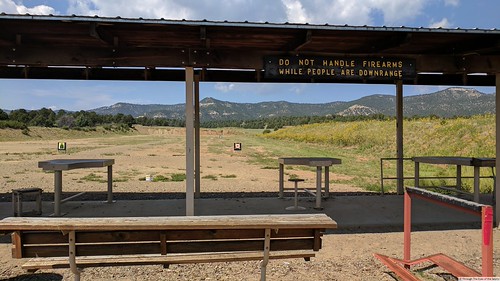
We had an enjoyable, relaxing five night stay at the NRA Whittington Center near Raton, New Mexico, elevation 6,885 feet. At this elevation the weather was cooler and the mountain views gorgeous.
Charlton Heston as The Scout
This Rabbit Was Checking Me Out on “His Gun Range”
Bill spent some time target shooting at their nice facility.
The Santa Fe Trail passes through the Whittington Center grounds.
They have a nice museum there as well with many weapons from the west.
“The Gun That Won The West” Winchester Model 1873 721,000 Produced
One day we drove into Raton for lunch and a little geocaching.
We stopped in the small local grocery store to pick up some items and noticed elk jerky for sale. No thanks!
We left Hutchinson and headed west, passing fields of yellow flowers and pumps pumping oil. We have seen quite a few of these pumps throughout Kansas. As we drove through the small town of Kingsley we saw that it is nicknamed “Midway, U.S.A” because it is halfway between New York City and San Francisco.
We made a stop in Dodge City, nicknamed “The Wickedest Little City in America”.
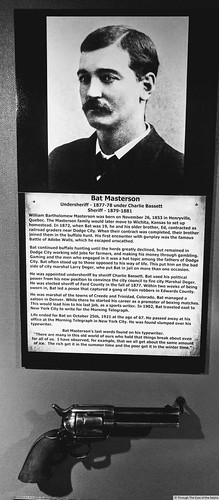
In the late 1800’s its Front Street was one of the wildest on the western frontier. There was one saloon for every twenty citizens, as well as card sharks and brothels. Cattlemen, buffalo hunters, soldiers, settlers, railroad men and gunfighters crowded the streets with drinking, gambling and fighting. Bat Masterson and Wyatt Earp were two of the most famous lawmen who tried to bring law and order to the town.
Dodge City grew up near Fort Dodge which offered them protection.
This is General George Custer taken at an Indian Village near Fort Dodge
Dodge City was a stopover on the Santa Fe Trail, and by late 1872, a station on the railroad. Buffalo hunting was popular and the trading and selling of buffalo hides, meat and bones brought considerable wealth to the area. By the time buffalo became almost extinct, the cattle trade had taken over with herds of Texas cattle being the main source of income. Dodge City was one of the largest cattle markets in the country. Today it is still a meat processing, major cattle shipping point as well as a supply and trade center for wheat.
Boot Hill was the highest point in Dodge City and the original location of the Boot Hill Cemetery. From this lookout point you could see wild game and buffalo as well as enemies approaching. Huge herds of buffalo roamed the prairie. Boot Hill was a burial ground for about six years from 1872 to 1878. During the town’s first year nearly thirty people were killed, a large number for a town of 500. Boot Hill became a cemetery for those who did not have money for a proper burial at Fort Dodge. They were stripped of their valuables and any clothes worth saving, and buried without a coffin or ceremony. They were buried with their boots on, thus giving the area the name Boot Hill. They thought it better to bury bodies on a slope so they would be better preserved because the water would run down the hill and not soak in. One theory is burying them on the hill gave them a boost to Heaven which they thought some needed. In 1878 a new cemetery was built east of town. The bodies in Boot Hill were moved to the cemetery. Today there are no known bodies remaining at Boot Hill and the markers and boots sticking up are there just to entertain and fascinate tourists.
“When Gabriel blows his horn, verily it will be a motley crowd of sinners that the graves on Boot Hill send forth to attend the final judgement.” May 4, 1878 Dodge City Times
We paid admission to visit the Boot Hill Museum and tour Front Street. We began our visit by seeing a short movie on the history of the area, with some emphasis on the settlement’s impact on the Native Americans. We were saddened to learn that the U.S. soldiers and settlers purposely killed off the buffalo herds to take away the Native American’s food supply and force them off their land.
After the movie we toured the Boot Hill Cemetery, the jail and the museum with exhibits on Native Americans and life in 1876 Dodge City. They had fake storefronts of shops such as the general store, post office, gunsmith, undertaker, bank and doctor’s office. They had a working saloon but we were the only ones there when we walked through. I was disappointed to see it really didn’t look much like the Long Branch Saloon on Gunsmoke. Supposedly they have Miss Kitty there and fake gunfights only on the weekends.
We visited the one room schoolhouse but didn’t bother with the Victorian house or church.
Inside the museum they had a room of Gunsmoke memorabilia which we enjoyed. I guess Gunsmoke is what brings many people to Dodge City, including us. But if you come thinking it will look like Dodge City on Gunsmoke, you will be disappointed. We didn’t have high expectations and knew ahead of time it was a tourist trap.
We didn’t have a campground reservation and had considered staying overnight in Dodge City, but our museum visit didn’t take long and we had most of the afternoon ahead, so we decided to press on.
As we continued west we passed one tiny town after another with mile after mile of flat land and frankly, pretty much a lot of nothingness. Each little town had a few houses and each one seemed to have a huge grain elevator, nicknamed “Prairie Cathedrals”. It was a long smelly ride since we passed a lot of very large feedlots crammed full of cattle. The horrible smell was overpowering at times, taking our breath away.
There were also many wind turbines, wildflowers and crops of corn and sorghum as well as other vegetables.
We stopped for the night in the little town of Elkhart, right on the border of Kansas and Oklahoma at a small and economical RV park with full hookups. It was perfect for a one night stopover and sure beats a Walmart parking lot!
We noticed a nearby geocache a few miles down the road so after dinner at the local cafe we drove over to it. The geocache was located at a tri-state point, a point where Kansas, Oklahoma and Colorado states meet. We took pictures standing in three states at once!
After a great night’s sleep we continued west, crossing into Oklahoma. We took a two mile detour to find another tri-state point, this one for Oklahoma, Texas and New Mexico. So in twelve hours time we stood in five states!
We left Oklahoma and crossed into New Mexico, our home for the next two months. We were excited to see the mountains of New Mexico ahead of us. We love the west and are really excited to be back!
We arrived at the NRA Whittington Center in Raton, New Mexico for a five night stay.
Famous Kansans:
Robert Dole, U.S. Senator and war hero
Clyde Cessna of Cessna aircraft
Russell Stover of the candy company
Edward Asner, actor
Kirstie Alley, actress
Burt Bacharach, singer and songwriter
Martina McBride, singer and songwriter
Walter Chrysler of Chrysler Motors, established in 1925
Amelia Earhart, female pilot and first woman to fly nonstop and solo across the Atlantic Ocean
Aneta Corsaut, played Helen on “The Andy Griffith Show”
We left the Minneapolis/St Paul area and headed south towards the Minnesota/Iowa border. Once again we began to see more dairy farms and silos. Our last stop in Minnesota was in the small town of Albert Lea where we stayed at the Myre Big Island Lake State Park. This park was conveniently located near Albert Lea which was nice because we had lots of chores to do to get ready for our next stop in Iowa. We did laundry, bought groceries and Bill got a haircut. Even though the park was close to town it was still isolated enough for us to see a doe and her babies two mornings as well as wild turkeys.
After three nights in Albert Lea we said farewell to Minnesota, which we had been visiting since early June, and headed to Forest City, Iowa. Along the way we saw dairy farms, fields of corn, silos and wind turbines. It is easy to see why this area is part of America’s breadbasket. More than 50% of the corn in the United States comes from Ohio, Indiana, Illinois, Missouri and Iowa. More than 50% of all grain comes from Ohio, Indiana, Illinois, Missouri and Iowa.
We arrived in Forest City to attend the Winnebago Grand National Rally. Forest City is the location of the main Winnebago plant. We pulled in line to wait for the gates to open. Bill noticed the RV in front of us had the tag of the president of the FMCA (Family Motor Coach Association) Amateur Radio Club. We are members of this club but have never had the chance to meet Rick and his wife Karen. While we waited, Bill got out to talk with them and made new friends before we even got in the gate. We enjoyed spending time with them, including dinner at the local Mexican restaurant our last evening there.
It was a great rally with fellowship, entertainment and informational seminars. On Monday we took a special all day tour by chartered bus to the nearby cities of Waverly and Charles City where we saw Winnebago parts being made. In Waverly we toured the factory where they were making wire harnesses for all of their motorized RVs. In Charles City we toured two area where they made Corian countertops and Winnebago doors and cabinets made of wood.
Mid week a powerful storm blew through the rally grounds. Our weather system clocked winds at 40 mph with heavy rain. At one point I saw a large flag flying through the air. It was scary and we listened for the tornado siren which fortunately never sounded. After the storm passed we walked around the grounds to check out the damage. All the large tents where daily seminars were held now had yellow caution tape blocking them off. Inside the tents we could see huge poles bent and chairs overturned and scattered. We heard reports of a tent landing on the roof of an RV. The next day the morning seminars were canceled while they waited for the tent owners to come from Waterloo to repair the tents before they would be safe for further seminars.
One evening they had a Row Party. Each state had a tent with free food or drinks that represented their state. Texas had chili, Wisconsin had cheese, California had wine etc. For some strange reason Virginia had lime margaritas. They sure were good!
The week passed quickly and too soon it was time to pack up and say goodbye.
Hoping we left the terrible mosquitoes behind, we headed further south to the tiny town of Aitkin, MN. We settled here for the Fourth of July holiday, glad to be off the busy highways. Our four days went by quickly and since there wasn’t much to see or do in the area, we used the time to do some chores around the RV. We installed extra insulation in the pantry and the upper cabinets to hopefully keep those areas cooler. We cleaned the vents and Bill changed the water filter and ice maker filter. We vacuumed out the tow car, washed it, and Bill applied wax. He also applied 303® Aerospace Protectant™ to the dashboard. He worked hard getting all the dead bugs off the front of the RV. We even managed to get a couple blogs published. It was a busy and productive four days! And on Independence Day the RV park had a golf cart parade.
On Thursday we moved to the Farmington, MN fairgrounds located about thirty minutes south of the Minneapolis/St Paul area.
After settling in we drove up to Bloomington to the Mall of America. The Mall of America is the largest entertainment and shopping destination in North America with 520 stores and more than sixty restaurants. It is four stories, sits on 96 acres and has 12,500 parking spaces. The most amazing thing was the amusement park in the center with a roller coaster, a boat ride as well as many other thrilling rides. After dinner at Bubba Gump Shrimp we spent a couple hours walking around the colossal complex.
In the Mall is a memorial to Thomas Burnett who died on 9/11 after his plane was overtaken by terrorists and went down in the fields of Pennsylvania. Burnett was born in Bloomington and attended school there during his childhood years. He was married and the father of four daughters when he died. I found it interesting that a year before the plane went down he started attending church because of a strong sense of foreboding which he expressed to his wife. On the day of the attack Burnett was one of four passengers to storm the cockpit, foiling the terrorists’ plan to crash the plane into the White House or U.S. Capitol. He is buried at Fort Snelling National Cemetery in Minnesota.
On September 11, 2002 the Mall of America dedicated the Tom Burnett 9/11 Memorial with a plaque entitled “Do Something” and an open door representing the cockpit door with the message “To Deem Life Important and to Act Affects All of Those That Bear Witness…”. The open door also represents a door to a brighter, safer future and encourages people to walk toward the future intent on doing something good, something kind, something noble and something right.
On Friday we had our six month blood work done and got service done on the Honda tow car.
Sunday we took advantage of lighter traffic and drove into Minneapolis and St Paul. Minneapolis and St Paul are ranked first and second by the Trust for Public Land for best city parks in the nation. Minneapolis-St Paul claims to have the coldest average temperature of any major metro area in the lower 48 states and because of this Minneapolis has a continuous network skyway system with enclosed pedestrian bridges that is purportedly the world’s largest. St Paul has five miles of glass tunnels to allow people to go from building to building. About 18 years ago Bill worked for six weeks in Minneapolis in late November, early December and he will never forget how cold it was out on the streets. Especially for someone from Florida!! He used those enclosed pedestrian walkways a lot!
We had quite a lengthy list of places to visit so we got a very early start. First up was Minneapolis which is a large city with many tall buildings. Very different from smaller St Paul.
We stopped by the Minneapolis Visitor Information Center to see the statue of Mary Richards. Who can forget this popular character from The Mary Tyler Moore Show! The statue was given by TV Land to the city. It used to be outside but construction on Nicolette Street forced the statue to be moved inside. We then drove to a nearby neighborhood to see the turn of the century Victorian house shown on the series where Mary supposedly had an apartment. We noticed the private residence is now for sale. There are other locations around the city featured on the show but there just wasn’t enough time to see them all.
We visited the St Anthony Falls Visitor Center Lock and Dam. At one time St Anthony Falls was the only natural major waterfall on the Upper Mississippi River. After the falls partially collapsed in 1869, the natural falls were replaced by a concrete overflow spillway. In the 1950’s and 1960’s a series of locks and dams was constructed to extend navigation.
From 1880 to around 1930, Minneapolis was the “Flour Milling Capital of the World”. Evidence of this can be seen in the Washburn Mill ruins of what was once the largest flour mill in the world located near the falls.
The Mississippi National River and Recreation Area (a U.S. National Park) protects a 72-mile and 54,000-acre corridor along the Mississippi River from the cities of Dayton and Ramsey, Minnesota to just downstream of Hastings, Minnesota. In the middle of Minneapolis is the St Anthony Falls Lock and Dam.
Overlooking St Anthony Falls Lock and Dam on one side and the mills ruins on the other is the beautiful Stone Arch Bridge. Constructed in 1883, this is a former railroad bridge which crosses the Mississippi River and is the only arched bridge made of stone on the entire Mississippi River. The second oldest bridge on the Mississippi, it is made of native granite and limestone and measures 2100 feet with 21 stone arches. The bridge is now a pedestrian and bicycle bridge and is an Historic Civil Engineering Landmark and was added to the National Register of Historic Places in 1971. We enjoyed walking on part of the bridge with beautiful views of St Anthony Falls, the Mississippi River and the Minneapolis skyline.
Next we visited Guthrie Theater because we wanted to walk on the Endless Bridge. This 178 foot long cantilevered structure is neither endless nor a bridge but a steel truss that is counterbalanced by the weight of the building. The Endless Bridge is in the left of the picture of the building. The attraction here is the magnificent views of the city, the Stone Arch Bridge and St Anthony Falls Lock and Dam.
We drove by the U.S. Bank Stadium which is where the Minnesota Vikings play football. The massive stadium is in the shape of a Viking ship. Really neat but hard to get a good picture of the entire stadium from our car.
Next was Target Field where the Twins play baseball. They had a home game today but we were early enough to avoid the crowd and traffic. The Twin Cities will host the Super Bowl LII in 2018 and the NCAA Final Four in 2019.
The Basilica of St Mary, named the first basilica in the United States by Pope Pius XI in 1926, is located here. It was completed in 1915, has a 200 foot high dome and a rose window.
We went by the Sculpture Garden but since we were running out of time and parking was scarce, we snapped a couple pictures of two of the most popular sculptures, the cherry and the blue chicken.
By now it was lunchtime and time to move on to St Paul, the capital of Minnesota. Minneapolis and St Paul is divided by an “S” shape carved by the Mississippi River. It is approximately a six mile drive between the two cities. At 26.2 miles, St Paul has more miles of Mississippi riverfront than any other city in the U.S. It is known as a “City of Neighborhoods” which celebrates different heritages and diversity. After grabbing lunch at a barbecue joint, we headed to the State Capitol building.
The Minnesota State Capitol is a Renaissance Revival Style building, with the second largest self supported dome in the world after Saint Peter’s. It was modeled after Saint Peter’s Basilica in Rome with the dome inspired by the U.S. Capitol dome. The building is made of 25 different types of stone including 16 varieties of marble from around the world as well as Minnesotan granite and limestone. Construction on the capitol was started in 1896 and completed in 1905 at a cost of $4.5 million. Above the southern entrance is a gilded chariot with four horses representing the power of nature; earth, wind, fire and water. The women leading the horses symbolize civilization and the man on the horse, prosperity.
Near the capitol is the Cathedral of Saint Paul, the third largest churches in North America, seating 3,000 people. It has a 175 foot copper dome and six chapels. The cornerstone was set in 1907 and the design was Inspired by churches in France.
Charles Schultz of the Peanuts cartoon fame, was born in Minneapolis but spent most of his childhood in St Paul where his father owned a barbershop. During this time Schultz and his father were known to purchase newspapers from Minneapolis and St Paul to be sure they saw every cartoon strip printed locally. For five summers after his death in 2,000, artists from all over St Paul designed and displayed renditions of Peanuts characters. In Rice and Landmark Parks as well as throughout St Paul you can see the Peanut characters.
We ended the day with a stop at Minnehaha Regional Park to see the beautiful 53 foot Minnehaha Falls, one of the most photographed sites in in Minnesota. The name Minnehaha comes from the Dakota language and means waterfall. Even though he never visited Minnehaha Falls, Henry Wadsworth Longfellow made the Falls famous in his poem, “The Song of Hiawatha”.
Enjoy the following video:
A bronze statue of Hiawatha carrying Minnehaha is located on a small island in the park. The statue was created in 1893 and placed in the park in 1912.
We enjoyed our time in Minneapolis and St Paul, however the two cities, especially Minneapolis, are very frustrating to drive in with many confusing one way streets complicated by construction and road closures.
Next up: Albert Lea and our last days in Minnesota
On Friday we decided to drive from Duluth on what is called the North Shore Scenic Drive on Rt 61 along the shoreline of Lake Superior. It was a beautiful day to enjoy the drive and the gorgeous scenery.
The Drive is 150 miles long from Duluth to Thunder Bay, Ontario with views of Lake Superior, glacier carved Sawtooth Mountains and Superior National Forest. Along the way we suddenly spotted Bigfoot!!
We decided to only drive 55 miles and work our way back while stopping at points of interest. Our first stop was at Tettegouche State Park where we took a short hike to an overlook with views of Lake Superior.
We had a picnic lunch at Palisade Head, an overlook 200 feet above Lake Superior. We drank in the amazing views while enjoying lunch.
After lunch we found a geocache and Bill found a new friend!
Next we passed through the tiny towns of Silver Bay and Beaver Bay before stopping at Split Rock Lighthouse. The lighthouse, said to be the most visited spot on the North Shore, sits atop a sheer cliff 150 feet above Lake Superior and is one of the best preserved and most visited lighthouses in the country. Split Rock Lighthouse was put into service in 1910. It was built by the federal government because of a disastrous 1905 storm that sank or damaged 29 ships on Lake Superior. This lighthouse was completely built from the lakeside because there were no roads at that time.
This is the light mechanism
In 1969 the lighthouse was decommissioned and deeded to the state of Minnesota. It is a National Historic Landmark. For a fee you can tour the lighthouse, a fog signal building, an oil house, three keepers’ houses, and storage barns. The lighthouse and buildings appear as they did in the 1920’s.
Split Rock is also a 2,057 acre Minnesota state park but the lighthouse is maintained by the Minnesota Historical Society.
Then we drove to Gooseberry Falls State Park so we could hike to Gooseberry Falls. It was an easy hike to the two beautiful falls.
On the way home we stopped at the Two Harbors Lighthouse which is now a bed and breakfast and the only operating lighthouse in Minnesota. Built in 1892, it is on the National Register of Historic Places.
It was a really great day with three state parks, two lighthouses, a beautiful overlook and some amazing scenery.
Saturday, our last day in Duluth, we drove across the bridge to Wisconsin. We wanted to visit Pattison State Park thirteen miles south of Superior, Wisconsin. The park is the location of Big Manitou Falls, which at 165 feet is the highest falls in Wisconsin and the fourth largest waterfall east of the Rockies. It is said to be the same height as Niagara Falls, just a lot skinnier.
We had to walk in a tunnel under the road and then it was an easy hike to the viewpoints. The water flows from the Black River and gets its dark color from decaying leaves and roots of vegetation.
Here is a video below we made of the falls.
After viewing the falls we found a geocache hidden in a tree.
This state park was very pretty with 80+ handcrafted stone and log buildings and structures built in the 1930’s by the CCC. We really enjoyed this park, as well as the three Minnesota state parks we visited the day before, all possible because of the hard work of the young men of the CCC (Civilian Conservation Corps).
We enjoyed our six days in Duluth. There were lots of things left to do. Until next time!
Lake Superior facts:
Lake Superior is the largest freshwater lake in the country, bigger than all the other Great Lakes combined. It is 350 miles long, 160 miles wide and has a surface area of 31,700 square miles
It contains 10% of the world’s fresh water with a volume of 440 trillion cubic feet
Average depth is 439 feet, with its deepest depth at 1,333 feet
Average water temperature is 42 degrees
There has been over 350 shipwrecks with more than 1,000 souls lost
Last time Lake Superior completely froze over was 1997, it was 90% frozen in 2013
On Monday we left Wild River State Park and headed further northeast to Duluth. As we approached Duluth we had splendid views of Lake Superior. Duluth with a population of 86,000, is located on Lake Superior and the St Louis River. It is one of the largest inland seaports in the world and an important grain center. All along the busy forty-nine miles of dock waterfront, you can see grain elevators, ore docks and shipyards. Duluth has plenty of outside activities with more than 130 city parks, 178 miles of trails, and sixteen designated trout streams.
Duluth has a rich history. In 1869, due to the booming lumber and mining industries as well as the arrival of the railroad, it was the fastest growing city in the United States. We crossed the railroad tracks to get to the campground and we saw this strange sign.
When we arrived at the campground it was 80+ degrees and sunny. The next day it barely reached 50 degrees and was overcast with occasional rain showers.
Wednesday was more of the same with a heavy fog blanketing the area and we heard occasional fog horns in the distance. We didn’t want to spend another day at home missing all Duluth had to offer, so we bundled up and decided to visit two museums downtown.
The first was a very small museum called the Karpeles Manuscript Library Museum. It was a museum we probably wouldn’t have taken time to visit on a sunny day, but on a cold rainy day it was great. The library museum, housing one of the world’s largest private manuscript collections, is inside a former Christian Scientist Church. It had original manuscripts, documents and handwritten letters, including letters from the Wright Brothers, small collections of Egyptian carvings, old telephones, ship models, and Plains Indians Treaties. Currently they have a special collection on Bob Dylan. Dylan was born in Duluth and went to elementary school there. There is a 1.8 stretch of road in Duluth named “Bob Dylan Way”. The manuscript library had some of his personal handwritten letters, handwritten sheet music and a copy of his 2016 Nobel Prize in Literature. We found out he was born Robert Zimmerman and changed his name to Bob Dylan. They had a copy of the court order application to change his name.
We learned the owners of the museum, David and Marsha Karpeles of California, also own museums in Jacksonville, FL, Buffalo, NY, Newburgh, NY, Tacoma, WA, Charleston, SC and Santa Barbara, CA. The collections are rotated among the museums. The Karpeles think that once someone has mastered textbooks and reference books in their field, they can then verify, analyze and extend their knowledge by examining and consulting original manuscripts written in an individual’s own handwriting. The Karpeles see it as a way to see a person’s first thoughts since you can see on the documents thoughts and ideas crossed out, ideas added but left out in the final document, as well as additional thoughts added later between the lines.
Next we visited the Lake Superior Maritime Visitor Center. Here they had informative displays on the history of Lake Superior shipping including replicas of ship cabins, an operating steam engine, scale models of ships and information on shipwrecks and bridges. They also had interesting displays on the history of the Army Corps of Engineers. We learned Congress authorized a Corps of Engineers in 1779 to support the Continental Congress. Its first mission was the building of fortifications to defend Boston at the Battle of Bunker Hill. After victory at Yorktown and peace in 1783, the Corps of Engineers was dissolved to save money.
In 1802 President Thomas Jefferson signed legislation to organize and establish a Corps of Engineers to be stationed at West Point and to constitute a military academy. They played a large role during the Civil War while building roads and railroad bridges, forts and batteries and destroying enemy supply lines. In the 20th century the Corps of Engineers contributed much to military construction in supporting the U.S. Army and Air Force as well as works of a civil nature. They helped with federal flood control, hydroelectric energy and the country’s leading provider of recreational facilities.
Corps of Engineers projects included:
In Washington DC
Construction of the Washington Monument
US Capitol dome
Lincoln Memorial
Library of Congress
Washington DC water supply system and subways
Panama Canal
Bonneville Dam
The Manhattan Project
Planning and construction of the Pentagon
Everglades Restoration Plan
Construction at the Kennedy Space Center
We decided to run to Walmart to get some supplies and it was actually faster and closer to the campground to cross the bridge to Superior, Wisconsin than go to the one in Duluth. The ports of Duluth and Superior are called “Twin Ports”. They are the leading bulk cargo transshipment ports on the Great Lakes-St Lawrence Seaway system. More than forty million tons of bulk cargo are shipped in and out each season, the most of the Great Lakes and one of the top twenty nationally.
On Thursday the temperature rose and the skies cleared so we decided to tour the Duluth lakefront area. We parked at Bayfront Festival Park and walked over four miles. Along the way we saw a replica of the Statue of Liberty,
Minnesota Slip Bridge,
the Aerial Lift Bridge,
Korean and Vietnam War Memorials,
and Leif Erikson Park where Erikson made his legendary landing somewhere along the rocky shore in approximately 1,001 AD (almost 500 years before Columbus).
We also found the Duluth’s Ten Commandments Monument. In 1946 a judge, who was a member of the Fraternal Order of the Eagles, sentenced a sixteen year old boy to memorize the Ten Commandments. This led local chapters of the Fraternal Order of the Eagles to to finance construction of over 4,000 tablet shaped granite monuments to be dispersed around the nation. Two Minnesota granite companies produced the monuments and in 1957 the monuments were donated to public places around the country. This was done at the same time as the release of the movie “The Ten Commandments” and some stars of the film attended various monument dedications around the country. This monument was displayed in front of the Duluth City Hall for almost 47 years. Due to a threatened lawsuit by the American Civil Liberties Union of Minnesota it was removed in May 2004 and put up for auction. Local citizens rallied to raise money but the winning bid came from a church in Lakeville, MN. The church gave the monument to a group of Duluth citizens who placed it here on private property in late 2004.
We enjoyed the great walk on a nice paved walkway with magnificent views of Lake Superior. Across the Lake we could see Wisconsin in the distance.
After our walk we drove across the Aerial Lift Bridge to Park Point which is the world’s longest freshwater sandbar, spanning seven miles. This area is popular for swimming and beach lovers. We saw a sign saying the water temperature that day was 51 degrees. Yikes!
On the way home we were held up at the Aerial Lift Bridge while we waited for the Mesabi Miner ship to pass under the bridge. We were thrilled because we were able to see this very unusual 386 foot long bridge in action. It is an elevator bridge that spans the Duluth Ship Canal. The support columns on either side have counterweights that balance the lifting portion of the bridge. The bridge can be raised to its full clearance of 135 feet in about a minute and has a 1,000 ton lift span. It was first raised in 1930 and is raised about 5,000 times a year. The Mesabi Miner is an American coal and iron ore carrier that operates on the upper four North American Great Lakes.
Next blog: More exploring along the Minnesota North Shore
Minnesota Facts:
The company Target’s headquarters is in Minnesota.
Famous people from Minnesota include Judy Garland, F. Scott Fitzgerald, Peanuts cartoonist Charles Shultz, Bob Dylan, Prince, novelist Sinclair Lewis, former wrestler, actor and governor Jesse Ventura, Loni Anderson, Richard Dean Anderson, James Arness (Gunsmoke) and brother Peter Graves (Mission: Impossible), Eugene McCarthy, former Vice President Walter Mondale, Harry Reasoner, Jane Russell, Marion Ross
Leaving Little Rock we headed west to Bentonville, Arkansas to see my Aunt Shirley and her family. Bentonville is also know for being the headquarters of Walmart. Bill and I last visited her in October, 2013 so we really looked forward to the visit. I was still under the weather from the tick bite and between the Prednisone and the effects of the bite itself, I was definitely not well. While there we had also hoped to take side trips to visit Fort Smith and beautiful Eureka Springs, but all those plans were cancelled. We did enjoy some delightful time with my Aunt Shirley, sitting on her back deck in the afternoon and watching the sun set from her front porch in the evening. She fixed some delicious meals and we also had family time with my Uncle Burt and cousins and their children. While we were there we got to celebrate the graduation of one family member from the University of Arkansas and the 17th birthday of another. Such treasured memories.
Far too soon it was time to continue our summer travels and head towards Branson, Missouri. Getting from Bentonville to Branson was not easy and a couple times we stopped to let the brakes cool down. Even though there many hills and curves, it was a beautiful drive through the Mark Twain National Forest.
We arrived at our nice campground located just outside the Branson town limits and a short drive to Branson Landing. The campground had recently been closed due to flooding and evidence of flood damage was still visible. It was surprisingly hot during our three night stay with daytime highs hovering around 90 degrees.
To be honest, Branson is really not our thing. It is too much of a tourist trap for our liking and we were not interested in the country shows or the Silver Dollar City amusement park. I can see how it would be a great place for people who like those kinds of things. Located in the heart of the Ozarks, Branson 25 years ago was nicknamed “the live country music capital of the universe”. Amazing considering its location deep in the Ozarks and isolated from big cities and interstates. Along Country Music Boulevard, also called the Strip, think of Lawrence Welk, fake Elvis shows, Jim Stafford, Andy Williams Theater, George Strait, Patsy Cline, Dick Clark’s American Bandstand, Oak Ridge Boys, wax museums, toy museum, Titanic Museum, Ripley’s Believe It Or Not, magic shows, Chinese acrobatics and the list goes on and on and on. Advertisements refer to more than 100 different shows at 50 different venues to choose from on a regular basis. For many, the highlight is Silver Dollar City, a theme park modeled after an 1880’s Ozark pioneer village with rides and entertainment. Branson is definitely a place for wholesome family entertainment and deep pockets.
In 2006 they added Branson Landing along the shore of Lake Taneycomo with high end retail shops and restaurants. There is a fountain show each hour throughout the day and even though we went twice in hopes of seeing a show, there didn’t seem to be much going on. The fountain shows were advertised as water fountains shooting 120 foot geysers accompanied by fire, fancy lights and rousing music. The area was recently flooded so we didn’t know whether the fountains were only partially working because of flood damage or the fact the summer season had not yet started.
We walked along Main Street, visiting Dick’s Old Time 5 & 10. Jammed full of everything you could imagine, it reminded me of the Ben Franklin store from my childhood. It was fun walking around and browsing all the “stuff”.
This is certainly a beautiful area of the country.
Next stop: Onondaga Cave State Park, Missouri
Missouri Fun Facts:
Nicknamed the Show Me State
Aunt Jemima pancake flour invented in St Joseph
Tums invented in Missouri
A new highway running from Chicago to the West Coast got its name at a meeting in Springfield, Missouri. Became known as Route 66
First Olympics in the U.S. were held in conjunction with the 1904 World’s Fair in St Louis. It was the only time grease-pole climbing was an Olympic event
Theodore Roosevelt was the first President to fly in 1910 in St Louis
Waffle cones, hot dogs, cotton candy, Dr. Pepper and iced tea were all first served to the public at the 1904 World’s Fair in St Louis
The eight-track tape was invented in 1964 by Bill Lear of Hannibal, Missouri. He also founded the Lear Jet Corporation.
Cookie Consent
We use cookies to improve your experience on our site. By using our site, you consent to cookies.
Contains information about the traffic source or campaign that directed user to the website. The cookie is set when the GA.js javascript is loaded and updated when data is sent to the Google Anaytics server
6 months after last activity
__utmv
Contains custom information set by the web developer via the _setCustomVar method in Google Analytics. This cookie is updated every time new data is sent to the Google Analytics server.
2 years after last activity
__utmx
Used to determine whether a user is included in an A / B or Multivariate test.
18 months
_ga
ID used to identify users
2 years
_gali
Used by Google Analytics to determine which links on a page are being clicked
30 seconds
_ga_
ID used to identify users
2 years
_gid
ID used to identify users for 24 hours after last activity
24 hours
_gat
Used to monitor number of Google Analytics server requests when using Google Tag Manager
1 minute
_gac_
Contains information related to marketing campaigns of the user. These are shared with Google AdWords / Google Ads when the Google Ads and Google Analytics accounts are linked together.
90 days
__utma
ID used to identify users and sessions
2 years after last activity
__utmt
Used to monitor number of Google Analytics server requests
10 minutes
__utmb
Used to distinguish new sessions and visits. This cookie is set when the GA.js javascript library is loaded and there is no existing __utmb cookie. The cookie is updated every time data is sent to the Google Analytics server.
30 minutes after last activity
__utmc
Used only with old Urchin versions of Google Analytics and not with GA.js. Was used to distinguish between new sessions and visits at the end of a session.