Category Archives: Private RV Campground

Private RV Campground

Redcrest, CA SEPT 27, 2018

While in Eureka on the California coast we ran the heat in the mornings and evenings and usually wore a jacket.  We left Eureka and headed inland. Remember when we talked about how chilly it was on the Oregon coast but if we had moved just an hour inland we would have been too hot? We followed U. S. Highway 101 south as it curved inland away from the coast. Our destination was Redcrest to spend several days seeing the majestic redwood trees. When we were outside preparing to leave Eureka we had on jackets. By the time we moved inland and reached Redcrest it was 88 degrees. Whew! What a difference. Time to switch from heat to AC. (Yes, we know our family and friends in Florida are laughing at our complaining about 88 degrees!)

We were last here in May, 2014 and pulled into the same RV park as before in tiny Redcrest, pop 112. It is a nice park but has absolutely no Verizon service.

Here we traded the beauty of the Pacific coastline with the magnificence of the redwoods.  And magnificent they are! IMG_4225

We spent our time driving along a road called “The Avenue of the Giants“ and hiked several trails in Humboldt Redwoods State Park, California’s third largest park and containing Rockefeller Forest, the world’s largest remaining contiguous old-growth forest of coast redwoods. 20180928_163540

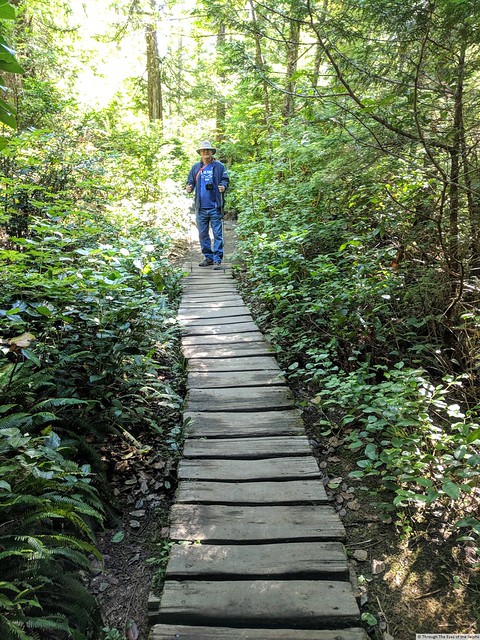
Our first hike was on the Greig-French-Bell Trail.  This trail is located in the fog prone northern edge of the park and therefore has a lush ground cover. This particular area is so visually striking it is often used as the setting for movies and TV commercials. IMG_20180928_124855IMG_4232IMG_4235IMG_4243

The most well known landmark on the trail is the Girdled Tree where in 1901 the bark was mostly removed and sent to San Francisco so the people there could see what redwoods looked like. IMG_4241

We hiked for well over an hour along the many meandering paths along the trail. Of the trails we hiked it was the least well marked and most overgrown. This was also a great time of year to visit the park since none of the trails were crowded. This is the very end of their tourist season. IMG_4252

IMG_4246

This is not a trail, it is a large fallen tree!

Next up was the most famous trail in the park, Founders Grove. It is described as an ancient forest and one of the greatest forests on earth. 20180928_144757IMG_4253

One highlight was the Dyerville Giant, a redwood that once stood here for as long as 1,600 years. At the time it was taller, larger and older than any other tree around it.  It was 370 feet tall which is two feet taller than Niagara Falls, was seventeen feet in diameter, fifty-two feet in circumference and weighed over one million pounds. When it fell in 1991 it registered on the seismograph and the locals said it sounded like a train wreck. 20180928_150211IMG_4257IMG_20180928_154426-EFFECTSIMG_20180928_160237

Along this trail we also walked the Mahan Plaque Loop. IMG_4254IMG_20180928_145322IMG_20180928_145527IMG_20180928_152639

IMG_4259

Some giant redwood trees shatter when they fall

IMG_4261IMG_20180928_154516

Our final trail was the Rockefeller Loop Trail. This forest grove is dark and very dense. It had started to lightly rain while we were walking on this trail and we hardly felt any raindrops thanks to the redwoods being our natural umbrellas. IMG_4271IMG_4270IMG_4272IMG_4276IMG_4279IMG_4284IMG_4286IMG_4291IMG_4297

We had a wonderful time among these majestic giants. But now it is time to return to the coast. IMG_20180929_114041

Interesting facts:

  • Due to climate change and other factors, Coast Redwoods now only grow naturally in a narrow 40 miles wide and 450 mile long strip from southern Oregon to southern Monterey County in California.
  • Initially, J.D. Rockefeller did not want the forest named after his family, he donated millions of dollars to save these trees. Until 1951 it was known as the Bull Creek-Dyerville Forest. IMG_4267IMG_4268IMG_4277
  • Redwoods are so immense they live simultaneously in three climatic zones. The base, the stem and the crown are in three separate zones.
  • Redwoods need great amounts of moisture. This area of California has 65 inches per year average rainfall plus moisture from summer fog.
  • A very large redwood can release up to 500 gallons of water into the air each day. The redwoods are being affected by the ongoing California drought.
  • It may take 400 years or more for a decaying tree to become integrated into the forest floor.
  • Redwood roots grow only a few feet down into the soil but can grow laterally a hundred feet or more. Their roots can intertwine, helping each other stand up.
  • Redwoods live a long time because they have few enemies. They have a thick fire resistant bark and lack resin.
  • The scientific name for Coast Redwood is Sequoia sempervirens which means “ever living”.

Eureka, CA SEPT 21, 2018

California here we come!  We left Brookings, Oregon and crossed over into California.  Once we entered the state we had to stop at a California Agricultural Checkpoint.  We expected this and had not stocked up on fruits and vegetables ahead of time. They only asked if we had citrus fruits or mangos, which we didn’t so they waved us on.

Our first stop was a six night stay in Eureka.  We were last here in May, 2014. Eureka has a population of around 27,000.  It has a rich history mainly based on the California Gold Rush in the mid to late 1800’s.  As thousands of people poured into the area in search of gold, their need for housing and the numerous redwood forests in the area provided a prosperous economy for northern California.  Lumber was manufactured and shipped from the region so the area became rich through lumber and shipping. Many people in Eureka became wealthy which can be seen in the many large Victorian style homes. As you may have guessed, Eureka received its name from the Greek word “Eureka” which means “I have found it” and was first used by the Greek mathematician Archimedes.  The gold rushers would say “Eureka!” when they discovered gold and the name stuck for the town.

One day we decided to drive along the area known as the Lost Coast.  It was a bright sunny day when we left home. We stopped for lunch and by the time we reached the coast and stopped at Centerville Beach a short time later, this is what we found.  Plagued by the sea mist yet again!

The Lost Coast was given this name because of depopulation in the 1930’s.  Because of the steepness and geographical challenges of the coastal mountains, this stretch of the coastline was too costly for the state to build highways or county roads through the area.  Therefore it is the most undeveloped and remote portion of the California coast. Just the kind of area we enjoy visiting! Without any major highways the small communities in this area are isolated from the rest of California.

In Eureka we were reminded once again how expensive food and fuel is in California!  Ouch! We still pay deposits on cans and bottles but it is only 5 cents compared to 10 cents in Oregon.  California has a plastic bag ban so we must remember to take our own bags in all the stores.

Next stop:  Redcrest to see the redwoods

Florence, OR AUG 26, 2018

On August 26th we headed south to Florence, Oregon (pop 8,000)  for a two week stay. We wanted to enjoy the Oregon coast and wait out the Labor Day holiday and all the traffic it brings. On the day after Labor Day all the full time RVers start singing “it is the most wonderful time of the year” because all schools are in session, the campgrounds empty out and things really get quiet. No more dodging kids on bikes or fighting for campground spaces. Nine months of peace and quiet. Ahhhh.

In spite of the holiday traffic and crowds, we did get in a little sightseeing. Florence is a great place to visit the Oregon Dunes National Recreation Area, a forty square mile park and the largest expanse of coastal dunes in North America with peaks up to 300 feet. The area was busy with dune buggies and ATVs which are allowed on the dunes. IMG_20180902_150732IMG_20180902_150222IMG_3965IMG_3967IMG_3968

IMG_20180905_145144-EFFECTS

US-101 Siuslaw River Bridge, Florence OR

Since Florence is a river town along the Siuslaw River, we rode to both the North Jetty and South Jetty where the mouth of the Siuslaw River meets the Pacific Ocean. During our time in Florence it was both chilly and windy; we could certainly feel the cold wind at the jetties. IMG_20180905_145000IMG_20180901_115934IMG_20180901_121721IMG_20180901_121233IMG_20180901_122010

Another day we drove south to see the Umpqua Lighthouse. Built in 1894, it is the only lighthouse on the Oregon coast that emits a red and white light. There are eleven lighthouses on the Oregon coast. IMG_3960IMG_3961IMG_20180903_120931-EFFECTS

The day after Labor Day we drove north to Heceta Head Lighthouse, also built in 1894 and located 206 feet above the Pacific Ocean.  This area of the Oregon coast is especially scenic and beautiful. We never tire of seeing this view! The sea mist, which has annoyed our picture taking all summer, persisted.

IMG_3978

Heceta Head Lighthouse in the Distance

IMG_3954IMG_3974

At the scenic viewpoint where these pictures were taken, we saw down on the rocks hundreds of sea lions barking at each other and frolicking in the icy cold water. IMG_3958IMG_3976

It was a blustery chilly day and I shivered at the thought of being in the water. We could not only see and hear the sea lions, we could smell them too. Certainly not a fragrance anyone would want to bottle! IMG_3975IMG_3986

On the way home we stopped at the very unusual Darlingtonia State Natural Site. Located here is an unusual plant which traps and digests insects. It is also known as the cobra lily and pitcher plant. IMG_3989

Native to the bog areas of Northern California and Southwestern Oregon, insects are lured into the leaf opening under the hood by nectar on the edges of the openings. Once inside the insects are confused and unable to find their way out. They fall into a pool of liquid at the base of the leaf where the insect is digested and absorbed. IMG_3991IMG_3990

Bill and I agreed the plants reminded us of something you would see on Outer Limits or Twilight Zone TV shows. Really creepy. As we stood there we saw a butterfly, moth and fly buzz around the plants. We found ourselves holding our breath and then saying, “No! Don’t land there! Danger, danger! “

And with that, it was time to head a little further south. Oregonians told us Oregon has one day of summer a year. We thought they were kidding. They weren’t. It has been cloudy much of the time, chilly and windy (mid sixties for highs and 50 at night). Now, not all of Washington and Oregon is this cool. If we had gone inland toward Seattle or Portland, we would have had plenty of heat.  Since we will be hugging the coast as we drive south it probably won’t get much warmer. But there is something psychological about heading south in the fall that at least makes you feel warmer.

Next up: Southern Oregon and our last days before hitting California

Hoh Rain Forest, WA AUG 9, 2018

Washington state, nicknamed the Evergreen State, has so much natural beauty with three national parks: Mt Rainier NP, North Cascades NP, and Olympic NP. For the past several weeks we have been enjoying the diversity of Olympic National Park. Encompassing 922,651 acres, it has three distinct and very different ecosystems:

  • glacier capped mountains, 
  • more than 70 miles of rugged coastline and
  • a temperate rain forest.

In previous blogs we described our visit to mountainous Hurricane Ridge, and in the past two blogs we talked about the rugged coastline. This blog is dedicated to the Olympic rain forest.

On Thursday we visited the nearby Hoh Rain Forest an hour away from our campground in Forks.  The Hoh Rain Forest is one of the last old growth temperate rain forests in the Western Hemisphere. It averages fourteen feet of rainfall annually.  The trees here can grow up to 300 feet tall. IMG_3402IMG_3408

As we approached the fee booth at the entrance to the park we were met by a long line of cars. We wondered why the line was moving so slowly and when it became our turn to show the ranger our pass, we found out why.  The ranger told us the parking lots were all full and we had to wait for a car to leave so we would have a place to park. We didn’t mind chatting with the friendly park ranger for a few minutes until we spotted a car coming from the opposite direction and it was our turn to enter. The ranger said they have been this busy all season. I can’t imagine what it is like on the weekend! (The cost to visit a national park is now $30 per vehicle and luckily we both bought senior passes when we became 62 which never have to be renewed)

Our goal was to take two hikes in this area of the park. We started with the Spruce Nature Trail which led us among moss covered trees and banks of ferns IMG_3409IMG_3414IMG_3416IMG_3417IMG_3418IMG_3422

IMG_3424

This tree has two ears

IMG_3426IMG_3427

which eventually led us past the Hoh River.  IMG_3434

This river is fifty miles long and begins high on glacier capped Mount Olympus and descends 7,000 feet to the Pacific Ocean. Hoh is a Native American term meaning “fast moving water”. Members of the Hoh Indian tribe still live in the area.  By the way, Washington state has more major cities with Native American names than any other state. IMG_3435IMG_3438

We then hiked The Hall of Mosses trail. We were amazed at the strange shapes the roots of trees formed as they spread through the forest. As you can imagine, the trails were very crowded.  IMG_344020180809_142548IMG_3442IMG_3443IMG_3444

We were last here in 2014 and we were somewhat surprised in this visit. Washington state has been very dry and it certainly shows in the rain forest. The area did not have the lush rain forest feeling we remembered from our visit four years ago. Instead it was hot, dry and the trails were dusty. 20180809_143557IMG_3445_stitch20180809_144115

IMG_3450

Not sure what to call this animal with a hat

20180809_144601

An amazing part of old growth forest is nurselogs: a fallen tree which, as it decays, provides ecological facilitation to seedlings to grow on it. 20180809_14585420180809_14403320180809_14471620180809_145706

The trail passes many large downed trees. IMG_3452IMG_3457IMG_345620180809_150357

Though we were surprised we still enjoyed our two rain forest hikes.

Today ( Saturday) we received about a quarter inch of rain. The first rain in a very long time. I could almost hear the grass, which crinkled when walked on, breathing a sigh of relief as it drank in the precious rain.

Tomorrow we move a little further south in Washington for some camping on the beach. Hopefully the marine layer will cooperate!

Ruby Beach, WA AUG 7, 2018

After our strenuous hike at Rialto Beach, the next day we decided to visit another nearby beach slightly to our south called Ruby Beach.  We had read this was a beautiful and easily accessible beach.

When we left the campground at Forks it was a bright sunny day with a temperature around 80.  At Ruby Beach we walked down the short trail from the parking lot to the beach and we were very disappointed to see a heavy marine layer which prevented us from seeing more than a quarter of a mile. IMG_3368

We saw lots of driftwood and a creek by the name of Cedar Creek flowing into the ocean.  In the middle of Cedar Creek was a rather unique sea stack.  : Sea Erosion LandformGeomopology – Scientific Figure on ResearchGate. Available from: https://www.researchgate.net/Sea-Erosion-Landform_fig57_322951064 [accessed 11 Aug, 2018]

Usually sea stacks are only found in the ocean but this one was in the creek water and had two holes worn in the middle.  IMG_338320180808_131623

We walked around for awhile and sat on some driftwood but didn’t stay as long as planned since the mist got worse, reducing visibility to about an eighth of a mile. After we drove a short distance from the beach it was once again bright sunshine and warm. 20180808_125009IMG_336920180808_12540720180808_131658IMG_339020180808_131637IMG_3376IMG_3381

On the way home we stopped at two unusual trees located on state land.  One was named Duncan Cedar and is the world’s largest western red cedar with a height of 178 feet and a diameter of 19.4 feet.  The tree is still living and has a little green at the top but it certainly was not a very pretty tree and had seen better days.  But the old fella deserved a visit and our respect. IMG_3394IMG_3396

The other tree was a very unique twisted tree, we took a picture of both sides of the tree.  IMG_3399IMG_3400

We found geocaches at both trees.

Bill and I were talking the other day about the fact that the west coast of the United States does not have thunderstorms like the east coast.  We have been on the west coast all spring and summer and have not had a single storm with lightning and thunder. I did a little research and it all has to do with the Pacific Ocean being so cold and the air in the west being so dry.

On a different note there has been quite a lot on the local Seattle TV news about the shrinking number of Orca whales in the Bay of Juan de Fuca.  Researchers say it is due to noise from boats and a dwindling food supply due to overfishing  being the greatest factors.  For several days every night on the news they were discussing one whale they were keeping an eye on who was losing considerable weight. They estimated she only has days to live and were trying to figure out ways to get salmon to her without other sea life eating it. You might have also seen on the news about another mother whale whose baby died.  She pushed the dead baby around for many days, refusing to accept it was dead. We learned that whales give birth to one offspring every one to six years. This mother whale was really grieving. So sad.

Next up:  A visit to the rainforest. In Washington state???

Clallam Bay, WA AUG 2, 2018

After a week at Salt Creek Recreation Area it was time to move on.  On the way out we were treated to the sight of five beautiful deer grazing in the campground field.  They are used to having people around and didn’t pay any attention to us. 20180802_101639

We made the hour drive west to Clallam Bay, Washington (pop 363) for a three night stay.  We were glad it was a short drive because the road was very curvy and hilly with lots of bumps and waves that swayed the RV from side to side. Our campground in Clallam Bay was not fancy, but nothing in this rather remote section of Washington state is fancy or developed.  Pretty much nothing in the way of stores or restaurants which was fine with us because we had stocked up on groceries in Port Angeles. Fishing, logging and tourism are the main industries in the town. IMG_3261IMG_3260

Our main reason for coming here was to visit nearby Cape Flattery, the most northwestern point in the lower 48 contiguous states.  On our drive to the Cape we had beautiful scenic views of the Cape of Juan de Fuca, including a couple cruise ships heading east to either Victoria, British Columbia or Seattle. IMG_3268

The land at Cape Flattery is owned by the native American Makah Indian Reservation and we had to buy a $10 annual permit to hike on their land. IMG_3270IMG_3272 The two mile round trip hike was not easy with narrow, uneven boardwalks and tricky tree roots just waiting to trip the unsuspecting hiker. The worst part of the hike was how crowded the trail was and since the boardwalks were narrow, we often had to stop to let someone pass.  We were also not thrilled that it was mostly uphill on the way back! IMG_3274IMG_3278IMG_20180804_155007IMG_3315IMG_3280IMG_3319

There were three viewpoints along the way, each breathtaking.  IMG_3282IMG_3284IMG_3286IMG_20180804_162258IMG_20180804_162324IMG_3290IMG_3295IMG_3298

At the last viewpoint we could see the Cape Flattery lighthouse located on nearby Tatoosh Island.   Built in 1854, it is a deactivated lighthouse and is the northwesternmost lighthouse on the West Coast in the lower 48.  In 2008 a solar powered beacon fitted with six year batteries was installed by the Coast Guard and the lighthouse was turned over to the Makah tribe which also owns Tatoosh Island. The lighthouse is closed to the public and special permission must be given by the Makah tribe to visit the island. IMG_20180804_163615IMG_3299IMG_3306IMG_3307IMG_3311IMG_3312IMG_3314IMG_3320

This tree looked like an elephant. 

Next stop:  Forks, WA

Rialto Beach, WA AUG 5, 2018

Leaving Clallam Bay in northwest Washington, we turned around and headed south once again.  Our destination was Forks which we last visited in 2014. The town of Forks, population 3,500, is best known as the setting for author Stephenie Meyer’s “Twilight” book series and five subsequent movies.  Twilight fans come to Forks from all over the world to have their pictures taken at different locations mentioned in the book but the funny thing is the only part of Forks actually filmed in the movie was the town sign!  The town was quick to use the Twilight series to their advantage and along Main Street are many small shops and hotels with the word “Twilight” in the name.

Last time we were in Forks it was a short stop so we never had a chance to visit the beaches nearby. This time we booked a week’s stay so we would have plenty of time to explore.

Our first outing took us to Rialto Beach less than ten miles from Forks. We waited to go until the afternoon so we would be there during low tide.  During low tide you have a better chance of seeing marine life in the tide pools and we also wanted to walk to the “Hole in the Wall” which is only accessible during low tide.  

The west coast beaches with their rugged coastline and jagged rocks are so different from the east coast. We walked the short distance to the beach, passing huge piles of driftwood that commonly washes ashore. 20180807_140004IMG_3323

We had a one and a half mile hike to our destination, “Hole in the Wall”, which doesn’t seem like a terribly long distance.  But it was a long, exhausting hike out and back due to the rocky beach. The beach is covered with small rocks and even though we had on shoes it seemed for every two steps we took forward, we slid back a step on the rocks. If we tried to walk closer to the water we sank in deep tiny pebbles worse than sand, we would get wet and the water was cold!!  When we left Forks the temperature was around 80 degrees. On the beach it was 57 degrees with a stiff wind blowing from the north. Even with jackets, we were cold! IMG_332120180808_131430IMG_3322

Despite all this we enjoyed looking in the tide pools seeing sea anemones 20180807_145800IMG_3333IMG_3335IMG_333620180807_150126IMG_334020180807_151050IMG_3360

and even a starfish. IMG_3363

Next we saw a sea stack called “Shark Fins”. 20180807_150144IMG_332420180807_153918

Once we reached the Hole in the Wall we had to climb over rocks (never my favorite thing to do!) to reach the opening where you could walk back and forth. You really have to know the tide charts because if you don’t return through the opening in time, you are trapped when the tide comes in. We had read stories of unsuspecting people being caught and clinging to the side of cliffs or trees.  We definitely respect Mother Nature and her power! IMG_334220180807_152140IMG_3344IMG_3346IMG_3354

The walk back was just as slow and agonizing as the trip out. By the time we headed back down the beach the marine layer started rolling in.

IMG_3364

We saw two girls using the trees to read their books

IMG_3366

This place is for the birds! 

When we reached the car you could hardly see in front of you. Meanwhile a few miles back in Forks there was bright sunshine and it was over 80 degrees.

Our pedometers showed between the hike to “Hole in the Wall”, walking around the tide pools and exploring the beach we logged a little over four miles. A very hard four miles. We were exhausted.

After that strenuous hike we were starving so we stopped on the way home at a restaurant on the Quinault Indian Reservation and had dinner.  Good food!

Next up: Another nearby beach and hike

Chimacum, WA July 19, 2018

When we left Birch Bay, which was our northernmost point in Washington this year, we planned to go to a campground near Port Townsend, Washington. We had a decision to make.  We could either drive over four and a half hours down to and around the Seattle /Tacoma area and fight horrendous traffic, or we could drive 90 minutes to Oak Harbor and take a thirty minute ferry over to Port Townsend. Hmmm. Even with the cost of gas, the ferry was the more expensive way to go. So, take the much longer way through terrible traffic and spend less money or shorten the trip by more than half, enjoy a leisurely scenic trip on the ferry but spend more money. What would you do? Yep, we took the ferry! 20180719_114616

From the ferry we had a short ten mile drive to our campground in Chimacum, just outside of Port Townsend, where we had a very nice campsite.

On Sunday we drove down to Bremerton.  On the way we stopped in the charming little town of Poulsbo and on the advice of our friends Peter and Beth we stopped at Sluys Bakery.  We waited in a line stretching out the door and had the best donuts we had ever eaten in this little family owned bakery. The very picturesque town of Poulsbo, overlooking Liberty Bay, has a strong Scandinavian heritage which is evident throughout the town.  In the 1880’s ninety per cent of the town’s population was Norwegian. 20180722_10381420180722_103915IMG_20180722_104808IMG_3205

After finding a couple geocaches we stopped at the nearby U.S. Naval Undersea Museum, an official naval museum which talked about the ocean environment, submarine technology, undersea weapons as well as diving and salvage.  IMG_3206IMG_3209IMG_3210

This is one of ten Navy museums operated by the Naval History & Heritage Command whose purpose is to preserve and collect Naval undersea history and science. Exhibits included U.S. torpedoes including the Howell torpedo IMG_3207IMG_20180722_120201

and a simulated control room from the USS Greenling. IMG_3211

Other exhibits show the NOMOADS underwater suit. IMG_3214IMG_3215

How the US Navy uses marine life to augment searches. IMG_3213

Next we continued on to Bremerton, home of the Naval Base Kitsap-Bremerton and the Puget Sound Naval Shipyard established in 1891, the city’s largest industry.

Bill took a tour of the USS TURNER JOY, a former U.S. Navy destroyer 1959 to 1982. IMG_3216IMG_3217IMG_3218

The vessel was named after Admiral Charles Turner Joy and constructed here a Puget Sound Naval Shipyard.

The USS TURNER JOY has been restored to her Vietnam War configuration and most of the rooms and facilities are open and appear to be operational. 

IMG_3226

Medical Bay

IMG_3227

Engine Room

IMG_3219IMG_3220IMG_3224

Every fifteen years stationary ships must have their keel cleaned. Last year the USS TURNER JOY was moved to a shipyard to have the barnacles removed. IMG_3228IMG_3230IMG_3232

On Tuesday we did some geocaching in Port Townsend, including at Fort Worden State Park where the movie “An Officer and a Gentleman” was filmed.   20180724_145125IMG_3235IMG_3237

On the way home we came across a doe and her two fawns. The fawns were happily prancing along the side of the road. IMG_3242IMG_3243

Next up we continue west to Salt Creek Recreation Area near Port Angeles, WA.                                                                                                                                    

Orcas Island, WA July 17, 2018

We continued our stay in Birch Bay, WA and on Tuesday we took the car on the ferry to another one of the San Juan Islands: Orcas Island.  20180717_11083920180717_110906IMG_20180717_110952

The ferry made a brief stop on Shaw Island to pick up a few walk on passengers. It was another great ferry ride with beautiful scenery. 20180717_11133920180717_11145620180717_111729

We arrived at the tiny village of Orcas on the southern shore.  Orcas Island, at 57 square miles, is the largest and most rugged of the San Juan Islands.  Horseshoe-shaped, it has the highest peaks of the underwater mountain chain forming the foundation of the San Juan islands.  

Unlike Friday Harbor on San Juan Island, there is no big tourist area here.  Eastbound, a small village along the waters of Fishing Bay, is the major town with a few restaurants, shops and art galleries. Around the island are several bed and breakfast and small resorts for those desiring a remote get away. Rumor has it that Oprah Winfrey recently bought a house on Orcas Island. IMG_20180717_120204-EFFECTS

The gem of the island is Moran State Park, Washington state’s fourth largest.  The park is 5,252 acres with five lakes, 38 hiking trails and several campsites.  MT Constitution rises 2,409 feet from the Salish Sea and is the highest point in the San Juan Islands.  We drove thirteen miles to the park along forests and hilly farmland with cattle grazing in the fields. IMG_3195

Once we entered the park, the road was winding, narrow and steep to the top.  Almost at the top was Little Summit with a geocache and great views. IMG_3145IMG_3146

At the top is a stone tower replica of Russian watchtowers from the 12th century.  20180717_142915

The view of the San Juan Islands, MT Baker, the Cascade Mountains and Rosario Strait was magnificent.  IMG_3168_stitchIMG_3186IMG_3173

Can you see my prince in the tower? 20180717_142640

This 53 foot stone tower was built by the CCC (Civilian Conservation Corps) and completed in 1936.  It is one of twenty historical buildings built by the CCC in the park.

While in Moran Park we also hiked to Cascade Falls and another smaller falls. IMG_3141IMG_3143

We had a wonderful day on this beautiful island, including finding some geocaches. While geocaching we saw a deer munching on some apples from an apple tree in a yard. IMG_3137

After we left the park we came to a rock wall with some really weird artwork.  Creepy! IMG_3197IMG_3203

Before we knew it, it was time to catch the ferry home. IMG_20180717_161550

We really enjoyed our stay in Birch Bay and nearby Blaine. Blaine is such a quaint little town with a Main Street decorated with flowering hanging baskets and America flags. 20180718_143107

Across the harbor we could see the Canadian town of White Rock. 20180718_142953

Next up: Another ferry ride, this time with the RV, and a new campground

San Juan Island, WA July 13, 2018

We continued our stay in Birch Harbor, Washington (pop 8,400) which is very close to the Canadian border.  In fact the nearby town of Blaine, located on the U.S./Canada border is the busiest border crossing between British Columbia and Washington state. IMG_3107

In Blaine is the Peace Arch Historical State and Province Park with a Peace Arch. It commemorates the signing of the Treaty of Ghent in 1814, the peace treaty between the U.S. and the United Kingdom that ended the War of 1812.  IMG_3122IMG_3100IMG_3115

The Arch, dedicated in 1921, is 70 feet tall and the first such structure in the world.  It was built on the International Boundary between the two countries. IMG_3120

School children from the United States and Canada donated money for the purchase of the land surrounding the Peace Arch.  IMG_3111IMG_3118

It is located in a WA state park with beautiful gardens, including one garden representing the flag of the United States and another flower garden representing the Canadian flag. IMG_3126IMG_3112

We could walk freely between the two countries at the Arch with no need to worry about a passport.  

It was interesting to see the houses and the street across from the state park are in Canada. IMG_20180715_13412820180715_134221

IMG_3133

On this Border is a Ditch and Not A WALL

On Friday we took the ferry over to San Juan Island.  This island is the westernmost island of the San Juan Islands and lies between the mouth of the Puget Sound and the Vancouver Island.  it is also the second largest and most populated of the 172 isles of the archipelago (group of islands). We originally planned to just walk on the ferry and ride a bus around the island but decided at the last minute to take the car along if there was space available.  We had to drive from our campground in Birch Bay to the ferry landing in Anacortes and arrived about an hour before departure. To our delight there was room for the car. Quite a surprise on a Friday in the middle of summer. The ride took a little over an hour and we certainly enjoyed the view of Mount Baker in the distance.  IMG_3043

Since San Juan is the westernmost island we also passed the major islands of Shaw, Lopez and Orcas. IMG_3030IMG_3046IMG_3048

We arrived at Friday Harbor which is the island’s largest town, ferry landing and a U.S. Port of Entry.  It is one of the last remaining 19th century wood-built fishing villages in Puget Sound. One square mile in size, Friday Harbor has about 2,000 year round residents and 15,000 summer residents.  Friday Harbor is the touristy section of the island with shops, restaurants, etc. We knew the rest of the island was going to be remote and without restaurants. Because we just decided on the way to the ferry to take the car, we hadn’t packed any food or drinks.  No worries. We stopped by a Friday Harbor grocery store and stocked up on snacks and drinks to get us through the day. Off we went! 20180713_10291720180713_10294120180713_103023

The island is only 55 square miles of land and it only takes fifteen minutes to travel from east to west.  We were surprised at the farmland and woodlands, prairies, as well as small seaside villages with miles of sandy beaches and bluffs.  It was typical to see unattended baskets of eggs for sale along the side of the road. IMG_3065

First up was the English Camp part of the San Juan Island National Historical Park, located on the northern part of the island.  Near South Beach and the southern end of the island is the American Camp. This English Camp commemorates the British and American struggle for possession of the San Juan Islands.  

The dispute resulted in the Pig War of 1859. Ever heard of that war? Neither had we. The war began in 1859 when an Englishman’s pig strayed onto land claimed by an American and started eating his potatoes.  The American shot the pig, who was the only casualty of the conflict. Both sides set up camps to lay claim to the land with neither side wanting to go to war, especially Lincoln who had the approaching Civil War to worry over.  For 12 years there was a joint U.S./British occupation of the island while the countries argued over who owned the San Juan Islands. Finally in 1872 arbitration gave the San Juan Islands to the United States and set the boundary between the United States and Canada.  

We read that this former English camp in a National Historical Park is the only place in the United States today where the British flag is raised each morning. The ranger pointed out that the park has an American flag on higher ground up the hill, therefore the American flag is always higher! IMG_3059

We were surprised to see a totem pole there as well.  Dedicated in 2016 it acknowledges the history of the native Coast Salish people at the site of a Coast Salish village. IMG_3062

Later in the day we stopped by the American Camp.  Not really all that much to see at either camp, but still a fun piece of history to learn about! IMG_3087

Next up was Lime Kiln State Park, a 41 acre state park named after the former lime kiln operations in the area.  It is also called “Whale Watch Park” because it is one of the top places to view orca whales in the world. Unfortunately we did not see any whales even though several had passed by a couple hours earlier.  We did enjoy seeing the 1919 picturesque Lime Kiln lighthouse. IMG_3085IMG_308220180713_125051-EFFECTS20180713_12490520180713_130019-EFFECTS

In the distance we could see the snow-capped mountains of the Olympic Mountains. IMG_3067IMG_3068

We ended our travels at the far tip of the island called Cattle Point where we saw another lonely lighthouse standing guard. IMG_3089IMG_3093

We cut our visit a little short and got to the ferry early.  Since we didn’t have a reservation for the car, we wanted to be sure we could get on the late afternoon ferry back to Anacortes.  What a great day!

Mt Baker stands out in this area of Washington, what a sight to see. IMG_3098

Next up:  Another ferry trip!