Category Archives: Private RV Campground

Private RV Campground

July 28, 2014 Glacier National Park, Part 2

Today we decided to hike one of the most popular trails in the park, the Avalanche Trail.  We were up early in an attempt to beat the heat and find a parking spot at the trailhead.  At 9:30 we got the last parking spot at the trailhead. Since there were numerous warnings about this being “Bear Country”, we were armed with a whistle in case we encountered Smokey theIMG_1620 IMG_1621 Bear.  We noticed hikers on the trail with bells attached to their backpacks and one even had two metal Sierra cups that clanged together as he walked.  These all did a great job of warning us that someone was coming up behind us, but truthfully the trail was so crowded that I expect any bears within miles had quickly retreated to someplace more quiet and peaceful.  Early on the trail we saw a beautiful waterfall and could see where over time the rushing water had carved a canyon through the rock.  Stunning!  The views of the valley and  mountains provided us with untouched beauty.IMG_1598 IMG_1600 IMG_1605

The five mile trail was a fairly steady climb of 500 feet and combined with the heat, we were glad to reach the end of the trail at Avalanche Lake with a gorgeous view of three waterfalls cascading down the mountain.

Avalanche Lake with high waterfalls in the distance

Avalanche Lake with high waterfalls in the distance

IMG_1615

The steep climb downhill had our toes screaming as they pushed against our hiking boots, and we were glad to reach the car and some AC!  The rest of the day was spent resting and enjoying the coolness of the RV.

The next day Bill went on a half day white water rafting trip on the Middle Fork Flathead River.  I was not feeling well from the effects of the heat and some dehydration from the previous day’s hike.  Bill went out on the water with an expert guide so I didn’t worry about him too much.  He had a great time and brought home some great pictures.  I am looking forward to going with him in the future!

IMG_20140730_172135

Middle Fork of Flathead river

Middle Fork of Flathead river

Middle Fork of Flathead river

Middle Fork of Flathead river

IMG_5313 IMG_5309 IMG_5311 IMG_5321

July 27, 2014 Glacier National Park Part 1

We left Coeur d’ Alene knowing we had a long drive ahead of us.  We typically drive around 100 miles every 3 to 7 days.  But the wildfires in Washington changed our timetable and itinerary and we had to move faster than we like to get to our reservation in Coram, Montana.  Bill knows the importance of taking a break every hour or so when driving a large vehicle, so with a couple breaks and a nice lunch break, it took us 6 hours to reach Coram.  As we drove through the northern tip of Idaho and western Montana we were amazed at all the large, beautiful lakes and magnificent views.  We saw mile after mile of farmland with crops and freshly cut hay in the fields.  As we traveled farther and farther east, the temperature also continued to climb.

We reached the private campground in Coram, Montana about 5 miles from the entrance to Glacier National Park.  Since the temperature was in the nineties, we were really hoping for a site with some shade.  While the park has very few trees, they did assign us a spot with a small tree that afforded us a little shade.  Since many campsites were in the blazing sun, we were grateful for even a little shade.  During much of our week in Coram the daytime highs were in the low 90’s but in the 50’s at night.  We would start the day with the heat on and then by lunchtime we were turning on the AC.

Our first day we awoke eager to begin exploring the park.  Glacier National Park was established in 1910 and encompasses over a million acres, includes parts of two mountain ranges, has over 130 named lakes, over 700 miles of hiking trails, more than 1,000 species of plants and hundreds of species of animals.  Glacier National Park borders Waterton Lakes National Park in Canada and together the two parks are known as the Waterton-Glacier International Peace Park, established in 1932 as the world’s first International Peace Park.  Both parks are designated by the United Nations as World Heritage sites and Biosphere Reserves.IMG_20140728_110952

The best way to view the park is by driving along the Going-To-The-Sun Road.  This 50 mile road, which bisects the park from the east to west, is one of the world’s most spectacular roads and an engineering marvel.  The road follows the shores of the park’s two largest lakes, hugging cliffs below the Continental Divide until it reaches Logan’s Pass at an elevation of over 6,600 feet.  The views as you climb up into the sky are truly stunning with views of mountains, lakes and waterfalls.  It is hard to imagine how they put in this road alongside the cliffs.  As you look at the pictures try to pick out the Going-To-The-Sun Road in the middle of the pictures.  It is a small line in the middle of the picture.  That is the road weIMG_1663 IMG_1658 IMG_1537 IMG_1660 IMG_1550 IMG_1548IMG_1519 IMG_1536drove!  Two of our favorite waterfalls was Haystack Falls and Bird Woman Falls.  Bird Woman Falls is just west of the Continental Divide which means the water here will eventually make its way to the Pacific Ocean.  Amazing!  This falls was named for Sacajawea, the Native American guide who led Lewis and Clark through the wilderness.  The word Sacajawea means “Bird Woman”.

Haystack waterfall

Haystack waterfall

IMG_1535

Bird Woman Falls, nearly 500 feet tall fed by snowmelt

Bird Woman Falls, nearly 500 feet tall fed by snowmelt

On our first day we intended to drive as far as Logan’s Pass and turn around and drive back to our campground on the western side of the park, saving the eastern side of the Going-To-The-Sun Road for another day.  It took us quite awhile to get to Logan’s Pass because at every turn we wanted to stop at an overlook and take pictures and marvel at the views before us.  Near Logan’s Pass we saw mountain goats grazing alongside the mountains. IMG_1634 IMG_1551 When we reached Logan’s Pass the parking lot was full and the Ranger was waving everyone on to the next parking area a quarter of a mile away.  When we reached that area it too was full.  We decided to skip the Visitor’s Center and return another day.  We turned around but at that moment a helicopter landed in the middle of the road, blocking traffic in both directions.  We heard that someone had suffered an asthma attack and it appeared that it would be awhile before the road was open again.  We decided to turn around again and head east which meant we would have a much longer way home but at least we would end up seeing the eastern side of the park which was better than waiting in the hot sun for the road to eventually re-open.  The eastern area of the Going-To-The-Sun Road is undergoing some extensive road repair as they replace the stone retaining walls, drainage pipes, asphalt and everything else that deteriorates with age, traffic and winter weather since the road first opened in 1933.  This meant we drove through three areas of one lane roads with some minor delays.  It was while waiting at one of these delays that we saw a baby cub lumbering across the road right in front of our car. We looked for the mama bear but didn’t see her.

Can you find the bear cub?

Can you find the bear cub?

Saint Mary Lake

Saint Mary Lake

Once we left the park boundary on the east we drove through the Blackfeet Indian Reservation.  It was quite a long way home and while the Road-To-The-Sun is amazing, it is

Tepees come in many sizes

Tepees come in many sizes

the only road through the park, which can be pretty inconvenient.  If you are on the west and want to do something on the east side of the park, you either have to drive the 50 miles on the Road-To-The Sun which is very crowded and slow going with cars and tour buses pullingIMG_1562 in and out of overlooks or drive south outside the park around to the east and go in that entrance.  Either way it is over a two hour drive each way to get from one side to the other.  We also found if you want to get a parking place at Logan’s Pass or at one of the popular trailheads, you better get an early start in the morning.  The park has a marvelous free shuttle bus system that you can catch at various places throughout the park which takes you to different locations if you don’t want to drive or worry about parking.  We didn’t ride the bus but one of our neighbors at our campground and his wife are spending their summer  working for Glacier National Park driving the shuttle buses.

Our first day at Glacier National Park was pretty amazing!

Mountain reflection on Lake McDonald

Mountain reflection on Lake McDonald

McDonald Lake

McDonald Lake


July 24, 2014 Coeur d’ Alene, Idaho

We awoke to the morning sound of rain and thunder.  We prepared to leave our campsite in Fall City and head toward Moses Lake where we would stay for one night.  We had to cross Snoqualamie Pass, elevation 3,200 in the rain and fog.  Once we reached the other side of the mountain it was like a different world.  The first thing we saw was a huge lake called Lake Kachess at the summit of the pass.  The lake is both a lake and a reservoir and is part of the Columbia River basin.  Due to the bad weather we did not get good pictures of the beautiful lake.  The water from the reservoir is used for irrigation. 20140723_104706 20140723_111427

At the base of the summit we began to see open farmland for as far as the eye could see with huge stacks of hay waiting to be loaded onto trucks.  20140723_113840 The grass along the side of the road and in some of the fields appeared to be brown and burnt, so unlike the lush green of western Washington.  So much of the moisture is trapped to the west by the mountains, leaving the east hot and dry.  We saw many windmills 20140723_131143 and some signs of irrigation, and the irrigated fields were green with crops. The sky continued to be ominous with heavy threatening clouds for most of our trip.  We passed through Grant County, Washington which had a sign along the roadway stating it was the largest potato growing county in the nation.  We thought those honors would have gone to a county in Idaho!  Also along the roadway we saw signs on fenceposts telling us what crops were growing in the fields.  What a great idea as this kept us fascinated as we passed sweet corn, potatoes, peas, alfalfa, onions, wheat and Timothy which we learned is a major source of hay.  We also watched as a couple crop dusting planes were flying over the fields.

We pulled into Cascade Campground, a beautiful campground owned by the city of Moses Lake and located right on their large lake.  We barely had time to pull into our campsite before a huge wind storm hit the area blowing over tents and trash cans and scattering items everywhere.  After about twenty scary minutes it quieted down but stayed windy for the rest of of the evening.  We would have liked to stay longer here since it is a beautiful location, but we needed to continue to move east.

The next day we headed further west, passing through Spokane.  After six weeks in Washington state we were excited to be moving on to Idaho and Montana. 20140724_135628 20140724_141846

We arrived in Coeur d’ Alene, Idaho, population 45,000.  We stayed here three nights to visit with Bill’s cousin Sue and her husband Steve.  Coeur d’ Alene is the second largest metropolitan city in the state of Idaho and the largest city in the northern Idaho Panhandle.  Coeur d’ Alene is named for a tribe of Native Americans who lived along the lakes and rivers when the area was discovered by French fur traders in the late 18th and early 19th centuries.  Today it is a resort town which relies heavily on tourism.  Barbara Walters called it a “little slice of heaven” and listed in as one of her most fascinating places to visit.  Good Morning America broadcast the Christmas tree lighting ceremony there several years ago because it is one of the largest in the United States.

We had a wonderful visit with Sue and her husband Steve in their lovely home.  Sue showed us her yard with gorgeous flowers, herb gardens, and we were able to pick raspberries, strawberries and blueberries fresh from her garden.  In the fall they will have a harvest from their apple trees.  Sue also makes wine and has won several ribbons at the Idaho State Fair.  She gave us several bottles to take with us to enjoy in our travels.  Steve is a fantastic cook and we enjoyed the meals he prepared for us during our visit.

Sue took us on a tour of Coeur d’ Alene and we toured the area around beautiful Lake Coeur d’ Alene.  We also introduced Sue to geocaching by finding a cache downtown by the lake. 20140725_145112 20140725_152721 IMG_1485 IMG_1502 IMG_1491

July 21, 2014 Fall City, Washington

The night before we were to leave the North Cascades National Park we found out the road east through the mountain was now open.  However we would need to stay one night in the disaster area, and since there was no electricity, telephone service or fuel in the area, we decided to stay with the new plan and take the longer route east.

The camp host came by to chat as we were preparing to leave.  He had been raised by his grandparents, his grandfather being a full blood Comanche and his grandmother a Quaker.  As he said, they made quite a pair!  His grandfather taught him to hunt, ride, fish and act like a man.  His grandmother disciplined him with a ruler in one hand and a Bible in the other.  He had some amazing firsthand stories told to him from his grandfather, especially about how the Native Americans were treated by the U.S. Army as recently as the 1930’s.  It was also interesting to hear about the large amounts of money the Native Americans are now making with all the casinos cropping up throughout the country.  They are using the money to buy back large amounts of land which then become reservations and the land returned to wilderness. They are also using the money to buy gold, oil rights and other mineral rights around the country.  If you look at state maps, especially in the west, you can see more and more reservation land.  We have noticed a lot of casinos west of the Mississippi and have heard from fellow RVers that casinos are a great place to stay overnight.  They allow RVs to park in their parking lots free of charge and they are a safer alternative to a Walmart parking lot.  Also we have found that more and more city ordinances are disallowing parking in Walmart lots overnight.  It was fascinating listening to him and we wished we could have spent more time talking with him.

Along the way, on Washington Route 530, we came to the scene of a tragic mudslide that  occurred in March.  The massive mudslide, covering one square mile, swallowed homes, killing 37 people.  Since the mudslide occurred on a Saturday morning, many people were at home.  The road was closed for two months and today they were still working on clearing the area and the devastation was unbelievable. 20140721_112949 20140721_112938

We arrived at a private campground for a two night stay and even though there was heavy tree cover, Bill was able to find a campsite where we could get TV satellite reception.  The next day we drove a short distance to Snoqualmie Falls, a waterfall that cascades 268 feet over granite cliffs.  To the Snoqualmie People (People of the Moon), who have lived for IMG_1471

centuries in the Snoqualmie Valley, the Falls is a traditional burial site where prayers are carried up to their Creator by great mists that rise from the powerful Falls.  They believe the mists rising from the base of the waterfall connects Heaven and Earth.  To them, supernatural powers permeates all life and most things possess spiritual power.  They believe the whole universe should be revered and is worthy of respect.  Today it is still a site of significant importance to the Snoqualmie people.  The Falls served as an important natural fort for the Snoqualmies from raiding canoes and enemies since the Falls are surrounded by three very high vertical cliffs.

Most of the water in the Falls comes from mountain snow and feeds into the Falls from the Snoqualmie River.  The valley area gets an average of 61 inches of rain a year and the mountains 105 inches, mostly between October and March.

Geologists also recently discovered that the Falls flow over a 20 million year old extinct volcano.  The geologists based their conclusion on the presence of “volcano bombs” which is heavy material that cannot travel far from the volcano site as well as the fact that the entire Falls area is dominated by lava flows which don’t move far from the volcano.

Snoqualmie Falls was shown in the TV show “Twin Peaks”.  The property, owned by Puget Sound Energy, is on the National Register of Historic Places because of its association with the Snoqualmie people.

Snoqualmie Falls was first used as a power plant and a source for hydro electrical power in 1899.  Today the water is diverted from the river for two nearby generator plants.  Generator Plant Two alone has a capacity of 40,700 kilowatts.

We grabbed a geocache at the Falls and a couple more on the way back.  We also saw a really neat totem pole at the entrance to the city limits.  The totem pole is 43 feet tall and depicts the Native American story of the Raven creator Quq who according to legend placed IMG_1477the moon-child in the sky so fishermen would have light to spear salmon at night.  The totem pole was carved from an old growth cedar by H.H. Hinds for his sweetheart and was erected in 1934.  The totem pole is unique because it is carved all the way around instead of only on one side, and because it was carved by a white man.  When the pole blew down in 1964 during a violent windstorm, serious rot was discovered and it wasn’t put back up until 1967.  In 1981 it was taken down and determined to be unrepairable.  From 1997 to 1999, the pole was restored by a team of people, including a local Boy Scout Troop, and was once again installed in 2001 where it has now stood off and on for 80 years. IMG_1475

We really enjoyed our time in Fall City but it was only a two night stop and it’s time to move on towards Glacier National Park!

July 16, 2014 Marblemount, Washington – North Cascades National Park

We arrived in Marblemount, population 203, and settled in at a small private campground. Marblemount is the last place to get gas and supplies for the next 75 miles before entering the park.  The campground was conveniently less than a mile from the entrance to North Cascades National Park.  After setting up camp we went to the closest ranger station to get maps and details on the park.

IMG_1373 North Cascades National Park, nicknamed “North American Alps”, is made up of 505,000 acres with jagged peaks, sheer canyons, countless waterfalls, and over 300 glaciers.  The area receives incredible amounts of snowfall each year and many parts of the park are closed from late November to late April.  Some of the roads we traveled had only been open since July 1st. Surprisingly, we found out that this park has more glaciers than any other US park other than Alaska. We thought that honor would have gone to Glacier National Park. A ranger told us that there is more water in one North Cascades glacier than all the glaciers in Glacier National Park.

IMG_1375 IMG_1377 IMG_1393 We spent time driving on the North Cascades Scenic Highway, stopping at many overlooks including Ross Lake, Ross Dam, Diablo Lake, Diablo Dam, Gorge Lake and Gorge Dam, which gave us incredible views of Canada to the north and valleys below.

At Diablo Lake Overlook we attended a Ranger talk about the power of ice.  One startling statistic she told us is that the number of glaciers has diminished by half, in less than 100 years, due to climate change.  We hesitate to use the words “global warming” but the Ranger had photographs of the glaciers in twenty year increments and it was amazing to see the shrinkage of the glaciers in recent times.  While the area gets a lot of snow, the amount of rain instead of snow is increasing.  She said the number of glaciers is increasing because some of the large glaciers are breaking up and becoming two or more instead of just one large glacier.  Her talk certainly gave us something to ponder.

IMG_1401 Ross, Diablo and Gorge dams were built between 1919 and 1967 as part of the Skagit River hydro-electric project and form three reservoirs which supply electricity to the city of Seattle.

Ross Dam

Ross Dam

25 mile long Ross Lake

25 mile long Ross Lake

Ross Lake, which begins in Canada, is the largest of the three reservoirs.

Diablo Lake

Diablo Lake

Find Diane on the Diablo dam?

Find Diane on the Diablo dam?

Diablo Lake is a brilliant turquoise blue caused by refracted light on fine rock sediment called glacial flour.

IMG_1390 We found a nice boardwalk trail through the forest with a lovely little waterfall.  Also during our visit to the park and surrounding area we were able to find several geocaches.  While getting one of the caches we met a husband and wife who were teachers on their summer vacation.  It is always nice to meet fellow cachers in our travels and find a geocache together.

IMG_1404IMG_1422

Mount Baker as viewed from the south

Mount Baker as viewed from the south

Zoomed in view of a Mount Baker glacier

Zoomed in view of a Mount Baker glacier

Another day we drove up to Baker Lake with a beautiful view of Mt Baker.  You will notice the water rushing downstream here is not blue but a gray color because of silt from the glaciers. Baker Lake is 9 miles long and a popular camping, fishing and boating area.

Baker Lake

Baker Lake

IMG_1416

As mentioned in an earlier posting, our plans changed due to the horrible Washington wildfires.  It was shocking to see on the news the reports of the devastation in towns not far from us.  Our hearts and prayers go out to the people affected by the fires and we pray for the safety of the firefighters.  Originally we planned to drive through the North Cascades National Park into eastern Washington to the northern tip of Idaho and then into northwestern Montana to Glacier National Park.  We have decided to continue on to Glacier National Park which means we backtrack down to Seattle and take I-90 across the state.  It makes for a longer drive and the interstate will not be nearly as beautiful and interesting as the drive through the Cascades, but we are determined to get to Glacier National Park this year.  Many thanks to all of you for your concern for our safety.  We will be on the move for the next week and will probably not have much time to post to the blog.  We will check in when we can.


July 3, 2014 Mount Rainier, Washington

We left Seaquest State Park the day before the 4th of July. We noticed that early in the morning the rangers had put new reservation cards on all the campsites. The park was going to be full for the holiday and we had been able to enjoy the quiet before the storm of campers.

After a brief time on the freeway, we turned east and were on small state roads as we headed towards Mount Rainier National Park. We arrived at a very small private campground for our four night stay.  We were unable to get cell phone, internet or satellite tv as we were under a thick canopy of trees. This campground was very convenient as it was less than a mile from the entrance to the park.

After setting up we headed to one of the Visitors Centers called Paradise in the park. The drive there was beautiful as we rose to an elevation of 5400 feet, passing small waterfalls fed by melting snow along the way. IMG_1105 IMG_1110


Mount Rainier National Park became a park in 1899 and was the nation’s fifth national park.

IMG_1103


More than 97% of the park is wilderness which includes glaciers, forests, meadows, lakes and wetlands. One of the Rangers at ParadiseIMG_1107 told us that this area is the second snowiest place on earth, with Mount Baker, also in north Washington State being the first. This is due to the amount of moisture it receives from the Pacific Northwest. We were somewhat taken aback when we asked the Ranger about hiking trails and he told us the trails at Paradise were currently snow covered with three to six feet of packed snow.IMG_1165 If we wanted to do any hiking in the park without snow we would have to go to a lower elevation.


We looked out of the massive windows at the Visitors Center and could see people walking up and down one of the snow packed trails. We could see those coming down often slipping and falling as the snow packed trail had turned to ice.

IMG_1106


No thanks! We were unable to catch a glimpse of Mount Rainier as he was hiding behind a thick cloud cover. Once we reached a lower elevation on our drive down, Bill was able to capture a picture, though he had to be patient and wait for some clouds to pass.IMG_1116 IMG_1124


The next day which was the 4th of July, we arose early to get a head start on the holiday crowd. We drove to another location in the park called Sunrise Visitors Center.IMG_1161 With an elevation of 6,400 feet, this is the highest point you can drive to in the park, and the views were amazing.


It was a bright sunny day and we were able to get great views of Mount Rainier and the surrounding mountains and valleys. 20140704_085931-1 IMG_1160 IMG_1170 IMG_1166


Along the way we came upon a brown bear eating some grass along the side of the road.

20140704_110243-1 IMG_1144 We were pretty amazed to see him! We stopped and rolled down the window to take some pictures. He ignored us and kept eating, at one point crossing the road in front of the car to continue his lunch on the other side. By this time cars on both sides of the road had stopped to take pictures.

Mt Rainier is a 14,410 foot tall ice covered volcano. It is in the same class of volcanoes as Mt St Helens. Though the glaciers are not as massive as they once were, the 35 square miles of glaciers constitute the largest single peak glacier system in the lower 48 states. IMG_1191 IMG_1163There are at least 25 glaciers with six of them originating at the summit ice cap. Each year approximately 10,000 people attempt to climb Mount Rainier. Almost half of those reach the summit. When we were at the Visitors Center they had a telescope outside and Bill spotted three climbers who looked like tiny dots high on the mountain. IMG_1173


We ate our picnic lunch while savoring this gorgeous view

IMG_1151


and then drove back down to a lower elevation where we hiked to a beautiful waterfall.  I loved the bridge made from a log.

IMG_1175 IMG_1180 IMG_1181 IMG_1187


June 16, 2014 Pacific Beach and Forks, Washington

Once again we awoke to the sound of raindrops on yet another travel day.  We headed up the coast to Pacific Beach, passing several cranberry bogs along the way.  Pacific Beach Washington is a tiny fishing village with a population slightly less than 300.  We stayed at the Pacific Beach State Park with a site overlooking the ocean.  Our first day we walked down to the beach which is a very wide beach.  There were a few people walking on the beach but for the most part it is deserted.  In this part of Washington they allow cars to drive on the beach and the we did drive our car down to one of the beach access points and enjoyed the view.

The next day we drove an hour to the Quinault Rain Forest in Olympic National Forest.  This rain forest is often called “Valley of Rain Forest Giants” because it is home to some of the state’s largest trees.  Here rainfall is measured in feet, not inches!IMG_0792


After visiting the small Visitors Center we walked across the parking lot to the historic Quinault Lodge which has a beautiful view of the Quinault Lake, a glacier carved lake.  On October 1, 1937 President Franklin Roosevelt had lunch at this lodge and nine months later signed a bill creating Olympic National Park.

We then drove on a 31 mile loop around the Quinault Lake  and Quinault River, stopping at several points along the way.  The Quinault River was very wide with large gravel bars.

IMG_0795

20140619_103341We hiked a short distance to the World’s Largest Sitka Spruce


IMG_0785


IMG_0787and drove past several beautiful waterfalls, including Merriman Falls.

IMG_0789 IMG_0791


IMG_0794

We finished the day by hiking a rather challenging trail to Washington’s largest tree, a 1200 year old Western Red Cedar. IMG_0802 IMG_0804 IMG_0806


20140619_114340


We were amazed by the epiphytes, which are plants growing upon other plants,20140619_103602 20140619_103609 as well as all the moss, lichens and ferns.

20140619_115712


We also were in awe of the “nurselogs” in which dead and downed trees support new life in the constant eternal cycle of life and death.  IMG_0778 IMG_0783 IMG_0802


The Olympic National Forest is 632,324 acres in size and surrounds Olympic National Park which has over 901,800 acres and was created in 1938 to protect and preserve the forests and herds of native Roosevelt elk. The first people to live in this area were Native Americans who came from Asia by way of Alaska.  Archaeologists estimate they lived here for many centuries before the white men arrived.  Olympic National Park is really three parks in one with its rugged mountainous areas, the 73 mile scenic ocean strip of the Olympic Peninsula which is one of the longest spans of wilderness coast in the lower 48 states, and the lush temperate rain forest which is the only true rain forest in the continental U.S.  The rain forest has been recognized internationally as a Biosphere Reserve and World Heritage Site.  The tree most often associated with the temperate rain forest of North America is the Sitka Spruce.

We had originally planned to stay four days at Pacific Beach, but when we saw all that Olympic National Forest had to offer, we decided to cut short our time in Pacific Beach and head further north to Forks, Washington so we could hike the Hoh Rain Forest before heading even further north as planned.

Fortunately our travel day from Pacific Beach to Forks was sunny and we enjoyed the two hour drive.  After arriving at a private campground and setting up we headed over to the Chamber of Commerce where a very helpful lady filled us in on all there is to know about Forks.  The town of Forks, population 3,500, is best known as the setting for author Stephenie Meyer’s “Twilight” book series and five subsequent movies.  Evidently Twilight fans come to Forks from all over the world to have their pictures taken at different locations mentioned in the book but the funny thing is the only part of Forks actually filmed in the movie was the town sign!  While we were in the Chamber of Commerce several people came in and admitted they were there because of the Twilight book series.  The town was quick to use this to their advantage and along Main Street are many small shops and hotels with the word “Twilight” in the name.

The next day we headed to Hoh Rain Forest, also in Olympic National Forest.  Along the way we had a view of snow capped Mount Olympus. 20140619_10490620140619_105024 How amazing is it to be headed to a rain forest and see snow capped mountains in the distance!  I told you the United States is beautiful!!


The drive from Highway 101 into the park was lengthy but well worth the drive.  We visited the small Visitors Center here which was much like the one at Quinault.  Due to the mild winters, cool summers and up to 12 feet of annual precipitation, the giant trees in this rain forest are some of the most spectacular examples of old growth temperate rain forests in the world. The trees here can grow to be up to 300 feet tall.  We hiked two trails, the Hall of Mosses which led us through an old growth temperate rain forest where the maple trees were draped with moss,

20140619_115049 20140619_115042 20140619_115555


and the Spruce Trail which led us down to the Hoh River. 20140619_124921 20140619_124735 20140619_124720 The Hoh River is 50 miles long and begins high on glacier capped Mount Olympus and descends 7000 feet to the Pacific Ocean as it is fed by snowmelt and rain along the way.  Hoh is a Native American term meaning “fast moving water”.  Members of the Hoh Indian tribe still lives in the area.  In fact Washington state has more major cities with Native American names than any other state.

We finished the day be doing several geocaches.  20140619_142946


Additional facts about Olympic National Park:

  • 60 named glaciers and many many more small ones
  • 650 archeological sites
  • 130 historical structures
  • 3,000 miles of rivers and streams
  • Butterflies are found in almost all areas of the park with some unique to this area

May 18, 2014 Eureka, California

We left Redcrest and made the short and easy drive north on Highway 101 to Eureka.  Now that we are no longer on California Highway 1, the road is much better!  We arrived at the Fairgrounds in Eureka which was a full hookup very reasonably priced campground.

Eureka has a population of around 27,000.  It has a rich history mainly based on the California Gold Rush mid to late 1800’s.  As thousands of people poured into the area in search of gold, their need for housing and the numerous redwood forests in the area provided a prosperous economy for northern California.  Lumber was manufactured and shipped from the region so the area became rich through lumber and shipping.  Many people in Eureka became wealthy which can be seen in the many large Victorian style homes.  There is a walking tour of all the historic homes in the area known as Old Town.  Two such homes are the William Carson Mansion and the “Pink Lady”.  The Carson Mansion, owned by William Carson who was the owner of a prosperous lumber company, is one of the most photographed and written about homes in California.IMG_20140520_200831 It  was sold in 1950 to the Ingomar Club which is a men’s club by invitation only.


The Pink Lady located across the street from the Carson Mansion, was built in 1889 by William Carson as a wedding gift to his son.  IMG_20140520_200712


As you may have guessed, Eureka received its name from the Greek word “Eureka” which means “I have found it” and was first used by the Greek mathematician Archimedes.  The gold rushers would say when they discovered gold and the name stuck for the town.

Eureka is also a very artsy town and home to hundreds of artists and we found a self guided walking tour of twenty murals painted on buildings throughout the town.  Here are a couple of our favorite which includes this mural, a tribute to architecture and the performing arts which is located on the side of a bank. IMG_20140520_201022 The mural measures 70 feet by 70 feet and is one of the largest murals in northern California.


The other is titled “Nature’s Bounty” and is made up of six 20 foot panels.  IMG_20140520_201454


We stayed here three nights and originally selected it because it was on our route north.  We were certainly glad we did since it turned out to be a charming, historical town.  We were even able to do some shopping at Walmart and Safeway, eat a couple meals out, grab some geocaches and Bill even managed to get a haircut.


May 11, 2014 Redcrest, California (Avenue of the Redwood Giants)

We reluctantly left the beauty of tiny Westport-Union State Beach Park and our magnificent ocean views (one interesting fact the host of this beach park told us is that this area is known as the “Blood Triangle” because more shark attacks happen in this part of CA than anywhere else in the world except Australia) and headed up California Highway 1. I have talked in previous posts about what a difficult road this is to drive on, but the drive from here to Redcrest was the last twenty-five miles of CA 1 and the worst of the worst with 10 MPH horseshoe curves and narrow roads with no shoulders or guardrails and sheer drop-offs. We turned away from the coast and the road became more mountainous and curvy. We finally reached the end of CA 1 and began driving on U.S. Highway 101. We drove almost the entire CA 1 north from San Diego which had been on our bucket list. We are glad we did because the beauty of the California coastline is unlike anything anywhere else. I think I will see those curves and drop-offs in my sleep for awhile.

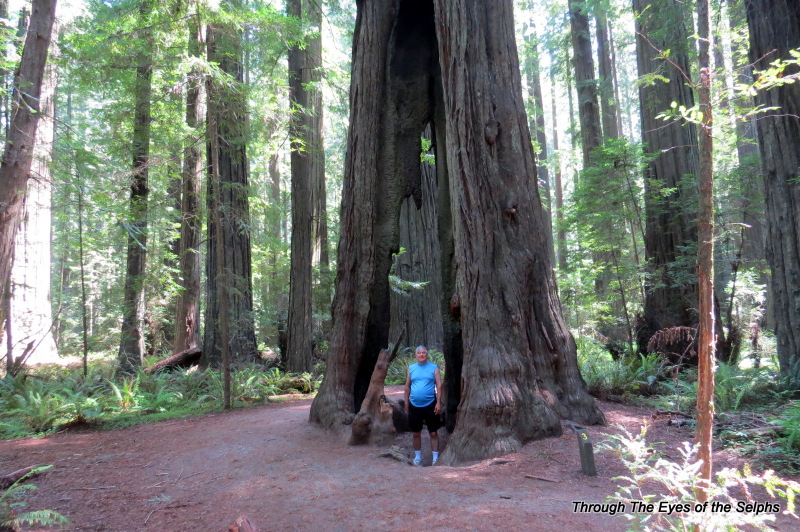
At the junction of CA 1 and 101 we saw a sign for a drive-thru tree and since it was only a quarter mile away we decided to check it out. For the admission of $5.00 you get to drive your car through a redwood tree.  IMG_0358 IMG_0362 IMG_0363These large and tall trees are the “Coastal Redwoods”. What a tourist trap and we didn’t even waste time in the gift shop. One of those glad we did it but once is enough experiences. There are two more such trees in this area but we will skip those. As we drove into Redcrest on 101 we saw many little gift shops and tourist attractions all taking advantage of the popularity of the beautiful redwoods in this area of California. We have traded the beauty of the Pacific coast for the magnificence of the redwoods. Away from the coast the temperature has gone up about fifteen to twenty degrees and everywhere we saw forests and redwoods. Beautiful!

We arrived in our campground in Redcrest on the Avenue of the Giants.  Redcrest is another small town with a population of 112 and relies heavily on tourism. We had good cell phone service in the main area of Redcrest but not in the campground.

Our first full day there we drove to Shelter Cove which was about a ninety minute drive from our campground.  It had been recommended by a campground neighbor and some tourist brochures.   I guess we have been spoiled by the beauty of the Pacific coastline because a long drive over very winding and curvy roads which climbed and then descended over 2,200 feet,  we arrived at Shelter Cove and were disappointed by the lack of views and beach there.  It certainly did not begin to compare to what we had seen in our previous travels up CA 1.  We did see a lighthouse there which at one time was further up the coast at Cape Mendocino. IMG_0364 The lighthouse was built in 1868 and lighthouse keepers had to take a small tender boat out to the lighthouse.  Due to the isolation this lighthouse was not a favorite of lighthouse keepers and it seems that men who did not follow orders or needed to be disciplined were sent to this lighthouse.  In 1948 the lighthouse was dismantled and moved into storage.  In 1999 it was moved and restored to Shelter Cove.

Before leaving Shelter Cove we did manage to find one geocache and saw some deer up close. IMG_0380 IMG_0371


The weather certainly warmed up with temperatures in the upper eighties and low nineties for several days.  This was quite a shock after the cool temperatures we experienced along the coast!  Avenue of the Giants is a thirty-mile 2-lane scenic driveIMG_0387 on what was once U.S. 101 surrounding by 51,222 acres of magnificent redwood groves. IMG_0427 IMG_0426 IMG_0423 IMG_0403 It is said to be the greatest display of Coastal Redwoods in the 500 mile redwood belt.

IMG_0408 IMG_0398 IMG_0389 IMG_0381  While in Redcrest we spent several days driving along the scenic Avenue of the Giants which is parallel to U.S. 101 and is surrounded by Humboldt Redwoods State Park.  The state park, established in 1921 to protect these magnificent trees,  is the third largest California state park and includes the Rockefeller Forest which is largest remaining old growth redwood forest in the world.  With 53,000 acres, it has many trails to hike and we also found several geocaches.


One trail we walked was the Gould Grove Nature Trail which has the third largest known redwood tree in circumference.  We also tried to find a geocache which included a rare albino redwood tree which is one of only a couple dozen known to exist.  We didn’t really know what an albino redwood was supposed to look like and couldn’t find anything that we thought resembled one.  We stopped by the Visitors Center and asked one of the rangers.  He gave us a paper with directions and it seems they rarely give the directions out because people have been known to touch the tree and pull off leaves so they stopped publicizing its existence.  We quickly found the tree and it was not what we expected.  The needles/leaves of the tree are white instead of green.

IMG_0429 IMG_0430


The same day we hiked to the Women’s Federation Grove which was founded in the 1930’s by members of the California Federation of Women’s Clubs.  Here there are picnic tables made from thirty to forty foot long redwood logs.  Today the area can be used for picnics since there are also grills and restrooms.  The focal point of the grove is a covered four-sided fireplace

IMG_0433designed by Julia Morgan, who also was the architect for Hearst Castle.

Along the top of each fireplace is an inspirational message.  Here are a couple favorites:

IMG_0435 IMG_0434On this day we were the only ones there and it was truly peaceful and tranquil with a river flowing alongside.


Later in the day we took another trail which led us first IMG_0445 IMG_0444to the “Tall Tree”.


Later we walked to the “Giant Tree”.

IMG_0452 IMG_0451 IMG_0456  This area was also used in the filming of the Stars War movie “Return of the Jedi”.  Since the seasonal bridge had not yet been placed for the summer, we had to cross a 20 foot wide stream with water up over our ankles.  When we got back to the car we had to wring water out of our socks!  But it was well worth it to see the Giant Tree and this beautiful area.


The next day we drove along the Avenue of the Giants to Founders Grove Nature Trail where we saw many amazing redwoods including the Founders Tree and
IMG_0467

IMG_0463


IMG_0480


IMG_0478


the Dyerville Giant which fell in 1991. They think it had been standing for as long as 1,600 years and was taller, larger and older than any tree around it.  It was 370 feet tall which is two feet taller than Niagara Falls, was seventeen feet in diameter and fifty-two feet in circumference, and weighed over one million pounds.  When it fell it registered on the seismograph and the locals said it sounded like a train wreck.  What an amazing week we had!

IMG_0483 IMG_0491

May 5, 2014 Manchester, CA

We left lovely Bodega Bay and headed north up California Highway 1. This road gives breathtaking views of the Pacific coastline that is unlike any other, but the drive itself is mean with many curves that include several horseshoe turns.IMG_0273 I think those crazy Mexican roads helped prepare Bill for driving an RV on CA 1, and I am thankful we are traveling north instead of south since the southern route is against the coastline with rugged cliffs and steep drop offs. An RV heading south passed us and I swear the driver had a look of sheer terror on his face!

We stopped at Fort Ross State Historic Park IMG_0238which is one of the oldest parks in the California State Park System. This 3,386 preserve was North America’s southern most Russian settlement. Members of the Russian-American Company founded the Fort Ross Colony in 1812. The nearby Metini natives have lived in this area for centuries and did not seem to mind the Russian building their fort. Earlier history shows that in 1784 the first permanent Russian settlement was built in what is now Alaska.

In 1812 twenty-five Russians and eighty Alaskan Alutiiq natives built houses and a stockade with the purposes of growing wheat and other crops for Russians living in Alaska, hunting marine animals and trading with the Spanish. The fort was dedicated in August 1812 and named Fort Ross in honor of Imperial Russia, also called Rossilia.  IMG_0242 IMG_0245 IMG_0249


Fort Ross also has a chapel with a beautiful redwood vaulted ceiling

IMG_0248


as well as a windmill that was the first windmill in California.IMG_0240 IMG_0241 The fort also has the first glass windows in California. The grounds also contain a Russian cemetery. In December 1841 Fort Ross was sold to John Sutter and then in 1873 to George Call who established the Call Ranch. In 1903 the California Historical Landmarks Committee purchased the Fort Ross area from the Call family and the State of California acquired it in 1906.

Bill and I found this area very interesting since we never knew there was a Russian settlement this far south. We enjoyed touring the Visitor Center, seeing a movie about the history of the fort, and walking around the grounds. We also learned that a special Cultural Heritage Day is held in July where they hold religious ceremonies in the chapel.

I have mentioned in other posts that this coastal region can be extremely windy.  We came across this tree while walking on the grounds. IMG_0254 It is not unusual to see this trees along the coast. Fort Ross is certainly located in a beautiful setting!  IMG_0244


In the parking lot Bill spotted an RV with Florida tags so we walked over to chat with them. We are always happy to meet fellow RVers and this couple are also full timers. They too find CA 1 very difficult to drive on which included their dog getting very carsick. We learned they are following the same route as us for several months so hopefully we will meet up with them again.

While we were at Fort Ross we kept hearing the barking of seal in the distance. We drove a little farther up the coast and stopped at one of the many turnouts. Bill always scares me when he gets too close to a cliff in his quest for that perfect picture. It is hard to tell from this picture I took from a safe distance away, but he was standing at the top of a huge cliff IMG_20140504_153851looking over the side at some seals and their babies resting on some rocks.


He got some great pictures of the seals and their babies using his 50X zoom.  IMG_0255 IMG_0259 IMG_0260 IMG_0261 IMG_0266 IMG_0267


We also came across some seals lying on the beach where the Russian River meets the Pacific Ocean

IMG_0284 IMG_0283


and discovered a beautiful arch rock.

IMG_0236 IMG_0237 IMG_0234


IMG_0288


The seventy-mile drive from Bodega Bay to Manchester took almost three hours of driving time not including stops which tells you something about the difficulty of driving an RV on this road with many 20 MPH curves. We did enjoy the ocean views on one side and pasture land with cattle on the other. At one point we saw a field of sheep with lambs running after their mamas. Thankfully we arrived safely at our next stop in Manchester where we will stay for three days.