Category Archives: National Landmark

National landmark or historical place

Valley of Fires, NM OCT 17, 2017

By the time we left Albuquerque we were really tired from all the early mornings and physical exertion from the Balloon Fiesta.  After filling the RV up with propane we headed south to Valley of Fires Recreation Area where we had a very nice electric and water site overlooking the lava fields.  This may be the youngest lava flow in the continental United States, with scientific evidence estimating that the most recent flow occurred 1,500 to 2,000 years ago.  The lava spewed from volcanic vents, covering the valley floor.  Occasionally it would surround areas of higher ground, forming islands called “kipukas”.  Our campground was located on a kipuka.

IMG_20171020_133558

The campground is surrounded by the lava field

20171020_124711

In the lava fields we hiked a very nice paved walkway where we saw lava, in some cases smooth like blocks and in other areas more ropy-looking.  20171020_13162120171020_13181020171020_132151

The lava is more than 160 feet thick near the center and covers over 125 square miles.  20171016_125532IMG_20171016_153241IMG_20171020_132521IMG_20171020_132545

We could see pressure ridges, collapsed lava bubbles, fissures, pits, collapsed lava tubes and rock shelters.  IMG_20171020_13034820171020_131158

We loved seeing all the cacti and plants growing among the lava.IMG_20171016_153322

Valley of Fires is located just outside of the town of Carrizozo, NM.  In the period between 1910 and 1920 it was a thriving railroad town and open for homesteading, with many railroad families claiming their 640 acres of free land.  With the modernization of railroad machinery and the introduction of new diesel engines, the need for the town’s railroad workforce was eliminated.  Today Carrizozo has a population of 940 and the town is showing signs of disrepair.  One of the main streets was used in a post apocalypse scene from the 2010 movie “The Book of Eli” with Denzel Washington.

IMG_20171017_132037We had planned to rest and relax here but we seem to always find things to do wherever we go!  Tuesday we drove an hour north to the Salinas Pueblo Missions National Monument.  This is made up of three pueblos and 17th century Spanish Franciscan missions.  The missions were abandoned in the late 17th century and the masonry ruins are surprisingly intact.  We first went to the Visitors Center to see a short film and view the exhibits.  

The three ruins, called the Abo Ruins, Gran Quivira Ruins and the Quarai Ruins, are within a thirty mile radius of each other.  Before the Spaniards came, these pueblos were major trade centers, with salt from the nearby salt lakes being an important trade commodity between the Pueblo and Plains Indians.  Between 1630 and 1680, Franciscan missionaries and Spanish colonists came and built churches using Indian labor and forced their religion and way of life on the Native Americans.  Drought, famine, disease and Apache raids were devastating on the Pueblo people.

IMG_20171017_133633First up was Quarai.  Here are remnants of church walls and remains of what was once a bustling Indian pueblo and Franciscan mission.  At one time the square was surrounded on three sides by blocks of stone houses three stories high.  Over 600 people hunted, farmed and traded goods and salt from nearby lake beds.  The first stone houses were built here around 1300.  By 1677, Quarai was deserted.20171017_13401420171017_13460220171017_134714IMG_20171017_135155

IMG_20171017_142306Next was the Abo Mission.  When the first Spanish priest walked into Abo in 1622, nothing would ever be the same for the Native Americans again.  Life as they knew it changed forever.  Artifacts uncovered from this area included a ceramic candlestick, mother-of-pearl cross and stone effigies all telling the story of conflicting religions.  We saw a large kiva, which is an underground meeting chamber for conducting religious ceremonies, teaching children, telling stories and weaving.  20171017_14271320171017_143008IMG_20171017_143044

The Franciscan priest supervised the construction of the massive church using Pueblo labor.  The walls were sandstone held together with mud mortar and plastered white with gypsum on the inside and whitewashed adobe on the outside.  When it was completed in 1651 it resembled the fortress churches in Mexico.IMG_20171017_142755

Last up was Gran Quivira, the largest of the pueblos.  At one time it was a village of more than twenty masonry house blocks and between 1,500 and 2,000 people.  There were approximately 300 rooms and six kivas.  They occupied this area for over 900 years.IMG_20171017_152715IMG_20171017_154304IMG_20171017_15442420171017_154902

20171018_131635Thursday we drove a short distance to the Three Rivers Petroglyph Site.  The Jornada Mogollon people carved more than 21,000 designs of humans, birds, animals, fish, insects, plants and geometric shapes in the basalt of the Three Rivers Valley in over 50 acres of the northern Chihuahuan Desert.  This area is one of the largest rock art sites in North America.  We followed a trail, somewhat challenging at times, through the desert looking at the petroglyphs and keeping a vigilant watch for rattlesnakes. 20171018_135949 

Thankfully we didn’t see any, but Bill did see a rattlesnake crossing the road across from our RV at the campground!  We only have a few pictures to show you because the pictures accidentally got deleted when transferring from the camera to the laptop.  Oh well, stuff happens sometimes!  

Here is a link to the BLM site where you can see some petroglyph pictures located at Flickr.

On Saturday we drove 45 minutes to Ruidoso to have lunch with Bill’s cousin Julie and her daughter.  Bill and Julie had not seen each other for 35 years!  We had a nice time catching up.IMG_20171021_145412

Next stop: A visit to Carlsbad Caverns National Park

Cochiti Lake COE, NM SEPT 25, 2017

After a short stop in White Rock we headed to Cochiti Lake Corps of Engineering campground about thirty miles outside of Santa Fe. It was a beautiful drive.20170922_10594220170922_112220

Cochiti Lake is located on the Rio Grande, the fifth longest river in North America.  The name Cochiti comes from the Native Americans who have lived in the area for over seven hundred years.  We passed through several Indian reservations on our way from White Rock to Cochiti Lake.  Many had signs prohibiting photography.IMG_20170924_155357

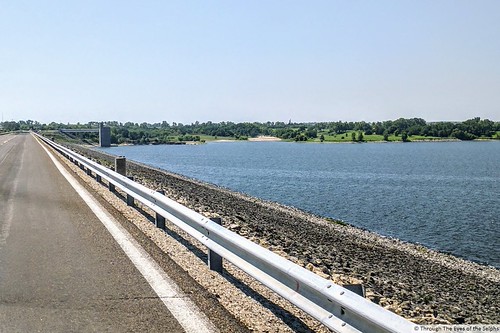
Cochiti Lake has one of the ten largest earthen dams in the United States.  It is 5.5 miles long and is 251 feet tall to enclose water from the Rio Grande and Santa Fe Rivers.  We paid a visit to the Dam Visitors Center.  A couple from Martinsville, Virginia was also visiting and it was nice to meet someone from my birth state!IMG_20170924_154626

On Monday we drove into Santa Fe, the oldest (407 years) and highest (7,000 ft above sea level) capital city in the United States.  We were there in 2015 and you can read about that visit here: Santa Fe, NM May 23, 2015 IMG_20170925_130324

This visit we wanted to tour the state capitol building.  The original capitol building was the Palace of Governors built in 1609 on the Plaza and served the Spanish, Mexican and American governments.  This current capitol building was constructed in 1966 and is the only round state capitol building in the United States.  IMG_20170925_122655IMG_20170925_123033

The building design forms the Zia sun symbol, a design found on a 19th century water jar from the Zia Pueblo.  The sun with four rays symbolizes the four directions, the four seasons, the four times of the day (sunrise, noon, evening and night) and life’s four divisions (childhood, youth, adulthood and old age).  The circle represents the circle of life, without a beginning or end.IMG_20170925_124249

 The Zia also believed man has four sacred obligations: strong body, clear mind, pure spirit and devotion to the welfare of his people.  We enjoyed walking around looking at the beautiful Native American and southwestern artwork. 20170925_12333420170925_12352220170925_12455820170925_12484620170925_124950

Of particular interest was a buffalo head made completely out of recycled materials including old paintbrushes, paper-mache, scrap metal and movie film.IMG_20170925_124309IMG_20170925_124454IMG_20170925_124503

On the way to lunch we stopped by Cross of the Martyrs, a park that was once the site of Fort Marcy and has a spectacular view of Santa Fe.  The white cross commemorates 21 Franciscan priests killed during the Pueblo Revolt of 1680.IMG_20170925_131428

We had lunch at a local recommended Mexican restaurant.  We struggled to eat our lunch with the hot green chile sauce.  Can you see the pain on Bill’s face?20170925_135626IMG_20170925_135646

After lunch we drove several miles east to the Pecos National Historical Park.  The Park was formed in 1990 and had a Visitors Center with an interesting movie and exhibits.IMG_20170925_143622

The area has a rich history.  From 1350-1838 it was home to the powerful Pecos Pueblo with pueblos rising four to five stories high and home to 2,000 people, including 500 warriors.  In the 1540’s Spain tried to colonize the area and convert the people to Catholicism.  Coronado and his men searching for the seven cities of gold clashed with the powerful, determined Pecos.  In the early 1600’s Franciscan friars again tried to convert the Pecos, destroying kivas, smashing statues and banning Pueblo ceremonies.  In 1621 a friar arrived who acknowledged the Pueblo culture, language and beliefs while also trying to educate and convert them.  A large mission church was built, some of which is still standing and we were able to visit.20170925_14480720170925_15081820170925_150834

By the late 1700’s, drought, disease, migration and Comanche raids greatly decreased the Peso population and by 1838 the last of the inhabitants had moved from the region.  From 1915-1929 archeological excavations of the site were done to study and save the remnants of six hundred plus years of human occupation.20170925_15153020170925_15164720170925_15173820170925_15191220170925_152648IMG_20170925_152117IMG_20170925_152609IMG_20170925_152011

In 1925, a man purchased 5,500 acres and created the Forked Lightning Ranch which was sold in 1941 to Buddy Fogelson, husband of actress Greer Garson.  In 1991 Greer Garson sold the ranch to a Conservation Fund which then donated it to the National Park Service.20170925_150917

There is always work to do!

Santa Fe facts:

  • Population of 82,800 (Santa Fe county is 147,423)
  • 37 square miles (Santa Fe county is 121,298 square miles)
  • Averages 325 days of sunshine a year
  • USA Today Readers’ Choice named it one of Top Historic Cities in the U.S.

White Rock, NM SEPT 20, 2017

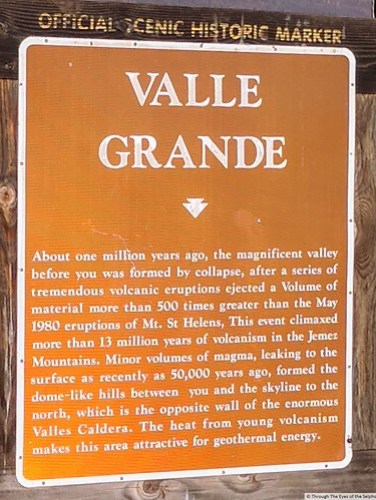
We left Abiquiu COE campground and headed to White Rock, New Mexico, elevation 6,365, just outside Los Alamos.  This was a short two night stopover, mainly to visit the Valles Caldera National Preserve, one of three super volcanoes in the United States.  The 89,000 acre Preserve is one of the newest additions to the National Park Service in October, 2015.  The Valles Caldera supervolcano erupted 1.2 million years ago and the center of the volcano collapsed, creating a volcanic caldera 13.7 miles wide.IMG_20170921_080004IMG_20170921_075645

Since they only allow thirty cars a day to drive around the backcountry of the Preserve, we got up earlier than we normally do to make the thirty minute drive there in order to arrive when they opened at 8:00 A.M.  It was a good thing we did because archery hunting season has begun and by the time we arrived fifteen of the passes had already been given out to hunters looking for elk.IMG_20170921_075709IMG_20170921_084139

We received our car pass from the ranger at the Valle Grande Contact Station and began our drive around the Preserve.  We were at an elevation of almost 10,000 feet and the car thermometer registered 28 degrees!IMG_20170921_083421  Can’t remember the last time we were in weather that cold. As we began the drive in the Valle Grande Valley, we saw a couple prairie dogs. We drove on unpaved roads around the dormant volcano caldera with expansive valley meadows, lush forested volcanic domes and streams where we saw an occasional fisherman.  Even though herds of elk and black bear also live in the Preserve, we only saw deer, cattle and prairie dogs.  Scenes from the 2013 movie “Lone Ranger” were filmed here.

IMG_20170921_083348

Prairie Dog

Los Alamos is famous as “The Secret City”, site of the top secret Manhattan Project during World War II which focused on atomic bomb design and testing.  When we were here in 2015 we toured the Bradbury Science Museum and the Los Alamos History Museum Campus.  You can read the blog about that visit here: Los Alamos, NM May, 20 201520170921_13224420170921_132336IMG_20170921_14503020170921_13200320170921_132059

This visit we wanted to see the new Manhattan Project National Historical Park operated by the National Park Service.  It is one of the few national parks that focuses on American science, technology and industry during World  War II.  We watched the movie about the Manhattan Project and looked at exhibits in the Visitors Center which focused not only on science but also the social and cultural life of the people who lived and worked in the “Secret City”.  Located in the Historical Park are life size bronze statues of Dr. J. Robert Oppenheimer and General Leslie R. Groves, leaders of the Manhattan Project.IMG_20170921_145021IMG_20170921_124449

IMG_20170921_141814

This is Where Dr. J. Robert Oppenheimer Lived

IMG_20170921_142836IMG_20170921_142817

Since we were last there the History Museum had been remodeled and additional exhibits added so we paid a second visit there.IMG_20170921_152816

IMG_20170921_152747

The Road To Los Alamos

The two days went by quickly and it was time to head to Cochiti Lake, outside of Santa Fe.

20170920_123935

Available at Local Grocery Store

Angel Fire, NM SEPT 4, 2017

As we continued our stay in Eagle Nest, one day we drove ten miles to visit the nearby town of Angel Fire.  The name Angel Fire comes from the Moache Ute Indians in the 1780’s.  During their autumn celebration they noticed red and orange flickering in the northern sky.  They saw it as a blessing of the fire gods and named their yearly celebration “Angel Fire”.  Years later Kit Carson mentioned seeing the Angel Fire at dawn and dusk and accredited the glow to sunlight striking frost on the branches of trees.

Eagle Nest and Angel Fire are very popular ski resort areas in the winter and fishing in the summer.IMG_20170905_123706

Some of the TV series “Lonesome Dove” was filmed around Angel Fire.  We drove to the location where the closing cabin scene was filmed here at Black Lake and meadow.  The property is now privately owned and we could not get close for a great picture. IMG_20170905_130104

After lunch at the local barbecue restaurant, we visited the Vietnam Veterans Memorial.  This Memorial was the first major Vietnam Veterans Memorial in the United States.  It was built by Dr. Victor and Jeanne Westphall to honor their son, 1st Lt. David Westphall who died in combat in a 1968 ambush in Vietnam.  In 1994 Dr. Westphall visited  the site in Vietnam where his son died. He took with him a handful of soil from the Memorial to scatter at the site of the ambush.  He also brought back Vietnamese soil from the site and scattered it at the Memorial.   

This Memorial received national attention in the 1970’s and was the inspiration for the Vietnam Veterans Memorial in Washington, D.C in 1982.  In 1987 the Angel Fire Memorial was recognized as a Memorial of National Significance.  IMG_20170905_133307IMG_20170905_133046IMG_20170905_160200

Today the Memorial is maintained by the David Westphall Veterans Foundation and the New Mexico Department of Veterans Affairs.20170905_15250020170905_15273120170905_152653

At the entrance to the free Memorial is a Huey helicopter which served two tours in Vietnam.  On its first tour it was badly damaged with 135 bullet holes, repaired and sent for a second tour.IMG_20170905_133743

Along the sidewalk leading to the Visitors Center are sponsored bricks with names of veterans.  The dates are dates of service.  Two stars signify a person killed in action and one star is missing in action.  New bricks are added every September and bricks were being added while we were there.

20170905_134650

Pop Music Was Nostalgic Reminder of the World They Left Behind

This statue is of a soldier in the field trying to write a letter to keep in touch with family back home.  It is called “Dear Mom and Dad”.IMG_20170905_13382220170905_133826

The Visitors Center has exhibits and a very moving ninety minute HBO documentary titled “Dear America: Letters Home From Vietnam”. It was extremely moving; there are no words to describe the power of the movie.  

The Visitors Center has over 2,000 photos.

IMG_20170905_134709

98 Pairs of Empty Boots Bear Witness to the 173rd Airborne Casualties from the Battle For Hill 875

Just like the Memorial in Washington, D.C., notes and mementos are left around the Memorial.  They collect them and put them on display in the Visitors Center.  One brief, heartfelt note caught my attention.  Well said!20170905_154151

This painting shows a shackled eagle, representing the frustration and futility of being captured.   The Statue of Liberty in the distance and sunshine represents freedom and a ray of hope for the future.20170905_152845

In a separate area is the Peace and Brotherhood Chapel which displays a photo of David Westphall and rotating photos of thirteen men also killed in the ambush.20170905_15162720170905_15433320170905_15430620170905_154245

Many Native American volunteered and died in Vietnam.IMG_20170905_154326IMG_20170905_153308

Next up: A drive on the Enchanted Circle

The Enchanted Circle, NM SEPT 2, 2017

On August 31st we drove further west to Eagle Nest, elevation 8,238 feet.  At this elevation we had nightly temperatures in the upper 30’s and low 40’s.  Time to turn on the heat and add a second blanket!  The daytime temperatures were very pleasant  Due to the short drive and mountainous roads, I drove the tow car instead of towing it behind the RV.  I managed to get a picture of our RV ahead of me as we approached picturesque Eagle Nest Lake.20170831_123607

IMG_20170901_150049We had a nice campsite with the only problem being very weak Verizon cell phone service and unreliable WiFi furnished by the campground.  One day we went a mile up the road to the Eagle Nest Public Library to use their internet to get a blog published.  While we were there a storm came up quickly with heavy rain and hail.  The temperature dropped almost thirty degrees and we were cold on the short drive home without a jacket or coat.

On Saturday we drove the 84 mile Enchanted Circle Scenic Byway.  We began in Eagle Nest and traveled counterclockwise around the circle, passing through many small towns.  We climbed steadily to Bobcat Pass and then dropped down slightly into the town of Red River, a popular ski area and summer resort. IMG_20170902_110136IMG_20170902_110740 

We stopped by a pretty little red schoolhouse.  I am always partial to these little schoolhouses.IMG_20170902_111152

This area of New Mexico was once a prosperous, productive mining district, securing six million dollars of gold between 1866 and 1907.  Surface ore was rapidly depleted and by the 1930’s all mining had ceased.  The only thing that kept the area alive was the creation of a dam built between 1916 and 1921.  The dammed water became known as Eagle Nest Lake.  The towns of Eagle Nest, Angel Fire and others became popular hunting, fishing and winter resort areas.  In Red River and other towns we saw ski slopes and lodges.

As we continued on to the town of Questa we traveled through the Carson National Forest.  The views were lovely but hard to capture on camera.  There was a haze from the forest fires to the northwest.  This haze continued our entire stay in Eagle Nest.  It wasn’t enough to cause us breathing problems but an obvious haze which the local tv station said was coming from the western wildfires.

IMG_20170902_123601We took a short detour to the Rio Grande del Norte National Monument to see the Rio Grande Gorge Bridge.  It is 1,280 feet long and towers 565 feet above the Rio Grande River.  It is the seventh highest bridge in the United States and 82nd highest bridge in the world.  The bridge was in several movies including “Natural Born Killers”, “Twins”, “White Sands”, “She’s Having a Baby”, “The Signal”, “Wild Hogs” and “Terminator Salvation”.20170902_123831IMG_20170902_122241IMG_20170902_12285620170902_12421420170902_124322IMG_20170902_12462320170902_124946

Near bridge are many vendors, especially Native Americans, selling their wares.

Next up was the town of Taos where we stopped for lunch and did some grocery shopping.  The town was crowded with Labor Day weekend visitors.IMG_20170902_134447

Before heading home we drove by the Orilla Verde Recreation Area to check it out as a possible future camping location.  We decided not to camp there but we really enjoyed seeing kayakers on the Rio Grande and big horn sheep grazing on the hillside. IMG_20170902_152545IMG_20170902_155059IMG_20170902_163028 

The sheep were pretty far away and blended in with the landscape so it was difficult to get a good picture.

Another great day in New Mexico!

Abilene, KS August 18, 2017

From Topeka we headed west to Milford Lake State Park in Milford, Kansas.  Milford Lake is the largest lake in Kansas made from the 16,000 acre Milford Reservoir, the largest reservoir in Kansas. IMG_20170817_121647 

One day we made the short drive to Abilene to visit the Dwight D. Eisenhower Presidential Library, Museum and Boyhood Home.  

Eisenhower is the 34th President and the only five star general to ever be elected President.IMG_20170817_154143IMG_20170817_154253

Located on a twenty-two acre site, the Eisenhower Presidential Library and Museum is made up of five buildings all within close walking distance.  Within the site:

  • twenty-six million pages of historical records and papers
  • 335,000 still photographs
  • 768,000 feet of original motion picture film
  • 70,000 artifacts

20170817_125937First we stopped by the Visitors Center and saw a twenty-five minute film on his life.  Next we visited his boyhood home.  Even though he was born in Denison, Texas in 1890, he always considered Abilene his hometown since his family moved there when he was a year and a half old.  He was one of seven sons.  All the boys were called “Ike”, an abbreviation of their last  name. By World War II, only Dwight still used the nickname.  

In the parlor of his boyhood home sits the radio the Eisenhower boys bought their mother so she could keep up with the news of the war. 20170817_133545 

The Boyhood Home was opened to the public in 1947.  The Eisenhower family lived here from 1898 until his mother died in 1946.  His parents were deeply religious and belonged to the River Brethren, a Mennonite sect with Dutch Pennsylvania origins.  The family often spent time reading aloud from the Bible.  His mother was a pacifist who was very saddened to learn  Dwight wanted to enter the military.  Growing up on the farm in Abilene his parents taught Ike humility, the value of hard work, respect for learning, discipline and spiritual devotion. Dwight’s mother sometimes had to take history books away from him so he would pay attention to his other subjects in school. IMG_20170817_133238 

His childhood heroes were Hannibal, George Washington and Robert E. Lee.  In 1909 the high school yearbook predicted that Dwight would become a history professor at Yale and his brother Edgar would be President of the United States.  Both his parents attended a small college and four of the sons graduated from college.  Every President since Eisenhower has had a college education.IMG_20170817_144727

Next we visited the museum, dedicated in 1954.  This museum was noticeably different from the previous Presidential museums we have visited.  Ten percent was dedicated to cowboy and pioneer life in old Abilene (Chisholm Trail), fifty-five percent to World War II and his military career and about thirty-five percent to his personal life and Presidency.  It is one of the very few Presidential Library and Museums we have been to without a replica of the Oval Office.20170817_134723a20170817_134756

Abilene was originally founded in 1856 and called Mud Creek, the town was renamed Abilene in 1860 after a Bible passage in the Book of Luke. The American style cowboy boot is believed to have started in Abilene when bootmaker Thomas C. McInerny made a pointed toe boot with a high heel that would stay in the saddle.  It replaced the Confederate Cavalry boot.  McInerny advertised his boots in the late 1860’s, probably making his shop the first to produce the modern cowboy boot in America. At one point McInerny employed fifteen men in his shop.  

Eisenhower enjoyed reading westerns and watching western  TV shows and movies.  He loved receiving western theme gifts.  On display is a pair of cowboy boots specially made for him.  Notice the capitol building on them.  He was a cattleman on his farm in Gettysburg, Pennsylvania where he raised Angus cattle (see our previous post of October 1, 2016).20170817_135101  

Eisenhower accomplishments:

  • Graduate of the United States Military Academy and a professional soldier.  Actually he had wanted to attend the Naval Academy at Annapolis, Maryland but at age twenty was too young to enlist there.  
  • At the Military Academy he was more interested in sports than academics. His final class standing was 61st in grades and 125th in demerits.20170817_135345
  • Served as Commander-in-Chief of Allied Forces in Europe during WWIIIMG_20170817_143723IMG_20170817_14424420170817_143510
  • Military governor of the American zone of occupation in Germany
  • Chief of Staff of the U.S. Army
  • Supreme Commander of NATO

    20170817_143311

    Three Display Cases Contained His Metals and Awards

  • President of Columbia University
  • 34th President of the United States.  He was the first Republican president since Herbert Hoover left office in 1933.IMG_20170817_144727  
  • He began his presidential address with a prayer which is mounted on the wall of the chapel where he is buried.IMG_20170817_155518
  • Initiated the country’s first civil rights legislation since post-Civil War Reconstruction
  • Ordered U.S. Army troops to enforce the integration of Central High School in Little Rock, Arkansas, a highly controversial decisionIMG_20170817_152509
  • Construction of the Interstate Highway System which contributed to economic expansion and improved daily lives of AmericansIMG_20170817_151255IMG_20170817_15123520170817_150819
  • His diplomacy kept the “Cold War” cold.  
    • Under Eisenhower’s administration the North Korean and Chinese believed nuclear weapons would be used if necessary.  The two Koreas signed a truce agreement in 1953.  
    • Between 1955 and 1961 the U.S. provided over $1 billion in weapons, financial aid and advisors to the South Vietnamese government, but no military troops.  
    • During the Geneva Summit Eisenhower met with leaders of Great Britain, France and the Soviet Union.  The “Spirit of Geneva” that resulted in the meeting provided hope that a post-Stalin Russia would be less hostile to the United States.  
    • President Eisenhower recognized Castro’s threat in Cuba and approved a covert plan to replace the Castro regime.  His plan continued after he left office.  
  • Created Department of Health, Education and Welfare which Congress had refused under Roosevelt and Truman.  Through HEW, he extended Social Security benefits to previously ineligible retirees.  He pushed vocational rehabilitation to provide assistance to physically disabled people and also increased the minimum wage by 33 percent.
  • Instituted the National Defense Education Act authorizing $1 billion in loans and grants over seven years for college students majoring in science, math or foreign languages.  This was in response to Russia’s launching of Sputnik.
  • Supported nationwide distribution of the polio vaccine and appropriated $28 million to inoculate those who could not afford it.  
  • Convinced Congress to accept a larger public housing program because of a decline in urban cities due to middle class movement to the suburbs, leaving behind mostly poor, black Americans.
  • In response to Sputnik and at Eisenhower’s urging, Congress passed the National Aeronautics and Space Act in July, 1958, creating NASA.20170817_151104
  • Today many people view the technology revolution and breakthrough in satellites, atomic energy and jet airliners to be one of the most lasting accomplishments of the Eisenhower presidency.  He approved the development of reconnaissance aircraft and satellites to provide better technical information about Soviet military efforts.IMG_20170817_151535

Eisenhower suffered a serious heart attack in 1955 but agreed to run for a second term in 1956.  He won re-election against Adlai Stevenson by the largest landslide in history, carrying 41 out of 48 states.  He suffered a stroke in 1957 that left his speech slightly impaired from then on.20170817_135506IMG_20170817_152408IMG_20170817_153106IMG_20170817_152825IMG_20170817_140617

The end of the Eisenhower presidency and the beginning of Kennedy’s signified the end of one era and the beginning of another in many ways.  Eisenhower was the last president born in the nineteenth century, Kennedy the first born in the twentieth.  At that time Eisenhower was the oldest man ever elected president, Kennedy the youngest.  Leaders around the world knew Eisenhower from his leadership roles for over twenty years.  Many foreign heads of state barely knew Kennedy.IMG_20170817_153511

Eisenhower once wrote that he admired above all others three presidents – Washington, Lincoln and Theodore Roosevelt.

Interestingly, a ranking of presidents in 1965 placed Eisenhower well below average.  Over the years as more became known about his presidency, by the year 2000, he was ranked in the top ten. As part of C-SPAN’s third Historians Survey of Presidential Leadership in 2017, almost 100 historians and biographers rated him as fifth best President.IMG_20170817_141948

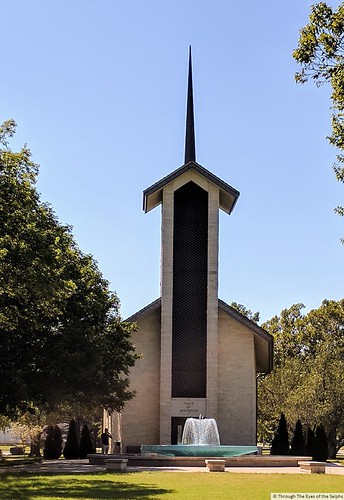
We finished our visit by stopping by the Place of Meditation, a chapel where President Eisenhower, Mamie and their son Doud are buried.  Doud died at the age of three of scarlet fever.  Eisenhower said his son’s death was “the greatest disappointment and disaster in my life”.IMG_20170817_155024IMG_20170817_155306

Eisenhower passed away in 1969 and was brought home to Abilene where he was buried in a regulation U.S. army casket.

I think you can learn a lot by reading a person’s quotes, or what others say about him.IMG_20170817_151421

Quotes by and about Eisenhower:

  • “The final battle against intolerance is to be fought – not in the chambers of any legislature – but in the hearts of men”. Campaign speech, 1956
  • “Always try to associate yourself closely with and learn as much as you can from those who know more than you, who do better than you, who see more clearly than you.  Apart from the rewards of friendship, the association might pay off at some unforeseen time – that is only an accidental byproduct.  The important thing is that the learning will make you a better person”.
  • “Desire may sometimes have to give way to a conviction of duty”.  (Eisenhower was reluctant to run for president, calling the idea absurd.  In 1945 President Truman told Eisenhower he would support him for President in 1948, even joking he would agree to be Vice-President.  In 1952 when leading Republican candidate Senator Robert A. Taft refused to support the United States providing troops to NATO, Eisenhower agreed to run.  By 1952, an estimated eighteen million American homes owned a television set, making it the first televised campaign.IMG_20170817_152703IMG_20170817_145730
  • “God help the nation when it has a President who doesn’t know as much about the military as I do.”
  • “Ike could be reelected even if dead.”   columnist Walter Lippmann on Eisenhower’s possible third term as president even though he was constitutionally prevented from running for a third term.  Eisenhower had an average approval rating of 64%.
  • “My principal political disappointment was the defeat of Dick Nixon in 1960.”
  • “There is no victory in any war, except through our imagination, through our dedication, and through our work to avoid it.”
  • “One of my major regrets is that as we left the White House I had to admit to little success in making progress in global disarmament or in reducing the bitterness of the East-West struggle.  But though, in this, I suffered my greatest disappointment, it has not destroyed my faith that in the next generation, the next century, the next millennium, these things will come to pass.”
  • “If all that Americans want is security, they can go to prison.”
  • “I wish to say a word directly to our young people.  It will soon be your country to run, and you should be interested and personally involved.”
  • “America will be a lonely land without him.  But America will always be a better nation – stronger, safer, more conscious of its heritage, more certain of its destiny – because Ike was with us when America needed him.” Lyndon Baines Johnson
  • “He was a general who truly hated war, but who hated the Nazis more.  He was the President who made a peace and kept the peace and this provided the conditions that made it possible for the American people to exercise their rights to pursue happiness.” Stephen E. Ambrose

Topeka, KS August 12, 2017

Our time in Independence, Missouri was over and we made the short trip over the border into Kansas, a new state for us.  We were excited about our plans to explore Kansas over the next several weeks.20170811_111743

First stop was at Rock Creek State Recreation Area in Perry, just outside of Topeka.  We had a lovely view of Perry Lake.  Bill has really reserved some campsites with wonderful views!20170813_133029

Topeka is the capital of Kansas, so on Saturday we headed into Topeka to tour the Capitol building.IMG_20170812_095326

The Capitol was built between 1866 and 1903 and is designed after the U.S. Capitol.  On top of the dome is a 4,420 pound, 22 foot high sculpture of a Kansa Indian.  It is named “Ad Astra” after the state motto “ad astra per aspera” meaning “to the stars through adversity”.  The arrow in his hand is pointing to the North Star. IMG_20170812_09563320170812_111748a 

Kansas was named for the Kansa Indians, a Siouan tribe in the region.  The French explorers were the first to write down the name Kansa.  One French explorer wrote Kansas on a map and soon everyone was calling it Kansas.20170812_104615

We don’t usually take guided tours of Capitol buildings because we prefer to take our time and wander around looking at exhibits and taking pictures.  But since a tour was about to begin when we arrived, we decided to go along.  IMG_20170812_101513

The building has beautiful murals and statues to famous Kansas people including Dwight Eisenhower, Amelia Earhart and Charles Curtis, the first Native American Vice-President of the United States.

20170812_100236

Dwight David Eisenhower 1890 – 1969 Soldier – US President

20170812_100222

IMG_20170812_101428

Amelia Mary Earhart 1897 – 1937 (?) Aviation Pioneer

IMG_20170812_111642

The murals depicted pioneer life with one mural of abolitionist, John Brown.  Notice the tornado in the distance. IMG_20170812_102606IMG_20170812_11162920170812_10312520170812_101423 

The flags in the Rotunda represent  all the nations that have  claimed all or portions of Kansas: United Kingdom, French Monarchy, the French Republic, Mexico, Spain, Texas, United States and Kansas.  Representative Hall featured marble, gold leaf, and pink columns made  from faux marble. 20170812_101505 

The  Senate chamber featured several types of marble, original native Kansas wild cherry wood desks and hand cast columns with ornate circular grills that helps with air circulation.

IMG_20170812_104107

Senate Gallery

IMG_20170812_104743

House Gallery

We rode the cage elevator, installed in 1923 which requires an elevator operator.IMG_20170812_105522  20170812_110455aIMG_20170812_110645

In 2014, a thirteen year, $330 million dollar renovation was completed.

After touring the Capitol we drove to the nearby Brown v Brown Board of Education National Historic Site.  IMG_20170812_114309It is the only national park named for a U.S. Supreme Court case.  It is located in the former Monroe School, at one time one of four schools for black children in Topeka.  In 1949 parents of six students who attended the school participated in the Brown v. Board of Education lawsuit. IMG_20170812_114346 

On May 17, 1954, the U.S. Supreme Court ruled that “in the field of public education, separate educational facilities are inherently unequal”.  Inside the school today is a museum to the Civil Rights Movement, especially in the field of public education.20170812_123739a

  • Kansas became a state in 1861, the 34th state.
  • President Eisenhower signed the Federal Aid Highway Act in 1956 which began the effort to build a nationwide system of highways.   Today the national system is called the Dwight D. Eisenhower National System of Interstate and Defense Highways and stretches over 46,000 miles across the country.  Kansas was the first state in the country to open an Interstate highway with a portion of Interstate 70 passing through  Topeka.
  • Some early travelers crossed the Kansas plains in wind wagons–wagons outfitted with sails.  It is said they traveled up to forty mph as the wind blew over the plains.
  • The state bird is the western meadowlark.  It is also the state bird of Montana, Nebraska, North Dakota, Oregon and Wyoming!
  • Kansas is part of “Tornado Alley”, an area of the country hit by more tornadoes than any other place in the world, along with Missouri, Nebraska, Oklahoma and Texas.  Kansas doesn’t lead in states with the total number of tornadoes, but it has the record for the highest number of F-5 intensity (most intense) tornadoes since 1880.
  • Kansas state flower is the wild native sunflower.  The sunflower image is on their state road signs.  They flower from July to September and can be up to ten feet tall.IMG_20170812_100143
  • Kansas state tree is the cottonwood.
  • Topeka was established in 1854 by a group of antislavery settlers, seven years before statehood was granted in 1861.  It had one of the most complex Underground Railroad networks in the country, with as many as 23 stops.
  • Payless Shoes was started in Topeka in 1956.  Mars, Inc came to Topeka in 2015 and now produces Peanut M&M’s and Snickers at its Topeka plant.  If you see TOP on the wrapper, it was made in Topeka!

Next stop: Milford, Kansas

Kansas City, MO August 9, 2017

While we were staying near Independence we drove one day into Kansas City to visit The National WWI Museum and Memorial, the world’s most comprehensive WWI collection.  The museum was amazing!

On the top of the Memorial are two Assyrian Sphinxes.  One, named Memory, faces east toward the battlefields of France, shielding its eyes from the horrors of war.  The other Sphinx is named Future and faces west, shielding its eyes from an unknown future.  Around the top of the Tower are carved Guardian Spirits of Honor, Courage, Patriotism and Sacrifice. We began our visit by taking an elevator to the top of Liberty Memorial, a 217 foot tower completed in 1926 with views of Kansas City. IMG_20170809_131238IMG_20170809_133103IMG_20170809_163018 

Sixty-five million people served in the Great War (later referred to as World War One), nine million died and the war involved over thirty-six countries around the world.

On the outside wall of the museum is the Great Frieze, one of the largest sculptures of its kind in the world.  Dedicated in 1935, it is 148 feet by 18 feet and represents the progression of humankind from war to peace.IMG_20170809_162519

The current museum was expanded in 2006 and designated a National Historic Landmark.  To enter the museum you walk on a glass bridge over a symbolic red poppy field, a symbol of the war because they grew profusely on the European fields of war. 

20170809_135046

These 9,000 Poppies Each Represent 1,000 Soldier Lost

Inside are two main galleries, 1914-1917 and 1917-1919.  The amount of information presented through pictures and exhibits was overwhelming.  Each year 500,000 people visit this museum.

One of the best known symbols of WWI was trench warfare.  Both sides dug deep trenches and by the end of 1914 there was a network of over 400 miles of trenches across Belgium and France.  By 1917 there were 35,000 miles of trenches across the Western Front.  Poet John Masefield who served in the British Army called it “the long grave already dug”. Replicas of trenches were located throughout the museum.20170809_145112IMG_20170809_14473520170809_14531520170809_150452IMG_20170809_144709IMG_20170809_145330IMG_20170809_15490220170809_14491120170809_15062020170809_150925

President Woodrow Wilson signed the declaration of war against Germany on April 6, 1917.  Millions were inducted, given basic combat training and by June 1917, U.S. troops had arrived in France.  The army was small and poorly equipped with uniforms the same as those used in 1898 during the Spanish-American War.  Equipment was scarce so in some cases they had to train with wooden guns and rifles.  For many, it was their first time in the military.20170809_15075720170809_153159

Americans across the country answered the call to help by rationing food, buying war bonds or stamps, worked longer hours and enlisted.  Industries switched to producing weapons, ammunition and uniforms.  The American Red Cross auctioned wool from sheep grazing on the White House Lawn, raising $100,000.  The wool was used by Americans to knit socks and sweaters for the troops.  Within a year, America had a military force of four million men and women.20170809_15281220170809_15282120170809_15290020170809_15330420170809_154944IMG_20170809_155638IMG_20170809_155702

Bill’s Grandfather Robert Tucker was a dispatcher motorcycle rider on a motorcycle like this for General MacArthur, 42nd Division, Rainbow Division.

IMG_20170809_160117

20,000 1917 Harley-Davidson Motorcycles were sent Over There!

IMG_20170809_153358

By November 11, 1918 fighting ended on the Western Front and Germany signed an armistice and began to withdraw its forces.  The Treaty of Versailles to end the war was drafted in January by the leaders of the United States, England and France.  In June, Germany signed it but protested the harsh conditions. 20170809_155937 

At the end of the year the U.S. Congress rejected both the Treaty and the recently formed League of Nations.  The United States later signed its own treaty with Germany and never joined the League of Nations.  The League of Nations was replaced 26 years later after World War II by the United Nations.

What else happened during WWI:

  • Herbert Hoover announced the United States sent $1.4 billion worth of food to the Allies in 1917.
  • Wartime Prohibition began with the Food Production Bill, making the U.S. completely “dry” until demobilization was completed.
  • President Woodrow Wilson signed the Selective Service Act which required all men between the ages of 21 to 30 to register for the draft.  It was later extended to men 18 to 45.  On the first day, over 9.2 million men registered at their local draft boards.  Only 252,294 men failed to report.
  • June 1917, Congress enacts the Espionage Act allowing the government to censor mail and making it a crime to aid enemy nations or interfere with the draft.  On July 20th, the first American draftees are chosen by lottery.
  • U.S. Post Office began airmail service and issued the first airmail stamps.
  • “Over There”, a patriotic song written by George M. Cohan was recorded by Enrico Caruso.
  • The first Choctaw Code Talkers, in which Indian languages was used as a substitute for code, occurred during WWI.  They translated field telephone calls, radio messages and field orders.  The code was never broken by the German intelligence.  This led to a greater use of Navajo and other languages as codes by U.S. forces in WWII.
  • March 31, 1918 U.S. begins daylight savings time by Congressional Act to save daylight.
  • The American Legion was formed in 1919 as well as the Women’s Overseas Service League was formed to aid returning WWI veterans.  Congress authorized disability compensation and vocational rehabilitation.
  • “I am back from the front and believe me!!…I have just come out of one of the worst battles and the most deciding battle of the war.  The American soldiers are the most gallant, brave, witty and stubborn fighters in the world”. Corporal John Lewis Barkley, 4th Infantry, 3rd Division in a letter home, November, 1918

IMG_20170809_171117After touring the museum we were famished and made the short drive to Kansas City, Kansas to have dinner at Joe’s Kansas City Barbecue. Bill had ribs and I had beef brisket.  Both really, really good.  Located in a gas station, the long line attested to their reputation.  A newspaper clipping on the wall named them one of the thirteen best places to eat before you die (see #13).IMG_20170809_173531

Kansas City Missouri Facts:

  • Population 460,000
  • Has more than 200 fountains, giving it the nickname “The City of Fountains”; more fountains are here than almost anywhere else except Rome.  In the 1800’s the fountains were used as water troughs for horses.
  • Locals say Kansas City has more barbecue restaurants per capita than any city in the country, earning it another nickname, “Barbecue Capital of the World”.
  • During the 1800’s Kansas City was the last stop for travelers to get provisions as they headed west.
  • During the 1920’s and 1930’s, Kansas City was known as “The Paris of the Plains” because of the many jazz clubs, gambling halls and disregard of Prohibition.
  • Across from the museum was Union Station, built in 1914 and formerly a train station but now a science museum.  We read that more than 79,000 trains passed through the terminal in 1917 and half of all GIs deployed during World War Two passed through this Union Station.IMG_20170809_164252

Next stop: Topeka, Kansas

Independence, MO August 7, 2017

Sunday we left Papillion Nebraska and headed towards Independence, Missouri.  It was a longer travel day than usual for us, but the miles passed quickly.  We passed over the Missouri River and as we passed through Kansas City we caught a glimpse of Kauffman Stadium where the 2015 World Series Champion Kansas City Royals were playing a home game.20170806_10104420170806_133850

We arrived at our campsite at Blue Springs Lake Campground just outside Independence.

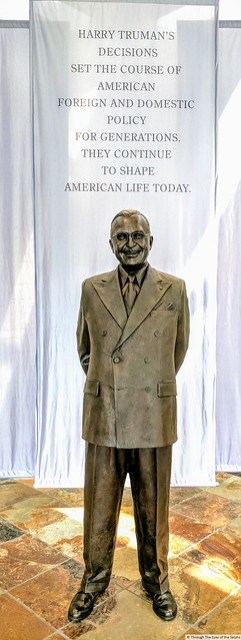
20170807_151330Our main reason for coming to northwestern Missouri was to tour the Truman Presidential Library and Museum in Independence, population 117,000.  This was the first presidential library to be created under the provisions of the 1955 Presidential Libraries Act.  The Presidential Library and Museum was dedicated on July 6, 1957 and Truman actively participated in the day to day operations of the library.  In the lobby is a beautiful mural entitled “Independence and the Opening of the West”.  We began our visit with a video detailing Truman’s life from birth to the beginning of his presidency in 1945.IMG_20170807_134230

Harry Truman, our 33rd President, (1945-1953) was a very simple, common man.  In no way do I mean that in a negative way.  He was a man with humble beginnings on a farm in Missouri.  He did not attend college because his family could not afford it.  He worked in Clinton’s Drug Store at the age of 14, before and after school and all day on weekends, making $3.00 a week.  He was never comfortable with the pomp and circumstance of life in the White House and never warmed to being served his meals by butlers and servants.  After his presidency ended he spent time at his presidential library personally training docents, talking with school groups, answering phones giving directions and answering questions.  

Truman was convinced the White House was haunted.  He didn’t realize it was the White House about to fall down around him!  20170807_14333820170807_143511

We found Truman’s reflections on life in the White House and his thoughts on previous Presidents in letters to his wife and daughter fascinating.  I know these are not easy to read because they didn’t photo well, but I hope you can make them out.20170807_143431(1)20170807_14343120170807_14300320170807_143112

Truman’s political career began as a county administrator.  He once said his years in the Senate were the ten happiest years of his life.  In the Senate he found a brotherhood unlike any other he had ever experienced.

Truman was chosen as Roosevelt’s running mate as a “Missouri Compromise”. Democratic party leaders knew Roosevelt would most likely not survive another term.  They distrusted the current Vice President, Henry Wallace, and Truman was seen as a moderate border state Senator, acceptable to both liberal and conservative Democrats.  At first Truman did not want the job of Vice President.  During the Democratic National Convention, Roosevelt told Truman if he refused the nomination he would be responsible for breaking up the Democratic Party in the middle of the war.  Truman felt the call to duty and accepted.

On April 12, 1945 Truman was summoned to the White House where Eleanor Roosevelt told him the President was dead.  He had only been Vice-President for 82 days.  When he asked Mrs. Roosevelt if there was anything he could do for her, her response was, “Is there anything we can do for you?  For you are the one in trouble now”.  

He was sworn in as the 33rd President later that evening.  The next morning Truman asked reporters to pray for him and said “it felt like the moon, the stars, and all the planets had fallen on me”.20170807_152335
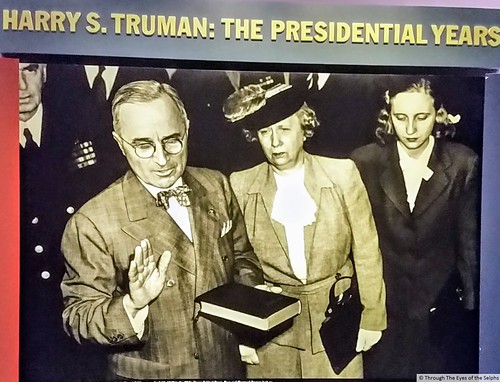
Truman took over as President with a country at war.  Few presidential acts have been met with as much controversy as his decision to use atomic weapons against Japan.  Even though seventy years has passed, the debate continues.20170807_152536IMG_20170807_152705

After the war ended Truman had his hands full with the challenges of shortages, inflation and labor unrest.  The worst shortage was in housing as soldiers came home, married and started families.  During the war little permanent housing had been built because building materials were needed for defense production.  Truman tried to remedy the situation with public housing and federally subsidized homes but his plans were derailed by Congress who felt the marketplace would fix itself.  The shortage persisted.20170807_152942

Here is his Oval Office with TV and back then the reporters were briefed in the Oval Office.IMG_20170807_151840IMG_20170807_152007

During the war, wage and price controls had kept inflation under control but once the war ended, restrictions eased and unions began striking for higher pay.  By February 1946, over two million workers had gone on strike, many in key industries like steel, mining, railroads and automobiles.  Truman ordered government takeover of the mines, railroads and threatened to draft railroad workers into the army.  These steps damaged his relationships with labor unions.

After price and wage controls were lifted after the war, there was a massive rise in inflation. During the second half of 1946, consumer prices rose at an annual rate of 30% and wholesale prices rose 50%, especially in food like meat.  The double digit inflation continued into 1947 and Truman’s popularity plummeted with some wondering if he was up to the job of President.  

But as the economy adjusted to peacetime, production continued to increase which generated large investments in manufacturing along with government spending for military and domestic projects.  The United States was now the world’s economic powerhouse with 7% of the earth’s population which produced half of the world’s manufacturing output.  Per capita income was 50% higher than any other country and unemployment barely averaged 4%.  Americans were now consuming and earning more than ever and the GI Bill provided healthcare, Education Grant’s, as well as home and business loans for veterans.

In 1948, the state of Israel was announced and Truman immediately recognized the new nation, the first country to do so and against the advice of Secretary of State George C. Marshall.  Marshall and others felt the new nation had little chance of survival and it would anger oil producing Arab countries.  Truman felt deeply about the horrors of the Holocaust and the plight of displaced European Jews, but he also knew it would provide Jewish support in the upcoming 1948 presidential election.

He ran for President in 1948, crisscrossing the country in the Ferdinand Magellan, the Presidential railroad car (we have pictures of the car in our Miami blog).  20170807_154741He was the first president to fly on a regular basis. With economic difficulties and low popularity, some questioned his electability.  He lost the support of Southern Democrats with his support of civil rights while others in the party attacked his policy on the Soviet Union.  The Republican Congress had rejected almost all his domestic reform policies.  Many felt he would not even win the Democratic nomination.  The Democratic Party was split.20170807_154659

Who can forget the famous incorrect newspaper headline the day after Election Day?20170807_15480520170807_154849

The Presidential Museum had interesting exhibits on the beginning of the Cold War which dominated his second term, overshadowing his domestic agenda of national health insurance, housing, civil rights and federal  education.  Little of what he called the “Fair Deal” was made law.20170807_155006

Truman’s foreign plan was to abandon isolationism and contain the Soviet Union through economic and military action. This led to the Truman Doctrine in 1947 and in 1948 the Marshall Plan.20170807_15413820170807_154227

From 1793 to 1949, America made no military treaties with European nations but Truman changed that with the formation of the North Atlantic Treaty Organization (NATO).  America joined Canada and ten European nations in a treaty of mutual defense to defend Europe from Soviet attack with the agreement that an attack on one is an attack on all.

In June, 1950 North Korea invaded South Korea and Truman sent troops to South Korea.  By 1951 some wanted Truman to bomb China and end the war.  Truman feared this would lead to worldwide nuclear war.  General Douglas MacArthur favored the bombing saying “there is no substitute for victory”.  Truman, favoring a “limited war” and fired MacArthur citing the constitutional precedent that civilians, not generals, control the nation’s military policy.  The firing was the most unpopular decision he ever made. His failure to end the war quickly led to further unpopularity at home.20170807_155218  

On display was a Purple Heart and the letter from the father of a  serviceman killed in Korea. The letter said since Truman was responsible for his son’s death, he might as well have his Purple Heart too.  As the war dragged  on his popularity  continued to  plummet and by the time he left office his popularity was below 30%.20170807_155946

IMG_20170807_161137Truman expanded presidential power by reorganizing the executive branch and creating new agencies responsible to the President, including the Department of Defense, Atomic Energy Commission, Council of Economic Advisers and the National Security Council.  He set a precedent for future presidents actions when he waged war in Korea without congressional declaration.

President Truman integrated the armed services and federal civil service and worked to end discrimination in voting, education, jobs and housing.  Even though Congress blocked most of his proposals, they led the way for future civil rights leaders.

He did not seek a third term in office, saying he had had enough of Washington and preferred his life back home in Missouri.  He had compared the White House to a big white prison on occasion.

Also on the grounds of the library are the gravesites of Harry and Bess as well as their daughter Margaret and her husband.IMG_20170807_161518IMG_20170807_161531  

There is also Truman’s office he used daily after his Presidency from 1957 to 1966.IMG_20170807_161818

IMG_20170807_160726

NOV 18, 1961 President JF kennedy, Vice President LB Johnson, President Eisenhower & President HS Truman at Sam Rayburn’s funeral

IMG_20170807_161751We stayed over three hours at the Presidential Library and Museum.  The Museum was well done and informative.  We learned though Truman was a simple man, he served as President during a very complex time in American history.

After touring the library we made the short drive to the Truman home where they lived from the time of their marriage in 1919 until his death in 1972. Truman loved to walk and the city of Independence uses his silhouette.IMG_20170807_150659IMG_20170807_163051IMG_20170807_163031

 Bess Truman continued to live there until she passed away in 1982 at the age of 97.  Their daughter Margaret was born in the house in 1924.  The house originally belonged to Bess Truman’s maternal grandfather and is where Bess and her family moved to in 1909.  When Harry and Bess married they lived there with her mother.  It served as the Summer White House during his Presidency.  His Winter White House was in Key West, Florida (we have pictures of it in our Key West blog).  Upon her death Bess Truman left the home in Independence to the United States to preserve the legacy of her husband and his presidency.

Truman Trivia:

  • Truman was born on May 8, 1884 in Lamar, Missouri.  The “S” in his name is only an initial to honor his grandfathers.
  • The family moved to Independence when he was six and he always considered Independence his home town.
  • As a child he dreamed of being a concert pianist and loved reading, especially history. By the time he was 14 years old he has read all the books in the Independence Public Library.IMG_20170807_161912
  • Truman’s jobs included a bank clerk in Kansas City in 1903 as well as working on the family farm from 1906 to 1917.  He wanted to attend college but after his father lost the family savings in risky investments he went to work as a bank clerk.  He gave up that job to work on the 600 acre family farm because his family needed him.  He worked twelve hour days planting crops and tending the farm animals.  
  • When his father died in 1914 he assumed responsibility of the farm.  He left the farm in 1917 to enlist in World War I.  He said his time on the farm taught him the value of hard work and common sense.IMG_20170807_144554

    20170807_160725

    The only known picture without his glasses

  • Harry married Bess Wallace on June 28, 1919 after he returned from World War I.  They both loved to write love letters to each other, especially on their anniversary.  There are more than 1300 handwritten letters from Harry to Bess in at the Presidential Library and Museum with a few on display.IMG_20170807_140954
  • He and a friend opened a haberdashery store in Kansas City in 1919 after he returned from World War I but it went bankrupt.  While he struggled to make a living with other jobs, he found success in the military. He started with the rank of Private in the National Guard of Missouri and left military service 37 years later as a Colonel in the U.S. Army Officers’ Reserve Corp.
  • As Vice President Truman was the “forgotten man of the Roosevelt Administration.  After the inauguration he only met with President Roosevelt twice.  He presided over the Senate and once said, “I am trying to make a job out of the vice presidency and it’s quite a chore”.IMG_20170807_145758
  • Truman and his family lived in Blair House for four years while the White House was being renovated. It is amazing to see how they gutted and rebuilt the White House from the inside.IMG_20170807_142411IMG_20170807_142708IMG_20170807_142523
    IMG_20170807_142301

    Bulldozer inside the White House

    IMG_20170807_142509

  • An assassination attempt was made on his life in 1950 while living at Blair House.
  • “Our Goal Must Be – Not Peace In Our Time – But Peace For All Time”. Harry Truman at Independence Day address delivered at Monticello, Virginia July 4, 1947.
  • “There can be no greater service to mankind, and no nobler mission, than devotion to world Peace.” Harry S. TrumanIMG_20170807_161614

Lincoln, NE August 1, 2017

From Papillion outside of Omaha we made the short trip to Lincoln, the state capital.  We had a reservation at Branched Oak State Recreation Area with a great full hook up site overlooking the lake.  Branched Oak Lake is the largest of ten Salt Creek flood control projects built by the U.S. Army Corps of Engineers to protect the city of Lincoln and surrounding communities.  The Branched Oak Lake Recreation Area is made up of an 1,800 acre lake and 3,960 acres of land.20170804_125954We stayed at Branched Oak for a week and spent much of the week relaxing and enjoying the lake views.

On Tuesday we drove into Lincoln to tour the state capitol building, named one of the Seven Modern Architectural Wonders of the World by the American Institute of Architects.  We did not find the building as visually appealing both inside or out as most of the other state capitol building we have visited.  The inside was very dark.  We rode an elevator to the 14th floor to the observation deck for a view of the city of Lincoln. IMG_20170801_104945IMG_20170801_105319 IMG_20170801_110952

The Capitol was built between 1922-32, the state’s third capitol building.  There is a 400 foot tower visible for miles.  It is said to be the first capitol building designed for function rather than as a memorial, and the first to deviate from the design of the U.S. Capitol. On top is “The Sower”, a bronze sculpture of a barefoot man casting grain seeds.IMG_20170801_110402IMG_20170801_111428IMG_20170801_11104620170801_111430IMG_20170801_110618IMG_20170801_111128IMG_20170801_111236IMG_20170801_111350

Remember I told you each state capital city has a replica of the Liberty Bell?  We found Lincoln’s in Antelope Park.IMG_20170801_145624

The University of Nebraska was founded in 1869.  We rode by Memorial Stadium, home of the Nebraska Cornhusker.  It was built in 1923 and was named in honor of Nebraskans who have sacrificed their lives in military service to the country.  It seats 90,000 and the stadium is said to be the third largest city in Nebraska on game days.  Every home day has been sold out since 1962.  Across the four corners of the stadium are words written by former Nebraska professor of philosophy Harley Burr Alexander.  My favorite is on the southwest front of the stadium:.  “Not the Victory But the Action, Not the Goal But the Game, In the Deed The Glory”.  I also like his words on the northwest corner:  “Courage; Generosity; Fairness; Honor; In these are the true awards of manly sport”.20170801_115002

IMG_20170801_151539We were looking for a geocache to do in Lincoln and noticed one located in a cemetery.  It said it was located at the grave of a famous actor/singer.  To get credit for the cache we had to name the person and the inscription on the tombstone.  We were intrigued so we set out to find it.  The grave belonged to Gordon MacRae.  He was best known for the movies “Oklahoma” and “Carousel”.  The inscription, by President Ronald Reagan, was “Gordon will always be remembered wherever beautiful music is heard”.

On Thursday we did drive an hour south to the 211 acre Homestead National Historic Monument of America located in the Tallgrass Prairie.  IMG_20170803_113129In 1862 President Abraham Lincoln signed the Homestead Act which granted 160 acres of land to anyone over 21 and head of a household who agreed to live on the land for at least five years, build a home and cultivate crops. It was part of Lincoln’s plan to modernize the west and end slavery. This prompted thousands of settlers to migrate west to the Nebraska Territory.  President Thomas Jefferson had proposed something similar in the early 1780’s.  Many in the industrial North hoped the Homestead Act would lure excess workers from crowded cities.  Eventually the Homesteaders created a vast market for agricultural equipment which helped factories in the east.  20170803_12312220170803_133059IMG_20170803_132912

One interesting example was barbed wire, invented by Michael Kelly in 1868 and Joseph Glidden in 1874.  Used by Homesteaders to fence off their property and keep off free ranging cattle that trampled crops, the barbed wire was mass produced in factories.  

This free land opportunity appealed to immigrants eligible to become citizens, former slaves who became eligible after the 13th Amendment abolished slavery and the 14th Amendment guaranteed equal treatment, Civil War veterans and women.  Foreign language advertisements distributed in Eastern Europe where famine in the 1870’s had destroyed crops and caused famine, promoted the idea of America, the Land of Plenty and the American Dream.  In the first half of 1862 twenty-five thousand Europeans, mostly Germans crossed the Atlantic.  By 1870 one fourth of the population of Nebraska was foreign born.  By the turn of the century, over two million Anglo-Americans, Italians, Danes, Swedes, Finlanders, Hollanders, Hungarians, Icelanders, Russians, Poles and Ukrarians had relocated to the Great Plains.  

But along with this Land of Plenty they were often unprepared to face extreme drought, prairie fires, hailstorms, tornadoes, grasshopper plagues and crushing loneliness.  270,000,000 acres of land in thirty states or 10% of U.S. controlled land was distributed to homesteaders. Surveyors, relying on the 1785 Land Ordinance Act, laid out 36 square mile townships.  This townships were then split into 640 acre (one square mile) sections.  These sections were  then subdivided into four 160 acre homesteads.  

160 acres was thought to be the ideal size for a family farm.  By 1900, 95% of Indian land had been lost to homesteading and other land politics. The Native Americans were forced from their ancestral homes and relocated to reservations, usually on the least desirable lands. A lot of the land was taken from the native American Indians. 20170803_13221920170803_13215620170803_132634IMG_20170803_132804

In 1976 the U.S. Congress repealed the Homestead Act.  According to a sign at the Heritage Center, there are more than 93,000,000 descendants of homesteaders today.

Along the sidewalk leading inside to the Heritage Center were outlines of each state included in the Homestead Act.  The square cut out in each state represented the amount of state land given in the Homestead Act.  20170803_11363720170803_113649

20170803_133225

Florida Homestead about 1876

We visited the wonderful Heritage Center with a movie and many exhibits on the Western Expansion and pioneer life.  The monument is located on the site of the Daniel Freeman homestead.  Daniel Freeman was the first to apply for the free land on January 1,1863, giving him Patent #1.  His grave, along with his wife and family is located on the monument property.IMG_20170803_134654IMG_20170803_134601IMG_20170803_135226

In the Heritage Center they have computers where you can research family whose state was part of the Homestead Act.  Since Bill has relatives from Alabama, a Homestead state, he spent some time researching the park system’s sites.20170803_115748IMG_20170803_120041IMG_20170803_135649

Nearby is the Freeman School, the longest running one room schoolhouse in Nebraska.IMG_20170803_141447

On the way home we stopped in the tiny town of Malcolm, population 472, at Lippy’s BBQ.  It was the best brisket I had ever eaten.  So good that since it was only three miles from the campground we drove back the day before we left and bought pulled pork and more beef brisket to take with us to Missouri.

Next stop: Independence, Missouri

Lincoln Facts:

  • Lincoln was named one of Lonely Planet’s Top Ten Places to Travel in the U.S. for 2017 (Lonely Planet is the largest travel guide book published worldwide.)
  • Lincoln’s average yearly temperature is 63.1 with a January temperature of 35 and July average of 89.  Annual precipitation is 28.9 inches and annual snowfall of 26 inches.
  • Lincoln has over 6,000 acres of parks and natural land, 125 parks and 131 miles of trails.
  • Lincoln has a population of over 250,000, smaller than Omaha.

More Nebraska Facts:

  • Nebraska is the nation’s 16th largest state.
  • Famous Nebraskans include Fred Astaire, Marlon Brando, Warren Buffet, Gerald Ford, and Henry Fonda.