Category Archives: Geocaching

Geocaching

Winterset IA July 25, 2017

Tuesday we drove to Winterset to visit the John Wayne Birthplace and Museum.  Wayne was born in the small four room house in 1907 and was named Marion Robert Morrison.  He weighted thirteen pounds! Adjacent to the birthplace is the museum with original movie posters, wardrobes from his films, movie scripts, contracts, letters, artwork and sculptures.IMG_20170725_131909IMG_20170725_13253420170725_14070420170725_141239IMG_20170725_142801

They had his last customized automobile in which the top had been raised to accommodate his height of 6’4”.20170725_135931IMG_20170725_135845IMG_20170725_135735IMG_20170725_14022720170725_13520920170725_13261920170725_132619(1)

Did you know John Wayne got his nickname “The Duke” from a dog? He had a dog named Duke and they were together so much they became known as “Little Duke” and “Big Duke”. Wayne from a Revolutionary War General he portrayed.20170725_145630IMG_20170725_140829IMG_20170725_143003IMG_20170725_142954

There was a small movie theater where we watched a documentary on Wayne’s life and career.  We sat in seats which originally were used at Grauman’s Chinese Theater in Hollywood.20170725_132932IMG_20170725_141608

IMG_20170725_164454Winterset is located in Madison County, Iowa, the setting for Iowa novelist Robert Waller’s 1992 novel The Bridges of Madison County which was also made into a movie in 1995.  Scenes for the movie were shot in Winterset and the town of Adel, Iowa.  People still talk about seeing Clint Eastwood sitting at the lunch counter of the local restaurant!  At one time Madison County had nineteen covered bridges and there are currently six remaining.  The bridges are covered to preserve their large flooring timbers which are expensive to replace.  We drove to the 1883 Roseman Covered Bridge, 107 feet in length and featured in the movie. It is the most popular of the covered bridges and is located far out in the county on a dusty gravel road.IMG_20170725_162848

Before leaving Winterset we also drove to Clark Tower in Winterset’s City Park.  Erected in 1926, it is an unusual monument to the county’s first pioneer family by their descendants.  Constructed of native limestone and 25 feet high, it made for an interesting drive up a very narrow one way road to the top of a hill to the monument.  We climbed to the observation point of the tower but trees prevented a clear view of the Middle River valley below.IMG_20170725_151815IMG_20170725_152200

We really enjoyed our visit to Des Moines and Winterset.IMG_20170725_14274020170725_14352020170725_143528

Next up: Nebraska!

Des Moines IA July 24, 2017

After a great Winnebago rally we left Forest City on Sunday and headed to Des Moines, Iowa’s state capital.  Along the way we continued to see corn, silos and wind turbines.  The corn was still not quite as high as an elephant’s eye, but it did seem to be crying out for rain.  Everything is so dry!20170723_120544

Our campground was the Walnut Woods State Park in West Des Moines.  The park has the largest natural stand of black walnut trees in North America.  There were also signs forbidding the collection of black walnuts in the park.

Our main reason for coming here was to visit Des Moines.  On Monday we made the short drive into the city.  The California Gold Rush once brought people here who stayed rather than continuing west.  The state capital was moved here from Iowa City in 1857.  Much of the economic and political action revolves around agriculture and the grain market.IMG_20170724_113345

IMG_20170724_122538

Cornerstone of the Capitol Building

IMG_20170724_110401IMG_20170724_110621IMG_20170724_123610

Our first stop was the state capitol building and it is one of the prettiest we have visited.  We had read that it was beautiful and it did not disappoint!  The capitol building is located on a hill surrounded by a 160 acre park with several monuments.

IMG_20170724_120953

Unusual to Allow Weapons inside the Capitol Building

The main dome is covered with 23 carat gold leaf and is flanked by four smaller domes.  The gold leaf covering the dome is so thin that 250,000 sheets pressed together would only measure one inch thick.  The building was begun in 1871 and completed in 1886.IMG_20170724_112418IMG_20170724_111720IMG_20170724_11195020170724_112918

IMG_20170724_112549

Can you find Diane?

The main dome, rising 275 feet above the Capitol grounds, is currently undergoing renovation and is covered with scaffolding.  

The interior is made of 29 types of marble and has ornately decorated ceilings and corridors as well as beautiful paintings and statues.IMG_20170724_111840IMG_20170724_112629IMG_20170724_113838IMG_20170724_114034IMG_20170724_114246

There is a scale model of the battleship Iowa which is currently docked in the Port of Los Angeles.  Bill toured the battleship in 2014 (see that blog here) when we were out west.  One of the battleship’s two bells, weighing 1,000 pounds is also on display.20170724_11504720170724_114509

IMG_20170724_115153

This is the Iowa State Flag

The capitol building had a glass display case of dolls representing all of the Iowa first ladies in their inaugural gowns.

We could have taken a guided tour but we picked up a guide pamphlet and did our own self guided tour.  The lady at the information desk told us to be sure and go into the law library.  It is not something we probably would have thought to visit but we sure were glad we did.  It was amazing with iron grillwork circular staircases at each end of the library.   Absolutely beautiful!

IMG_20170724_113054

Can you find Bill?

IMG_20170724_113150

We walked around the grounds and saw a small replica of the Statue of Liberty and the Liberty Bell.  Did you know each capital city in the United States has a replica of the Liberty Bell somewhere in their city?IMG_20170724_121527IMG_20170724_122127

Next: John Wayne’s hometown Winterset IA

Baudette and NW Angle, MN June 27, 2017

As we drove from Kabetogama to Baudette we followed the Rainy River with views of Canada across the river.  We were glad to see sunny skies and warmer temperatures.  20170627_121912We settled in at a nice city campground.  This area of Minnesota is known as Lake of the Woods and Baudette is located in Lake of the Woods County.   Baudette is known as the Walleye Capital of the World.  Can you guess what a walleye is? IMG_20170628_145609There are no stoplights in the entire county.  Established in 1923, it is the youngest Minnesota county and there are only three and a half people per square mile.  There are two schools in the county.  One is just west of Baudette and serves preschool through 12th grade.  The other school is in Northwest (NW) Angle and serves children through sixth grade.

Our purpose for coming this far north in Minnesota was to visit the NW Angle, the northernmost point in the contiguous United States and the only place in the contiguous United States north of the 49th parallel at 49.3 degrees.  We had been to the southernmost point and the easternmost point in our travels, so we couldn’t pass this up.  Lake of the Woods has 14,552 islands and NW Angle is where the islands begin in the lake.

The thing is, in order to get to NW Angle, you have to drive to the top of Minnesota, enter Manitoba, Canada, exit Canada and re-enter Minnesota, about two hours each way from Baudette.  Which means you better have your passport handy and you have to deal with border crossings.  That never stops us, so off we went.

IMG_20170627_162205We passed into Canada after stopping at the border, showing our passports and answering the usual questions.  The Canadian border agent made us lower the back window and open the trunk.  He asked us several times if we knew anyone in Canada or were visiting anyone.  Then he sent us on our way.  After driving in Canada for about fifty miles we crossed back into Minnesota and arrived at NW Angle, population 119.  It is hard to believe this remote location is still part of Lake of the Woods County and part of Minnesota.  Signs directed us to Jim’s Corner where we had to check in with the U.S. border patrol.  This is where it really got different!  At Jim’s Corner there was a small shed.  Inside was a videophone.  IMG_20170627_164207IMG_20170627_180513There were two buttons on the phone.  One button had a U.S. flag symbol and the other button a Canadian flag.  We pushed the U.S. flag and spoke with a U.S. border patrol agent.  He asked us our names, birthdates and car tag.  Then the usual why and how long we were there questions.  We were then free to begin exploring the area​.  

IMG_20170627_162251NW Angle has a total land area of 596 square miles with 123 miles being land and 473 miles of water. Seventy percent of the land is held in trust by the Red Lake Indian Reservation, part of the Ojibwa tribe.  IMG_20170627_162325IMG_20170627_170057NW Angle was given to the U.S. by mistake during the Canada-U.S. border agreement in the Treaty of Paris.  A mapmaker’s error misrepresented the source of the Mississippi River which was an agreed upon boundary.  When the mistake was discovered, the British wanted to change the boundary in the Treaty of Ghent, but the U.S. refused to secede any land.

I must say NW Angle had the biggest black flies we have ever seen in our lives.  Whenever we stopped they immediately attacked the car with such intensity it was very unsettling.  The pings as they hit the windows and sides of the car was like something out of a  Sci Fi horror movie.  The really strange thing was the wind was blowing and whenever we got out of the car they didn’t bother us and didn’t bite.  They just attacked the car.IMG_20170627_170148

We had planned on finding some geocaches and at first I refused to get out of the car because of the flies.  But after Bill got out and convinced me the flies wouldn’t attack me, we both enjoyed finding the geocaches.  There was one geocache near this original single room schoolhouse.IMG_20170627_170235

We stopped at the smallest post office in the continental U.S.IMG_20170627_170659

Here is the one room schoolhouse which is the only school in NW Angle and the last remaining one room schoolhouse in the state. The school is K through sixth grade, has one teacher and twelve students, with enrollment and attendance varying seasonally.  29714055462_bc515bdb54_bSome children arrive by boat from nearby islands.  In the winter some students travel to school by snowmobile.

We found the northernmost marker which looked exactly like the marker in Key West, Florida except this one was blue.IMG_20170627_173231

In 1997 some residents of NW Angle suggested leaving the United States and becoming part of Canada.  This angered the leaders of the Red Lake Indian Reservation which holds most of the land.  The residents’ main gripe was what they considered to be unequal fishing regulations between the U.S. and Canada.  The NW Angle residents worked with their Congressman to get an amendment introduced to bring equity in the ways the two nations were treated under NAFTA.

After a couple hours exploring it was time to head home.  But first we had to go back to the shed at Jim’s Corner and check in with the Canadian patrol.  This time we pressed the Canadian flag symbol on the phone, but we were put on hold for almost twenty minutes.  We were very grateful we were waiting inside the shed and not outside with the flies.  There is a second phone outside in case there are people waiting.  Finally a Canadian agent came on the line and asked us almost the same questions we had been asked before.  She then gave us a four digit number to use in case we were stopped by Canadian police.  The number would prove we had checked in.

We left NW Angle and re-entered Canada.  Our drive through Canada back to the Minnesota border was uneventful.  When we re-entered the U.S. at the Canadian border we now had a real in person United States border agent.  He didn’t ask us to open the trunk, just wanted to know what we did in Canada and if we had anything to declare.  Very easy getting back in.

I read that the lack of in person border patrols at NW Angle has caused some safety concerns since 9-11.  It is possible to enter the area by car or boat without being easily detected.

We arrived back home after our six hour adventure.  And what an adventure it was!

This is the northernmost point in our 2017 summer travels.  When we leave Baudette we will head back south.

Next stop:. Leech Lake Recreation Area, MN

Voyageur National Park, MN June 25, 2017

Minnesota has certainly been cooler and wetter than we expected and things did not change as we moved from Ely northwest to Kabetogama, Minnesota and stayed at the Woodenfrog State Forest Campground.  We were there for two nights and both nights it got down into the forties.

After getting settled in our campsite we drove twenty five miles north to International Falls, population 6,400.  We were curious to see what the city was like and we were definitely underwhelmed considering it is a key port of entry and supply point for Ontario, Canada.  We drove to the International Bridge linking the United States and Canada and were disappointed to see just an ordinary bridge.  We didn’t even take a picture.  International Falls has a paper mill and there was a bad smell that permeated the area.

Next we visited the Smokey the Bear Park and found a geocache.  At 26 feet tall, made of steel and fiberglass and weighing 82 tons, it is the largest Smokey the Bear statue of its kind in the country.  It was unveiled in 1954.IMG_20170625_153902

We also found a geocache at Big Vic, a 30 foot statue of a voyageur, honoring the French-Canadian fur traders who once navigated the rivers and lakes in this rugged area of Minnesota.IMG_20170625_155855

Since we left Duluth we have had to rely on small local markets for groceries.  The choices are extremely limited and the prices high.  So I was happy to find that International Falls had a Super One grocery store and before heading back home we stopped for some groceries.

Our reason for coming to this area was to visit Voyageurs National Park, the only national park in Minnesota. The park is 218,000 acres with 30 lakes, 1,000 islands and 600 miles of bedrock shoreline between Minnesota and Canada.  There are four main lakes in the park which eventually drain into the Hudson Bay.  Lake levels are controlled by dams at the international border at Fort Frances, Ontario Canada and International Falls, MN as well as dams at Kettle Falls and Squirrel Falls on Namakan Lake.

Our campground was near the Kabetogama Visitors Center in Voyageurs National Park, one of three visitors centers.  The visitors centers are accessible for road, but the interior of the park is accessible only by water.IMG_20170625_143840  There are many resorts and private campgrounds near the park, but the campsites in the park are only accessible by boat.  We advance booked a boat tour since it is the only way to see the park.  In the summer the park can be accessed by motorboat, houseboat, canoe or  kayak.  In the winter it is accessible by snowmobile, snowshoe or cross country skis once the lakes freeze.  The Park Service plows miles of ice roads on Rainy Lake for ice fishing and wildlife viewing.  Voyageur National Park became a national park in 1975.

When we left the RV Monday morning to head to the boat it was 55 degrees, pretty chilly to be out on the water!  Not far from the campground Bill spotted a red fox on the side of the road, but it ran away before we could get a picture.

We boarded the pontoon boat with a park guide and a park employee driving the boat.20170626_09394120170626_09522120170626_135731  We were provided with binoculars  and a blanket which came in very handy for the next two hours.  We toured the park with views of Canada across the water.  We stopped at several locations to see bald eagles, birds and a loon which is the state bird of Minnesota.  IMG_20170626_101438IMG_20170626_105042IMG_20170626_10402220170626_10411620170626_111116IMG_20170626_111529IMG_20170626_141905IMG_20170626_144321IMG_20170626_144539We were amazed at all the bald eagle nests and the guide told us there are many more in the park we couldn’t spot.  We saw several fishing boats as well as some houseboats which the guide told us are available to rent from some concessionaires in the area.20170626_140950

We stopped at the Kettle Falls Hotel for lunch.  Built in 1913, the hotel was frequented by loggers, prospectors and commercial fishermen.  During Prohibition bootleggers took advantage of the hotel’s proximity to Canada and its remote location to smuggle liquor south of the border.  Legend has it that a Madam financed the construction of the hotel who later staffed the hotel with the “fancy ladies” who “entertained” the guests.  William E. “Big Ed” Rose, a timberman, sold his Kettle Falls holdings to Robert Sloan Williams in 1918 for $1000 and four barrels of whiskey. IMG_20170625_143924IMG_20170626_11585120170626_120145The hotel and restaurant was sold to the National Park service in 1977 and is operated jointly by the Park Service and a concessionaire.  The hotel is listed on the National Register of Historic Places.  Kettle Falls got its name from the naturally formed kettles in the bedrock below the falls.  The kettles were formed by hard rock being swirled around soft rock over thousands of years.

The hotel restaurant was understaffed and it seemed to take forever to get served lunch.  While we waited we walked around the hotel.  We noticed the badly slanting floor in the bar area.  When the hotel was built the owner wanted it done as cheaply as possible so they did not build a foundation.  The clay soil often accumulates water which builds up and can become mushy over time, causing the earth to sink.  The hotel floor sank creating a sloping floor for the entire bottom level of the hotel.  IMG_20170626_123754When the Park Service renovated the hotel in the 1970’s they decided to repair the foundation of the floor but preserve the sloping in order to preserve the uniqueness of the hotel. The original hotel had eighteen guest rooms but since the National Park Service acquired the property and brought it up to fire code it now has twelve guest rooms.  It is still being used as a hotel today and they had one room open to visit.  The hotel’s original owner furnished the hotel with second hand furnishings or castaway items.  It really is a high class hotel…notice the box fan for air conditioning and the fly swatter on the wall.   The hotel is not open in the winter because there is no heat upstairs and there are no televisions or Wifi either.20170626_12391720170626_12393020170626_124007

After lunch our guide led us on a short walk to the Kettle Falls Dam.  IMG_20170626_134737The falls are now under the dam.  There is a stake in the ground showing the boundary of the United States and Canada.  IMG_20170626_134953When standing at the Kettle Falls overlook and looking towards the dam, it is one of the only places in the continental United States where you look south to Canada.

We then boarded the boat for the trip back.  While we were walking to the dam it started to lightly rain.  IMG_20170626_135647We have learned that bright blue skies in Minnesota in the morning does not guarantee a day without rain.  It was a very cold ride back even with a blanket and coats.  Even though the boat was covered we occasionally felt the rain and the ride back was sometimes  rocky.  We saw the Minnesota’s state bird the Common loon.IMG_20170626_151430 By the time we got back we had been gone for six hours, four of which was on the water.  IMG_20170626_150057We were cold and glad to get back on land and in the warm car.  On the way home we saw a doe and her fawn. IMG_20170626_155638 

Next stop: Baudette, MN

Grand Marais, MN June 18, 2017

We left Duluth and drove up the North Shore Scenic Drive to Grand Marais, forty miles from the Canadian border.  Grand Marais, population 1,351 is a beautiful town situated on Lake Superior.  It has a summer vacation destination vibe with small tourist shops, restaurants, a few hotels and tons of gorgeous scenery.  There are no fast food restaurants or big stores located in Grand Marais.  Like the rest of Minnesota, it is a fisherman’s dream come true.20170619_13432920170619_134220IMG_20170619_133607

We stayed at a city campground/marina with beautiful water views.  The campground was a short walk from the small downtown area.  One day we strolled downtown and wandered along the waterfront.  Bill had a great fish lunch at the Dockside Fish Market where you can buy lunch or pick up fresh fish to take home.  Bill had fish and chips with what he said was delicious whitefish.  The only way to get it fresher was to go out with your own fishing pole!20170619_14221620170619_130722IMG_20170620_103636

Tuesday we drove forty miles up to Grand Portal State Park located right at the US/Canadian border. IMG_20170620_113532 In fact when we turned into the entrance to the park we could see the border crossing just ahead and the welcome to Minnesota sign for those arriving from Canada.  The state park, established in 1989, is actually located on the Grand Portage Indian Reservation.  The Native Americans lease the land to the state of Minnesota for $1 a year.IMG_20170620_114509IMG_20170620_11462620170620_114528

Our purpose for coming here was to see the High Falls, which at 120 feet is the tallest waterfall in Minnesota.  To view the Falls we walked an easy half mile along a beautiful boardwalk through a forest setting.IMG_20170620_120159

The High Falls were gorgeous and we could see the Pigeon River which is part of the international border between Canada and the United States.  Here, the Pigeon River is twenty miles of a series of treacherous cascades and waterfalls on its way to Lake Superior, making this section of the river completely unnavigable.  For this reason a “Grand Portage” was necessary.  In this case, the Portage consisted of a 8.5 mile foot path used to carry boats and supplies from Lake Superior to the Pigeon River.  It was followed by voyageurs (French for travelers) to Port Charlotte and the boundary waters separating Minnesota and Canada. Through this portage passed all the trade goods from Montreal and furs from the Canadian Northwest.  Along this 8.5 mile path voyageurs carried two 90 pound packs as well as their canoes.IMG_20170620_12132720170620_122501

Native Americans were the first to develop and use the portal from Lake Superior inland for centuries.  The Ojibwe called the portage “The Great Carrying Place”.  The Ojibwe people frequently traveled the portage carrying birch bark canoes and baskets of fish, garden seed, wild rice, and copper. The two oldest copper sites in North America come from the Lake Superior basin. When the French traders came in the 17th century the Native Americans showed them the portage which they then used to transport goods from large lake canoes to smaller canoes.  The Grand Portage was the earliest European presence in the Great Lakes region with the first documented travel along the Grand Portage in 1731.20170620_13211820170620_132407IMG_20170620_132421

Next we stopped at the nearby Grand Portage National Monument.  We saw an excellent movie on the history of the area, with an emphasis on the Native American viewpoint.  The Visitors Center also had interesting exhibits and displays.  We then walked down the hill to a reconstructed Ojibwe village and Voyageur Encampment reconstructed based on archeological excavations.  The furnishings are in the 1797 style.  The settlement consisted of a stockade, great hall, kitchen and warehouse.IMG_20170620_131434IMG_20170620_13163320170620_13192920170620_14022520170620_14021020170620_14042520170620_13590520170620_135926

In 1763 after the French and Indian War, France ceded Canada to Great Britain and the British took control of the fur trade away from the French. From 1784 to 1803 the North West Company, owned by Highland Scots, ran a very profitable fur trading operation in the Great Lakes area.  The company’s headquarters was located at Grand Portage and was the largest fur trade depot on the continent.  It was a profitable time for the Europeans as well as the Native Americans.  They got along well and traded goods each needed.  The Native Americans taught them how to build birch bark canoes and traded pelts and their immense knowledge of the area for glass beads, wool clothing, kettles, axes, firearms and liquor.  20170620_143240IMG_20170620_141537Some of the voyageurs even married Native American women.  Much of the settlement was empty most of the year as the men were out hunting, but every July they held the Rendezvous, an annual gathering when furs from wintering posts in Canada were delivered to Grand Portage.  20170620_13220820170620_132532

Hundreds of vogageurs came to the Grand Portage and it was a time of great celebration for the voyageurs as well as the Native Americans.  The North West Company shipped fur pelts originating from over 100 trading posts through the Grand Portage.  In the 1700 and early 1800’s, fur pelts were used for fashionable clothing.  Furs for hats made up more than 65% of all English fur imports.  Beaver pelts accounted for over 60% of total pelts traded in one season during the height of the Grand Portage between 1785-1802. The use of beaver pelts for hats severely depleted the beaver population in North America, Europe and Russia.  In 1793 alone 182,000 beaver pelts passed through the Grand Portage.  Beaver was considered the highest quality fur. The Rendezvous was when the voyageurs received their pay for the past year’s work and once the celebration ended the trappers headed out for another season of travel and trade.

The North West Company left the Grand Portage in 1803 when the new United States claimed the area in a border agreement with Canada.  The Company knew possibly doing business with the new United States led to issues of citizenship, licensing and import duties they wanted to avoid.  Their leaving the area after years of profitable trade with the Indians led to hard times for the Native Americans in what they called “The Starving Times”.IMG_20170620_143357

In the early 1800’s there was an intense and sometimes violent rivalry between the North West Company and the Hudson Bay Company for business.  The two companies merged in 1821 into the Hudson Bay Company.

In 1958 the Grand Portage Band of the Minnesota Chippewa tribe donated the land to the United States and it became a national monument.

On our last morning in Grand Marais, Bill took some great pictures of a sunrise and found a beaver friend swimming in the bay.IMG_20170621_050124IMG_20170621_050938IMG_20170621_050329
IMG_20170621_050333

IMG_20170621_050345

Beavers like to slap the water every now and then

IMG_20170621_051819

Here are two videos for you to select and view:


Next stop: Ely, Minnesota

Duluth, MN Part 2, June 16, 2017

On Friday we decided to drive from Duluth on what is called the North Shore Scenic Drive on Rt 61 along the shoreline of Lake Superior.  It was a beautiful day to enjoy the drive and the gorgeous scenery.IMG_20170616_120840

The Drive is 150 miles long from Duluth to Thunder Bay, Ontario with views of Lake Superior, glacier carved Sawtooth Mountains and Superior National Forest.  Along the way we suddenly spotted Bigfoot!!20170618_121048

We decided to only drive 55 miles and work our way back while stopping at points of interest.  Our first stop was at Tettegouche State Park where we took a short hike to an overlook with views of Lake Superior.20170618_12140820170618_124208

We had a picnic lunch at Palisade Head, an overlook 200 feet above Lake Superior.  We drank in the amazing views while enjoying lunch.IMG_20170616_123410IMG_20170616_123656

After lunch we found a geocache and Bill found a new friend!IMG_20170616_130011

IMG_20170616_132106Next we passed through the tiny towns of Silver Bay and Beaver Bay before stopping at Split Rock Lighthouse. The lighthouse, said to be the most visited spot on the North Shore, sits atop a sheer cliff 150 feet above Lake Superior and is one of the best preserved and most visited lighthouses in the country.  Split Rock Lighthouse was put into service in 1910.  It was built by the federal government because of a disastrous 1905 storm that sank or damaged 29 ships on Lake Superior.  This lighthouse was completely built from the lakeside because there were no roads at that time.  20170616_143221IMG_20170616_134424IMG_20170616_133838IMG_20170616_134226

IMG_20170616_134207

This is the light mechanism

In 1969 the lighthouse was decommissioned and deeded to the state of Minnesota.  It is a National Historic Landmark.  For a fee you can tour the lighthouse, a fog signal building, an oil house, three keepers’ houses, and storage barns.  The lighthouse and buildings appear as they did in the 1920’s.

Split Rock is also a 2,057 acre Minnesota state park but the lighthouse is maintained by the Minnesota Historical Society.

Then we drove to Gooseberry Falls State Park so we could hike to Gooseberry Falls.  It was an easy hike to the two beautiful falls.IMG_20170616_15110320170616_151055IMG_20170616_151957

On the way home we stopped at the Two Harbors Lighthouse which is now a bed and breakfast and the only operating lighthouse in Minnesota.  Built in 1892, it is on the National Register of Historic Places.IMG_20170616_104947

It was a really great day with three state parks, two lighthouses, a beautiful overlook and some amazing scenery.

IMG_20170617_115916Saturday, our last day in Duluth, we drove across the bridge to Wisconsin.  We wanted to visit Pattison State Park thirteen miles south of Superior, Wisconsin.  The park is the location of Big Manitou Falls, which at 165 feet is the highest falls in Wisconsin and the fourth largest waterfall east of the Rockies.  It is said to be the same height as Niagara Falls, just a lot skinnier.

We had to walk in a tunnel under the road and then it was an easy hike to the viewpoints.  The water flows from the Black River and gets its dark color from decaying leaves and roots of vegetation.20170617_115205IMG_20170617_115227IMG_20170617_115621

Here is a video below we made of the falls.

After viewing the falls we found a geocache hidden in a tree.20170617_121638

This state park was very pretty with 80+ handcrafted stone and log buildings and structures built in the 1930’s by the CCC.  We really enjoyed this park, as well as the three Minnesota state parks we visited the day before, all possible because of the hard work of the young men of the CCC (Civilian Conservation Corps).

We enjoyed our six days in Duluth.  There were lots of things left to do.  Until next time!

Lake Superior facts:

  • Lake Superior is the largest freshwater lake in the country, bigger than all the other Great Lakes combined. It is 350 miles long, 160 miles wide and has a surface area of 31,700 square miles
  • It contains 10% of the world’s fresh water with a volume of 440 trillion cubic feet
  • Average depth is 439 feet, with its deepest depth at 1,333 feet
  • Average water temperature is 42 degrees
  • There has been over 350 shipwrecks with more than 1,000 souls lost
  • Last time Lake Superior completely froze over was 1997, it was 90% frozen in 2013

Next stop:. Grand Marais, MN

West Branch, IA May 30, 2017

20170530_115021(1)On Tuesday May 30th we left Hannibal, Missouri and soon crossed over into Iowa, a new state for us.  On the way north we made a stop at the Herbert Hoover Presidential Library and Museum in West Branch, Iowa.  Another presidential library to mark off the list!IMG_20170530_141859

We started at the Visitors Center where we watched a twelve minute movie.  Then we began a walking tour of the area.  When Hoover was born in 1874 the town of West Branch had a population of 350 people who were mainly farmers.  IMG_20170530_150534Hoover’s father did not like farming so he had a blacksmith shop.  The walking tour around the Herbert Hoover National Historic Site included his birthplace cottage, the schoolhouse where he attended school, the Friends Meetinghouse where he attended church as a young boy with his family and a replica of his father’s blacksmith shop.IMG_20170530_144912

IMG_20170530_150506The birthplace cottage, 14 by 20 feet and built in 1871, was sold and later bought and restored by Herbert Hoover and his wife.  Hoover said the cottage “was physical proof of the unbounded opportunity of American life”.

The schoolhouse was built in 1853.  This Quaker community believed strongly in education for both boys and girls.  We saw evidence of how Hoover’s Quaker upbringing and faith shaped his life as we toured the Presidential Library and Museum.IMG_20170530_165204

The Friends Meetinghouse, built in 1857, was simply furnished with wooden benches and an iron stove.  Hoover’s family belonged to the Religious Society of Friends (Quakers), and his mother was a minister and devout Quaker who often spoke on temperance and other causes.  Services of silent meditation were held here twice a week.  People sat for long periods of time waiting for anyone who had an insight or spiritual message to feel compelled to speak.  Hoover said those services lasting hours taught him great patience and “intense repression”.  20170530_164919Notice in the picture there is a partition that could be lowered between the two sides.  Men and women were separated with the idea that the separation would allow women to feel more free to speak up.

IMG_20170530_150733Also in the historic area was a statue of Isis, the Egyptian Goddess of Life.  It was given to Herbert Hoover by the children and citizens of Belgium in gratitude for his work on their behalf during and after World War I when he was Chairman of Commission for Relief in Belgium.IMG_20170530_150719

IMG_20170530_151111Next was the Presidential Library and Museum, built in 1962 and dedicated by former Presidents Hoover and Truman.  The library/museum was small but well done and gave us great insight into our 31st President.  Before this visit we thought of Hoover as a lesser known President who led us into the Great Depression and was a failure as President.  We came away with a greater appreciation of Hoover the man and the struggles he faced as president.

As a young child Hoover faced great tragedy.  His father died in 1880 when Hoover was six.  His mother used life insurance money to buy food and clothing and did needlepoint to bring in extra money.  His mother made sure the children remained strong in their community, school and religious activities.  Four years later in 1884 he was orphaned at the age of ten when his mother died of typhoid and pneumonia.  Hoover and his two siblings were split up when Hoover went to live with a maternal aunt and uncle in Oregon he hardly knew.  He left West Branch with a suitcase full of clothing, a little food, and two dimes sewn in his clothing.  His siblings remained in Iowa but in separate homes.

In Oregon he was quickly put to work, spending long hours helping at home.  His time there was not a happy one, though his aunt and uncle loved him and taught him a strong work ethic. He dropped out of school at the age of thirteen and went to work at his uncle’s real estate office. He later went to night school and attended Stanford University where he graduated with a degree in mining.  While at Stanford he met his wife, Lou Henry.

After graduation he worked as a mining engineer in Nevada, California and Australia.  Later Hoover and his wife lived in China where he was a chief mining engineer.  While in China the Boxer Rebellion trapped them there in 1900.  While the city they lived in was under fire, the Hoovers worked to help defend the city, with Hoover guiding U.S. Marines around during the battle because he knew the terrain.  Mrs. Hoover helped in hospitals and was fearless as she carried on her duties with a 38 pistol strapped to her side.

20170530_151504Hoover became an independent mining consultant, traveling around the world, and becoming a millionaire by the age of 40.  He had investments on every continent and offices in San Francisco, London, New York City, St Petersburg, Paris and Burma.  He specialized in helping troubled mining operations, bringing them back into the black and taking a share of the profits for his expertise. By 1914 he had an estimated fortune of $4 million.

After World War I began in 1914, Hoover helped organize the return of around 120,000 Americans from Europe, distributing food, clothing, steamship tickets and cash.  When Belgium suffered a food crisis after they were invaded by Germany in 1914, Hoover led an immense relief effort to feed the entire Nation during the war.  They obtained and imported millions of tons of food to distribute to the Belgium people, being sure none of it went to the German army.

20170530_152125In 1917 President Woodrow Wilson appointed Hoover to head the U.S. Food Administration to ensure the United State’s food needs during the war. Hoover believed “food will win the war” and in an attempt to avoid rationing he came up with “meatless Mondays, wheatless Wednesdays and the slogan when in doubt eat potatoes”.

After his efforts during World War I, Hoover was well known, perhaps second only to President Wilson.  His rags to riches story and humanitarian efforts were very appealing to the American people.  But it wasn’t yet his time to achieve success in politics though he considered running in 1920.

After Harding was elected president in 1920, he appointed Hoover as Secretary of Commerce.  He remained in that office until 1928, serving under both Harding and Coolidge.  Much of his work as Commerce Secretary centered around eliminating waste and increasing efficiency in business and industry.  He worked on the early organization, development and regulation of radio broadcasting and was influential in the early development of air travel.20170530_152826

20170530_153946He ran for president in 1928 on the Republican ticket and won a landslide victory with 58% of the popular vote.20170530_153818

Hoover held a press conference on his first day in office and in his first 120 days in office held more press conferences than any other president, then or since.

His plan was to reform the nation’s regulatory system, believing a federal bureaucracy should have limited regulation over the country’s economic system.  Hoover wanted a balance among labor, capital and the government.

Hoover early on tried to warn of the dangers of speculation and rampant investments in the Stock Market.  He tried to discourage people from uncontrolled investments and encouraged people to invest in bonds rather than stocks.  But only months after he took office the Stock Market Crash of 1929 occurred, resulting in the Great Depression.

20170530_155002Hoover implemented many policies in an attempt to pull the country out of the Depression but in 1930 the unemployment rate was 8.9%, rising to 24.9% in 1932.  Businesses had defaulted in record numbers on loans and more than 5,000 banks failed.  Homeless people lived in shantytowns called “Hoovervilles”.

Hoover believed in a balanced budget and to pay for government programs and make up for lost revenue he signed the Revenue Act of 1932 which raised taxes.  Top earners were taxed at 63%, up from 25% when Hoover took office.  Also estate tax was doubled and corporate taxes were raised almost 15%.

Hoover did not take a salary as president, instead he split his salary between a number of charities and put the rest toward the salaries of his staff.

Hoover ran against Franklin Roosevelt in 1932.  As he campaigned around the country he faced the most hostile crowds of any sitting president as he was pelted with eggs and rotten fruit and heckled during speeches.  On several occasions the Secret Service stopped attempts on his life.

20170530_154413Despite Hoover’s efforts, he was blamed for causing the Great Depression.  Roosevelt won the election 57.4% to Hoover’s 39.7%.  Roosevelt was the first Democratic Presidential nominee to win a majority of the popular vote since the Civil War.

20170530_154356Hoover left office bitter at his election loss and continuing unpopularity.  He was a constant critic of Roosevelt and the New Deal.  He wrote more than a dozen books, many critical of the New Deal, and even hoped to possibly run for president again in 1936 and 1940.  He lost to other Republican candidates both times during the nominating process.

Following World War II Hoover became friends with President Truman.  Truman appointed Hoover to a commission to reorganize the executive departments which became known as the Hoover Commission.20170530_153138

In his retirement he continued writing books and was a major fundraiser for the Boys Club of America.  He died at the age of 90 in 1964. (Mrs. Hoover passed away in 1944). They are both buried a short walk from the Presidential Library and Museum in very simple graves, reflecting the Quaker ideals.IMG_20170530_163843IMG_20170530_163809

His time as president was unfortunate.  Perhaps he is best remembered as the “Humanitarian President”.  As well as feeding millions during wartime, he increased the Federal budget to include children’s programs.  He had the first ever White House Conference on Child Health and Protection.  In 1949 he co-founded UNICEF.  He oversaw disaster relief for ten states after the Great Mississippi Flood of 1927.  He achieved unprecedented prison reform including building new prisons and increasing rights and humanitarian treatment of prisoners.  He increased the amount of land in the National Park System and canceled private oil leases on public land.  There can be no denying the influence his early life as the poor son of Quakers in a small town in Iowa had on the man who would one day become President.

IMG_20170530_142723My country owes me no debt.  It gave me, as it gives every boy and girl, a chance.  It gave me schooling, independence of action, opportunity for service and honor.  In no other land could a boy from a country village, without inheritance or influential friends, look forward with unbounded hope.  My whole life has taught me what America means.  I am indebted to my country beyond any human power to repay“.  Herbert Hoover, 1920

Next stop: Forest City, Iowa

Hannibal, MO May 28, 2017

Our time in St Louis came to an end and we left with great memories of a wonderful and historic city.  We drove north to a Corps of Engineers park outside of Hannibal, crossing the Missouri River.  The park was located on the Mark Twain Lake, a result of the construction of the Clarence Cannon Dam and Power Plant.  The campground was full for the Memorial Day weekend and we were glad to be off the road and away from the holiday traffic.

IMG_20170528_143010Our main reason for coming to Hannibal was to see the Mark Twain locations.  First we went to the tiny town of Florida, Missouri which was the birthplace of Samuel Clemens who became known as Mark Twain.  The population of the tiny town has declined over the years and according to the ranger the current population is four.  Yes, she said four!

IMG_20170528_134430The Mark Twain Birthplace and Museum, owned by the Missouri State Parks was quite impressive.  Mark Twain’s parents moved here from Tennessee in 1835 and Twain was born later that same year in November, two weeks after the appearance of Halley’s Comet.IMG_20170528_134526IMG_20170528_134545

IMG_20170528_141225He died in 1910, one day after Halley’s Comet appeared once again.  When Twain was four the family moved to Hannibal which was the inspiration for St Petersburg, the fictional home of Huckleberry Finn and Tom Sawyer. His birthplace, a two room cabin, was moved to the current site at the museum and the museum was built around the small house.IMG_20170528_142337IMG_20170528_142433IMG_20170528_143643IMG_20170528_143656

There were many exhibits on Twain’s life including a handwritten manuscript of “The Adventures of Tom Sawyer” and furnishings from his Hartford, Connecticut home.IMG_20170528_144436

Over the course of his life Twain was:

  • an apprentice for a printer (after quitting school after fifth grade),
  • riverboat pilot,
  • miner,
  • writer,
  • humorist,
  • entrepreneur,
  • publisher
  • and lecturer.

Twain’s personal life was tragic.  Twain’s father died when he was eleven.  His only son died at nineteen months, two of his three daughters and his wife Olivia predeceased him.IMG_20170528_144647IMG_20170528_144659

Twain lost a substantial amount of money on bad investments.  His writings and lectures helped him recover financially, including a year long around the world tour in 1895 for the purpose of paying off his debts.  We were surprised at the amount of time Twain and his family lived overseas in Europe, mainly England and Austria.  Later in life Twain suffered from depression due to the deaths of his wife and children.  There are no known descendants.

Afterwards we drove the short distance to the original location of the cabin where a red granite monument marks the spot.

We then drove to Hannibal, population 18,000.  Here Mark Twain tourism is evident.  There is the Mark Twain Boyhood Home and Museum (privately owned), IMG_20170528_170823IMG_20170528_163959the Mark Twain Cave and the Mark Twain Riverboat to name a few.  In the area were a number of buildings including Becky Thatcher’s house,IMG_20170528_163948IMG_20170528_163910

reconstructed Huckleberry Finn’s houseIMG_20170528_165152IMG_20170528_165124

and a statue of Tom and Huck.IMG_20170528_164821

Hannibal is a pretty little riverboat town and we walked over for a glimpse of the Mississippi River.IMG_20170528_165652IMG_20170528_165643IMG_20170528_165603IMG_20170528_165708IMG_20170528_165858

IMG_20170528_171632Before leaving town we rode by the Molly Brown Birthplace and Museum.  Molly was born in Hannibal and is best known as a survivor on the Titanic who helped with the ship’s evacuation and had to be persuaded to get into Lifeboat No. 6.  She insisted the boat go back to look for survivors and threatened to throw the crew overboard if they didn’t.  She became known as “The Unsinkable Molly Brown”.  I remember watching a movie by that name starring Debbie Reynolds in 1964 and there have been many movies and musicals about her life.

Next stop: Iowa

St Louis, MO Part 4 May 25, 2017

We originally planned to stay in the St Louis area for four nights, but it became evident we couldn’t see everything in four days so we extended our stay an additional night.

20170525_103805Thursday we had two places to visit.  First up was Grant’s Farm.  This 281 acre farm is operated by Anheuser- Busch and is the ancestral estate of the Busch family.  Open since 1954, it has 900 animals, a Clydesdale stable and breeding farm, animal shows, a collection of the Busch family’s carriages and trophies and the replica of a 19th century Bavarian village.  The farm is named in honor of Ulysses S. Grant who built a cabin here in 1856 on land he once owned and farmed.20170525_104254

The tram guide pointed out that this fence was made from welded civil war gun barrels.IMG_20170525_143127IMG_20170525_143142

Entrance to the farm is free but you do have to pay $12 to park.  The only way in and out of the farm and village area is by riding a free tram with a narrated tour of the property.  Lines to the tram can get quite long and by the time we left in the early afternoon the line stretched back to the parking area.

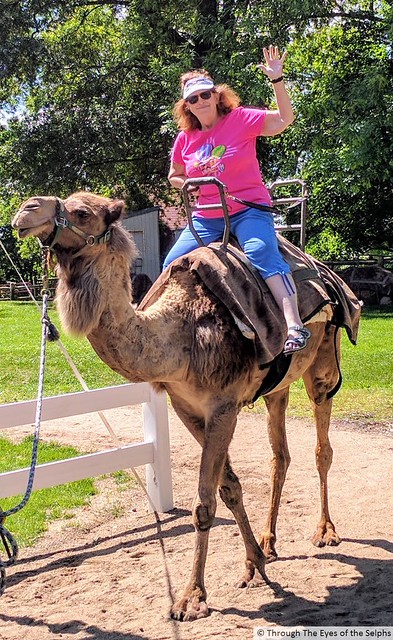
It would be pretty impossible for the farm to match our zoo experience the day before, and it didn’t.  We didn’t expect it to.  Our main reason for visiting Grants Farm was for the camel ride.  For $6 each we were able to mark an item off our bucket list.  We rode a camel and didn’t have to go to the Middle East to do it!  It was lots of fun riding Ruby but I found it very uncomfortable sitting on the hump, especially without a saddle.  I certainly would not want to ride one across the desert!IMG_20170525_104850IMG_20170525_105005

We attended an elephant show where the trainers told us about elephants and had the elephant do some tricks.20170525_11195120170525_111745IMG_20170525_11234120170525_112826

We had lunch at the little Bavarian village with Bill getting a Bratwurst and each visitor over 21 receiving free beer.IMG_20170525_121838IMG_20170525_122231IMG_20170525_105905IMG_20170525_105601IMG_20170525_105752

We enjoyed our time at Grant’s Farm but it is definitely geared more for small children.

IMG_20170525_142600Next we drove down the road to the Ulysses S. Grant National Historic Site.  First we watched a sixteen minute introductory film and then walked up to look at the house.  This 9.65 acre site was the family home of Grant’s wife Julia Dent.  Ulysses and Julia purchased the farm from her family during the Civil War.  Tours of the house are available but we did not take it.  IMG_20170525_132353We did spend time inside the stable which is now an interpretive museum, similar to a presidential library.  The museum was very well done and informative covering his early years, military career including leading the Union Army during the Civil War, and two terms as president from 1869-1877.  20170525_141331IMG_20170525_14240120170525_141645During his presidency he stabilized the country in the years after the war ended and enforced civil rights and voting laws.  20170525_134950He signed the Civil Rights Act of 1875 and strengthened the Republican party in the South.  His administration implemented the gold standard and tried to strengthen the dollar. He was unable to effectively halt a five year depression after the “Panic of 1873”.  This produced high unemployment and bankruptcies.  Corruption charges escalated during his second term and Grant’s administration faced more charges of corruption than any other 19th Century president.  20170525_13453220170525_134628Grant died from throat cancer in 1885 at the age of 63.  He had been a heavy cigar smoker.  He is buried at Grant’s Tomb in New York City along with his wife Julia.20170525_141612

On our last day in St Louis we made another stop by Ted Drewes Frozen Custard for one last treat.

We must say we really really enjoyed our time in St Louis.  We were impressed with all the free attractions and friendly people.  The traffic in and out of the city was not at all bad, even with all the construction around the Arch.  There is still so much we didn’t get to see so we hope to return someday.

Next stop: Hannibal, Missouri to visit Mark Twain

REVISED: St Louis, MO Part 3 May 24, 2017

This replaces previous post of the same name; three videos are available below.
On Tuesday we took the RV to get two new front tires which took a good part of the day.  On Wednesday morning we were ready to head out for some more St Louis sightseeing.  Our plan for the day was to visit Forest Park where there were several places we wanted to see.

IMG_20170524_103109Forest Park is one of the largest municipal parks in the United States (larger than Central Park) and covers 1,300 acres.  This park was the site of the 1904 World’s Fair.  First we stopped at the Visitors Center to purchase a $2.00 all day trolley pass that would allow us to hop on and off at various places in Forest Park.IMG_20170524_165938

IMG_20170524_101553We hopped on the trolley and our first stop was at the St Louis History Museum.  A free museum, it was built on the site of the main entrance to the 1904 World’s Fair.  It was originally built as the first national monument to Thomas Jefferson and honors Jefferson’s role in the Louisiana Purchase, preceding the Jefferson Memorial in Washington DC.  IMG_20170524_101857Exhibits feature the history of St Louis from 1764 to the present day.  While we were there they were having a special exhibit on Route 66 called “Route 66: Main Street Through St Louis”.  Route 66 was known as the “Mother Road” and the “Main Street of America”.  We really enjoyed seeing the exhibits on the important role this famous road had in American history.    IMG_20170524_103411IMG_20170524_104326IMG_20170524_104602IMG_20170524_104735IMG_20170524_104829IMG_20170524_105124

IMG_20170524_105611

Do you know what these are? (Answer at end of Blog)

They also had a replica of the Spirit of St Louis airplane. This Spirit of St Louis Sister Plane was used in the 1957 Jimmy Stewart movie.IMG_20170524_110201

We rode the trolley to our next stop, the St Louis Science Museum, another free museum and one of only two free science centers in the United States.  Advertised as one of the largest in the country, one of the top five Science Museums in the country and one of the most visited in the world with 700+ permanent galleries as well as a planetarium and OMNIMAX Theater, our expectations were really high and we were somewhat disappointed.

IMG_20170524_115013IMG_20170524_121921 It was a great science center for children but did not have much for adults.  Unfortunately we just missed a King Tut exhibit set to open May 27th.  Our favorite thing was the pedestrian bridge over the interstate connecting the north and south sections of the Center.  The bridge had glass windows in the floor where you could look down and see the vehicles pass underneath you. They also had windows with radar guns so you could clock the speed of the vehicles as they passed by.

select video above also

Select video above

We took the trolley back to our car and drove a short distance to Pickles Deli, a highly rated deli where Bill got his favorite Reuben sandwich.  On the way out of Forest Park we stopped to take a picture of a Confederate​ statue.  We noticed a news van and some people milling round.  Ironically minutes later on the way to the deli we were listened to the local radio station and heard that this very statue was vandalized the evening before.  Like many other Confederate statues across the country today, discussions are being held about removing this Confederate statue from Forest Park.IMG_20170524_123407IMG_20170524_123335

On the way back to Forest Park we drove by the beautiful Cathedral Basilica of Saint Louis, built between 1907 and 1914.  We didn’t have time to go inside but that is definitely on our list for next time.IMG_20170524_132228

Our final stop of the day was the St Louis Zoo. This zoo is free and is advertised as one of the top zoos in the United States and was voted America’s top free attraction.  This zoo really wowed us and we really enjoyed our time here and was quite impressed.  During our time in St Louis we were really impressed with all the free museums and other places that usually charge an admission in other cities.  Well done, St Louis!IMG_20170524_144333IMG_20170524_144452

The zoo has over 24,000 animals, many of them rare and endangered.

IMG_20170524_144729

Golden Lion Tamarin

IMG_20170524_155952IMG_20170524_153157IMG_20170524_154133IMG_20170524_145239IMG_20170524_152131IMG_20170524_145440IMG_20170524_145908IMG_20170524_162154

We did pay to ride the Emerson Zooline train which is the nation’s largest miniature rail line, providing a 1.5 mile long narrated tour through the 90+ acre park.  The train engines are one third size replicas of the Iron Horse, the historic steam locomotive that helped build the transcontinental railway.  We passed through two tunnels as we traveled around the park.IMG_20170524_140416

We loved seeing all the animals but our favorites were the giraffes, hippos and penguins.  We were amazed at how close we got to the animals and were especially thrilled with the large number of penguins.IMG_20170524_150803IMG_20170524_150756IMG_20170524_163202

Select video above

IMG_20170524_154713IMG_20170524_154900IMG_20170524_155154IMG_20170524_155228

By the time we got back to the car our Garmin pedometers said we had walked over seven miles. What a great day!

Next:. Our last day in St Louis and a camel ride!
Answer: Speakers used at a drive-in theatre.