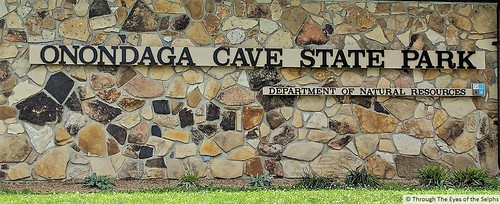
Onondaga Cave State Park, MO May 19, 2017

IMG_20170519_124925After leaving Branson our next reservation was supposed to be Meremac State Park in Missouri. But recent rains and substantial flooding left the park closed during our scheduled stay. Missouri State Parks found us a reservation at the nearby Onondaga Cave State Park.  This turned out to be a beautiful Missouri State Park with electric and water hookups.  We were very happy there and loved our campsite.  The recent flooding in the area caused great damage here as well, and we were thankful it was open for us.IMG_20170519_144649IMG_20170519_144745

IMG_20170519_143818During our stay we took a guided tour of Onondaga Cave.  The cave was first discovered in 1886 and opened to the public in 1904.  After years of land disputes and court battles among various  neighbors as well as the potential building of a dam which would have flooded the cave and was voted down, the land was given to the state of Missouri and became a state park in 1982.  The cave was designated a National Historic Landmark. The name Onondaga is the name of an Iroquois tribe and means “People of the Mountain”.  Our tour began with a short video on the history of the cave and cave etiquette.  Our tour guide was a young girl who later said she was new and this was only her second tour, but she did an excellent job.  The cave had impressive walkways and lighting throughout the cave.  The stalagmites and stalactites were beautiful.  As we exited the cave we were required to walk over a mixture of water and bleach to cleanse our shoes on hopes of preventing the spread of bat killing diseases such as white nose syndrome. Missouri is home to about 6,300 caves and back in 2010 many of them were closed to help bats hurt by habitat destruction and disease.  I don’t remember the exact number but the tour guide told us the number of bats in Onondaga Cave alone has been substantially reduced over the years by disease.  We were asked to please change clothes before entering any other area caves in an effort to cut down the spread of white nose syndrome and other disease harmful to bats.IMG_20170519_131243IMG_20170519_131615IMG_20170519_131741IMG_20170519_131757IMG_20170519_132551IMG_20170519_132620IMG_20170519_133529IMG_20170519_133605IMG_20170519_133820IMG_20170519_133923IMG_20170519_133930IMG_20170519_134000IMG_20170519_134227IMG_20170519_140038IMG_20170519_140516IMG_20170519_140917IMG_20170519_141050

We really enjoyed our unexpected visit to Onondaga Cave State Park. Since there was no Verizon signal in the park we visited the public library in Bourbon, MO on Saturday to use their internet.  I was delighted to find the library was having a used book sale and found ten books I just had to have. All the books were priced at 10¢ each, but we always like to support small libraries, so we decided to pay 20¢ per book to help out the library.  On the way out of town we passed a local food stand where the Bourbon area Veterans were having a fundraiser so we stopped and Bill had a Bratwurst for lunch.

Next stop: St Louis

Bentonville, AR & Branson, MO May 16, 2017

Leaving Little Rock we headed west to Bentonville, Arkansas to see my Aunt Shirley and her family.  Bentonville is also know for being the headquarters of Walmart. Bill and I last visited her in October, 2013 so we really looked forward to the visit.  I was still under the weather from the tick bite and between the Prednisone and the effects of the bite itself, I was definitely not well.  While there we had also hoped to take side trips to visit Fort Smith and beautiful Eureka Springs, but all those plans were cancelled.  We did enjoy some delightful time with my Aunt Shirley, sitting on her back deck in the afternoon and watching the sun set from her front porch in the evening.  She fixed some delicious meals and we also had family time with my Uncle Burt and cousins and their children.  While we were there we got to celebrate the graduation of one family member from the University of Arkansas and the 17th birthday of another.  Such treasured memories.

Far too soon it was time to continue our summer travels and head towards Branson, Missouri. Getting from Bentonville to Branson was not easy and a couple times we stopped to let the brakes cool down.  Even though there many hills and curves, it was a beautiful drive through the Mark Twain National Forest.

IMG_20170515_130727We arrived at our nice campground located just outside the Branson town limits and a short drive to Branson Landing.  The campground had recently been closed due to flooding and evidence of flood damage was still visible.   It was  surprisingly hot during our three night stay with daytime highs hovering around 90 degrees.20170518_101714IMG_20170514_183029

IMG_20170517_192617To be honest, Branson is really not our thing.  It is too much of a tourist trap for our liking and we were not interested in the country shows or the Silver Dollar City amusement park.  I can see how it would be a great place for people who like those kinds of things.  Located in the heart of the Ozarks, Branson 25 years ago was nicknamed “the live country music capital of the universe”.  Amazing considering its location deep in the Ozarks and isolated from big cities and interstates.  Along Country Music Boulevard, also called the Strip, think of Lawrence Welk, fake Elvis shows, Jim Stafford, Andy Williams Theater, George Strait, Patsy Cline, Dick Clark’s American Bandstand, Oak Ridge Boys, wax museums, toy museum, Titanic Museum, Ripley’s Believe It Or Not, magic shows, Chinese acrobatics and the list goes on and on and on.  Advertisements refer to more than 100 different shows at 50 different venues to choose from on a regular basis.  For many, the highlight is Silver Dollar City, a theme park modeled after an 1880’s Ozark pioneer village with rides and entertainment.  Branson is definitely a place for wholesome family entertainment and deep pockets.20170518_101838

In 2006 they added Branson Landing along the shore of Lake Taneycomo with high end retail shops and restaurants.  There is a fountain show each hour throughout the day and even though we went twice in hopes of seeing a show, there didn’t seem to be much going on.  The fountain shows were advertised as water fountains shooting 120 foot geysers accompanied by fire, fancy lights and rousing music.  The area was recently flooded so we didn’t know whether the fountains were only partially working because of flood damage or the fact the summer season had not yet started.IMG_20170517_19014320170517_191027IMG_20170516_215749

We walked along Main Street, visiting Dick’s Old Time 5 & 10.  Jammed full of everything you could imagine, it reminded me of the Ben Franklin store from my childhood.  It was fun walking around and browsing all the “stuff”.IMG_20170516_112842

This is certainly a beautiful area of the country.

Next stop: Onondaga Cave State Park, Missouri

Missouri Fun Facts:
  • Nicknamed the Show Me State
  • Aunt Jemima pancake flour invented in St Joseph
  • Tums invented in Missouri
  • A new highway running from Chicago to the West Coast got its name at a meeting in Springfield, Missouri.  Became known as Route 66
  • First Olympics in the U.S. were held in conjunction with the 1904 World’s Fair in St Louis.  It was the only time grease-pole climbing was an Olympic event
  • Theodore Roosevelt was the first President to fly in 1910 in St Louis
  • Waffle cones, hot dogs, cotton candy, Dr. Pepper and iced tea were all first served to the public at the 1904 World’s Fair in St Louis
  • The eight-track tape was invented in 1964 by Bill Lear of Hannibal, Missouri.  He also founded the Lear Jet Corporation.

Little Rock & Hot Springs AR May 7, 2017

20170506_114226Leaving Mississippi behind, we crossed the mighty Mississippi River where we could see evidence of the recent flooding. We skirted around Memphis, luckily passing through on a Saturday morning so the traffic was light.  The roads around Memphis were really rough and full of potholes.  Quickly we crossed over into the beautiful state of Arkansas.  We continued to see a lot of flooded farmland as we traveled towards Little Rock, the capital and largest city in the state.  The last time we were in Little Rock in Oct 2013 a government shut down closed the Clinton Presidential Library, so we were looking forward to checking another presidential library off our list.20170506_114205

We arrived at Downtown Riverside RV Park located right in the heart of North Little Rock.  It is little more than a parking lot with hookups, but wow, what a location!  It is located right on the Arkansas River with views of the Clinton Presidential Library in the distance across the river and a view of the Little Rock skyline.IMG_20170507_092842

IMG_20170509_144610

Pedestrian bridge looking toward campground from the Presidential Library

A walkway from the RV park led to the Clinton Presidential Park Bridge, which is a pedestrian bridge, so the Library was just a short walk away, no need to even drive your car.  The Park had security and a gated entrance so we felt safe even though we were in the heart of North Little Rock.  At night the bridge was lit up with lights that changed color. IMG_20170508_205345IMG_20170508_205337 Across the Bridge was the Arkansas River Trail, an 88 mile multi-use loop trail perfect for walking or biking.  The Clinton Presidential Park Bridge, dedicated on September 11, 2011, is one of Little Rock’s six bridges and connects pedestrians to Little Rock from North Little Rock.

IMG_20170507_114004On Sunday we decided to make the drive to Hot Springs to visit Hot Springs National Park.   The town of Hot Springs received its name from the rising steam from more than forty boiling springs. Native Americans were drawn to the area during the late 1700s and early 1800s for the healing potions given by the Great Spirit.  People today still come for the therapeutic auras and spas.  It is also the boyhood home of Bill Clinton.

The springs are found along the western slope of Hot Springs Mountain where thermal water, which is naturally sterile, begins as rainwater.  It is absorbed into the mountains and carried 4,000 to 8,000 feet underground where the earth’s extreme heat raises its temperature to 143 F.  The purified water makes its way back to the surface through cracks and pores in the form of hot springs.  The entire process takes around 4,000 years!  The 47 springs have an average daily flow of approximately 750,000 gallons.  The water is collected into one central system where it is distributed to bathhouses and drinking fountains.  Tub baths as well as fancy spa baths are available for a cost.

In 1832, because of the number of people coming to the area for the medicinal benefits, the federal government set aside the springs and surrounding area as the country’s first park-type federal reservation created to protect a natural resource.  In 1921 it became a national park.  The park Visitors Center is located in one of eight bathhouses known as Bathhouse Row.  The popularity​ of the springs began to decline in the 1950s.

IMG_20170507_121136It was definitely the strangest national park Visitors Center we have ever visited.  We parked in a parking garage and walked to the Visitors Center located in the restored Fordyce Bathhouse in the middle of Bathhouse Row.  There we found the usual park rangers, a film, exhibits and a self guided tour of 23 restored rooms furnished as they appeared during the height of the area’s popularity.   Behind the Visitors Center were display springs where we could feel how hot the water was as it emerges from the ground.  We found a couple of geocaches and then wanted to explore more of the natural areas of the park.  We drove to the nearby West Mountain Summit Drive where the car wound around Hot Springs Mountain with some nice views of the town below. A short hike in the park took us to another geocache.IMG_20170507_120202IMG_20170507_112205IMG_20170507_112119IMG_20170507_134002

Sunday morning before heading to Hot Springs I discovered a rash on my thighs that was very itchy.  Bill and I both thought it was bug bites.  During our visit in Hot Springs the rash and itching intensified and at times I felt dizzy and lightheaded.20170508_153446

By Monday morning the rash now covered a larger part of my body, the itching was driving me crazy and I was weak and very dizzy.  Bill took me to a nearby walk in clinic in North Little Rock.  By this time I was so lightheaded I could barely walk from the car to the waiting room.  As I walked to the examining room I briefly passed out and was sick to my stomach.  As the nurse asked me questions I mentioned that eight days earlier I had been bitten by a tick while hiking at Wind Creek State Park in Alabama.  That comment immediately alerted the nurse and doctor who diagnosed my sickness as a tick borne illness.  They gave me a shot at the clinic and i was put on Doxycycline antibiotic, Prednisone and an anti nausea medicine.  It has taken a week of treatment and excellent care from my wonderful husband for me to start feeling better.  The side effects of the Prednisone has been pretty unpleasant as well as the rash. I had no idea a tick bite could make a person so ill.  I have heard this is going to be a particularly bad year for ticks.  Please check yourself after any outdoor activities and check your pets as well!!

Needless to say our sightseeing in Little Rock did not happen as planned.  We drove by places I had hoped to walk around and visit.

IMG_20170509_114917One really beautiful place was The Old Mill at T.R. Pugh Memorial Park a short distance from the campground.  The Old Mill was built in 1933 and is on the National Register of Historic Places.  It was never a real working mill but was built to be a replica of an old water powered grist mill that was in service in Arkansas in the early 1800s as a tribute to Arkansas pioneers.  What caught my attention was it was used in the opening scene of  the 1939 classic film “Gone With the Wind” and is the last standing structure from the film.  The Old Mill was honored on the 50th anniversary of the film and was the site of the unveiling of the Gone With the Wind commemorative stamp.IMG_20170509_115220IMG_20170509_115313IMG_20170509_115602IMG_20170509_115107

It is truly a gorgeous setting.  I made it to the mill bridge while Bill went inside and looked around.

We drove by the state capitol building, something we try to do in all capital cities.  Constructed between 1899 and 1911, I had hoped to see the six doors at the front of the building up close. They are made of four inch thick bronze fashioned by Tiffany of New York .  In the early 20th century they cost $10,000 each.  Today all six would cost 1.5 million.  The capital grounds also include many memorials and monuments.  All that will have to wait for another visit.20170509_13205220170509_132301

IMG_20170509_130822Bill toured the MacArthur Museum of Arkansas Military History.  Located in the historic tower of the Old Arsenal which was built in 1840 as part of a frontier military post, it is the birthplace of General Douglas MacArthur and a National Historic Landmark.  MacArthur was born here while his father was stationed at the arsenal.  It houses exhibits of Arkansas military history from Territorial days to the present as well as exhibits about the Civil War, World War I and World War II.IMG_20170509_121955IMG_20170509_121927

IMG_20170509_130637

Bill’s Grandfather Robert Tucker served with the Rainbow Division

IMG_20170509_122634IMG_20170509_121609

The main reason we came to Little Rock was to see another presidential library, in this case the William J. Clinton Presidential Center and Park.  The original plan was to leave the car at the RV park and walk across the Clinton Presidential Park Bridge with its magnificent river views of Little Rock.  But a tiny little Alabama tick had other plans for me so we drove over instead.  The glass building projects over the Arkansas River representing a “bridge to the 21st century”.  There is 20,000 square feet of exhibition space including the largest collection of presidential archives and artifacts in U.S. history.  Also included are replicas of the Oval Office and Cabinet Room.  There is a penthouse suite above the museum where President Clinton often stays.IMG_20170509_140943

IMG_20170509_151900IMG_20170509_151729We began our visit with a twelve minute film about President Clinton’s life and political career before touring the museum. I sat on a lot of benches but Bill was able to spend time looking at the exhibits.IMG_20170507_161604

We liked Little Rock very much and there is certainly much to see and do there.  It certainly deserves another visit in the future.

Next stop: Bentonville, Arkansas to see my Aunt Shirley!
Summer Travels Begin, Farewell FLA, April 2017

This blog has been delayed due to my being under the weather.  It is from back in late April, but we didn’t want you to miss any of our travels, so bear with us as we catch up!

As our time in Florida came to a close, we reflected on arriving in Florida the beginning of November.  We began in the Panhandle and gradually worked our way counterclockwise around Florida.  We spent time with family and friends, had a major repair on the RV and completed our yearly physicals.  We counted many many alligators along the way and took our first airboat and swamp buggy rides.  Now it was time for our last stop in Florida.  We stayed three nights in Jacksonville and very much enjoyed visiting my Uncle Bill, Aunt Peggy and cousins.  We also managed to meet an old friend of Bill’s and his wife for dinner one evening.  Bill met a Boy Scout childhood friend he hadn’t seen in fifty years for coffee on Saturday morning and really enjoyed reminiscing and catching up.

IMG_20170423_135722

Aunt Peggy and Uncle Bill

IMG_20170423_132933

Rachel, Sarah, Peggy and Becky

And with that, our winter travels in Florida ended and our summer travels began!

First stop was in Cordele, Georgia for two nights so we could visit Bill’s cousins nearby.  Always nice to visit these sweet, lovely ladies!

IMG_20170424_161814

Bill and 2nd Cousin Helen

IMG_20170425_150431

Shirley (Ruby’s daughter), Bill and his 2nd Cousin Ruby

While in the area we made the short drive to Fitzgerald, Georgia to visit the Jefferson Davis Memorial Historic Site.  The museum was closed that day but we did walk around the thirteen acre historic site in the beautiful Georgia countryside.  Confederate President Jefferson Davis and a few men crossed the Savannah River into Georgia on May 3, 1865.  Davis was headed to unite rebel forces and continue the fight.  On May 9, 1865 they camped in this pine forest, unaware they were being pursued and the enemy was close.  At dawn they were captured by two groups of Union cavalry.  Strangely, the two Union forces were not aware of each other and briefly shot at each other, killing two Union cavalrymen.  Davis was taken prisoner and held in Virginia for two years until he was released.  A monument marks the spot he was captured.  We really enjoyed our visit here but the Georgia gnats were vicious!IMG_20170425_155134IMG_20170425_155238IMG_20170425_162242

Next up we said farewell to Georgia and hello to Alabama.  We spent four nights at the huge and beautiful Wind Creek State Park in Alexander City.  Our final days in Florida had been such a whirlwind we spent the time here resting, stocking up at Walmart, picking up our mail at the local post office, doing laundry at the park’s nice air conditioned laundry room and catching up on monthly paperwork.  We did drive over to the 2,040 acre Horseshoe Bend National Military Park in Daviston, Alabama.  IMG_20170427_135350It is the site of Andrew Jackson’s victory over the Red Stick Creeks, a faction of the Creek Nation in the horseshoe bend of the Tallapoosa River.  This was the last battle of the Creek War of 1813-1814 and resulted in the Treaty of Fort Jackson which gave 23 million acres of Creek land, half of their land, to the United States.  Today, three fifths of that land is now Alabama and one fifth is what is now Georgia.  It also brought national fame and recognition to Andrew Jackson, his first step on the road to the White House.  Nine months later (1815) Jackson defeated the British at the Battle of New Orleans, the last battle of the War of 1812. In 1828 Jackson was elected president and two years later signed the Indian Removal Bill, requiring southeastern tribes to move west of the Mississippi River to Indian Territory (Oklahoma) leading to what the Cherokees called the “Trail of Tears”.menawa 20170427_152617

I think this is definitely one of the lesser visited national parks but the ranger was very friendly and we toured the exhibits at the visitors center and watched their twenty minute movie about the Creek culture and the Battle of Horseshoe Bend.  There is a three mile loop drive with five stops where exhibits describe different events.  We enjoyed the beautiful drive and found several geocaches​.  On the way home as we crossed the Tallapoosa River, Bill noticed hundreds of turtles sunning on rocks.IMG_20170427_153609

One funny story about our stay here.  Our first day in the park we heard birds walking on our roof.  They sometimes do this when they are looking for food.  Back in November we were having the same problem and we could occasionally hear them pecking the roof.  Bill bought a large fake owl.  It is very lifelike and you fill the inside with small rocks to keep it stable.  We named him Hootie and when Bill placed Hootie on the roof we had no more bird problems.  So once again Bill got out Hootie and placed him on the roof of the RV.  That night we kept hearing an owl hooting.  He kept at it until we finally fell asleep.  We think the owl was trying to talk to Hootie!  We had the same thing happen when we used Hootie in Clearwater.  That time the hooting of the owl drew the neighbors and us outside where we saw it in a tree until we spooked it and it flew away.  Yes, Hootie looks very real and draws owl friends!IMG_20170429_112246

We really enjoyed our time at this lovely Alabama State Park.  Well done, Alabama!

Next we headed to Clear Creek Recreation Area in the Bankhead National Forest outside of Jasper, Alabama.  Bad weather was headed that way so we left Wind Creek State Park early, drove through Birmingham on a quiet Sunday and arrived at Clear Creek under a tornado watch.  We just settled in before the heavy rain started.  Fortunately the extreme weather stayed away and we just had about an inch of rain during the evening and through the night.  We were greeted the next morning with beautiful clear blue sunny skies, pleasant temperatures and a steady breeze.  We loved​ being able to open up the windows and letting the breeze in. While here we celebrated our sixth wedding anniversary with dinner at home and a bottle of Asti.

While at Clear Creek we went geocaching in an interesting area of the park.  One tricky geocache was located under these rocky overhangs, which served as shelters for prehistoric people for 10,000 years in this part of the United States.  During the Civil War this county seceded from the Confederacy and many people forced from their homes sought refuge here.  This geocache required some rock climbing which always makes me nervous so Bill found it without my help.IMG_20170502_155410

After a three night stay, just relaxing and enjoying the forest, we headed to Chewalla Lake Recreation Area in the Holly Springs National Forest outside of Holly Springs, Mississippi.  As we crossed the border into Mississippi we stopped at the Mississippi Welcome Center.  It was the prettiest Welcome Center we had ever stopped at with lovely antique furniture and paintings of Robert E Lee and Jefferson Davis.  There was definitely an Elvis presence to emphasize the fact that Elvis was born in Tupelo, Mississippi.IMG_20170503_113109IMG_20170503_113241

IMG_20170503_113157

General Robert E. Lee

IMG_20170503_113403

President Jefferson Davis

Our campsite at Chewalla Lake in the Holly Springs National Forest was almost empty and very quiet.  We considered driving an hour east to Tupelo to tour Elvis’s birthplace or driving an hour south to Oxford to see the home of the famous author William Faulkner while we were in the area, but both days it rained and the temperature hovered around 50 degrees.  We just couldn’t get motivated to get in the car and do any driving and sightseeing in those conditions.  We did make the short drive into Holly Springs to pick up some supplies at Walmart.  We also managed to grab two easy geocaches so we could add some Mississippi geocaches to our total.

Next stop is Little Rock, Arkansas where the drama got real!

St Augustine, FLA April 19, 2017

The trip from Flagler Beach to St Augustine was short and sweet with beautiful views as the road followed the oceanfront for some of the way.  We settled into a site at our home St Augustine Elks Lodge for two nights where they have eight sites with electric and water hookups.

Our reason for stopping here was to visit historic St Augustine and in particular the Castillo de San Marcos National Monument.  Bill grew up nearby and has been here many times.  We got an early start and managed to get a parking spot right at the fort.  The Castillo de San Marco is the oldest masonry fort in the continental United States. IMG_20170420_102336Construction of the fort began in 1672 when Florida was part of the Spanish Empire.  The fort is constructed from coquina stone, completed in 1695, and altered and renovated many times over the centuries.  Coquina is a soft limestone of broken shells of shellfish.  Coquina is the Spanish word for cockle and shellfish.  Coquina rock is very good material to use in the construction of forts due to the coquina’s porous softness which allow cannonballs to sink into the walls of the fort rather than shatter or puncture the walls if they were made of granite. Coquina has been quarried and used as a building stone for over 400 years in the Caribbean and Florida.IMG_20170420_113246IMG_20170420_113506

When the British took control of Florida in the Treaty of Paris in 1763, the fort was renamed Fort St Mark.  In 1783 Florida was transferred back to Spain and then in 1821 as part of yet another treaty was given to the United States.  It was renamed Fort Marion and declared a national monument in 1924.  In 1942 it was turned over to the National Park Service and was renamed its original name of Castillo de San Marcos by an act of Congress.  It was interesting to learn that the fort changed hands six times, all peaceful through treaty or agreement, among four different governments: the Spanish Empire, the Kingdom of Great Britain, the Confederate States of America and the United States of America (with Spain and the United States having possession two times each).

While under U.S. control the fort was used as a military prison for Native American tribe members, including the Seminoles and their famous war chief Osceola and members of Geronimo’s Apache tribe.  A form of Native American art called “Ledger Art” began during imprisonment at the fort.

IMG_20170420_102314We entered the fort through the “Sally Port” which is the only way in or out of the fort.  There is a drawbridge and heavy sliding door to protect the entrance.  The fort is made of over 400,000 blocks of coquina stone, all cut and set by hand.  The outer walls of the fort vary from a thickness of 14 to 19 feet at the base to 9 feet towards the top.  When the fort was completed in 1695 it was 22 feet high.  IMG_20170420_101619The fort was originally built as a safe refuge for the St Augustine townspeople but also as a military warehouse.  In 1702 when St Augustine was attacked by the British, about 1,500 soldiers and civilians lived in the fort for 51 days.  Between 1738 and 1756 there was almost constant warfare between Spain and England and the walls of the fort were raised from 22 to 35 feet.  By 1740 the gun deck mounted over 70 cannons of different sizes with the largest having a range of three and a half miles.  The view allowed the fort to be defended by attack from land or sea.  Under British control from 1763 to 1784, Florida was divided into East and West and became the 14th and 15th British colonies.  These colonies remained loyal to England during the Revolutionary War.  During the war 500 British soldiers lived in the fort with others living in the homes of citizens.IMG_20170420_114039

We were lucky to arrive just in time for a park ranger narrated tour which was very interesting and gave additional insight into the construction and life at the fort.  After finishing our tour of the fort we walked over to the historical section of old St Augustine.

IMG_20170420_120756St Augustine, founded in 1565, is the oldest continuously occupied European established settlement in the continental United States.  The city was the capital of Spanish Florida for over 200 years.  When Spain ceded Florida to the United States in 1819, St Augustine was the capital of the Florida Territory until 1824 when Tallahassee became the capital.IMG_20170420_120740

We walked down the center of the historic section but didn’t stay long.  The street is cluttered with souvenir shops, wax museum, a Ripley’s Believe It Or Not, pirate museum, Gator Bob’s Trading Post, and restaurants.  It is hard to distinguish the beauty of the Spanish influence on the buildings from the storefronts and restaurants.  Much different from historic Williamsburg in Virginia which is like walking back in time to colonial America.  I found the whole St Augustine historic district experience disconcerting and less than pleasant.  I suppose it is all in what you are looking for.  I was expecting something along the line of Williamsburg.IMG_20170420_115742

We did take pictures of the Cathedral Basilica of St Augustine and the oldest wooden schoolhouse in the United States.IMG_20170420_115906

Records indicate the house was built around 1740 and was turned into a schoolhouse in the 1800’s.  The last class was held in 1864.IMG_20170420_120643

We both enjoyed visiting the fort and I think Bill enjoyed historic St Augustine more than I did. Perhaps I have been influenced by many trips to Colonial Williamsburg and my Virginia roots!

Next stop will be our last stop in Florida, Jacksonville.

Flagler Beach, FLA April 13, 2017

We were sad to leave Jetty Park at Cape Canaveral, but it was time to continue north.  We drove an hour and a half to our next stop, Gamble Rogers Memorial State Recreation Area at Flagler Beach.  This is a very popular park year round and since we booked ten months out instead of the maximum eleven months, we were not able to get a spot on the beach side.  We had to settle for the riverside campground across the road (A1A).   This campground area is newer and the sites are much more spacious and the entire area is less congested.  We missed being on the beach side but were quite content with our campsite.  Once again the wind was whipping each day with a minimum ten mph winds with gusts exceeding fifteen mph.  Too windy to even put the big awning out on the RV.IMG_20170415_171405

Everyone raves about the beach at Gamble Rogers but it didn’t begin to compare to the beach and boardwalks at Jetty Park.  The Flagler Beach area sustained significant erosion damage in Oct 2016 from Hurricane Matthew.  Parts of A1A were washed away and we could see where the new road had been constructed.  Gamble Rogers also sustained quite a bit of damage from erosion, and all but one of the walkways down to the beach had been destroyed.  They still have quite a bit of repairs to complete.

IMG_20170417_185727The park is named for James Gamble Rogers, IV, a man who gained national prominence playing lead acoustic and electric guitar with the Serendipity Singers.  He was also a storyteller whom some compared to Mark Twain and Will Rogers.  Gamble traveled the back roads of Florida with the up and coming Jimmy Buffet.  Gamble taught Buffet the trade and was the opening act for Buffet at Margaritaville in Key West.  In 1991 Gamble, his wife and another couple were camping at then Flagler Beach State Recreation Area.  Gamble jumped in the water to save a man who was drowning.  Both Gamble and the swimmer died.  A plaque was erected in honor of his bravery and in 1992 the park’s name was changed to Gamble Rogers Memorial State Recreation Area.

The park has some nice trails where we enjoyed walking and geocaching.

When we checked into the park the ranger said they are trying to promote other state parks in the area and gave us a free pass to visit Bulow Plantation Ruins Historic State Park located ten miles away in Ormond Beach.  On Easter Sunday we attended a sunrise service at Flagler Beach. IMG_20170416_065754IMG_20170416_065953IMG_20170416_070210IMG_20170416_065930 We then made the very short drive down to Ormond Beach to visit the state park.

IMG_20170416_144210

The Dirt Road to Bulow Plantation Ruins Historic State Park

The 2,200 acre Bulow Plantation was built in 1821 and was once a prosperous ante-bellum sugar plantation where the Bulow family grew sugar cane, cotton, rice and indigo with the help of 193 slaves.  The slaves lived in 46 slave cabins also on the plantation.  When war broke out with the Seminole Indians in December 1835 during the Second Seminole War, the U.S. army troops occupied the plantation against the wishes of Bulow.  In 1836  the plantation was destroyed by fire, probably by the Seminole Indians. (A sign at the Interpretive Center said the Second Seminole War was the “longest, costliest and bloodiest Indian War in United States History”). All that is left today are the ruins of the sugar mill, a spring house, several wells and the crumbling foundations of the plantation house and slave cabins.  The sugar mill was built of coquina sedimentary rock made up of crushed shells and the ruins are listed on the National Register of Historic Places. There is an interpretive center describing the plantation’s history and the process of turning sugar cane into sugar and molasses. Unlike sugar mills which used animal power before the 1800’s, this plantation used steam powered mills which allowed the cane to be processed faster.  However it was still a long, tedious and HOT process. The sugar mill business was profitable.  After the plantation and sugar mill was destroyed by fire, Bulow estimated his destroyed sugar crop for 1836 would have been worth at least $20,000.  The molasses was sold for making rum.  Like other Florida plantation owners they traded with the Seminole Indians, trading blankets, fabric, beads, black powder and lead for the Indians’ cattle and hogs. Naturalust John James Audubon visited the plantation on Christmas Day, 1831.  The property was acquired by the state of Florida in 1945 and was dedicated as a State Historic Park in 1957.

IMG_20170416_155016

Artist Rendering of Plantation Home

IMG_20170416_150915IMG_20170416_152526

After touring the grounds we spent some time geocaching in the area, hiking over four miles.  IMG_20170416_182640IMG_20170416_180950

One geocache we found was at the Fairchild Oak.  It is one of the largest trees in the South, and while it is impossible to know for sure, it is estimated to be between 2,000 and 2,500 years old!  The tree is named for Dr David Fairchild, a world famous botanist and naturalist.  Among his greatest accomplishments is the introduction of soybeans to American agriculture.  It was a really beautiful tree and another example of something we probably would have never found if not for geocaching!IMG_20170416_181211IMG_20170416_181524

While we were in Vero Beach we watched a rocket launch from the deck of a restaurant while having dinner with Sean and Cathy.  We were disappointed there weren’t any launches while we were at Jetty Park, an ideal place for viewing launches.  On our last day at Gamble Rogers there was another launch.  We stood on a beach overlook with several other people and waited but we were a little too far away and it was too hazy.IMG_20170418_111009

We ended our stay at Flagler Beach by driving up to nearby Palm Coast to meet Bill’s former boss and his wife for dinner.  We enjoyed fabulous barbecue food at Captain’s BBQ overlooking the river.  The food was great and we recommend it to anyone passing through the area.

We move tomorrow (Wednesday) to St Augustine for two days.

FLA Treasure Coast & Space Coast March 23, 2017

Leaving Fort Lauderdale we made our way north to Fort Pierce and settled in at the Savannas Recreation Area.  This is a wonderful St Lucie County campground with full hookups.  It is also another one of the very popular, hard to reserve Florida county parks.  Our campsite backed up to a narrow canal.  A stiff wind during our stay kept away mosquitoes.  There were many signs warning of alligators in the canal but we only saw one during our week stay.  The Savannas area is a popular fishing and kayaking area but it was too windy to get out on the water while we were there.

We enjoyed driving around the Fort Pierce area.  We looked for other possible campgrounds for future visits but didn’t really see anything we liked better than where we were staying.

We did some geocaching and stopped by the old Fort Pierce site.  The fort along the Indian River was built in 1838 as a main supply depot for the army during the Second Seminole War.  It was abandoned in 1842 at the end of the war and burned down the next year.  Nothing left now but some historical markers and a beautiful view.  It is also the site of an ancient burial mound of the Ais Indian tribe who once lived from the Cape Canaveral area to Saint Lucie inlet.IMG_20170329_165323IMG_20170329_165518IMG_20170329_165549

The city of Fort Pierce is very picturesque with lovely views of the water.  It is nicknamed the “Sunrise City” and is a sister city to San Francisco, the “Sunset City”.IMG_20170329_165604

IMG_20170329_160942Last summer while traveling through Pennsylvania we stopped by Shanksville to pay our respects at the site where United Flight 93 crashed on September 11, 2001 due to a terrorist attack.  We noticed on the wall honoring those who died, the name of CeeCee Ross Lyles from Fort Pierce.  She had been a member of the Fort Pierce Police Department before becoming a flight attendant.  We knew there had to be a memorial to her somewhere in Fort Pierce.  We stopped by the Fort Pierce Visitors Center and found out it was just a short walk away.  We found her statue and memorial at a beautiful, peaceful spot overlooking Indian River.

Next we traveled to Vero Beach for a five night stay to visit Bill’s son Sean, Sean’s fiancee Cathy and Bill’s Aunt Charlotte. Always nice to visit with them!

20170330_181201

Bill, Sean and Cathy dining near Vero Beach

As we continued traveling north our next stop was one of our favorites, Jetty Park in Cape Canaveral.  Jetty Park is a Brevard County Park campground, extremely popular and rather pricey.  We love this campground because there is an easy, close access to a beautiful beach and we can watch cruise ships depart each day.  It is a great place to watch rocket launches at the Space Center.  We watched a couple of launches when we were there last year but unfortunately none were scheduled while we were here this year.  During our ten day stay we spent time at the beach and enjoyed long walks on the beach, pier and boardwalks.  The beach was beautiful both during the day and at night under the full moon.  Each day we watched cruise ships departing with throngs of excited passengers crowding the decks.IMG_20170410_172254IMG_20170408_134319IMG_20170408_134347IMG_20170407_171947IMG_20170407_172032IMG_20170411_215306IMG_20170411_220646

We learned that on March 10, 1783 the last Continental Naval engagement occurred nearby during our eight-year War for Independence.  The Continental Frigate Alliance inflicted severe damage on the British warship HMS Sybil and then went on to her destination in Rhode Island.IMG_20170407_170355

One day Bill’s college friend Pete and his wife Beth drove over from their home near the gulf coast to spend the day with us.  Bill and Pete reconnected back in January after almost forty years and we have enjoyed seeing them several times during our five and a half months in Florida this winter.  Thanks so much Pete and Beth for making the long drive over to Jetty Park.  Much, much too soon our time in Jetty Park was over.  (Huge sigh)IMG_20170410_172414IMG_20170407_142402IMG_20170407_142552IMG_20170407_142521

Next stop will be Gamble Rogers State Park at Flagler Beach.

Fort Lauderdale, FL March 20, 2017

We left Miami and continued our counter clockwise travel around perimeter of Florida, making the short drive north to the Fort Lauderdale area.  We camped at Markham Park, very popular Broward County park.  After getting all settled in we made the short drive to visit Bill’s cousin Crystal and her family. We drove to Ft Lauderdale Beach to see how it compares to Miami Beach.IMG_20170322_144445IMG_20170322_140420IMG_20170322_140224IMG_20170322_152215

On Tuesday Bill met an old Boy Scout childhood friend for lunch and then did some target practice at the Markham Park rifle range.IMG_20170321_153114IMG_20170321_153111

IMG_20170320_133945The highlight of our visit was on Wednesday when we drove inland ninety minutes to the Seminole Indian Reservation to visit the Billie Swamp Safari.  What an amazing experience!!  We signed up for the day package which included an airboat ride, swamp buggy ride, a critter show and a venomous snake show.IMG_20170320_140112IMG_20170320_140643

First we went on the airboat ride which included earplugs because of the loud noise of the motor. It was fun to fly across the “River of Grass”, slowing down occasionally as the guide pointed out different animals and birds.  It was over far too quickly!20170320_14291320170320_14391220170320_14455720170320_14475720170320_14530920170320_14532320170320_145758

Next up was the Critter Show.  The host was a unique guy, part wise guy and part comedian, but very knowledgeable about the animals.  He picked different people from the audience to come up to handle the animals.  Once you were selected you couldn’t say no and you didn’t know until you got up there what you would have to handle.  I was rather nervous I would be selected to handle a snake.  In that case, no would mean no, and they would have to take me kicking and screaming from the room before I would do it.  Luckily I wasn’t selected to handle the tarantula, snake, skunk, alligator or ferret.20170320_155412

We had a little time before the venomous snake show so we walked around the property and saw a very rare Florida panther, a bobcat, two wolves, otters, a bear, exotic birds, crocodile and many alligators.20170320_15072320170320_18003620170320_17595420170320_18014620170320_18035320170320_180444

20170320_160336

Red Tail Hawk sunning

20170320_160211

Crested Caracara

20170320_160150

Barred Owl

20170320_15052620170320_16023820170320_15040920170320_16030420170320_151048

One huge alligator has the name Trump, he was named several years ago.20170320_150929

I can’t believe I agreed to go to the venomous snake show but I thought facing my fears and learning more about them would help.  I told Bill I wanted to sit on the top row far away from the host.  The host was extremely knowledgeable and didn’t expect anyone to come down front so that pressure was off.  He answered lots of questions including several from me such as “how long do you have to get help once you are bitten before you die?”.  I can’t say I loved the show but it was very informative and I was glad I went.20170320_16250220170320_16392120170320_164908

Our last activity of the day was the swamp buggy eco tour where we explored more of the swamp in an elevated buggy to get better views.  We thought the tour would be going more through water but mainly we were on land.  It was quite bumpy and lots of fun!  We saw bison, antelope, zebras and ostriches, including ostrich eggs, just to name a few.  At one point we had to wait for bison to get out of the road, reminding us of our visit to Yellowstone.  We even saw a baby bison, the youngest we have ever seen.20170320_17140520170320_17474920170320_17463020170320_17450120170320_17511120170320_173710

Much too soon the day was over and we left marveling at all we had seen and done in one day.  I would love to go back and do it all over again, even the snake show! We recommend this multi-hour adventure.

Next stop: Fort Pierce, Florida

Miami, FL Part 2 March 4, 2017

IMG_20170316_113049This blog continues with more of our time in Miami.  Even though it was Spring Break time for college students, we decided to drive to Miami Beach.  Rather than taking the interstate or turnpike, we took the scenic route Old Cutler Road.  The drive was beautiful with huge trees including banyan trees as well as azaleas in full bloom.  IMG_20170316_114429IMG_20170316_115547IMG_20170316_115730IMG_20170316_120418IMG_20170316_120715IMG_20170316_120857IMG_20170316_120914IMG_20170316_120940When we entered the Miami Beach city limits we began to see cruise ships and the traffic picked up.  IMG_20170316_125005IMG_20170316_125133We drove down Ocean Drive and as expected it was pretty crazy with throngs of scantily clad college students crowding the restaurants, roadways and beach.  IMG_20170316_132529IMG_20170316_132140IMG_20170316_132218IMG_20170316_132544IMG_20170316_132809We drove to the northern end of Miami Beach where it seemed a little calmer and after only a little time stalking for a spot, we found a parking space.  IMG_20170316_140955IMG_20170316_141031There was a very nice boardwalk sheltered from the sun and we found walking on it much more appealing than the crowded beach in the hot sun.  IMG_20170316_141419IMG_20170316_142346IMG_20170316_144037Pictures sometimes really are worth a thousand words so I will let the pictures do the talking.  One college student from Kentucky managed to get in Bill’s picture.  IMG_20170316_142642He told us he hated going back home to the cold weather the next day.  He said he had had a great time in Miami but had also made some bad decisions.  Sounds like stories I don’t want to know!  Along the boardwalk we passed big hotels including The Fountainebleau, featured in the 1964 James Bond movie “Goldfinger”.PANO_20170316_151621

IMG_20170318_145633On our last day in the Miami area we visited the Gold Coast Railroad Museum.  The museum is on the site of the former Naval Air Station Richmond, the largest coastline airship base built for World War II.  The museum featured exhibits of passenger cars, locomotives, freight cars and cabooses. IMG_20170318_132935IMG_20170318_140439IMG_20170318_140551IMG_20170318_141914IMG_20170318_144137IMG_20170318_144206IMG_20170318_144838Many of the trains were open to tour and some had exhibits inside on the history of train travel. Our main reason for wanting to visit the museum was to see the Ferdinand Magellan, a National Historic Landmark and the Pullman car built for President Franklin Roosevelt and used by the president beginning in December, 1942.IMG_20170318_134851  IMG_20170318_134817IMG_20170318_133942IMG_20170318_133938IMG_20170318_133823IMG_20170318_134012The train also carried Roosevelt’s body back to Washington after his death. The car has four bedrooms, a dining room and an observation lounge. There is 5/8 inch steel armor plating, three inch bullet proof glass and two escape hatches, one in the ceiling of the observation lounge and the other in the side wall of the shower in the presidential bathroom in the center of the train. IMG_20170318_133959At one time there was a special elevator installed on the platform for Roosevelt’s wheelchair but that was removed after his death.  This train was also the location where Truman held up the famous newspaper headline declaring “Dewey Defeats Truman”.  IMG_20170318_134817(1)IMG_20170318_134024IMG_20170318_134207Four presidents used the train, with the last official use ending in 1954.  Ronald Reagan used the train for one day in 1984 during his presidential campaign as part of a whistle stop tour. Due to extreme deterioration of the interior, tours of the inside have been very limited.  But we asked about seeing the inside and the guide graciously offered to unlock the door and let us walk through.  It was amazing to walk through the car and imagine the history that unfolded there.  The guide told us Roosevelt’s casket was placed on the dining room table and we could visualize presidents waving from the platform. The inside smelled very old and much restoration still needs to be done to preserve this piece of history.  According to the museum’s brochure they are waiting for funding.IMG_20170318_134228

We ended our last day in Miami by having dinner at Casavana, an excellent Cuban restaurant.

From Bill Baggs State Park to Biscayne National Park to touring Miami Beach to historic Gold Coast Railroad Museum, we had a great time in Miami!!

Next stop: Fort Lauderdale

Miami, FL Part 1 March 4, 2017

We reluctantly said farewell to our alligator friends at Big Cypress National Preserve and headed towards Miami.  Fortunately we moved the day before smoke from wildfires blanketed the Big Cypress National Preserve.  We encountered some road construction and then arrived at our destination for the next fifteen days, Larry and Penny Thompson Memorial Park located in South Miami Heights.  This is a large, popular county park located about twenty miles south of downtown Miami.  It is so popular that reservations are very hard to get, as are many parks in southern Florida in the winter.

Our campground, as is all of Miami, is located in a culturally diverse community.  One quickly feels like the minority in this area of south Florida.  Miami has changed quite a bit since it was once called “The Magic City” and was viewed as a winter playground for the rich and famous.  Between 1960 and 2000 the Miami metro area grew by 141%, with a large number being people from Cuba as well as Puerto Rico and many foreign countries.IMG_20170309_142049

IMG_20170309_133654On Wednesday we drove over to Bill Baggs Cape Florida State Park.  We enjoyed the beautiful views located in the park.  Juan Ponce de Leon called the area Cape of Florida when he landed here on his first Spanish expedition to Florida in 1513.  The park is home to a lighthouse built in 1825 and reconstructed in 1846.  It is the oldest standing structure in Miami-Dade County.  Near the lighthouse is a reconstructed lighthouse keeper’s house, Bill and I enjoyed the nice water views from the rocking chairs on the front porch.00001IMG_00001_BURST20170309121308IMG_20170309_122342IMG_20170309_121046IMG_20170309_120741IMG_20170309_120607

From the Biscayne Bay side of the park, we had views of the remains of what was once Stiltsville, a group of wood shacks built on stilts.  It is believed the first shack was built in 1933 toward the end of Prohibition by Crawfish Eddie Walker.  He built the shack for gambling which was legal a mile offshore.  A few years later two of Eddie’s friends built shacks on stilts and between shipwrecks and channel dredging, more people built stilt shacks.  IMG_20170309_121858IMG_20170309_115328IMG_20170309_115317Newspapers began calling the area “the shacks” or the “Shack Colony” and in the 1940’s and 1950’s it was a popular place for lawyers, bankers and politicians to drink and relax, including Florida Governor LeRoy Collins.  Various social clubs were built on stilts shacks and when rumors of gambling persisted, the clubs were raided in 1949 but no evidence of gambling was ever found.  Crawfish Eddie’s shack was destroyed by Hurricane King in 1950. Most of the remainder structures were damaged by Hurricane Donna in 1960.  In 1965 the state required shack owners to pay $100 annually to lease their “campsites”.  No new construction was permitted, no commercial leases, and no shacks more than 50% damaged could be rebuilt.  In 1980 the area fell within the boundary of Biscayne National Park.  The leases were still honored. At the beginning of 1992 there were fourteen shacks but after Hurricane Andrew struck that same year, only seven remained.  The Stiltsville Trust was formed in 2003 to save the remaining structures with caretakers doing periodic maintenance and park personnel installing hurricane strapping to try to prevent damage from major storms, all in an effort to save the historic structures.  Over the years Stiltsville has been the setting for movies, TV shows and books.

We enjoyed a nice picnic lunch where we were visited by some new friends.IMG_20170309_135934 20170309_125255 (1) We then went down to the beach and enjoyed dipping our toes in the Atlantic Ocean.  We enjoyed the views of Miami during the drive over and back.IMG_20170309_133405IMG_20170309_131840

IMG_20170315_142949Another day we drove to Biscayne National Park.  This park is located thirty-five miles south of Miami International Airport, twenty-one miles east of the Everglades, and is the northernmost part of the Florida Keys.  IMG_20170315_143542First established as a monument in 1968 and later as a national park in 1980, it is made up of 181,500 acres, with only 5% of the park land.  The other 95% of the park is submerged or made up of small islands only accessible by boat.  It is a paradise of crystal clear aquamarine waters and lush seabeds.  It is composed of the longest stretch of mangrove forest on Florida’s east coast and part of the world’s third longest coral reef tract.  We drove to the land part of the park at Convoy Point and visited the Dante Farrell Visitors Center where we saw an excellent film on the park’s ecosystems.  We walked along the boardwalk where we saw a stingray, barracuda, schools of fish and views of a distant Miami.IMG_20170315_152222

In the next blog we will continue our explorations of Miami.