Category Archives: Exploring

Exploring

Graz, Austria May 11, 2023

On May 11th we took a train from Vienna to Graz, Austria.

The train left early in the morning so Bill grabbed a quick breakfast at the McDonald’s at the train station. In keeping with their conservation agenda and “going green”, they gave him a wooden knife and fork instead of plastic. We had booked tickets ahead of time but no reserved seats. We had no trouble finding nice seats together and the train set off right on time for the two hour trip. Trains in Europe are very punctual. It was a  beautiful scenic ride over the Semmering Pass, a UNESCO World Heritage Site listed as “one of the greatest feats of civil engineering during the pioneering phase of railway building”. We crossed the River Schwartz, passing through many tunnels and viaducts with small villages nestled in the hillsides. With such a scenic landscape, the time passed quickly.

We arrived in Graz (pop 332,000) and though it was early, they let us check into our room. Even though it is Austria’s second largest city, Graz receives a small number of tourists compared to Vienna or Salzburg. 

Graz, located on the River Mur, doesn’t have the grandeur of Vienna, but it definitely has charm and beauty. It is said to be one of the best preserved historic cities in Europe. We learned that 20% of the population are students, 150 languages are spoken here and the city council is run by a communist mayor, evidently a surprise from the last election. Sixty percent of the city is green spaces with a strong emphasis on sustainability and ecology. The city uses new emission free hydrogen buses.

Along with its World Heritage status for its Medieval Old Town in 1999, in 2003 Graz was crowned the European Capital of Culture. In 2011 an additional UNESCO award was bestowed as a City of Design for its design schools, forward thinking architecture and embrace of modern urban design. Graz is only the second city in Europe to hold two UNESCO titles. Berlin is the other. Graz is also the birthplace of Arnold Schwarzenegger. 

Unfortunately when we reached Graz there began a week long chilly, rainy spell that followed us to two other cities. On top of that I came down with a bad cold. 

We walked from our hotel to the train station where we bought a day pass that included both the city tram and bus. We walked to a tunnel next to the train station and caught a tram into the city center. 

From the top of the Schlossberg hill, in spite of the clouds, we had a nice view of Graz with its many red tiled roofs. With our daily pass we were able to ride the Schlossberg Funicular to the top and came down using the Schlossberg Lift. The Funicular ascends at an incline of 61% and has been in operation for the last 100 years. The Lift has glass walls that give you a clear view of the rock lined elevator shaft.

Part of the Armory

At the top of the hills are the remains of the old fortification which in 1544 was a huge Renaissance fortress, now listed in the Guinness Book of Records as the strongest fortification of all time. Even Napoleon found it impossible to capture at the beginning of the 19th century. However in 1809 when Napoleon occupied, and was threatening to destroy Vienna, Graz surrendered. The  fortress was dismantled after the Treaty of Vienna in 1809. The Hackher Lion is a monument to Major Hackher, the last defender of the fortress.

Also at the top of Schlossberg is the famous Clock Tower.

Napoleon’s troops destroyed the Schlossberg fortress, the residents all came together to pay a ransom to save their beloved clock tower from destruction. The clock tower is unique with its large wooden balconies and clock face where the hour and minute hands are reversed in size since the minute hand was added later. It has struck the hour precisely since 1712.

As we used the Schlossberg Lift to descend, we then walked in a tunnel through the hillside to ground level. It was once part of an extensive system of tunnels that was built in the Second World War as a shelter for the people of Graz during aerial bombing. The tunnels were part of a four mile long system with 20 entrances that could hold up to 40,000 during an air raid. 

In the Old Town’s main square, Hauptplatz, is the Town Hall, built in 1893, with its neoclassical design.

The Graz Cathedral is the city’s most important place of worship. It was built between 1438-1462. The cathedral has a Gothic exterior and a Baroque interior with a vaulted ceiling over the altar.

Next door was the Mausoleum of Emperor Ferdinand II, built in 1614. It is thought to be one of the most beautiful mausoleums in Europe.

Part of the University Next Door

The Franciscan Church has the tallest towers in Graz.

Murinsel is a quirky ultra modern design structure floating in the Mur River. It is an island constructed in 2003 in honor of the city’s European Capital of Culture award. It is shaped like an upside down seashell and is made of steel and glass. It is used as an open air amphitheater, has a cafe and children’s play area. Two pedestrian bridges tether it to the riverbanks.

Nearby is the Parish Church Graz-Mariahilf, 1607.

Another modern structure built in 2003 was the Kunsthaus Graz, or the Graz Art Museum. The roof is made of acrylic and the locals have nicknamed the structure “the Friendly Alien”. At night the building lights up like a spaceship.

The Glockenspiel is a structure with 24 bells that ring out on the hour. Three times each day the two wooden doors open and two little figures in traditional costume come out and dance to Alpine folk tunes. Unfortunately we missed that by 18 minutes.

We saw the Kaiser-Josef-Markt farmers’ market open each day except Sunday. The rain didn’t seem to bother the shoppers. So many European towns have these daily fresh markets.

Across the street from the market was the Opera House.

Also on this corner is the Evangelical Church of Graz-Heilandskirche, 1824.

We really enjoyed Graz, in spite of the chilly rain! 

Next up: A train ride and 3threedays in Ljubljana, Slovenia 


Vienna, Austria May 9, 2023

After a good night’s sleep we were up early the next morning for a day of exploring Vienna. Our original plan was to use the Hop On Hop Off Bus. But our friendly, helpful hotel concierge convinced us we didn’t need to pay for the expensive tickets and instead we could take the subway located close to the hotel into the city center. Our subway tickets also gave us access to the city’s tram and bus service. I must say that Vienna has excellent public transportation. Taking the concierge’s advice saved us money ($95 for us on Hop On Bus vs $16 for us for 24 hour public transportation). 

Austria, with 8.5 million citizens, shares boundaries with eight  European countries: Germany, Italy, the Czech Republic, Hungary, Slovakia, Slovenia, Switzerland and Liechtenstein. Most Austrians speak German (the second largest German speaking city after Berlin) and are mainly Catholic. 

Vienna, the capital and largest city, has a population of just under 2 million. It lies in the eastern part of Austria on the Danube River.

Its past residents have included Mozart, Beethoven (giving it the nickname “City of Music”) and Sigmund Freud (also giving it the nickname “City of Dreams”).

We walked the couple blocks to the closest subway station, bought our 24 hour tickets, and were quickly on our way. The public transportation, whether subway, tram or bus, is very punctual.

A J F Kennedy Memorial Plaque

We hopped off at city center and immediately our visual senses were overwhelmed with the architectural beauty that surrounded us. In every direction we saw majestic buildings. Bill and I had been here in 2016 on a group tour and we agreed it was more beautiful than we remembered. Group tours are nice but I think when you are on your own you have more time to stop and take in your surroundings. Sometimes on tours you have to worry about keeping up with a guide or being rushed from one place to another.

The first masterpiece we saw was the Romanesque and Gothic architecture of St Stephen’s Cathedral, the most important religious building in Vienna. The groundbreaking of this Catholic church was in 1137 with completion in 1578. Made of limestone, it stands at 448 feet with 2 main spires and 22 bells.

One bIG oRGAN

Beethoven discovered the totality of his deafness when he saw birds flying out of the bell tower as a result of the bells’ tolling but could not hear the bells. The largest bell weighs 44,380 pounds and is the largest in Austria and the second largest swinging bell in Europe. The roof of the church is covered by 230,000 glazed tiles. The roof is so steep that it is sufficiently cleaned by rain and seldom covered with snow.

Over the centuries, soot and air pollution accumulated on the church and gave it a black appearance, but recent restoration projects have returned some parts of the church back to the original white. 

We were able to go inside and oh my, there are no words to describe the beauty. The main part of the church has eighteen altars and several formal chapels. 

In the basement of the church are tombs, catacombs and crypts containing emperors, military leaders, Bishops, Cardinals and 72 members of the Habsburg dynasty. 

From there we wandered along the streets soaking it all in. 

The Greek Revival style Parliament building foundation was laid in 1874 and completed in 1883. It contains over 100 rooms and is where the president of Austria is sworn in.

The Vienna Plague Column, also known as the Trinity Column, was erected after the Great Plague Epidemic in 1679. It is one of the best known and prominent sculptural artworks in Vienna. Some consider it one of the most ambitious and innovative sculptures anywhere in Europe of that time period.

Vienna Plague Column

The Hofburg is the former imperial palace of the Habsburg dynasty. It was built in the 13th century and served as the winter residence.

Since 1946 it is the official residence and workplace of the president of Austria.

Neptune Fountain

Part of the palace is now the Sisi Museum which gives an authentic look at the life of the Empress Elizabeth, known as “Sisi”, the famous Empress of Austria and Queen of Hungary. She was assassinated in Geneva in 1898.

Theseus Temple was built in 1829 as a replica of the ancient Greek temple of Hephaestus in Athens.

Iron Square is rather unique. It is the midsection of a tree trunk from the Middle Ages into which hundreds of nails have been pounded for good luck over the centuries.

The Nail Heads Are Large

When we were here in 2016 we had lunch at a little Chinese restaurant on a side street near St Stephen’s Church. Bill remembered how good it was and wanted to go back. Bill remembered exactly where it was so we had Chinese food for lunch once again in Vienna! The restaurant has a new owner but was still good.

St Peter’s Catholic Church

Guess where we ended the day. Yes, at the Vienna Hard Rock Cafe for another shirt to add to Bill’s collection.

This is a 3D Artwork on the side of a Tall Building

It was an easy subway ride home and walk back to the hotel. After a nice dinner we had another seven miles logged for the day. A really wonderful day in Vienna! 

Next up: A train ride and visiting Graz, Austria

Fiumicino, Italy & Vienna, Austria May 8, 2023

On Monday, May 8th our transatlantic cruise came to an end. It was disembarkation day! We took a shuttle from the port of Civitavecchia to the Rome airport, a one and a half hour bus ride. We were staying the night in Fiumicino, a small town on the outskirts of Rome. We had chosen this hotel because they provided free transportation to and from the airport. We were only staying one night before our early flight to Vienna the next day. The owner of the hotel spoke very little English and we speak no Italian other than ciao (hello) grazie (thank you) and arrivederci (goodbye). So we all used Google translate to communicate. By the way, unlike the United States, any kind of hotel shuttle to and from the airport is hard to find, and free transportation is unheard of. 

The hotel was small but our room was clean and pleasant and we were pleased with our choice. 

We walked three blocks down to the beach overlooking the Mediterranean Sea but it was spitting rain so we didn’t stay long.

On the way back we stopped by a supermarket a block from our hotel for some snacks and drinks for lunch. The checkout girl was chatting away until she looked up and saw our blank expressions. She said, “Oh!” but between the three of us we communicated enough to check out.

After a relaxing afternoon we walked a few blocks to a little family run restaurant for pizza. Again very limited English. The pizza was not the best but we were hungry and made the best of it. We found one TV station in our room that had English translation with some older CBS shows like “The Rookie” and “CSI Los Angeles”.  There were many tv stations but only one that had English language as a choice. 

The  next morning we were up bright and early at 5:00 AM. When we opened our patio door we could hear birds chirping away. I don’t know that we have ever heard so many birds singing so loudly. At 5:45 as promised our host was there to drive us back to the airport.

We had breakfast at the airport before our flight on Austrian Airlines to Vienna. Bill and I slept during most of the 90 minute flight. Our transportation to the hotel was waiting for us. We were very pleased with our hotel in Vienna called Hotel Caroline. Even though it was before noon, they let us in our room early. The room was large with a sitting area, mini-fridge and large safe. The bathroom was also a nice size. 

After unpacking a few items we walked to lunch and stopped by a supermarket for some drinks and snacks. There was a cold breeze blowing and we were glad to have jackets! After walking to dinner later that evening we had logged seven miles for the day. 

Next up: A full day of sightseeing in Vienna with lots of pictures. 

Corsica, France May 7, 2023

On Sunday May 7 we visited the island of Corsica, population 351,000. It is an island in the Mediterranean and one of the 18 regions of France. A single chain of mountains makes up two thirds of the island. We visited the capital city of Ajaccio. Napoleon Bonaparte was born here in 1769, the second of eight children. This was 15 months after France purchased the island from Italy. 

This was a tender (ferry) port meaning the ship anchored offshore and we had to take a tender boat to shore. If you did not take a ship excursion you had to pick up a tender boat ticket from a staff member between 6:30 AM and 9:00 AM. The earlier you picked up a ticket, the earlier the tender boat you would be able to take to the island. You had to wait until your number was called to board the boat. A bit of a nuisance but not terrible. At one point they had to halt the tender boat operation for 45 minutes while another cruise ship came in and parked.

Eventually our number was called and we were on our way. It was a beautiful day and the ship was docked in a sheltered harbor so the short 15 minute ride to the island was smooth.

From the ship, the town appeared picturesque and quaint. But once in town it felt old, tired and somewhat rundown with some buildings in need of repair. The streets were very narrow, with those by the harbor lined with cafes and many souvenir shops.

The streets were densely packed with tourists eager to do some last shopping since this was our last port of call. It was difficult to make our way along the narrow crowded streets. 

Napoleon’s influence is obvious throughout the town with statues and monuments, including bronze N’s on the streets.

The house and street where he was born is an attraction as well as the church where he was baptized.

The church where he was baptized is especially beautiful and was open.

Our Lady of the Assumption Cathedral

This 18th century baptismal font was used to baptized Napoleon.

Another church across town says his tomb was inside. Research back on the ship said that Napoleon’s body is in Paris.

There was a citadel fortress built in 1492 to protect the city from maritime attacks. It was open and free. Very little information was available and what information there was, was in French only. The fortress did not look like any effort had been made to restore it or keep it up as an important historical attraction.

The moat was used one time for a tennis court.

Moat with Tennis Court

We didn’t see much in the way of economy other than tourism. Of the five ports we visited, this is the only port where a young man asked for money. I imagine there is very little employment available in the town.

Bird Landing

Napoleon on Horse with his Four Brother

After wandering around for two and a half hours we were more than ready to catch the tender boat back to the ship. 

Next up: Disembarkation near Rome

Toulon, France May 6, 2023

Saturday May 6 we visited Toulon, France, a port city on the southern Mediterranean coast, population 180,000. The area is home to an important naval base, which is the largest French military port and harbor to submarines and warships. Rugged limestone mountains form a backdrop to the city along the sea. The city of Toulon is experiencing one of the largest increases in cruise visitation in the Mediterranean.

We sailed into the port of Seine and had to figure out how to get into Toulon across the bay. I must say that Royal Caribbean does a really poor job of helping their passengers know details about ports. Other cruise lines we have used, Holland America, in particular, does an excellent job. Before each port, Holland America has a port talk where they talk about each port, what to see and do, and how to get around on your own. Royal Caribbean only talks about their expensive excursions and if you want to explore on your own, they offer no help whatsoever. Another rant about Royal Caribbean is they don’t reimburse you port fees for missed ports of call. We missed Ponta Delgada but they are refusing to reimburse port fees.  Holland America cruise line reimburses port fees for missed ports. Added to that the poor quality of food, I guess it is three strikes and they are OUT! I heard more complaints and griping about this cruise line from fellow passengers on this cruise than any other cruise we have been on. The complaints were mainly about poor communication, lack of information and poor quality of food. We can live with the lack of quality food, but the lack of information was especially annoying. Too many better cruise lines to choose from. 

With that said, between reading about ports ahead of time and talking with other passengers, we figured out there were two ways to get to Toulon, by city bus or ferry. Both bus and ferry pick up places were a three quarter mile walk from the ship. First we tried the ferry since it was only a 25 minute ride, but the line was so long we gave up and walked to the bus stop. The bus arrived quickly and we were on our way. It was a 45 minute ride with many stops, but we enjoyed seeing the area and the bus was full of locals out to do their Saturday shopping, chatting away in French of which we understood nothing.

When we arrived in Toulon we saw a sign for the Toulon Cathedral we wanted to visit and it was a short walk. We noticed many people dressed up and were told a celebration at the cathedral had just ended.

The doors were open and we were able to visit the empty church. Beautiful!!!. The cathedral is a national monument, with construction begun in the 11th century and remodeled in the 18th century.

After leaving the cathedral we found ourselves in the main area of a huge fresh air market full of Saturday shoppers. Everything was for sale from clothes and shoes to fresh fruits and vegetables, cheeses, olives, fresh fish, baked goods, handmade soaps and beautiful fresh flowers. We really enjoyed walking among the locals as they shopped and chatted. People here do not do a week or two worth of shopping at one time. Instead, these markets are open each day for people to buy fresh produce and meat. Bill and I bought a french pastry to enjoy as we wandered. Delicious!

Squid on the Left and Octopus on the Right

We made our way slowly towards the waterfront where people had gathered at restaurants and cafes for a leisurely lunch.

We decided to try to take the ferry back and this time the line was short and we were able to get on the next ferry. It was a short 25 minute ride across the bay and then the walk back to the ship.

We logged five miles on our watches. A nice day spent in Toulon, France! 

Next up: Corsica, France 


Barcelona, Spain May 5, 2023

On May 5th we arrived at our port in Barcelona, Spain. We were feeling tired from the previous two days of lots of walking. We had planned on riding the Hop On Hop Off Bus in Barcelona which made for an easier day. 

Barcelona, population 1.6 million, is one of the largest metropolises on the Mediterranean Sea. As with any large city, there is always the chance of petty crime, in particular pickpockets. We had heard stories from other travelers and we were on guard, but experienced no problems. 

The day began somewhat stressful. The ship arrived an hour later than planned and when we arrived at the terminal there was a very long line waiting to buy bus tickets. After buying those tickets we learned we had to stand in another line to get a different ticket for a shuttle bus to take us from the port several miles to the location of the Hop On buses.

This is their World Trade Center

The Christopher Columbus Statue

The Christopher Columbus stands a 24 ft tall bronze statue atop a 131 ft tall Corinthian column. The statue said to depict Columbus pointing towards the New World.

Then there was a huge line waiting for the shuttle buses and then once we got into Barcelona, another long line to board the Hop On buses. We learned there were five cruise ships in port today with over 16,000 cruise passengers wanting to visit the city.

Our perseverance paid off. When the next Hop On bus arrived, the bus was miraculously empty. We were the first ones on and were able to grab prime seats on the top deck. We contentedly rode the orange-line bus around the city snapping pictures from the top deck.

This stadium in Barcelona, Catalonia, Spain was originally built in 1927 for the 1929 International Exposition in the city. It was renovated in 1989 to be the main stadium for the 1992 Summer Olympics. The Olympic torch is on the left of the entrance.

As we passed the most popular attractions we could see long lines everywhere.  We saw nothing we wanted to see bad enough to give up our great seats. We had visited Barcelona in 2016 on a month long bus tour of Europe and had already visited many of the top tourist attractions.

Barcelona Stadium

This time we were able to see many parts of Barcelona we had not seen before such as different residential and shopping areas. The best way to share our day is with pictures. The architecture is exquisite. We liked Barcelona very much but prefer a small town like Cartagena with much less people and less traffic.

National Art Museum of Catalonia is located in the National Palace of Montjuïc, built for the International Exhibition of 1929.

The Las Arenas de Barcelona bullring was inaugurated in 1900 and was the second of 3 bullfighting rings built in Barcelona. Closed in 1977, then converted it into a shopping canter and entertainments complex.

Previous Bull Fighting Ring

Eventually we needed lunch and a restroom so we saw several possible places for lunch and hopped off at the next stop. We enjoyed a relaxing lunch sitting outside surrounded by plenty of pigeons, hoping for a handout.

Even The Pigeon Likes Five Guy Fries

After lunch we walked around the square while enjoying the beautiful day. As luck would have it we walked right by a Hard Rock Cafe where Bill got a “Hard Rock Cafe Barcelona” tee shirt. A miracle we came upon it considering the size of the city. We then hopped back on the bus for the last part of the bus tour. Getting the shuttle bus back to the ship was much easier in the afternoon. After logging over five miles on our watches, we were glad to get back on the ship and relax.

Elevators Here use “-1” for Basement

Next stop: Toulon, France

Cartagena, Spain May 4, 2023

On May 4th we visited the beautiful Mediterranean port city of Cartegena, Spain, population 220,000.

It was a charming city that we liked very much. Once again, instead of scheduling a ship excursion, we decided to explore on our own. We purposely had a late breakfast to let the thundering herd of eager passengers get off first. By the time we left the ship, there were no lines at the elevators or gangway.

Cartagena City Hall

Cartagena Crest

Cartegena was founded by the Carthaginians around 220 B.C. There are Roman ruins including a 1st century Roman theater.

Roman Theatre As Seen From The Fortress

After stopping by the information booth at the port entrance to get a map of the city, we headed to the Castillo San Felipe de Barajas, a fortress. In order to get to the fortress located high above the city, we first took a lift to the top. What a beautiful panoramic view we had of the city!

This is the Fee Based Lift or Elevator

The Remains of a Bullfighting Ring

A Model Of The Fortress

The castle fortress was built in 1536 by African slave labor under Spanish rule during the colonial era. Its high location in a strategic position provided protection from enemies by land or sea. The triangular shape included eight batteries and a garrison of 200 soldiers and four gunners.

No Flags but Poles Representing Cartagena

Our Ship from the Panoramic View Point

Viewing the City from the Panoramic View Point

Viewing the City from the Panoramic View Point

Inside the Fortress

Peacocks Run Wild Near the Fortress

Today, Cartegena is an important naval base. The inventor of the first battery powered submarine, Isaac Peral, came from Cartegena. 

As we walked along we saw many tiled pictures like this.

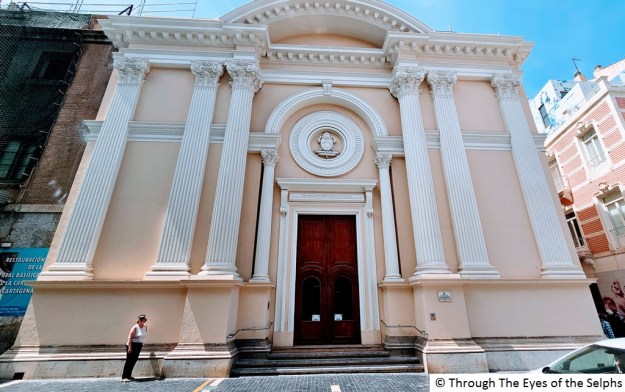
We also saw the beautiful The Royal Basilica of Our Lady of Charity is a neoclassical Catholic temple with a metal structure.

After visiting the fort we walked to the popular and pedestrian friendly street, Calle Mayor, in the heart of downtown and not far from the harbor. Closed to traffic, it is a very clean, picturesque area of stores and restaurants where people stroll along or sit at little sidewalk cafes enjoying coffee or a meal with pleasant sea breezes. Above the stores and restaurants are apartments and residences. The architecture is stunning.

Artificial Flowers Around the Town

Iglesia Castrense de Santo Domingo, a Catholic Church, built 1580

Gran Hotel from 1916

Battle of Santiago de Cuba was a decisive naval engagement that occurred on July 3, 1898 between an American fleet, led by William T. Sampson and Winfield Scott Schley, against a Spanish fleet. This monument is in commemoration of the Spanish losses.

After logging almost five miles, we returned to the ship. One thing we have noticed is the sidewalks in Spain are usually cobblestone, tile or marble. They can be slick and are definitely harder on the feet and legs. We had a great day and we would definitely like to return here again someday. 

Next up: Barcelona, Spain

Malaga, Spain May 3, 2023

Very early on May 3, just after midnight we began our passage through the Strait of Gibraltar. We went up on a top deck to see the lights of Spain on one side and Africa on the other. It was so windy I thought we were going to be knocked off our feet. We could see lights in the distance but unfortunately it was too dark to see the famous Rock of Gibraltar. We will have to save that for another trip.

Morocco to the South in Africa

Another Ship Headed for Malaga

After getting to bed shortly before 2:00 AM, we were up at 8:30 for breakfast. After nine days at sea, we arrived at the port in Malaga, Spain. Malaga lies on the southern coast of Spain on the Mediterranean Sea and is a beautiful city of just under 600,000, the sixth most populous in Spain. It is known for beautiful weather, with 300 days of sunshine a year. Malaga’s history goes back 2,800 years, making it one of the oldest continuously inhabited cities in Western Europe. Its most important economy comes from tourism, construction and technology. In recent years it has become a tech hub with a new large technology park.

Instead of doing a ship excursion, we decided to walk around and explore on our own. After exiting the ship we walked along the beachfront on a lovely pedestrian walkway that led to the town center.

In the old historic area we saw an ancient Roman theater dating to the 1st century B.C.

High above the ruins, on a steep hill overlooking the sea, is the Moorish Castle of Gibralfaro, built in the 11th century. Also is the dramatic LA Alcazaba, an old military fortification originally built to protect the city from pirates.

Malaga is the birthplace of Pablo Picasso and his birthplace is a museum. There is an additional museum of some of his work.

Next we saw the majestic Cathedral of Malaga, a huge Renaissance designed Catholic church built between 1528 and 1782.  There was a long line waiting to enter so we didn’t go inside.  

Of course no port stop is complete without a stop at the Hard Rock Café so Bill could add to his Hard Rock tee shirt collection.

We made our way back to the ship with just under seven miles logged on our watches. Sure felt good to sit down for a late lunch with lots of iced tea and water! 

With no sea days left and four more ports before we reach Rome, we have some very busy days ahead! 

Next up: Cartegena, Spain

Israel Day 7 Conclusion MAR 28, 2023

In the afternoon we visited the site of the Garden Tomb and Skull Hill. Since 1894, the Garden Tomb, wine press and its surrounding gardens have been maintained as a place of Protestant worship. A local docent did an introduction to the area.

Excavated Wine Press

First Skull Hill: The four gospels all say that Jesus was crucified at “the place of the skull” (Matthew 27:33-35, Mark 15:22-24, Luke 23:33, John 19: 17-120) The  word skull is “calvary” in Latin and “golgotha” in Hebrew.

A Picture of the Wall Face Taken 100 Years Ago

Located just outside of Old Jerusalem’s northern wall, near the Damascus gate, is a rocky hill with small natural caves and a wall that resembles a skull. Today, considerable erosion has worn away the hill and the bridge of the nose is gone. The docent showed us photos of what the skull looked like years ago. What was jarring, and somewhat unsettling to us is that the location today is a bus station! What???

Our Picture Taken of the Skull

Nearby, is The Garden Tomb, a possible location of Jesus’ tomb and resurrection. Some say that archeological studies and the presence of a large cistern and wine press points to the existence of a garden at that time. We were allowed to go inside the tomb, believed by many to be the resting place of Jesus. However some archeologists question whether this is the correct location because typological features suggest the tomb was originally carved out during the 8th–7th centuries B.C. and was not a new tomb as stated in scripture.

This Tomb Opening Has Been Blocked Over the Years

The Tomb Inside

We have done quite a bit of research when writing this blog on the sites of Jesus’ crucifixion and tomb. It has been confusing and frustrating at times. Could it be the Church of the Holy Sepulcher? Was it located at Skull Hill and the Garden Tomb? Or neither place?

An excellent article we read when researching is:

https://rsc.byu.edu/vol-4-no-1-2003/revisiting-golgotha-garden-tomb

I particularly like his conclusion that even though the correct site is not known, each of the sites provide an excellent peaceful, serene location to teach others about Jesus’ sacrifice so that we may have eternal life. 

Another interesting article is:

https://firmisrael.org/learn/where-is-the-tomb-of-jesus-holy-sepulchre-garden-tomb/

After visiting the Garden Tomb, our guide had reserved a place for us to have Holy Communion with our pastor. It was a solemn, reverent occasion, made even more so by Angie’s acapella singing of, “Were You There? ” 

select the image below to play the video

A beautiful end to our time in Jerusalem!

We finished the day at the Church of the Resurrection in Abu Ghosh, Israel a 12th century Crusaders church. The Crusaders associated the place to Emmaus, referred to in the Gospel of Luke.  (Luke 24: 13-35) On the road to Emmaus is where resurrected Jesus met two disciples who didn’t recognize him.  As they walked down the road, the disciples expressed sadness and hopelessness over the death of Jesus. When Jesus joined them for dinner, took bread, blessed it and gave it to them, they joyfully recognized him as the resurrected Christ.  Jesus had a LAST supper before his crucifixion, this was his FIRST supper as our resurrected Lord and Savior.

The Mosaics are Deteriorating

On our final trip to the hotel, I took some parting shots of the places and people of Jerusalem.

We Saw Many Mosques During the Week

That night after dinner we had a special presentation by Don Piper on his experiences documented in his book “90 Minutes in Heaven”. 

We then went back to our room to rest for a couple of hours. Our ride to the airport picked us up at midnight for a 5:00 AM flight. Lots of sitting and waiting followed by more sitting and waiting during our layover in Frankfurt, Germany. We were a little concerned about Frankfurt because of airport worker strikes there. Sure enough, when we landed in Frankfurt we sat on the tarmac waiting for them to bring the jetway out so we could disembark. Finally the captain came on and said no one was available so we would be exiting from the rear of the plane, down the steps and taking a shuttle to the gate. No problem for us but not convenient for those with mobility issues or small children and lots of carry on items. Fortunately the bus was there and we didn’t have to wait for it to show up. 

Long trip home, over 24 hours, but it was good to be home

Next: more exciting overseas travels coming up in May! 


Israel Day 7, Part 1 MAR 28, 2023

On Day 7 we spent our second day in Jerusalem, which was also our last day of the tour. We began at an overlook on the top of Mount of Olives. What an amazing view of Jerusalem!
Even here you can take a camel ride!

Each Time a Jewish Grave is Visited a Stone is Placed on the Top

Following Jesus’ steps on Palm Sunday, we walked down the steep hill to the Church of Dominus Flevit, the teardrop church. According to the Gospels, it is here that Jesus wept over Jerusalem. This occurred during Jesus’ triumphant entry into Jerusalem on the first Palm Sunday. Looking down on the city, Jesus wept over it as he prophesied its future destruction. (Luke 13: 13-34) (Luke 19: 37-44). Within 40 years, 70 A.D., Jesus’ prophesy was fulfilled. The Romans besieged Jerusalem, burned the Temple and destroyed the city.
An Italian architect designed the church, built in 1955. It was structured as a teardrop in the form of a cross to symbolize Jesus’ grief. The teardrop is surrounded by four vases because of the custom to collect one’s tears upon the death of a loved one. The church stands on the site of the ruins of a Byzantine church.

The altar of the church overlooks Jerusalem. The cross and chalice design focuses on the Church of the Holy Sepulcher, believed to be the site of Jesus’ crucifixion and tomb.

This is the Kind of Tree that Was Used to Make the Crown of Thorns

Our walk continued to the Garden of Gethsemane. The word “Gethsemane” means “olive press” and since it is almost impossible to kill an olive tree, the root systems of these trees could go back two thousand years. In the garden there are eight ancient olive trees.

Here we toured the Church of All Nations, also known as the Basilica of the Agony. The church, built in 1924, is the third church built on this site. This church, as well as Byzantine and Crusader churches, were built over the Rock of Agony, associated with Jesus’ prayer of agony the night before he was crucified. (Matthew 26:36-46) (Mark 14: 32-42),(Luke 22:44-53).

The altar has a rock with a crown of thorns with birds in a posture of submission, willing to drink from the cup of Christ’s passion.
It is here that Jesus was arrested and betrayed by Judas. (Matthew 26: 47-56), (Mark 14: 43-50), (Luke 22: 47-53, (John 18: 1-12).
The architect wanted to portray the nighttime of the Agony by leaving the interior of the church in semi-darkness, with only natural light filtered through violet blue alabaster windows.
The starry night sky is recreated in the ceiling domes, with the stars surrounded by olive branches.
On the facade of the church is Christ as the mediator between God and mankind.

On right is a throng of humble, meek people in tears, looking to Christ for comfort and assurance. On the left, are those in power and the wise (like the Jewish priests) choosing not to recognize Jesus as Christ and the Gospel (one of them is holding a book with the word “ignorance” on it).

Next up: Part 2 of our final day in Israel