Category Archives: Cruising

Final Brazil Show & Sea Days JAN 18

January 17th was our last day on the Amazon River. Mid morning at Macapa, a Brazilian pilot boat pulled up close to the ship and two Brazilian pilots with all their gear transitioned from our ship to the boat. As they pulled away they took photos of the ship and waved goodbye. Our captain sounded two long blasts of the ship’s whistle to bid them farewell. We were able to watch it all from our cabin balcony.

The next day, two certificates were delivered to our stateroom commemorating our successful completion of the Amazon River. 

In the evening we had a final evening show by the Oi Brazil performers. As usual, their performance was topnotch, leaving the audience on their feet applauding and cheering.

At the finale, our cruise director Kimberly surprised us by appearing on stage dressed in one of the native costumes. She is definitely one of the best cruise directors we have ever had. She is always enthusiastic, helpful and full of energy and surprises. 

In the evening we also crossed back over the equator.

We now have three sea days as we make our way in the Atlantic Ocean to our next port of call, Grenada. The sea days can be as active or lazy as you make them. There are many activities to choose from each day. There are pools and hot tubs of course. Activities include guest lecturers, upcoming port talks, arts and crafts, flower arranging, poker, bridge, bingo, a fully equipped gym, pickleball, Tai Chi, aerobics, watercolor painting, cooking demonstrations, pilates, dance classes, health seminars, trivia games, shuffleboard, creative writing, book clubs, games and cards, chess, afternoon tea, a movie with popcorn each afternoon on the large screen in the main stage theater, etc. 

A group gets together and knits and crochets blankets for children. It is called the “Linus Project” and last year hundreds of blankets were completed. In the evenings there is some kind of show and different music venue. Everything from an orchestra playing classical music, a rock band in the Rolling Stones Lounge to a piano bar playing hits through the decades.

Food is also always available whether in the formal dining room, the informal buffet or in the pool area where they serve hamburgers, hot dogs and fries. The buffet has a special area which changes each day. Mexican, Asian, Thai, Brazilian, etc. One day it was “New York Deli” with American flags on display. Bill was thrilled to get a reuben sandwich, one of his favorites.  In our cabin we have movies on demand with many movies of different genres. The movie titles are changed occasionally with different movies added or deleted from the list. We also get several TV channels such as Fox News, BBC, MSNBC, Food Network etc along with a special events channel. This weekend it is showing all the football playoff games. 

It is almost impossible to be bored or hungry on a sea day! 

On January 18th a James Bond movie was shown in the theater. That evening was formal dress night in the dining rooms and the theme was Casino Royale.  The dining rooms were decorated like casinos and they had all kinds of games, free drinks and prizes.

On January 19th they had a King Neptune Ceremony by the pool. King Neptune and his queen arrived to pardon all those who had sailed the equator for the first time.

Kimberly, the Cruise Director, presided over the court while the captain and his officers were the judges.

The ship crew who had crossed the equator for the first time were Pollywogs. They had to kiss the fish and then get slimed. The judges determined whether they jumped in the pool or had to bake in the sun.

In the end King Neptune accepted their seaworthiness and pardoned them. They officially became Shellbacks. A corny ceremony but all in good fun with lots of laughs. All the passengers received a certificate certifying our passage over the equator. 

One evening we had a performance by The Flyrights from London, England. Their high energy performances included Motown and soul. They were fantastic and had everyone on their feet twisting and dancing. We were all disappointed to hear they were only performing for one night. Most ship performers were booked for two nights of shows. Evidently the Cruise Director was bombarded with requests for them to have a second show. We were surprised to see a second performance had been arranged, bumping the second show by a mentalist who did not impress the crowd. As Kimberly, the Cruise Director, said when she introduced the Flyrights at their second show, “what Grand World guests want, they get“.  It was another great performance that had everyone dancing, clapping and singing. We hope we see them sometime in the future on another cruise!

Next up: Saint George’s, Grenada

Santarem, Brazil JAN 16, 2024

Overnight we traveled on the Amazon River toward Santarem and eventually the Atlantic Ocean. This picture (provided by our ship) shows how the Amazon River is not straight.

On January 16th we stopped at Santarem, our last port of call in Brazil. This was our fifth port in a row and once again this was a tender boat port. The tender boat drivers have really had a busy week! I think everyone is looking forward to the sea days coming up next. Especially since the clocks went ahead one hour and we lost an hour of sleep.

This view (provided by our ship) shows the confluence of the Amazon and the Topajos Rivers at Santarem, Brazil.

We booked our first excursion of the cruise, “Highlights of Santarem”. We were glad to be doing more bus touring today and less walking. The extreme heat has been hard on us. 

Santarem (pop 300,000) was founded in 1661 and was originally called “New Santarem”.  It is one of the oldest cities in the Brazilian Amazon. At one time the economy revolved around timber, rubber, coffee and gold mining. Today the main economy is soybean cultivation and lumber.

Our tour group met at 8:45 and together we took a tender boat on the thirty minute ride to shore while the ship remained docked offshore in deeper water. 

We had an excellent tour guide whose enthusiasm to share his city with us really wore everyone out. The extreme heat sure didn’t help. The three and a half hour excursion ended up being four and a half hours. We really got our money worth. 

In Brazil the “tour buses” are really more like school buses or city buses with no AC. Since everything we saw was outside, there was no escaping the heat. 

Our guide understood and spoke English with a heavy accent but he was still easy to understand. 

Our first stop was at a rubber tree and flour farm. First a local man showed us how rubber is extracted from the rubber tree.

We then walked briefly through a rainforest area where he pointed out mango trees and trees with Brazil nuts, among many others.

We then walked to another area where several locals demonstrated how they made a type of flour that is used to make many dishes, including tapioca.

Next was an area with many local fruits and Brazil nuts which were identified and samples were offered. We passed on any samples. They demonstrated how hard it is to crack a Brazil shell  and showed how one shell can have over twenty individual nuts inside.

We then were driven to a couple markets where we were shown many items that were natural products that are good for many health problems. Surprisingly we were not given time to shop which is often the case. We were then taken to another open air market with fresh meat products, especially many kinds of fish.

Amazing to see all fresh fish displayed in all the heat. Shrimp was piled up without any ice.

Back on the bus to see the cathedral. Our guide gave us a nice detailed tour of the cathedral. It was surprising because usually tour guides take you to cathedrals and wait while you wander around. Our great guide proudly gave us a great tour of the cathedral. We were told that just 60% of the people were Catholic.

This statue has human hair that is replaced yearly.

By this time we were wilting, but there was more! We stopped at an overlook where the Amazon River converges with the Tapajos River. 

By this time we were hot, tired and hungry. Just when we thought we couldn’t take more, the guide told us we had one final stop. A municipal museum where he led us through several rooms with the history of Santarem. By this time our eyes had glazed over and I wondered which of us was going to be the first to pass out from a heat stroke.

As much as we enjoyed and appreciated our guide, it was truly a relief to arrive back to the pier to catch our tender boat. 

On the bus ride back to the pier our tour guide had five prizes to hand out to people that could answer questions from what he told us today. I correctly answered a question and won a cute little souvenir made from a Brazil nut with a little figure of a toucan inside and the name “Santarem” painted on the front. I had to turn it into security when we boarded the ship so it could be put in the deep freeze for a couple days to kill any insects. They later delivered it to our cabin. 

That afternoon we began the final leg of our trip on the Amazon River. Tomorrow we will once again cross the equator as we make our way back to the Atlantic Ocean. From our balcony during the sail away we passed the convergence of the two rivers, giving us a great view.

Some thoughts on our time cruising the Amazon River. We were surprised we didn’t see any other cruise ships or pleasure boats on the river. All the boat traffic were barges and freighter, etc. At each of the five ports, we were the only cruise ship. We came to realize that this part of the world is isolated and takes some time to cruise the river. Therefore only cruise ships with longer itineraries make this voyage. It seems only around twelve cruise ships make this trip each year. Perhaps that is why we often saw little rowboats come up alongside the ship and take pictures. The funny thing is they were taking pictures of us and at the same time we were taking pictures of them. 

We were surprised to see the muddy color which eventually as we traveled further down the river became more of a blue green color. We were also surprised to all the logs, trees, branches, plants and debris being carried in the swift current. Between that and the narrow, shallow places to navigate, it is no surprise that we had Brazilian navigators/pilots onboard the entire eight days. Our tour guide in Santarem told us this area is having a severe drought.

Next up: A final Brazil show and what happens on a sea day


Parintins, Brazil JAN 15, 2024

On January 15th our port of call was Parintins, Brazil, (pop 115,000).

We knew it was going to be a tender port, but we were surprised when Kimberly, our Cruise Director, came on the intercom and said that this tender port was without a doubt going to be the most challenging tender port so far. Uh oh. She said it was not suitable for people with wheelchairs and scooters or with mobility issues. She mentioned deep swells and a floating dock.  After I took a dose of seasick medicine, we headed out. It was a long ride to the floating dock where the tender boat driver had to watch out for floating logs, trees and debris in the water.

We arrived at the floating dock which turned out to be another boat docked by the pier. We transferred from our tender boat to the floating boat with a low ceiling and stepped onto the pier. This was all done safely by the great Holland America crew who had many hands reaching out to assist. Actually it wasn’t nearly as bad as we expected.

It was another hot day as we walked around the town. We noticed that motorbikes and pedicabs were everywhere and we had to be very careful crossing streets.

The pedicabs were interesting to watch as many had no steering wheel so the driver would just lean in whatever direction he wanted to turn.

We visited the Catholic church built in 1981 with a 130 foot bell tower. We have noticed the churches in the Amazon are very simple and plain, though very pretty.

We spent quite a bit of time trying to find Bill a Brazil souvenir shirt. There were many little shops but instead of having Brazil souvenirs, they had shirts that said NYC or American sports teams. Seemed to be more geared to local shoppers rather than tourists. There was a definite language barrier since we did not find anyone who spoke or understood English. We found this during all of our ports of call along the Amazon River. I am sure it is different in larger metropolitan areas of Brazil. We tried using Google Translate with some degree of success.

We finally gave up and as we made our way back to the tender boats we found some little souvenir stands near the pier. Bill found a shirt and hat. Success at last!

This time instead of one of the ship’s tender boats, we had to take a local ferry boat back to the ship. The ferry boat had brought in a floating barge they placed next to our ship. We transferred from the ferry boat to the floating barge to our gangway. Another experience but easy transition.

We have one final port of call left in Brazil. And guess what. It is another tender port. 

Next: Santarem, Brazil 

Manaus, Brazil JAN 14, 2024

Yesterday we visited a remote village deep in the Amazon rainforest. Today we visited Manaus, the capital of the state of Amazonas or the Brazilian Amazon.  Located in the center of the largest rainforest in the world, it is the most populous city in the Brazilian Amazon (pop two million). The two locations yesterday and today could not have been more different. After several days in remote areas of the Amazon rainforest, Manaus provided us with culture shock. It was strange to look out and suddenly see tall buildings and bustling traffic. 

Perhaps the biggest shock was to realize we suddenly had to worry about crime and safety. Several days ago when the cruise director gave her port talk on Manaus, she mentioned taking safety measures common when visiting large cities. We have heard it many times and didn’t think too much about it. Today we took our time getting off the ship since we planned to just walk around. Too many people rush to get off so we like to take our time and let the herd off first. About an hour later as we were preparing to leave, the cruise director came on with a special announcement from the captain. “People should walk around the town in groups. Do not walk through parks or down isolated streets. If you are approached and demanded to give money or valuables, do not resist. Give them what they want. Those items can be replaced. Watch out closely for pickpockets. Keep your phone close so it will not be snatched.” Wow! We had never heard those specific warnings before. Had something happened to someone who had already left the ship? Suddenly walking around did not sound so inviting. 

Since the ship had docked unexpectedly at a different dock, we took the ship’s complimentary shuttle to the central dock/terminal close to the city center just to get a feel for the area.  The tour buses and shuttles had a difficult time entering the dock because of a low clearance ramp.

This Dock Is Where We Would Normally Dock

One large vehicle became stuck entering the dock, slowing down traffic.  What a mess! The end of the ramp had sprung up and caused many vehicles to scrape their bottoms.

When we reached the central area, outside the port terminal we met one couple from the ship headed back. They said to stay on the main sidewalk and we should be fine. We were heading up the street and ran into another couple. They said it was very steep and hilly but when they told us the streets had just been closed off for a street festival and it was very crowded, we turned around and headed back. We snapped a few pictures and took the shuttle back to the ship.

As someone on the ship later commented, Manaus is a rough town, a blue collar town. A town with many social and economic challenges.

Bill entertained himself for quite awhile during the afternoon watching workers emptying all the trash off the ship onto a large barge. He had a bird’s eye view from our balcony. Tons of trash including many pallets of cardboard and some old appliances.

As the ship sailed away later that afternoon we sat on the top deck and enjoyed the last views of the city.

At this point we had reached the furthest point we were going up the Amazon River. The ship turned around and headed back down the Amazon River towards the Atlantic Ocean. We have two more ports of call in Brazil.

The Bridge Too Far

Next up :Parintins, Brazil


Boca da Valeria, Brazil JAN 13, 2024

Boca da Valeria is a tiny, remote village of indigenous people on the Amazon River in north central Brazil. The village of 75 people is typical of the hundreds of villages scattered across the Brazilian Rainforest. These villagers still live much as their ancestors did for thousands of years before Europeans arrived at the beginning of the 16th century. The people here are Caboclo Indians which means copper colored skin. They are a mix of indigenous Brazilian and European people, mainly Portuguese.

All transportation is by boats only. Riverboats are used to go twenty miles to the closest cities for supplies. 

Only about a dozen cruise ships visit this village every year. It is among the smallest ports of call in the world. A visiting cruise ship is such a big event, they close the school on cruise ship days.

We took a tender boat for the short ride to a dock in the center of the village. The makeshift dock was lined with villagers welcoming us.

Many of the children were dressed in native clothing and had pets to show us including birds, sloths, iguana and even a baby crocodile.

A rutted, uneven dirt path led to the center of the village, a block long. Several wooden houses were perched on stilts. During the rainy season the Amazon River can rise 30 or more feet. The windows had no glass or coverings except for occasional wooden boards.

There were power lines between some of the houses in the center of the village with the electricity supplied by a communal generator.

Drinking water is stored in large plastic tubs on small towers. There are no paved roads, no cars, no bikes. People survive by fishing and farming.

The largest building is the Roman Catholic church, founded in 2008 and honoring Paul the Apostle.

There is a one room schoolhouse.

While the women and children welcomed us to the village, the men were offering 30 minute river boat rides for $5 a person.

Holland America crew members, officers and passengers brought many boxes of gifts to give the children and their parents. These included books, school supplies, toiletries and toys. Bill and I had not anticipated this happening and were not prepared with gifts, so instead we made monetary donations to the church and school. 

The dirt path became steep and even more rutted and we assume it led to more homes deeper in the rainforest. It was sweltering hot and we felt like we had spent enough time there so we headed back to the ship.

It was a very interesting experience deep in the Amazon. People around the world can be wealthy in many different ways. These friendly, kind, welcoming people are wealthy in many ways others are not.

The ship’s crew is always looking for ways to wow us. So this afternoon in the buffet area, the ship’s pastry chefs had a cake extravaganza of over 100 cakes they made and beautifully decorated. After some time for everyone to walk around and admire all the amazing artistry, they cut the cakes. They had every type of cake you could imagine. Bill and I both went for the five layer carrot cake with cream cheese icing. They also had complimentary chocolate martinis. 

Next up: A completely different experience in Manaus, Brazil


Alter do Chao, Brazil JAN 10, 2024

On January 10th we crossed the sand bar separating the Atlantic Ocean and the Amazon River. During this time the ship slowed down, and since the water was only a depth of 26 feet, the captain needed to raise the ship’s stabilizers. We thought the ship might rock and roll some, but we didn’t feel a thing. The color of the water changed from the deep ocean blue to a light green color and then muddy water. The Amazon River travels over 4,000 miles across South America into the Atlantic Ocean. It is the second longest river in the world, with only the Nile being longer. The water discharged by the Amazon is greater than the world’s next seven biggest rivers combined.

Around 5:00 A.M. on the morning of January 11th we crossed the equator. At 6:00 A.M. we arrived at Macapa, Brazil. This was not a port of call for us but a service call with the Brazilian authorities who boarded the ship. This was all handled by the captain and ship’s officers.  We slept right through it. The Brazilian authorities did a health review, mainly of the galley, and a Brazilian pilot came onboard to help the captain maneuver down the river safely. There are some places where the river becomes narrow and shallow and great care needs to be taken. A rotation of various Brazilian pilots will remain onboard for the next eight days while we are on the Amazon River.

By 10:30 A.M. we were once again on our way. The previous night all the passengers received a written message to conserve water during these eight days so the ship would not need to take on additional water. This was for our own health and safety. We were also warned not to drink any water or have drinks with ice while in various ports in Brazil. There were also warnings about not eating certain fruit, vegetables and other food off the ship. They even mentioned not eating pudding. We were told to keep our balcony drapes closed at night to keep mosquitoes and moths away. And it goes without saying to not leave your balcony doors open! We have been warned, the bugs on the Amazon are BIG! We have not noticed any mosquitoes so far. But plenty of large beetles on the upper decks at night and the largest moths I have ever seen. They are particularly bad around bright lights so they are dimming the outside lights for the next several days. We were also told there are many beautiful wood souvenirs that can be bought in Brazil. However, when people come back on board with these purchases, they will be taken by security and put in cold storage for 48 to 72 hours to get rid of any bugs in the wood. This is to protect the passengers as well as the ship. I think we will stick to our usual refrigerator magnets.

In the evening the ship had a party on the pool deck with a performance by Brazilian singers and dancers. It was festive and loud.

On Friday, January 12th we reached the port of Alter do Chao, Brazil. Fortunately it was a cloudy day which somewhat helped keep down the temperatures. Due to the shallowness of the water, the ship had to dock further offshore. It was a 30 minute ride on the tender boat to shore. Fortunately the river water was calm.

Alter do Chao is known as the Brazilian Caribbean and is known for one of the most beautiful freshwater beaches in the world. 

In the early 20th century it was one of the transportation routes of latex extracted from rubber trees. By 1950 the extraction of latex declined in this area. Today the area focuses on tourism. 

After getting off the tender boat we had to walk on platform boards across some water to a sandy beach. We then trudged through sand to a well worn bridge that took us to the road leading to town. It was about a half mile walk to the town plaza with a church, a couple small markets and some open air vendors.

The beautiful, yet simple Catholic church was built between 1876 and 1896.

Across the water is beautiful Ilha do Amor, or Love Island, accessible by rowboat or wading across depending on the season of the year and water levels.

The Amazon river dolphin (Inia geoffrensis) is also known as the pink river dolphin, boto, or bufeo. It is the largest freshwater dolphin in the world, with the ability to grow up to nine feet long and weigh up to 400 pounds. They are born gray and turn pinker as they age, as their skin becomes more translucent and allows blood to show through.

After about 90 minutes of walking around we were sweltering from the heat and humidity. While waiting for the next tender boat, Holland America crew provided a tent with chairs, cold water and cold washcloths. Much appreciated. 

We were more than happy to get back to our cool cabin on the ship. 

Next up: the tiny, remote village of Boca da Valeria, Brazil 

Devil’s Island, French Guiana JAN 9, 2024

After a nice day at sea, we arrived at Devil’s Island, French Guiana. It was raining hard with deep swells. By the time we finished breakfast, the sun was out and it was hot with high humidity. I get seasick easily so the thought of being in a rocking tender boat was not a good idea. There was also the promise of mosquitoes along with the heat and humidity. So, I chickened out and Bill went alone. He was able to get an early tender boat so hopefully the heat would be more tolerable. 

Lots of hard work for the ship’s crew to unload the tender boats and then reload them later in the afternoon.

Bill’s on his way with the French Guiana Navy standing guard.

Getting off the tender boat and heading on the island.

Devil’s Island was a French penal colony during the 19th and 20th centuries. It was created by order of Napoleon III to empty prisons in France. There are actually three islands where prisoners were kept. The prisoners were some of the worst offenders of heinous crimes, but also political prisoners were sent here. One of the most famous political prisoners was Captain Alfred Dreyfus who was accused of spying for Germany.

Steep Trails

Final Stairs to the Hilltop

In operation for 100 years, it officially opened in 1852 and was notorious for the hot tropical climate, disease, and harsh treatment of criminals. The penal colony had a death rate of 75%. It is said that the few survivors who made it home described the horrendous conditions which scared some criminals into going straight. Most of the estimated 80,000 prisoners never returned home. Most prisoners were allowed to walk freely around the island since there was almost no chance of escaping. Any prisoners who tried to escape or misbehaved were put on one of the three designated islands and were put in solitary confinement of silence and darkness. One of the other three islands, Ile Du Diable, or Devil’s Island, was reserved for political prisoners. The prisons were closed in 1953 and the islands’ ownership were transferred to the Guiana Space Center. Devil’s Island is closed to the public. Iles Du Salut, also called Ile Royale, is the island Bill visited. It was once the reception area for arriving prisoners and held the general prison population. 

The Guard Quarters buildings.

The remnants of the prisoner cells.

Hospital constructed in 1895.

The chapel was built in 1894.  Prisoners were required to attend mass until 1887.

Current lighthouse was built in 1934 with electricity added in 1982.

This is the semaphore building for island communications.

The 1973 movie, “Papillon”2, starring Steve McQueen was based on the Devil’s Island penal colony. Over the years, Devil’s Island has been mentioned in various movies and television shows.

After two hours on the island, Bill returned with his clothes wringing wet. He said the mosquitoes were not bad but the heat was horrible. The Cruise Director told us later that evening that several people had passed out from the heat. She cautioned everyone to drink lots of water and stay hydrated. And we haven’t even crossed the Equator yet!

Next up: Cruising the Amazon River, Crossing the Equator, and visiting Brazil

Scarborough, Tobago JAN 7, 2024

After 3 days at sea, our first port of call was the tiny town of Scarborough on the island of Tobago. The island of Tobago, population 53,000, lies south of the hurricane belt, just off the coast of South America. At 116 square miles, it is a mass of coral and volcanic rock. Tobago is  surrounded by the Caribbean Sea on the north coast and the Atlantic Ocean on the southern and western sides.   The island has white sandy beaches and dense tropical forests.

Scarborough, population around 1,000, is located on the southeastern side, is the capital of Tobago. Scarborough’s historic roots date back to 1654. It became the capital in 1769, exporting rum, cotton, indigo and sugar. Today its major source of income is tourism.

Rather than taking an excursion, we decided to use the map conveniently provided by the cruise ship and walk around on our own. Interestingly, the cruise director came over the ship’s speakers and said the port authorities in Tobago said no camouflage or military looking clothing was allowed on the island. At the port entrance we were approached by many locals offering us taxis and day tours. They were close to being very annoying with their persistence. Since it was Sunday AND a holiday, many stores were closed. We didn’t mind because we are not shoppers. Unlike many Caribbean towns, we didn’t see bars and restaurants located near the port advertising tropical drinks. We saw a KFC, a Church’s Chicken and a Subway. Rather strange, actually. We noticed two supermarkets and a hardware store listed on the map. We walked about three miles, taking pictures of the town.

A Government Office Building

Frankly there wasn’t much of interest. There are various popular dive spots around the island so perhaps there are more restaurants, stores and things to see at those areas. With no buses running and since we were not interested in diving, it didn’t seem worth it to pay for the high priced excursions to those areas.

We first walked to the Love Tobago sign. Everyone has to go to those signs, right?

We saw two churches. One was St Andrew’s Church, built in 1819.  The church was destroyed in a hurricane in 1964 and rebuilt.

Another church was Saint Joseph Roman Catholic Church.

It was a really hot day and since much of Scarborough is hilly and we were hot and tired, we headed back to the ship. The AC was very welcoming and cold soft drinks really hit the spot.

Next up: Devil’s Island, New Guinea  This is a tender port and the captain is expecting deep swells which could make for difficult and potentially dangerous tendering conditions, so we will see.

A new adventure begins, JAN 03, 2024

In December our travel agent emailed us a cruise opportunity that was too good to pass up. Only problem was it was an 84 day trip leaving January 3rd.  To prepare for departure we had two items that needed to be done quickly. We needed a yellow fever vaccine and a Brazilian visa. 

We called several pharmacies around The Villages and none of them gave the yellow fever shot. Fortunately I thought of calling the Costco pharmacy and they had the vaccine. And they were happy to help even though we are not Costco members. While talking with the very nice and helpful pharmacist he mentioned if you are 60 or over you can get a waiver to not get the vaccine. Apparently research has shown that the potential side effects from the shot in older people are greater than the possibility of getting yellow fever. Through Costco we were able to get a waiver signed by a doctor which we picked up at the Costco pharmacy. It was a lot cheaper than a yellow fever vaccine and much less painful. 

The second important thing to accomplish was getting a Brazil visa. Beginning January 10th, all citizens of the United States, Canada and Australia need a visa to enter Brazil. I could write a novel on how frustrating it has been trying to get the visa. Believe me, you can’t imagine. The company hired by Brazil to process the applications were overwhelmed by the volume of requests by travelers entering by plane and cruise ship, etc and did not have computer software to handle the overload. It was, somewhat comforting to find out from Cruise Critic and Holland America that everyone else was having the same problem. In the end, after many tense days, we were able to board the ship with our visas still being processed.  As it turned out, Bill received his visa by email the third day on the ship and I received mine on the fourth day. Ironically that was the same day Holland America announced that Brazil had waived the visa requirement until April 10th. Our visas are good for ten years so perhaps we will need them on another visit to Brazil in the future. 

On January 3rd, we left home with a sunrise promising a beautiful day, and drove a rental car to Fort Lauderdale to board the ship. We had a folder full of documentation to provide and were apprehensive about what to expect. There is always the worry on these international cruises that there will be some form or document we forgot. As it turned out, embarkation was very easy and fast.

Our Holland America ship, the Zuiderdam, is smaller than the Royal Caribbean and MSC ships from our travels last summer. We prefer the Holland America ships. They don’t have the glitz and glamor of the other cruise lines with zip lines, putt putt, simulated surfing and water slides. But the smaller Holland America ships means less walking and definitely less people. While the other ships had capacities of 3,000 + passengers, the Zuiderdam has a capacity of 1,900. We have 1,270 passengers on this voyage. Older passengers with no children, crying babies at dinner, crowded elevators and dining rooms.  Without all the glitz, we still have plenty to do. Guest lecturers on the history and culture of upcoming countries, port talks on upcoming ports, great evening shows, several music venues, and plenty of friendly passengers to meet.

On the first night in the dining room, each lady was given a long stem red rose.

Our First Sunset

On our second day, Holland America had a block party. At 4:00 pm everyone went outside their cabin door to meet their neighbors. Waiters came around with champagne, red and white wine as well as little bowls of snacks. For a hour we got to know our “neighbors”. The lady in the cabin next door is a single lady who sold her house in California and now lives on the cruise ship full time. We also met neighbors from Canada as well as a couple who lived on a 35 foot boat full time for nine years, circumnavigating the world. 

The Holland America crew is friendly, attentive and eager to please.

One evening when we returned to our cabin after dinner, we found gifts left for us. We each received a tote bag, backpack, battery for charging our phone or tablet, a wallet and a hat which will come in handy in the hot days ahead. Nice touch, Holland America!

After three days at sea, on January 7th we reached our first port of call, the island of Tobago and the small town of Scarborough. 

Next: A day in Scarborough, Tobago


Helsinki, Finland JUL 6, 2023

The last port of our last cruise was Helsinki, Finland. This country’s geographic position has led to competition between Sweden and Russia for domination over Finland in the 18th century. After 1807, Russian influence prevailed in Finland. Finland declared its independence in 1917, resulting in an uneasy relationship between the two countries. The relationship was in bitter conflict during WW2 when the two countries were on opposite sides. After the war ended, Finland tread a careful path during the Cold War. Today, Finland is a member of both the European Union and NATO. Russia said Finland, by joining NATO, was making a mistake and hurting its relationship with Moscow. Interestingly, six percent of Finnish residents speak Swedish exclusively. Swedish is a mandatory subject in schools. Most of Finland’s signs and street names appear in Finnish and Swedish.

We decided to take the Hop On Hop Off Bus in Helsinki which conveniently picked us up at the port. 

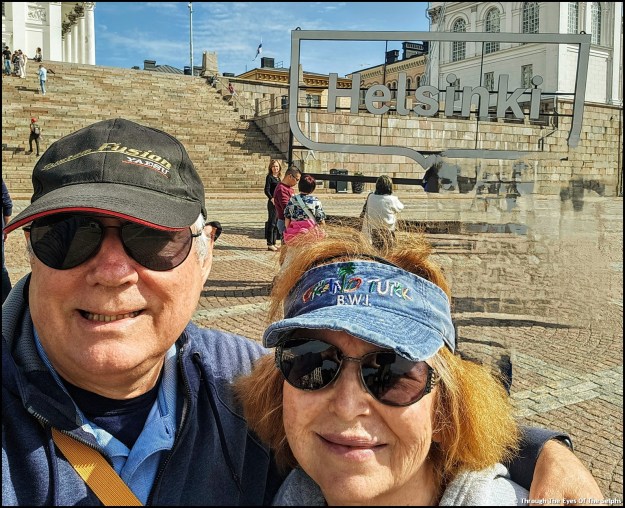
We visited Senate Square with a Lutheran Cathedral on the hill. Built from 1830 to 1852 as a tribute to the Grand Duke of Finland, Tsar Nicholas I of Russia.

Helsinki Cathedral

Grand Duke of Finland Alexander II

The City Hall was built in the 19th century.

The Presidential Palace had guards standing watch. It is one of three official residences of the President of Finland. It was built between 1820 and 1845.

The Parliament House was constructed between 1926-1931.

In 1952, the Summer Olympics were held in Helsinki. The stadium is mainly used for concerts.

The tower of the stadium is 238.5 feet, the measurement of the length of the gold medal win by Finnish Matti Jarvinen in the javelin throw of the 1932 Summer Olympics.

We visited the beautiful Uspenski Cathedral. It is the largest Greek Orthodox church in western Europe and was constructed between 1862-1868.

The sea fortress of Suomenlinna, a UNESCO World Heritage Site, was built on six interconnecting islands. It was first used by Sweden in 1748.   It was surrendered to Russia in 1808 and remained in Russian control until 1918 after Finland proclaimed its independence.

The Sibelius Monument is made of more than 600 hollow steel pipes welded together in a wave like pattern. It is dedicated to Finnish composer Jean Sibelius. The design of the monument is to capture the essence of his music.

K. J. Stahlberg played a central role in the drafting of the Constitution of Finland in 1919.  He was also the first president of Finland from 1919-1925.

On Market Square you can find vendors selling fish, vegetables, fruit and crafts.

After finding a geocache, we caught the bus back to the port. Helsinki was a nice city, but it did not have the wow factor of many other European cities. 

Next up: Lisbon, Portugal